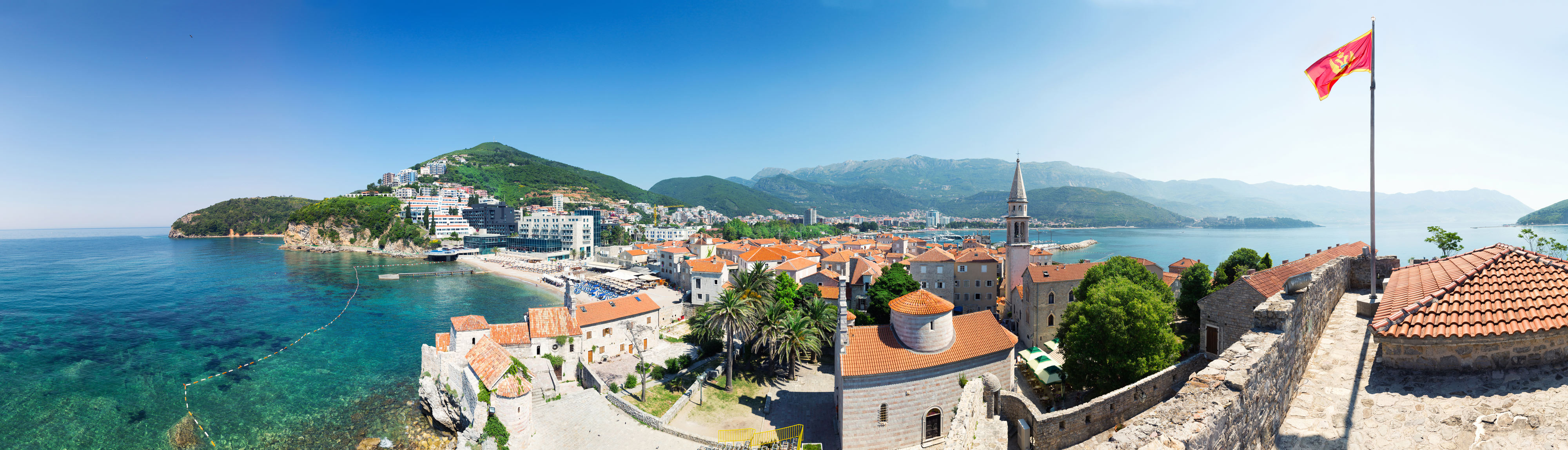
Seen from a bird's eye view of those paragliders who, in calm times, flown over Budva all year round, from the surrounding mountains - or from postcards - the Old Town looks like a harmoniously framed medieval
Seen from the bird's eye view of those paragliders who fly over Budva all year round during calm times, released from the surrounding mountains - or from postcards - the Old Town looks like a harmoniously framed medieval urban entity. That's what Budva really is. It is the oldest city on the shores of the Adriatic.
Told from the beginning, the story goes like this:
Budva (Montenegro) has been known since the 4th c. ex. n. e. as the Greek colony of Butua (Budoe). Later, it became part of Diocletian's province of Prevalitania. As a border town between the Eastern and Western Roman Empires, Budva fell prey to the Saracens in 841 and 865, who plundered and demolished it. Restored after the Saracen devastation, in 886 it became the seat of the Dukljan bishops. Since 1089, the bishops of Budva have been subordinate to the archbishop of Bar.
At the end of the 12th c. Budva became the property of Serbian rulers from the Nemanjić family, who gave it the status of a free city (1346-1372).
After 1360, Budva became a war port of the Principality of Zeta, and then the property of the Bosnian duke Sandalj Hranić (1396-1398). Budva came under the rule of the Republic of Venice later, with the status of a free city, in 1455.
In 1569, Budva was captured by the Turks, and in 1571, Ulcinj pirate Uluj Ali robbed it.
The fortress remained in the hands of the Venetians, and they built new city fortifications in 1639. Kornaro from Venice fortified the city to such an extent that Pasha Soliman from Skadar attacked it several times in vain.
In 1667, the same year in which Dubrovnik, Kotor, and Perast suffered catastrophically in the Great Earthquake, Budva also suffered.
Budva remained in the hands of Venice until the fall of the Venetian Republic in 1797. From 1815 to 1918, Budva was under Austrian rule. In 1839, the Austrians rebuilt all the fortifications. During the 20th century, Budva will give one big name: Stefan Mitrova to Ljubiša. He was a writer and popular politician, a representative of Bokelje before the Dalmatian Parliament, within Austria.
On two sides, the city ramparts are literally lapped by the sea. An aerial view reveals a harmonious mix of narrow streets, many dead ends, and tiny squares, church complexes, gardens, and the ever-present people on the streets. Budva is a lively city, rich in offers, but even richer in history. When you enter the Old Town through a small door on the mainland side, you enter the main street. Then you enter a space that is a cultural and historical monument!
Inside the walls from the 15th century, with several "sea" and "land" doors, there are the churches of St. Ivan (from the 8th century, restored in the 17th century, with paintings by Venetian masters), St. Sava, St. Marije in Punta and St. Three.
In front of the Old Town itself, there are visible archaeological remains, where many objects from the era of the Illyrians, Greeks and Romans were found.
The Citadel fortress was built in the middle of the 9th century and is located in the southern part of the Old Town. It served to defend Budva from the sea. Inside the fortress is the church of St. Maria de Castello, from the 12th or 13th century. After the catastrophic earthquake that hit Montenegro in 1979, the remains of an early Christian basilica from the beginning of the 6th century were discovered near the fortress.
Budva is characterized by extremely beautiful beaches. In front of the city walls is the exclusive Ričardova glava beach. About 200 meters west of the Old Town lies the sandy beach of Mogren, which is one of the most beautiful in Montenegro. It is about 800 meters long, and divided into two idyllic separate beaches, bordered by a steep cliff through which a path has been cut.
To the east of the city, stretches the longest and most famous – Slovenska beach, 1600 meters long. The long beach from Bečići to Rafailovići, Pržno beach, Sveti Stefan beaches and many others, including the long Jaz beach, are worthy of praise.
Today, you can go everywhere from Budva, by land and sea. By sea - to the inner part of the Bay of Kotorska (to Herceg Novi, Perast and Kotor), and by land to the nearby monasteries: Podlastva from 1350; Podostrog-Podmaine (the summer residence of the Montenegrin rulers, rebuilt in 1630, surrounded by walls and loopholes, with two churches, and with frescoes from the 17th century), the Duljevo monastery built in the 14th century by the Serbian emperor Dušan; the Praskvica monastery with frescoes from the 17th century, founded in 1050; the Reževići monastery, which was built by Stefan the First in 1226; Buildings from 1116; Stanjević from 1736. where the famous Serbian writer, educator, the one who brought potatoes to our area - Dositej Obradović (1739-1811) stayed, and many other sacred places can be easily and quickly reached from Budva.
Fortunately for every Budva visitor, all these Orthodox monasteries are located right next to the main road - from nearby Lastva Grbaljska to nearby Buljarice. They are easily and quickly reached.
Budva is a modern city with several well-respected art galleries, a local TV and radio station, museums, craft shops and those with global trademarks. Budva is the capital of Montenegrin tourism.