Montenegro.com in Argentina: With Montenegrins in General Madariaga
October 14, 200410 min readby Montenegro.com Admin
Gordan Stojović and Rodolfo Jokanović, president of the "Zeta" association from Buenos Aires. In front of the museum of emigrants in Buenos Aires, the first place where new emigrants disembarked, something similar
Gordan Stojović and Rodolfo Jokanović, president of the "Zeta" association from Buenos Aires. In front of the museum of emigrants in Buenos Aires, the first place where new emigrants disembarked, something similar to Ellis Island in New York.
Since its establishment in the mid-nineties of the last century, Montenegro.com has directed a very significant part of its activities towards the diaspora. At that time, there was literally no organized center or institution in Montenegro that would deal with the cooperation and protection of the interests of emigrants, their organization and information activities.
If there was something we didn't know about, it worked on very outdated principles, the new times of the Internet and global communications required a completely new approach and a huge sacrifice, not just a mere service but also someone who is able to start and organize.
At that time, we supported the organization of many actions among expatriates, as well as helped many in creating, completing and designing web sites in the diaspora, and worked on connecting expatriates, both individuals and organizations. The role of the Montenegro.com portal is unavoidable when mentioning the organized actions of the diaspora during the nineties, especially in North America.
However, at the same time as new associations were being founded that gathered emigrants and their descendants all over the world in Latin America, a fairly large number of people appeared who were interested in their long-lost roots through Montenegro.com.
Descendants of our second- and third-generation emigrants from Argentina, Uruguay, Peru, Chile, and Venezuela started contacting us asking for information about the country of their ancestors. Montenegro.com met everyone within the limits of what was possible.
The letters of those people seemed incredible to us because, due to the disastrous school system, we simply knew nothing about our emigration, and if there were any of our people in South America, it was almost completely unknown to the general public. Even today, we are witnessing that people, even those with a "solid" education, are asking "are there any of our people in Argentina?"
However, the enthusiasm of our team grew and we became friends with many people and immediately started cooperation.
At the invitation of the "Zeta" association based in Buenos Aires, the first editor of the diaspora section on Montenegro.com, as well as the author of the books "Montenegros in Argentina" and "Montenegro Emigration in Argentina I", Gordan Stojović stayed in this country and on that occasion met with many prominent emigrants, their descendants, and organizations. Members of the board and founders of the association "Zeta" with a friend from Montenegro. From left to right Juan Cetkovich, Miloš Deretić, Gordan Stojović (Montenegro.com) and Rodolfo Jokanović
From today, reports from this distant country will be published in several installments.
With Montenegrins in General Madariaga
The city of Gauca
Gauchi during the city fair
General Madariaga is a small town of about five thousand inhabitants, famous far and wide for its Gauchis and extremely high-quality meat. By the way, gauchos in Argentina are the same as cowboys in North America, that is, people who raise large cattle and have a very specific way of life, a code of conduct and spend most of their life on horseback.
Today, Madariaga is a very rich town where people live extremely well compared to the quality of life in other parts of Argentina.
By the way, the second mayor in a row is of Montenegrin origin. The name of the current mayor is Juan Knezevich and the name of his predecessor is Adrian Mirkovich.
By the way, among the Montenegrins themselves there is a lot of political rivalry between the Peronists and the radicals - so when I listened to those stories about divisions, it seemed to me as if I was in Montenegro.
In fact, a lot of things reminded me of Montenegro, fortunately not only stories about political confrontations in Argentina, but also some much more pleasant things, such as prosciutto, which you will read about in the rest of the text.
At the very beginning of the twentieth century, the first Montenegrins began to settle in General Maderiago. As the people there told me, the first of our people was a certain Perović, and after him, many others began to come to that small town, in the province of Buenos Aires, to clear forests. Probably, as in many similar cases, the people who disembarked from the ships in Buenos Aires followed the trail of voices to find where "ours" were in those vast expanses of Argentina.
The feeling of loneliness and distance must have been incredibly strong. When I think of myself now in the 21st century, especially when I was in the Immigrant Museum and at the Dock Court in Buenos Aires, the places where our and all other immigrants landed and came into contact with Argentina for the first time, I feel nostalgia for Europe and home.
I can only imagine the feeling of those people who, after several months of travel, landed on the soil of Argentina. It almost comes as a reflex and the first thing that comes to a person's mind is to look for something that resembles where he came from, for any trace of something already known, already seen, warm and safe.
So the Montenegrins in Chako and those in Tandil as well as those in Buenos Aires, Venado Tuerto and General Madariagi certainly followed the voice of other Montenegrins living and working in those places, again incredibly far away, looking for a trace of the warmth of home and heart.
A truly incredible dimension of everything, especially for me, who should look at all this exclusively from the scientific side, who have already dedicated a significant part of my life to this problem and achieved, for our conditions - otherwise completely unconditional - very significant successes. However, I can't help but think of them alone, thousands of kilometers away from home, standing and looking completely alone, without any idea of the vastness of the new world, their future.
Descendants of the first Montenegrins who settled in General Madariag today are mainly engaged in cattle breeding, and there are also those who have achieved incredible wealth in this business, so that they are the owners of several thousand head of cattle and several tens of thousands of hectares of land. By the way, Montenegrins were widely known throughout Argentina as very good workers, and at the very beginning they did the most difficult jobs. They were loggers, they worked building roads, laying rails, quarries, they worked as port workers and construction workers all over Argentina.
Today, about 150 families of Montenegrin origin live in General Maderiaga, about 500 people in all, which is a very significant number and which has greatly helped to preserve customs and language. From the very beginning, the Montenegrin community in General Maderiaga was organized through many associations that mostly had the character of mutual aid. They were organized in that way, first of all, because many of our emigrants were left alone, they worked all their lives to collect money to return to Montenegro, and they rarely got married, so there was no one to bury them. Only a small number founded families.
The first one that was founded in the thirties of the last century was Sociedad Montenegrina de socorros Mutuos - Montenegrin mutual aid society, Sociedad de socorros mutuos Montenegrina - Montenegrin mutual aid society Association seal
Sociedad Montenegrina de beneficienca – Montenegrin charitable society Association seal
That same society has preserved continuity to this day, even though it has changed its name over time. In the meantime, it was also called Sociedad Montenegrina Yugoslava de socorros mutuos - Montenegrin Yugoslav Society of Mutual Aid, but after the Second World War it changed its name to Socieded Yugoslava "Njegos", as it is still called today.
Fierce political divisions in Montenegro during the twenties and thirties of the last century did not escape the Montenegrins of Madariaga, however, their descendants do not want to talk about it, probably not wanting to be reminded of ugly things. All I managed to find out was that the rivalry was very strong and that there were even gunfights with unfortunate consequences.
Many other things that happened in Montenegro had a significant impact on our colonies in Argentina, so they still have a great influence today.
After a four-hour drive from Buenos Aires through an incredibly monotonous landscape, endless plains with fields full of cows, we finally came across a sign indicating the entrance to the city of gauchos. At the very entrance to the city there is a very impressive statue of Christ. There we waited for our hosts, Basilio Vas Jankovic and Mr. Markovic. After their arrival, we headed towards the "Njegoš" home, where the rest of the management of the expatriate society was waiting for us. With Vaso Jankovic at the reception at the embassy in Buenos Aires
The welcome was incredibly warm as in all other places during my stay. Those people really did their best to host us and to give me the opportunity to see everything I was interested in. Toast
In the interior of the home there is a large cumin in which asador was baked - beef prepared in the gaucho style, a famous Argentinian specialty, many famous Argentinian wines and many other appetizers. With the hosts
Klisići, Novakovići, Radonjići, Markovići, Jankovići, Bulajići were waiting for us in the home. I quickly threw myself into looking at the walls on which there were many pictures from the commemoration of many events in General Maderiaga. Among the most interesting are, of course, the pictures from the annual celebration of Gauča, such as this one from 1988, when Montenegrins presented themselves in costumes and with fiddles, as well as the picture in which they presented the first settlers and what they did. First prize at the couch celebration 1988 The first Montenegrins cut wood.
And so we all started a story about families, about Argentina, work, history, life and of course Montenegro. Each of these people had countless questions about what was happening, how to live, where is who, how far, etc.
Montenegrins in Genaral Madariaga, as well as in Argentina in general, everyone I met is most affected by the long-term almost complete ignoring of their existence by the home state. Tablecloth and glasses with the image of Peter II
They boasted about individuals and many people who, as individuals, worked to provide them with the minimum that was necessary to maintain a minimum of identity. This succeeded in the colonies both in General Madariaga and in Chaco, but in Buenos Aires, where there are thousands of descendants of our settlers, I can say based on all the research, contacts, etc., that barely 20% of them have even an occasional connection with the country of origin, and the language and customs were lost in the second generation, which fortunately has not yet happened in the colonies, where there was usually a core of enthusiasts who worked to maintain culture, customs, and language.
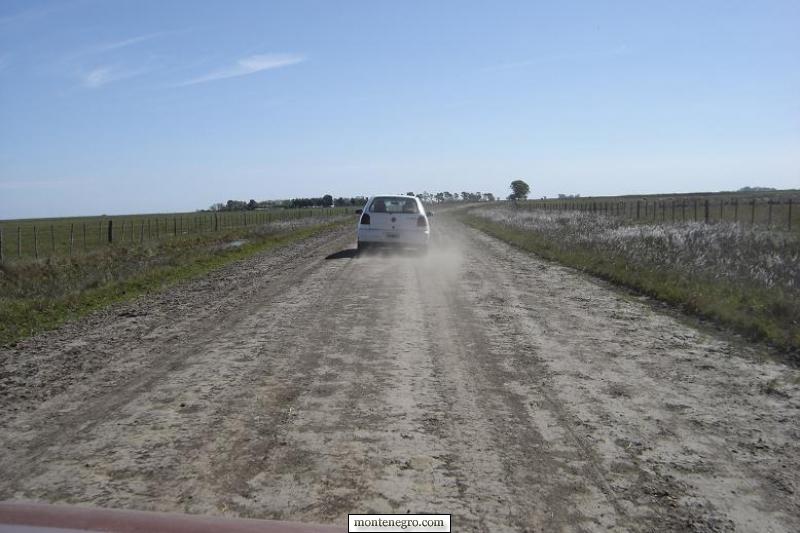
However, despite everything, most people have a huge amount of enthusiasm to accept any positive move or initiative from Montenegro towards them. Many of them told us that they have the feeling that some positive developments have been taking place recently and that they hope that all this will not remain just a feeling created by chance or opportunity. After lunch together at the "Njegoš" home, we said goodbye to the hosts and went to visit the Marković family and their famous ranch "Los Pinos", which is located not far from the city. We set off again through the dust of the pampas following our guide, the famous host Vas Jankovic. Next - At the Marković ranch with prosciutto
Hotels in Montenegro