Getting to Montenegro: Airports, Flights & Transfers
Updated Originally published 9 min readby Mila Božić
A complete guide to reaching Montenegro by air, road, rail and sea — including which airport to choose for your trip.
Montenegro packs a startling amount of geography into a country smaller than Connecticut: fjord-like bays, a 100-kilometre Adriatic coastline, glacial lakes and peaks that brush 2,500 metres. The good news for travellers is that almost all of it sits within a few hours of an airport. The slightly less good news is that there isn't one obvious way in, and the airport that makes sense in July may be closed by November.
After years of meeting friends off flights and ferrying guests around the Bay of Kotor, I've learned that choosing your point of entry is the single decision that most shapes a Montenegro trip. Land at the right airport and you're sipping coffee in a stone old town within the hour. Land at the wrong one and you've added a mountain pass and a border queue to your holiday.
This guide walks through every realistic way to reach Montenegro — by air, road, rail and sea — and ends with a simple framework for picking the best entry point for your trip. All prices and journey times are approximate and reflect the situation as of 2026; always reconfirm before you book.
Which airport should you fly into?
Answer three questions. The ranking changes with the month, because most routes here are seasonal.
1
Tivat Airport TIVstart here
Closest airport to your base
26 destinations this month
About 12 min by road, uncongested
Transfer seen at €15–30
2
Dubrovnik Airport DBV
52 destinations this month
Adds a land border to the plan
No published transfer price for this leg
3
Podgorica Airport TGD
36 destinations this month
No published transfer price for this leg
Compare the whole journey, not the airfare
Fill in what you are actually quoted. A cheaper flight is not a cheaper trip once bags, transfer and a recoverable arrival are counted.
Cost column
TIV
TGD
DBV
Flight and seats
Baggage
Airport transfer
Late-arrival cover
Total
€23lowest
—
—
Route counts compiled from published airline-and-destination listings on 2026-09-03; fares are observed ranges, not regulated tariffs — Montenegro does not set airport taxi prices. Confirm your own route and get the total fare in writing.
The two Montenegrin airports
Montenegro has two international airports, and they serve very different purposes.
Tivat sits right on the coast, a few minutes from the water in the Bay of Kotor. It is far and away the most convenient gateway for the famous coastal towns: it's roughly a 10-15 minute drive to Tivat itself and the Porto Montenegro marina, around 30-40 minutes to Kotor, and under an hour to Budva. Herceg Novi is about 45 minutes around the bay.
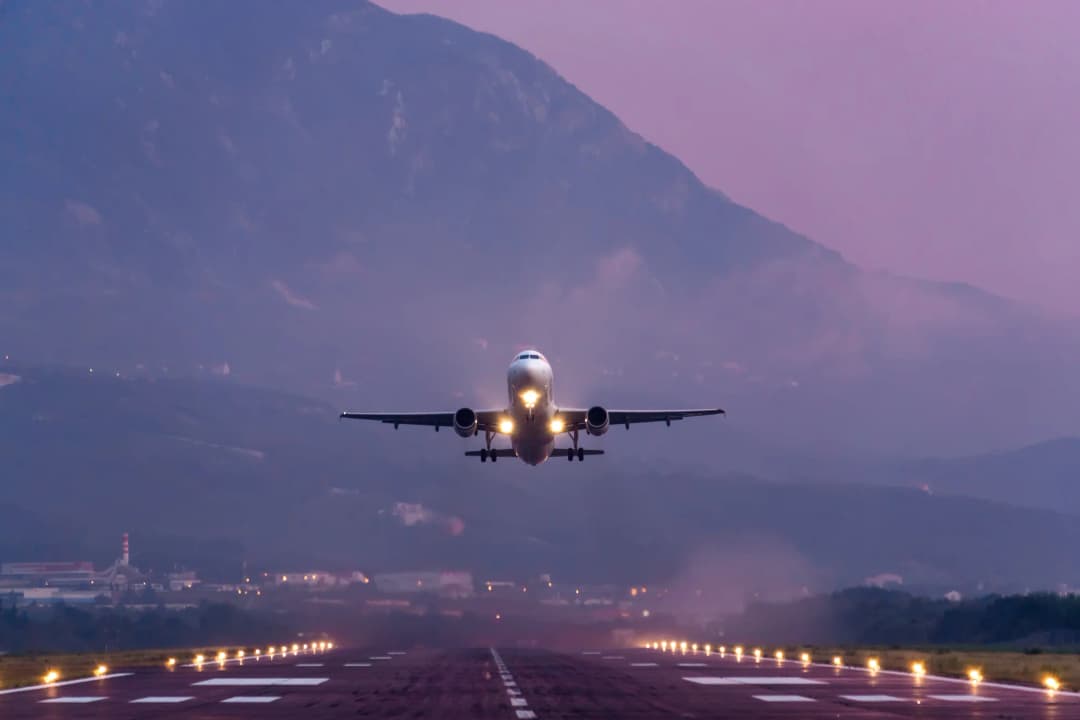
The catch is seasonality. Tivat is overwhelmingly a summer airport, with the great majority of its flights running roughly May to October. In peak season you'll find direct connections from dozens of European cities — London, Manchester, several German and Scandinavian hubs, Vienna, Zurich, Moscow-region carriers and more — many of them charter or seasonal-scheduled. In winter, the schedule thins dramatically and you may find no direct flight from your home city at all.
The capital's airport, Podgorica, is the country's year-round workhorse. It hosts the national carrier and a steady roster of scheduled flights to European hubs like Belgrade, Vienna, Istanbul, Zurich, Frankfurt, Paris, Rome, Ljubljana and Moscow-region cities, operating through winter as well as summer.
Geographically it's the better choice for the interior and the south: it's about 15 minutes from central Podgorica, around 30-40 minutes from Virpazar and Lake Skadar, and a sensible springboard for the northern mountains — Kolašin and Žabljak in Durmitor. For the coast it's workable but slower: budget around 1.5 hours to Budva and roughly 1.5-2 hours to Kotor via the Sozina tunnel.
Flight time is roughly two and a half to three hours depending on which airport you leave from — a short-haul hop, not a long-haul day. What changes enormously is when you go. In summer both Montenegrin airports fill with seasonal charter and low-cost services from across Britain and Ireland; in winter most of that disappears, and Tivat in particular keeps only a short year-round list. Podgorica holds the more durable network and is the airport that keeps a year-round London Stansted service when the coast has gone quiet.
That asymmetry is the single thing worth checking before you book anything else: "fly into Tivat for Kotor" is good advice in July and can be the wrong instruction in February. Our airport comparison guide works through it month by month using the official passenger figures, and is the better page to read if you are choosing between the two.
We do not publish fares here. Prices on this route move week to week and any figure printed on a page like this is out of date before it is read — check a comparison site for the current number, then come back for the part that does not change, which is what each airport is actually good for once you land.
Flying into Dubrovnik (Croatia)
Here's the move many seasoned visitors make: fly into Dubrovnik Airport (DBV) in neighbouring Croatia and cross the border by land. Dubrovnik has far more flight options than Tivat — more carriers, more cities, more competitive fares, and a longer operating season — and it sits only a short distance north of the Montenegrin frontier.
From Dubrovnik Airport, reaching the Bay of Kotor takes roughly 1.5 to 2.5 hours depending on traffic and, crucially, the queue at the border. The main crossing is at Debeli Brijeg, between Croatia and Herceg Novi. In peak summer those border lines can swell to an hour or more on busy afternoons, so factor in a buffer.
A few practical notes: Montenegro is not in the EU or the Schengen Area (it's an EU candidate and uses the euro unilaterally), so you'll pass through a real border check. If you're driving a rental car across, you must tell the rental company in advance — many require explicit permission and a Green Card insurance extension to take the vehicle into Montenegro, and some don't allow it at all. See our visa and entry guide for the border formalities.
Arriving by bus
Montenegro is woven into the Balkan and wider European coach network, and the bus is often the cheapest way in. Regular international services run from:
Dubrovnik — frequent in summer, down the coast to Herceg Novi, Kotor, Budva and beyond; roughly 2-3 hours to Kotor.
Belgrade (Serbia) — overnight and daytime coaches to Podgorica and the coast.
Sarajevo and Mostar (Bosnia & Herzegovina) — scenic routes over the mountains.
Tirana (Albania) — handy for the south and Ulcinj, and increasingly used by travellers combining the two countries.
Coaches are inexpensive, reasonably comfortable and connect to Montenegro's well-developed domestic network once you're inside the country. Buy tickets at the station or through online aggregators; fares and schedules vary, so treat any figure as approximate. For how the buses work once you've arrived, see getting around Montenegro.
Arriving by car & border crossings
Driving in is straightforward and gives you total freedom once you arrive — though Montenegro's mountain roads reward a calm, unhurried driver. The main crossings are:
Debeli Brijeg / Sitnica — from Croatia (Dubrovnik direction) into Herceg Novi and the Bay of Kotor. The busiest summer crossing.
Ranče / Vraćenovići and others — from Bosnia & Herzegovina toward Nikšić.
Dobrakovo / Ranče region crossings — from Serbia toward Bijelo Polje and the north.
Sukobin — from Albania (Shkodër direction) toward Ulcinj and the south.
At the border you'll need your passport, vehicle registration, and proof of insurance valid for Montenegro (a Green Card, or you can buy short-term border insurance on entry if your policy doesn't cover the country). Crossings are generally smooth outside peak hours; midday and early evening in July and August are the slow times.
Arriving by train
One genuinely characterful option is the Bar–Belgrade railway, one of Europe's great scenic lines. Coming from Serbia, the train enters Montenegro near Bijelo Polje in the north, then threads through the mountains via Kolašin and Podgorica down to the coastal terminus at Podgorica and Bar. It's slow and the rolling stock is dated, but the engineering — tunnels, gorges and the soaring Mala Rijeka viaduct — makes it a journey worth taking for its own sake. There is no railway along the coast itself. More on riding it in our getting around guide.
Arriving by sea: cruise & ferry
Cruise ships
Kotor is one of the Adriatic's most photogenic cruise calls — ships sail right up the bay and dock beneath the fortress walls of the old town. Bar and occasionally other ports also receive vessels. If you're arriving on a cruise, you're set down in the thick of it.
Ferries from Italy
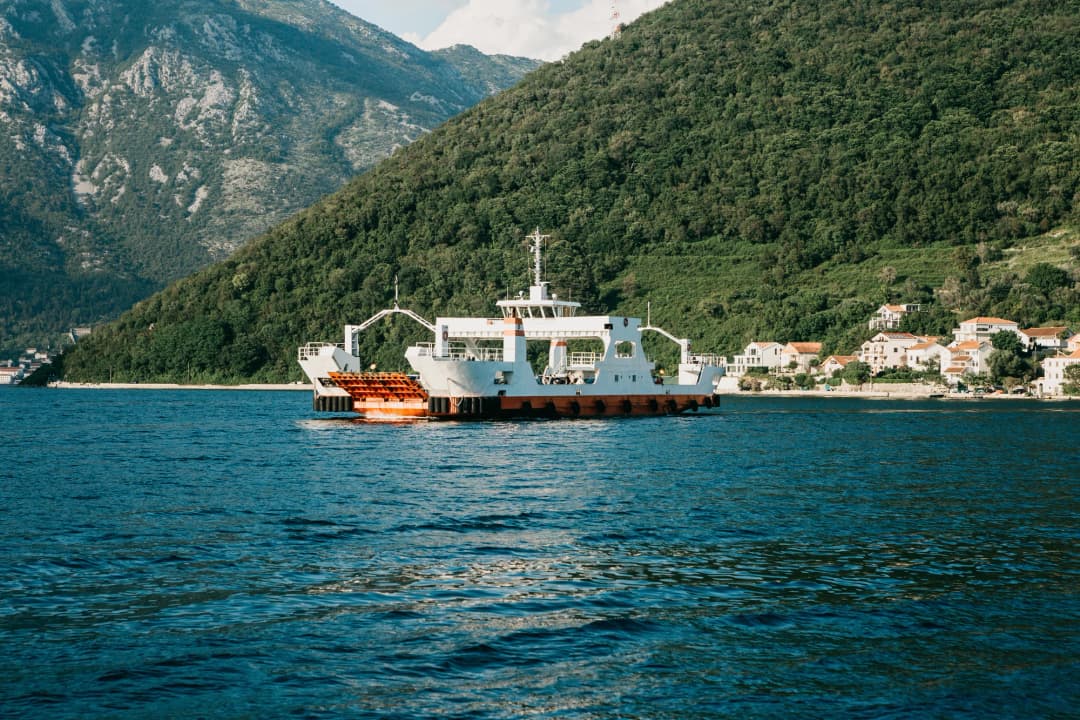
For a slower, more romantic approach, overnight car ferries link Italy with Bar, typically sailing from Bari and Ancona. Crossings run mostly in the warmer months and take roughly 9-12 hours overnight, letting you bring your own car and wake up on the Montenegrin coast. Schedules are seasonal and change year to year, so check the operators directly rather than relying on an old timetable.
Getting from the airport to your hotel
However you fly in, here are your options for the last leg:
Private transfer — the most stress-free. A driver meets you at arrivals and takes you door to door for a fixed, pre-agreed price. Worth it for groups, families, late arrivals, or anyone heading somewhere awkward like the mountains. Many accommodation hosts can arrange this for you.
Taxi — readily available at both airports. Agree the fare or insist on the meter before you set off; airport taxis sometimes quote optimistic flat rates to tourists.
Rental car — desks operate at both Tivat and Podgorica. Ideal if you plan to explore independently. Book ahead in summer, when cars sell out.
Bus — the cheapest option. Tivat and Podgorica both have bus links to nearby towns, though you may need a short taxi hop from the terminal to the main road or station, and luggage space can be tight.
Which airport should you use?
Put it together and the decision usually makes itself:
Coast in summer, especially the Bay of Kotor? Fly into Tivat if there's a good direct flight; otherwise Dubrovnik for cheaper, more frequent options and an easy land transfer.
Travelling outside the summer season?Podgorica — it runs year-round — or Dubrovnik.
Heading for the mountains, Lake Skadar or the capital?Podgorica, hands down.
Want the widest choice and lowest fares, and don't mind a border crossing?Dubrovnik.
Combining Montenegro with Albania? Consider flying via Tirana and entering overland in the south.
Whichever gateway you choose, getting in is the easy part — the joy begins once you're on the ground. Read our companion guide on getting around Montenegro to plan your onward travel, check the entry and visa rules before you fly, and when you're ready to settle on a base, browse places to stay across the coast, the capital and the mountains.
···
Updated · Originally published
Montenegro Travel Newsletter
Get weekly stories, guides, and insider tips about Montenegro delivered to your inbox.