Montenegro has a reputation as one of the Adriatic's best-value destinations, and for the most part it earns it. Compared with Western Europe — and often with neighbouring Croatia — your money stretches noticeably further here. A good dinner, a comfortable apartment, a bus across the country: all tend to cost less than you'd expect for a place this beautiful.
But "cheap" deserves an asterisk. The coast in peak summer is a different animal from the quiet interior in spring, and a beachfront sunbed in August can cost more than a full meal inland. Where you go, when you go, and how you travel make a bigger difference here than almost anywhere.
This page answers the question itself. The arithmetic behind it — three daily budget tiers, sample prices, what a whole week totals, and a calculator that adjusts for the month and the town — is in our Montenegro trip cost breakdown. Every figure is an approximation for planning rather than a quote: prices move with the place, the season and the venue, and the coast in July and August is always above the rest.
The short answer
No — Montenegro is generally more affordable than Western Europe, and a comfortable trip here costs less than the equivalent in Italy, France or even much of coastal Croatia. Everyday essentials like coffee, bakery food, local beer and bus travel are genuinely inexpensive. Where costs climb is the obvious place: prime beachfront accommodation, restaurants and sunbeds on the coast during the July–August peak, when demand outstrips supply.
The single biggest lever on your budget is timing. Travelling in the shoulder season or heading inland to the north can roughly halve your accommodation and dining costs versus a peak-summer coastal trip. Get those choices right and Montenegro is a bargain; get them wrong and it can feel surprisingly pricey for the Balkans.
How it compares to its neighbours
Context helps. Set against Croatia — its glamorous Adriatic neighbour — Montenegro generally comes out cheaper, particularly on accommodation and restaurant dining. Croatia's most popular coast has seen prices climb steadily since it joined the eurozone, and the famous Dalmatian hotspots now command premium rates; Montenegro offers a comparable coastline of dramatic bays, walled old towns and clear water for noticeably less, especially once you step outside its own July–August peak.
Against Western Europe — Italy, France, Spain's costliest resorts — the gap is wider still. A seafood dinner, a night in a comfortable apartment, a coffee on a historic square: each tends to cost a fraction of the equivalent on the Italian Riviera just across the Adriatic. Within the Balkans, Montenegro sits roughly in the middle: a little pricier than Albania or North Macedonia on the whole, broadly in line with Serbia and Bosnia inland, but with a coast that can spike in summer. The takeaway is that you're getting Mediterranean scenery at distinctly sub-Mediterranean prices, provided you don't confine yourself to the August beachfront.
Currency, cards and tipping
Montenegro uses the euro, despite not being in the EU or the eurozone — it adopted the currency unilaterally, so there's no separate local money to exchange. Cards are widely accepted in hotels, larger restaurants, supermarkets and shops, especially on the coast. That said, carry some cash: small konobas, markets, bakeries, taxis, parking and rural spots often prefer or require it.
ATMs are plentiful in towns and at the coast, though they thin out in remote mountain areas, so withdraw before heading into the interior. Watch for ATM operator fees and the "dynamic currency conversion" prompt — always choose to be charged in euros rather than your home currency for a better rate. Tipping is appreciated but modest: rounding up or leaving around 10% for good service in a restaurant is the norm, and there's no obligation to tip for casual coffees or quick bites.
So, is it expensive?
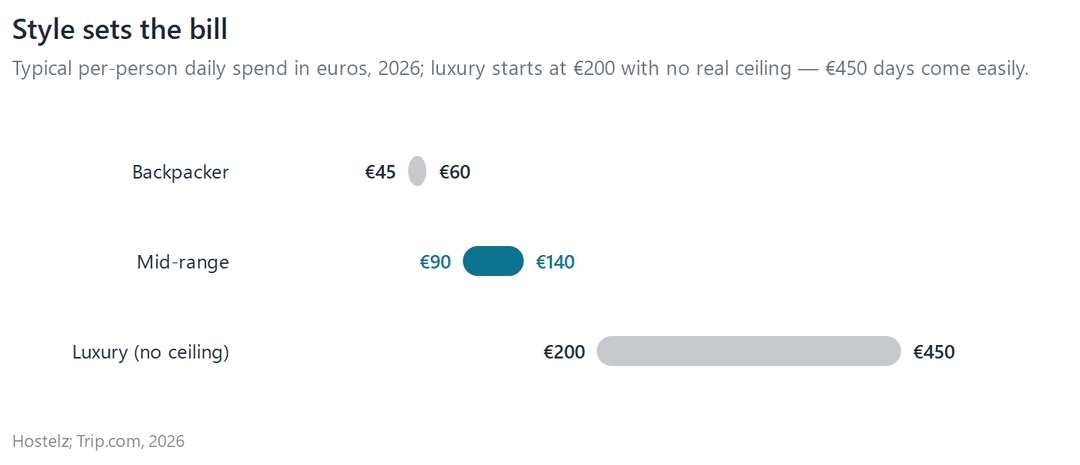
For the great majority of travellers, Montenegro is a value destination — cheaper than Western Europe, frequently cheaper than Croatia, and able to deliver a memorable trip on a modest budget. A backpacker can get by on €45–60 a day, a mid-range traveller will be very comfortable on €90–140, and the luxury tier still tends to undercut the famous Mediterranean rivals.
The only real cost trap is the peak-summer coast, where beachfront everything commands a premium. Sidestep it by travelling in the shoulder season, mixing in the cheaper interior, and leaning on apartments, konobas and buses — and Montenegro stays firmly in bargain territory. When you're ready to price up a trip, browse places to stay across the country and see just how far your euros go.