1853
An island turned into a machine
Lastavica is a small circular rock about two hundred metres across at the mouth of the Bay of Kotor, and the fort covers roughly ninety per cent of it. There is essentially no island left over. That is the clearest statement of what it was for.
It was built in 1853 under Lazar Mamula (1795–1878), an Austrian baron, artillery general and governor of Dalmatia, as one of three forts — Oštro on Prevlaka, Mamula on its island, Arza on the tip of Luštica — put up between 1850 and 1854 to close the entrance to the bay. Nothing could enter without passing through all three fields of fire.
The design is a circular multi-storey tower with flanking guns in casemates and two casemate batteries, east and west, of six guns each. Inside: three floors of bomb-proof vaulted rooms, powder magazines underground, gun platforms on the roof, cisterns holding six months of water and sleeping quarters for two hundred men. It is a building designed to be sealed and to keep working.
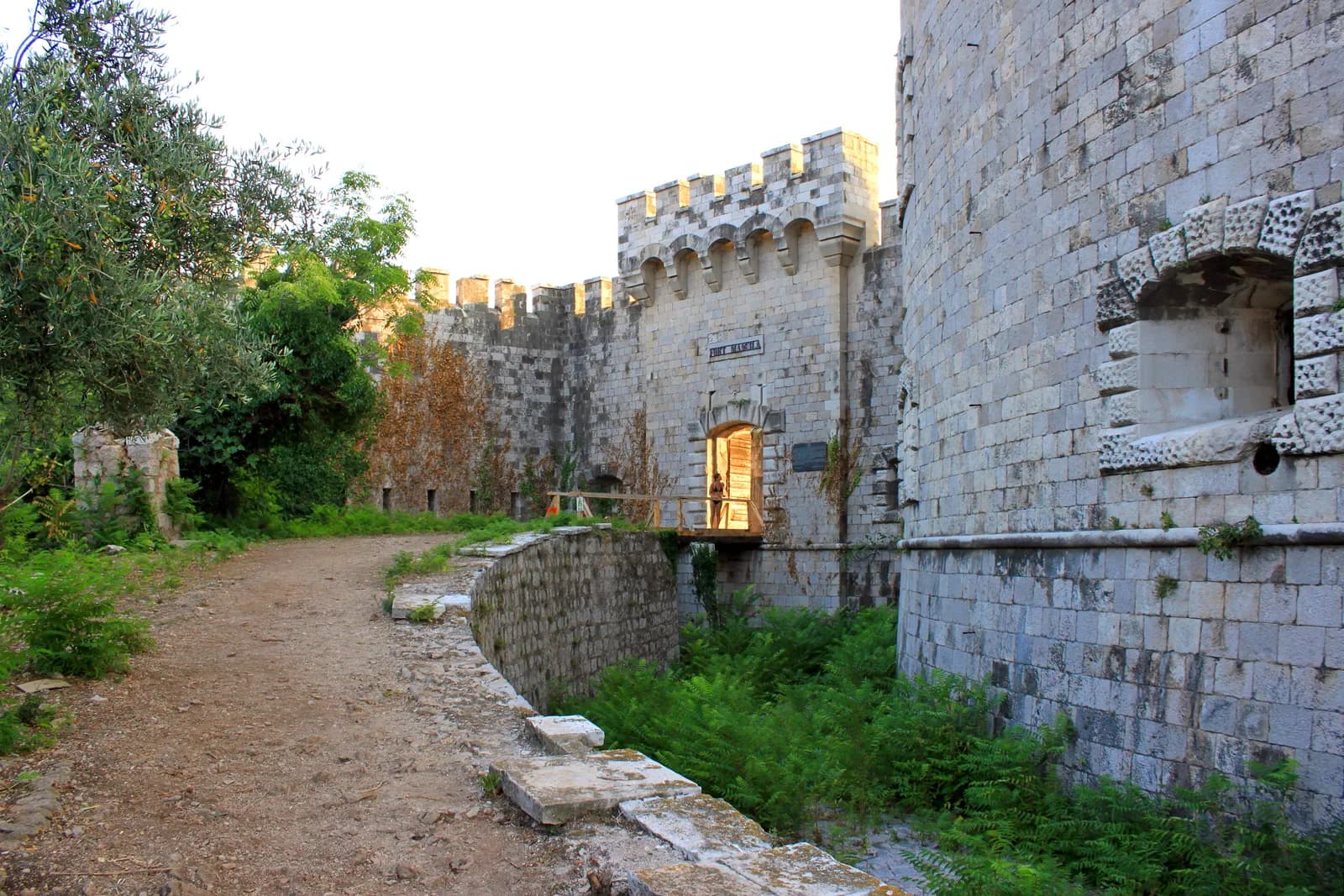
- The circular tower. The curved face of the main fort, in cut ashlar laid in horizontal courses. A circle has no corner for an attacker to concentrate fire on, and every point of the wall is the same distance from the centre.
- A casemate opening. The recessed opening in the curved wall is a gun position in a bomb-proof vault. There were three storeys of these, plus two casemate batteries of six guns each, plus more guns on the roof.
- The gatehouse. Crenellated, with machicolations above the door — openings to drop things through onto anyone at the entrance. The plaque beside the doorway commemorates the camp.
- The bridge. The only way in, across the moat on the north-eastern side. The original was designed to be pulled in. The shores everywhere else are steep and unlandable.
- The dry moat. Cut into the rock of the island around the fort. Seventy years of abandonment after 1945 filled it with ferns.
1942 – 1943
Eighteen months
After Italy occupied the coast in 1941, the fort was turned into a concentration camp. It was opened by order of the Italian occupation command on 30 March 1942 and disbanded in September 1943.
In those eighteen months 2,332 people were imprisoned here, from Boka Kotorska, eastern Herzegovina and southern Dalmatia. Herceg Novi accounted for 810 of them, Kotor 356, Tivat 122, Budva 110. The first prisoners brought to the island were 110 women and children.
130 people died on Lastavica, of disease, of starvation, and by execution. In 1959 an ossuary was found on the island containing the bones of 58 people, mostly from Dubrovnik, Korčula and Trebinje.
These figures come from Herceg Novi’s own municipality, which commemorates the camp’s dissolution each year on the island. They are more precise than the accounts in wide circulation, and they are the ones this article uses.
2016 – today
And then it was for sale
After the war Lastavica was abandoned. Nobody lived there; nothing was done with the fort; it decayed quietly for seventy years. That is the condition in which heritage becomes a development opportunity.
In January 2016 the Montenegrin government approved the conversion of the site into a luxury resort under a 49-year lease to a developer, and in 2023 Mamula reopened as a five-star hotel. Former prisoners objected. So did the former UN Secretary-General Boutros Boutros-Ghali, who said he was surprised that the only solution proposed for preserving and using the fort was a business arrangement.
This article is not going to tell you whether to stay there. It will point out what is not in dispute: a place where 2,332 people were imprisoned and 130 died now takes bookings, the decision was made by a government, it was opposed by people who had been held there, and the fort — which was falling down — is standing.
Surprised that the only solution for preserving and using the fort is a mere business arrangement and privatisation agreement.
Boutros Boutros-Ghali, former UN Secretary-General, on the Mamula lease
1853 → today
The full timeline
Dated events only. Where sources disagree, the conflict is stated in the entry rather than resolved silently.
Austro-Hungarian
1853–19181850–1854
The first line of defence goes up
Oštro on Prevlaka, Mamula on Lastavica and Arza on Luštica, closing the entrance to the Bay of Kotor.
1853
Fort Mamula is built
Circular multi-storey tower; three floors of casemates; two casemate batteries of six guns each; magazines, cisterns for six months and quarters for 200 men. Named for Lazar Mamula (1795–1878).
1 Sep 1914
Shelled from thirteen kilometres
Admiral Boué de Lapeyrère’s fleet opens fire. It is the first of three attacks.
19 Sep 1914
A 305 mm shell hits the breastworks
It penetrates twelve metres of wall and soil and kills one sailor.
1918
A prison for mutinous sailors
The fort holds sailors from the mutiny in the bay, inspired by the October Revolution.
Italian occupation
1941–194330 Mar 1942
The camp opens
By order of the Italian occupation command. Wikipedia gives 30 May; Herceg Novi’s municipality and the fort’s own history both give 30 March.
1942–43
2,332 prisoners, 130 dead
From Boka, eastern Herzegovina and southern Dalmatia — 810 from Herceg Novi, 356 Kotor, 122 Tivat, 110 Budva. The first were 110 women and children. 130 died of disease, starvation and execution.
Sep 1943
The camp is disbanded
The municipality gives 14 September, the fort’s own history 30 September. Both make it eighteen months.
Abandoned
1945–20151959
An ossuary is found
Containing the bones of 58 people, mostly from Dubrovnik, Korčula and Trebinje.
1945–2015
Nobody lives on the island
The fort is left to decay for seventy years.
Leased · resort
2016–todayJan 2016
The government approves a resort
A 49-year lease to a developer. Former prisoners object, as does former UN Secretary-General Boutros Boutros-Ghali.
2023
Mamula reopens as a five-star hotel
Corrections
What the internet gets wrong
These claims circulate widely online and do not survive checking. If you have read about Mamula elsewhere, you have probably met at least one of them.
Dates differ
The camp opened on 30 March 1942, not 30 May.
Wikipedia gives 30 May 1942. Herceg Novi’s municipality and the fort’s own published history both give 30 March 1942, and both make the camp eighteen months long. Use 30 March.
Figures
2,332 prisoners and 130 dead.
Round numbers like “over 2,000” and “more than 1,500” circulate widely. The municipality, which commemorates the camp annually, gives 2,332 held and 130 dead, with a per-town breakdown. Those are the figures to use.
Not a Nazi camp
It was run by Fascist Italy.
Mamula is often described loosely as a Nazi camp. It was established and operated under Italian occupation, which is a matter of record and worth getting right.
Check before you go
The island is a private hotel.
Since 2023 Lastavica has operated as a five-star resort under a long lease. It is not a public monument, and access is on the operator’s terms.
Sources and image record
Dates and interpretations are tied to the archive and research sources below. Where they conflict, the conflict is named in the text rather than smoothed over.
- Opština Herceg Novi — Znamenitosti
The municipal inventory of the fortress system, with dates, dimensions and functions
- Opština Herceg Novi — The history
Sovereignty timeline; 1979 earthquake damage across the fortresses
- Plan (archaeology) — the phasing convention
The colour-by-period phase plan this page’s visual system borrows
- Opština Herceg Novi — commemoration of the camp’s dissolution
The municipal figures: 30 March 1942, 2,332 prisoners, the per-town breakdown, 130 dead
- IMG Mamula — Istorijat
Construction, armament in 1914, the WWI attacks, the camp dates. Published by the site’s operator
- Wikipedia — Mamula
The 1853 construction, the 49-year lease, and the Boutros-Ghali objection
- Wikimedia Commons — Fort Mamula
Marcin Konsek · CC BY-SA 4.0 · the annotated photograph