The story
Two thousand years of the same wall
Kalaja is the oldest fortification in this series and the only one that is still somebody's address. It is a castle, a neighbourhood and an archaeological section all at once: the oldest remnants of its walls are Illyrian, and people are living inside them.
The Illyrians built on a small peninsula on the right side of the gulf. Before 162 BC the town belonged to an Illyrian people the sources call the Olcinijantas; Rome conquered them in the second century BC. Major changes came later from the Byzantines and then from Venice, which took Ulcinj after the fall of the state of Zeta in 1405 and held it for about a century and a half.
At the highest point stands the Balšić tower, named for the last representatives of the Balšić dynasty — a wealthy family from the Shkodër area who made Ulcinj their residence at the end of the fourteenth and the beginning of the fifteenth century. The Ottomans, who took the town in 1571, added a distinctive spherical top to it. You can date the empires on that one tower by looking up.
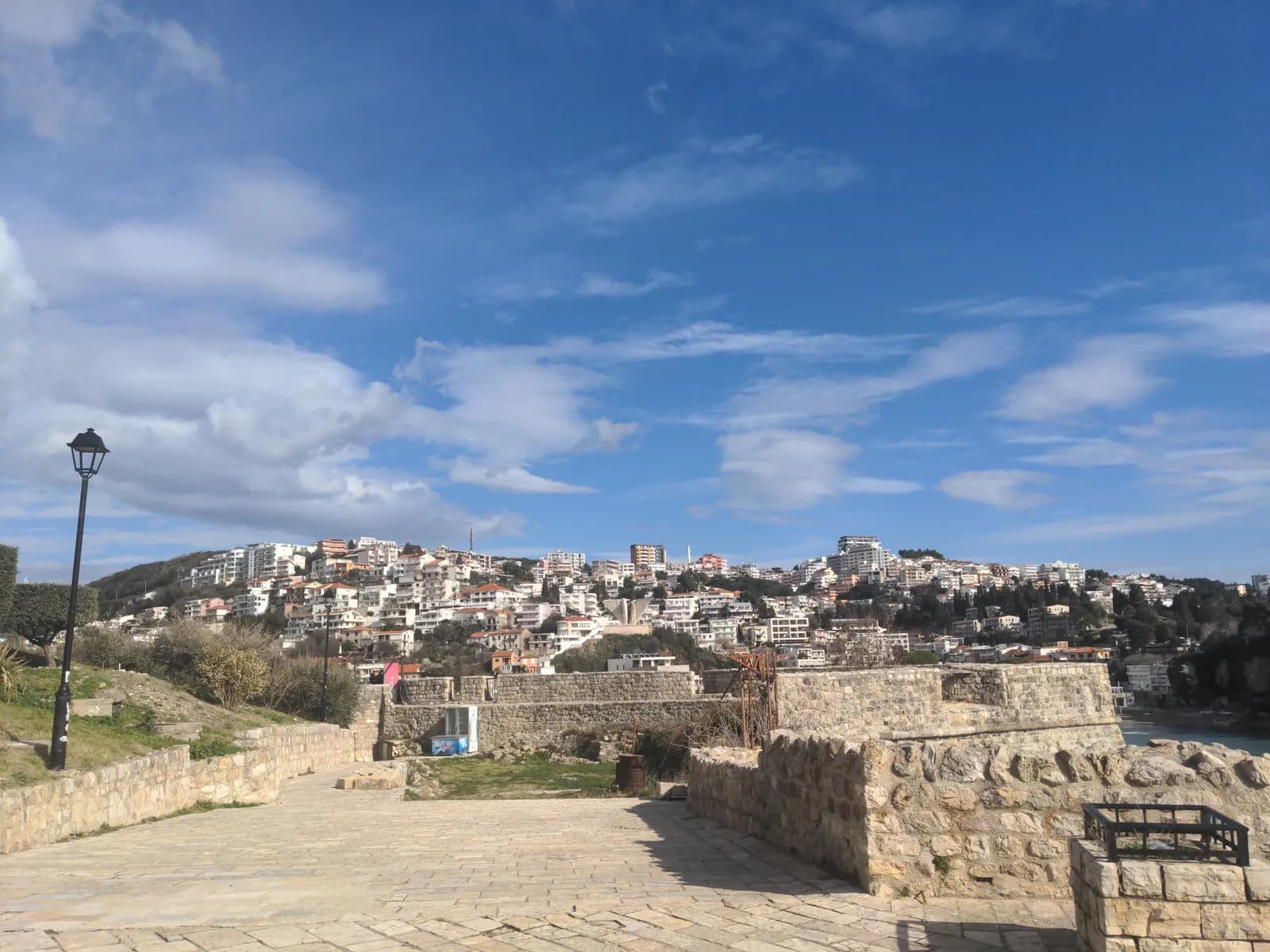
- Inside the walls. Stone houses and terraces within the fortification — the part of this series that is still a neighbourhood. Kalaja is a castle people live in, not a monument they visit.
- The rock it stands on. A small peninsula on the right side of the gulf. The Illyrians chose it, everyone since has kept it, and the oldest courses in these walls are theirs.
- The town below. Modern Ulcinj, and the beaches that are now the town's business. In the seventeenth century this water carried a corsair fleet reported at four hundred ships.
- The sea they worked. Corsairs of North African and Albanian origin raided from here across the Mediterranean, ransoming wealthy Italian merchants and supplying the largest slave market on the Adriatic.
- Where the ground moved. The epicentre of the 1979 earthquake lay along this coast, about six kilometres east of Stari Bar. It killed 31 people in Ulcinj and damaged the old town badly.
1571 – 1878
Four hundred ships and a slave market
Ulcinj fell to the Ottomans in 1571, in the upheaval around the Battle of Lepanto and with the help of North African corsairs. Those corsairs then stayed.
By the seventeenth and eighteenth centuries the town's fleet is reported at some four hundred ships, crewed by men of North African and Albanian origin, raiding across the Mediterranean. They kidnapped wealthy Italian merchants for ransom, and Ulcinj operated what became the largest slave market on the Adriatic. The square in front of the church-mosque was called Slave Square. What that meant for the people sold in it is the next section.
It is now called Cervantes Square.
1650 – 1925
The people who were sold here
It is easy to write about corsairs as adventure. The trade they ran was the buying and selling of human beings, it was the town's major business for the better part of two centuries, and it has descendants.
By around 1650 Ulcinj had become a major slave-trading centre of the Mediterranean — taking over, the accounts say, from Herceg Novi at the other end of what is now Montenegro. It was profitable and it was legally sanctioned, which is the part that modern readers find hardest and which mattered most at the time.
Named arrivals
From the middle of the eighteenth century the records get specific. In 1770 Ulcinj's Ali Basha brought two enslaved women from Egypt. In 1775 a group returning from North Africa brought thirteen African men and women. Townspeople also bought people in Tripoli — brought there from Sudan and Chad — for resale in other Mediterranean ports.
Some were sold on. Others were kept in Ulcinj, and here the story turns in a direction most accounts of Adriatic piracy never follow: after a period of enslavement they became free citizens, working in agriculture and at sea.
A community, and then not
By 1878 the African community of Ulcinj numbered around 300 people, in roughly a hundred households. After Montenegro took the town in 1880 many left for Albania, and about sixty remained. By 1925 there were five households. Chattel slavery was formally abolished across the Ottoman Empire by imperial decree in 1887, by which time Ulcinj had not been Ottoman for seven years.
The last well-known member of the community was Rizo Šurla — a photographer, fisherman and bohemian, who had been a boxer and a waiter in Zagreb and a Partisan on the Srem Front. He died in 2003. His sister is the last direct descendant of Ulcinj's African community.
Only memories and emptiness remain.
On what is left of Ulcinj’s Afro-Albanian community
The square where people were sold is still there, in front of the church-mosque, a few minutes' walk inside these walls. It used to be called Slave Square. It is now Cervantes Square, named for a writer who was almost certainly never here — which is its own comment on how a town chooses to remember.
1878 → today
Still lived in
Ulcinj did not pass to Montenegro with Bar. Bar fell in January 1878; Ulcinj held out for nearly three more years. The Congress of Berlin and the negotiations that followed awarded the town to Montenegro, the Great Powers sent a naval squadron to make the point, Ottoman forces under Dervish Pasha fought at Klezna on 22 November 1880, and Riza Pasha was then given three days to hand the town over. The transfer took effect that month.
On 15 April 1979 the Montenegro earthquake struck, with its epicentre along this coast about six kilometres east of Stari Bar. It killed 31 people in Ulcinj and damaged the old town badly, the church-mosque among some 1,600 cultural monuments hit across the republic. Restoration over the following years brought the Venetian-era character of the stone houses back.
That is the difference between Kalaja and almost everything else in this series. Forte Mare is a cinema, Mamula is a hotel, Kosmač is a shell, Stari Bar is empty and the Citadela is in the sea. Kalaja was repaired because people needed to keep living in it — which is, in the end, the only conservation strategy that has ever reliably worked.
to t → today
The full timeline
Dated events only. Where sources disagree, the conflict is stated in the entry rather than resolved silently.
Illyrian & Roman
to the 6th centurybefore 162 BC
An Illyrian fortified peninsula
Held by the Olcinijantas. The oldest remnants of the walls date from this period.
2nd c. BC
Rome conquers the town
Byzantine
6th century–14056th c. onward
Byzantine rebuilding
Major changes to the fortification, on the Illyrian base.
late 14th c.
The Balšić tower
The Balšić dynasty, from the Shkodër area, make Ulcinj their residence and give the tower its name.
Venetian
1405–15711405
Venice takes Ulcinj
After the fall of the state of Zeta. Venetian rule lasts about 150 years.
Ottoman
1571–18801571
The Ottomans take the town
In the upheaval around Lepanto, with the help of North African corsairs.
Ottoman period
A dome on the Balšić tower
The distinctive spherical addition at the highest point of the fortress.
c. 1650
Ulcinj becomes a Mediterranean slave-trading centre
Taking over, by the accounts, from Herceg Novi. The trade was profitable and legally sanctioned.
1770
Ali Basha brings two enslaved women from Egypt
1775
Thirteen African men and women brought from North Africa
Townspeople also bought people in Tripoli, brought there from Sudan and Chad, for resale in other Mediterranean ports.
17th–18th c.
Four hundred ships
A corsair fleet of North African and Albanian crews raids the Mediterranean. Ulcinj runs the largest slave market on the Adriatic, in the square now named for Cervantes.
Montenegrin
1880–today10 Nov 1880
The Powers award Ulcinj to Montenegro
Nearly three years after Bar fell. Montenegro accepts the exchange proposed at Istanbul, giving up Hoti and Gruda for Ulcinj.
22 Nov 1880
The handover is forced
A Great Power naval squadron stands off the coast; Ottoman forces under Dervish Pasha cross the Bojana at Klezna. Riza Pasha is given three days to hand the town over.
15 Apr 1979
The Montenegro earthquake
31 dead in Ulcinj; the old town badly damaged, the church-mosque among some 1,600 monuments hit across the republic.
1878
About 300 people in the African community
Roughly a hundred households. After the Montenegrin takeover of 1880 many leave for Albania and about sixty remain.
1887
Chattel slavery formally abolished across the Ottoman Empire
By imperial decree — seven years after Ulcinj had ceased to be Ottoman.
1925
Five households left
2003
Rizo Šurla dies
Photographer, fisherman and bohemian; a boxer and waiter in Zagreb and a Partisan on the Srem Front. His sister is the last direct descendant of the community.
1980s
Restored, and still inhabited
Years of work brought the Venetian-era character of the stone houses back. Kalaja is a lived-in neighbourhood, not a monument.
Corrections
What the internet gets wrong
These claims circulate widely online and do not survive checking. If you have read about Kalaja elsewhere, you have probably met at least one of them.
Legend
Cervantes was held in Algiers.
The story that he was enslaved at Ulcinj, and that Dulcinea came from Dulcigno, is a persistent and much-loved local legend. The historical record places his five years of captivity in Algiers. The square is named for him anyway.
Widely repeated
“Ulcinj passed to Montenegro in 1878.”
Bar fell in January 1878; Ulcinj did not. The Powers awarded the town to Montenegro in November 1880 and it took a naval demonstration and fighting at Klezna to force the handover.
Not only pirates
The slave market had descendants.
Accounts of Ulcinj usually stop at corsairs and treasure. An African community lived here into the twentieth century — around 300 people in 1878, five households by 1925, and one living direct descendant today.
Not a museum
People live inside the walls.
Kalaja is an inhabited neighbourhood of Ulcinj, not an open-air site. It is the only fortification in this series that never stopped being used for its original purpose — shelter.
Figures
“Four hundred ships.”
The size of the Ulcinj corsair fleet is a reported figure from the period, not a verified count. The scale of the raiding and the slave market are not in doubt.
Sources and image record
Dates and interpretations are tied to the archive and research sources below. Where they conflict, the conflict is named in the text rather than smoothed over.
- Wikipedia — Ulcinj Castle
Illyrian origin, the Balšić tower, Byzantine, Venetian and Ottoman rebuilding
- Visit Montenegro — The History of Ulcinj
The Olcinijantas, the Roman conquest, Venice from 1405 and the Ottoman period from 1571
- TO Ulcinj — Miguel de Cervantes
The town's own account of the Cervantes legend and Cervantes Square
- Only Memories and Emptiness Remain: Ulcinj’s Afro-Albanian Community
The documented history of the community: the 1770 and 1775 arrivals, manumission, naming, the population figures and Rizo Šurla
- Wikipedia — Battle of Ulcinj (1880)
The Berlin settlement, the naval demonstration and the forced handover of November 1880
- Wikipedia — 1979 Montenegro earthquake
15 April 1979, magnitude 6.9, epicentre about 6 km east of Stari Bar
- Wikimedia Commons — View of Ulcinj from the castle
Desnosie · CC0 · the annotated photograph
- Plan (archaeology) — the phasing convention
The colour-by-period phase plan this page’s visual system borrows