The story
Built by the winners of 1539
Kanli Kula belongs to the same decade as the most famous siege in this town’s history, and to the winning side of it. When Hayreddin Barbarossa retook Castelnuovo from its Spanish garrison in August 1539, the Ottomans set about making sure it could not happen again.
The programme that followed gave Forte Mare its bulk and its crenellated crown. On the high ground north of the Old Town it produced something new: a large rectangular fortress commanding the landward approach, hollow inside, with a cistern sunk into its floor to keep a garrison in water through a siege.
Herceg Novi’s own heritage inventory dates it to the sixteenth century and notes that the first written record of it comes only in 1664, when the Ottoman traveller Evliya Çelebi passed through. Wikipedia puts the construction at 1539 precisely. Both are consistent: a fortress built in the aftermath of 1539 and only described in writing a century and a quarter later.
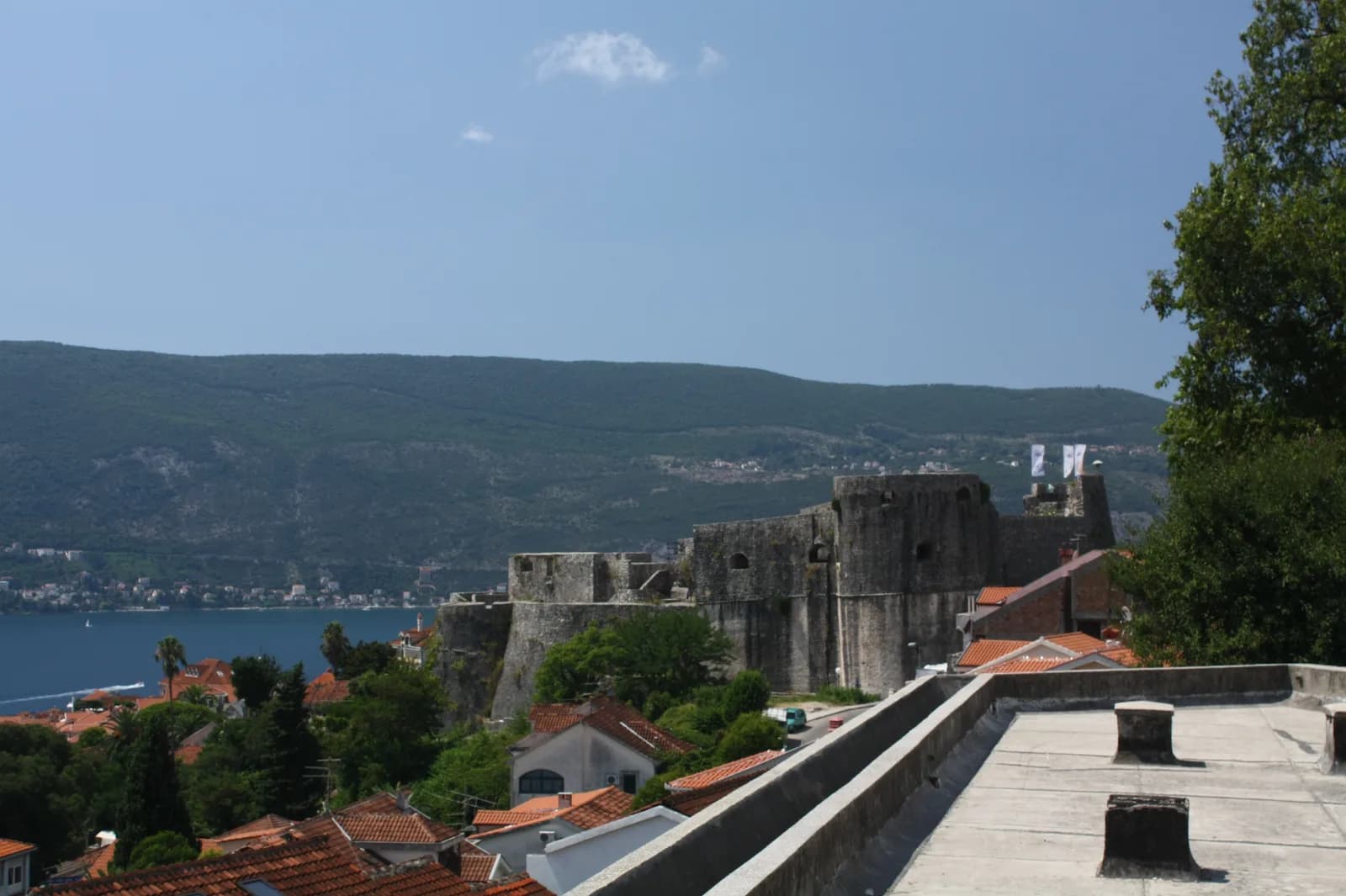
- The rounded bastion. The high rounded mass at the fortress’s corner. A curved face deflects shot that a square corner would catch — standard practice by the time this was built, in the age of gunpowder.
- The long curtain wall. The wall runs north from the Old Town along the ridge. Small openings punched through it at intervals are gun ports, not windows: this face looks out over the approach from inland.
- The battered base. The wall thickens as it descends. Sloping the base puts more stone exactly where a besieger’s guns are aimed, and makes a scaling ladder sit at a useless angle.
- The town, below. Kanli Kula holds the high ground behind Herceg Novi. From up here the whole Old Town, the harbour and the entrance to the bay are in one glance — which is precisely why it is here.
- The far shore. Across the water is the Luštica peninsula and the strait the whole fortress system existed to close. Mamula and Arza sit out at the entrance, beyond the frame.
The name
The tower earns its adjective
At some point the fortress stopped being only a fortress. The cistern — a stone chamber cut into the floor, with one way in — was turned into a cell, and the building acquired the name it has carried ever since: Kanlı Kule in Turkish, the bloody tower.
It was said locally that the doors of Kanli Kula opened only one way for an inmate: neither release nor escape was expected. That is lore rather than record, and worth holding at arm’s length. What is not lore is what the prisoners left behind.
The prisoners dated the building
The walls of the cell are covered in carvings: galleys and other ships, crosses, coats of arms, names and dates, scratched into the stone by men with nothing else to do and no expectation of leaving. They are still there.
And they turned out to be evidence. The vessel types depicted were in service in the sixteenth and seventeenth centuries, which allowed historians to date the founding of the prison from the drawings themselves. A building whose written record begins in 1664 was dated by its inmates, in graffiti, from the inside.
The men who were never going to leave are the reason we know when the door first shut.
The carved ships in the cell, read as archaeological evidence
1687 → today
From a cell to a thousand seats
Venice took the town on 30 September 1687 and repaired Kanli Kula in the same programme that patched Forte Mare and renamed it. Under Austria-Hungary the fortress became a garrison building, one more structure in a bay stiff with military installations, and then — like most of the system — it stopped having a job at all.
The second life began in 1960, when the interior was adapted as a summer stage; by 1966 it had been rebuilt as an open-air amphitheatre. Concrete tiers were poured inside an Ottoman shell, and the room where prisoners waited became a place where a thousand people sit down together in the dark.
The 1979 earthquake damaged the interior badly. The reconstruction that followed was executed in what its own describers call the Venetian style — worth noticing, because the fortress is Ottoman. Like Forte Mare’s 1984 rebuild, what you are looking at is partly a later century’s idea of what the place should have looked like.
Today Kanli Kula is the largest of the Herceg Novi stages, programmed by JUK Herceg Fest. The film festival whose line runs back to the first Yugoslav Festival of Film Direction in 1987 screens here; so do the Guitar Art Summer Fest and the Operosa opera festival. It is, by a wide margin, the most cheerful use any prison in the Bay of Kotor has ever been put to.
1539 → today
The full timeline
Dated events only. Where sources disagree, the conflict is stated in the entry rather than resolved silently.
Ottoman
1539–1687c. 1539
The fortress is built
In the wave of fortification that followed the Ottoman recapture of the town. The municipality dates it to the 16th century; Wikipedia gives 1539.
16th–17th c.
The cistern becomes a prison
The building takes the name Kanlı Kule — bloody tower. Prisoners carve galleys, crosses, arms and dates into the walls.
1664
First written record
Evliya Çelebi passes through Novi and describes it. The prison graffiti had already been accumulating for a century.
Venetian
1687–179730 Sep 1687
Venice takes Herceg Novi
After a month-long siege ended by draining the spring below Forte Mare.
1687 →
Venetian repairs and additions
Carried out immediately after the conquest, in the same programme that renamed the sea tower Forte di Mare.
Austria · Russia · France
1797–18141797–1814
Four flags, no building
Venice falls, Austria annexes, Russia occupies, France takes over, Montenegrin and Bokelj forces briefly hold the town. Nobody has time to build.
Austro-Hungarian
1814–191819th c.
Garrison use
The fortress serves the Austro-Hungarian garrison rather than the executioner.
1918
Habsburg rule ends
Yugoslav & Montenegrin
1918–today1960
The interior becomes a summer stage
1966
Rebuilt as an open-air amphitheatre
Concrete seating tiers inside the Ottoman shell, for over a thousand spectators.
15 Apr 1979
The Montenegro earthquake
The interior is badly damaged and afterwards reconstructed in what its describers call the Venetian style — for a fortress that is Ottoman.
1987
The film festival begins
The first Yugoslav Festival of Film Direction is held in the Herceg Novi fortresses.
today
The town’s main stage
Programmed by JUK Herceg Fest: the Montenegro Film Festival, Guitar Art Summer Fest and Operosa all play here.
Corrections
What the internet gets wrong
These claims circulate widely online and do not survive checking. If you have read about Kanli Kula elsewhere, you have probably met at least one of them.
Often confused
Kanli Kula is not the fortress on the sea.
That is Forte Mare, down at the water. Kanli Kula stands on the high ground behind the Old Town and guards the landward approach. Photographs of the two are routinely swapped online.
Dates differ
1539, or “the 16th century”.
Wikipedia gives 1539; Herceg Novi’s own inventory says 16th century and notes the first written mention only in 1664. Both point at the same post-siege building programme.
Lore, not record
“The doors only opened one way.”
A good line, repeated widely, and not something any source documents. The carvings in the cell are real; the epigram about the doors is folklore.
Not Venetian
The interior looks Venetian because of the 1980s.
The post-1979 reconstruction was carried out in the Venetian style. The fortress itself is Ottoman work of the sixteenth century.
Sources and image record
Dates and interpretations are tied to the archive and research sources below. Where they conflict, the conflict is named in the text rather than smoothed over.
- Opština Herceg Novi — Znamenitosti
The municipal inventory of the fortress system, with dates and functions
- Opština Herceg Novi — The history
Sovereignty timeline; 1979 earthquake damage across the fortresses
- Urbs incognita: Stari grad Herceg-Novi
Masonry survey and phasing; the 1493 / 1508 / 1551 campaigns; critique of the post-1979 restoration
- Wikipedia — Siege of Castelnuovo
The 1538–39 Spanish year in detail: forces, dates, terms, casualties
- Wikipedia — Herceg Novi
Precise sovereignty dates 1798–1918; the 1608 earthquake
- JUK Herceg Fest — Festivals
Programming at Kanli Kula and Forte Mare; the festival lineage from 1987
- Plan (archaeology) — the phasing convention
The colour-by-period phase plan this page’s visual system borrows
- Wikipedia — Kanli Kula
Construction in 1539, the prison, the 1966 amphitheatre and the post-1979 rebuild
- Herceg Novi Tourist Organisation — Kanli kula
The municipal account of the prison and the summer stage
- Wikimedia Commons — Kanli Kula fortress
Mercy · CC BY-SA 3.0 · the annotated photograph