The story
A fortress on the corner
Budva's citadel is not a lone tower on a headland like Arza, or a hill fort like Španjola. It is the corner of a wall — the strongest point of a circuit that goes all the way round a small walled town on a small peninsula, facing the open sea.
It dates from the fifteenth century, built under Venetian rule to hold the town against Ottoman incursion. Engravings kept in the Budva museum describe the sixteenth-century fortification as thick hewn stone walls with seven towers set around the perimeter — which is a specific enough description to draw from, and the plan above does.
Most of the walls and buildings of the Old Town went up under Venice. The citadel is the part of that circuit that had to work hardest: towers, stone walkways and lookout points above the water, on the corner an attacker coming from the sea would actually choose.
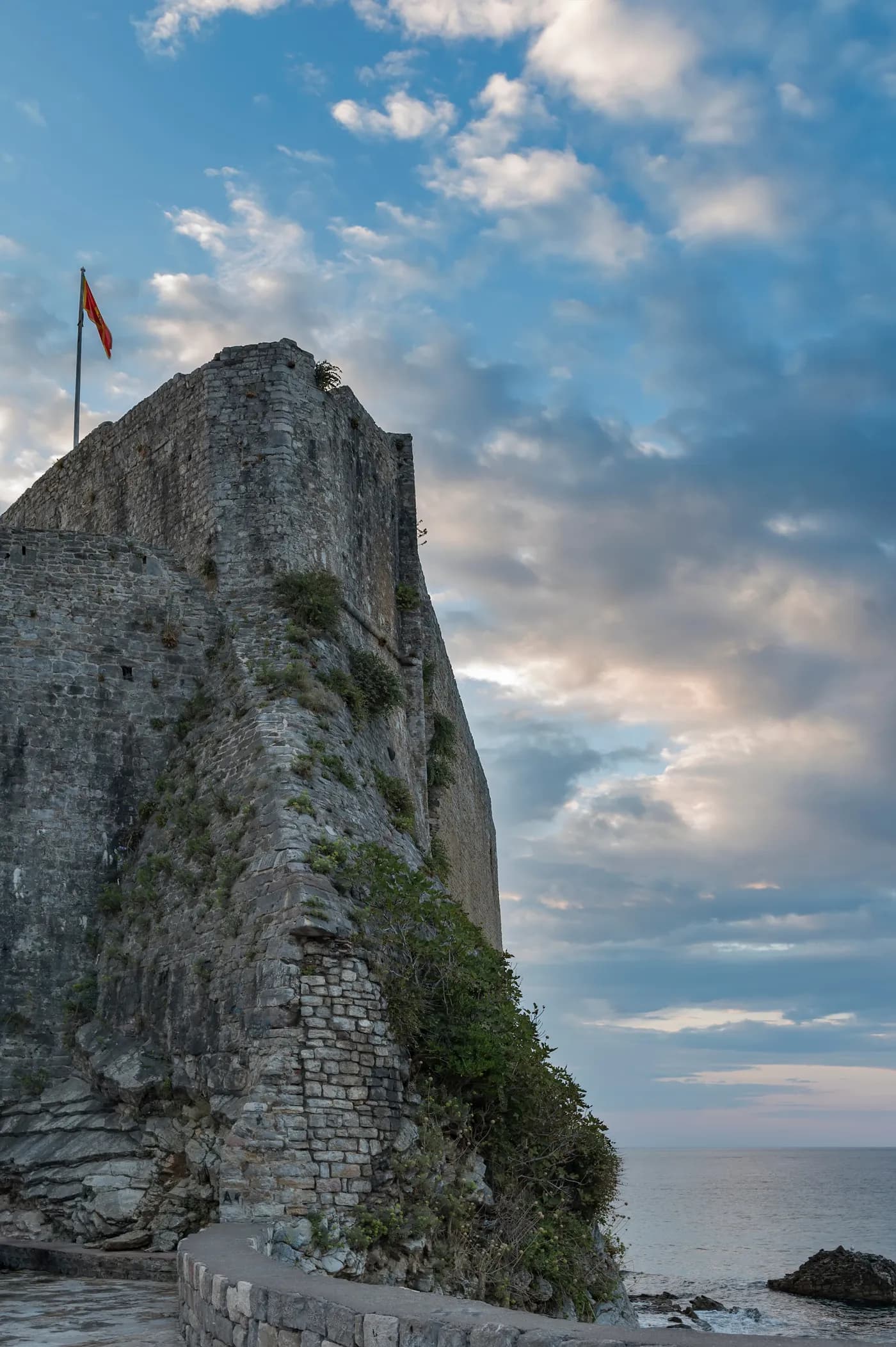
- The crown. The top of the seaward corner, with the flag on it. This is the point of the whole circuit — the corner an attacker arriving by sea would have to take first.
- The batter. The wall leans outward as it drops. That slope puts more stone exactly where a besieger's guns are aimed and makes a scaling ladder sit at a useless angle — the same answer Forte Mare and Španjola give, three hundred kilometres of coast apart.
- The spur at the foot. Neat, regular masonry at the base, against the rougher wall above it. The 15th-century fabric and the post-1979 repair are both here, and the joint between them is visible if you look for it.
- Built off the rock. The wall does not sit on the ground; it grows out of the bedrock of the little peninsula. There is no foundation course, because there did not need to be one.
- The sea it faced. Open water, and the island of Sveti Nikola off to the south. This is the direction the Ottoman galleys the citadel was built against would have come from.
15 April 1979
The same ninety seconds
On 15 April 1979 an earthquake of about magnitude 7 hit this coast. In Budva it severely damaged the fifteenth-century walls and ramparts protecting the Old Town, and the citadel with them.
This is the fourth time that date appears in this series, and it is worth putting the outcomes side by side. At Herceg Novi the Citadela overturned completely and was never rebuilt. Forte Mare and Kanli Kula were repaired, in ways heritage scholarship has since criticised. Kotor was listed by UNESCO and declared in danger in the same year, and took until 2003 to come off that list.
Budva got the best outcome of the four. With UNESCO's help the fortress and the walls were restored, and the work was finished by 1987 — eight years, and the circuit was whole again.
Four fortifications, one earthquake, four different afterlives.
15 April 1979, across the Montenegrin coast
Today
A library on a rampart
The citadel is open, ticketed and busy. Inside there is a small museum, a quiet library with antique books under glass, and a panoramic terrace looking across to the island of Sveti Nikola.
It is the most domesticated fortress in this series, and that is not a criticism. Of all the ways a fifteenth-century gun platform can end up — hotel, ruin, locked, underwater, cinema — a room full of old books on top of a sea wall is one of the better ones.
15th → today
The full timeline
Dated events only. Where sources disagree, the conflict is stated in the entry rather than resolved silently.
Venetian
15th century–179715th c.
The citadel is built
Under Venetian rule, to defend the town against Ottoman incursion. Also recorded as the Fortress of Saint Mary.
16th c.
Seven towers, on the record
Engravings now in the Budva museum describe thick hewn stone walls with seven towers around the perimeter.
1797
The Venetian Republic falls
Austria · Russia · France
1797–18141797–1814
The usual seventeen years
Austria, Russia and France in turn, as along the rest of this coast.
Austro-Hungarian
1814–191819th c.
Garrison use, then obsolescence
Yugoslav & Montenegrin
1918–today15 Apr 1979
The Montenegro earthquake
Magnitude about 7. The 15th-century walls and ramparts of the Old Town are severely damaged.
1987
Restoration complete
The fortress and walls are restored with UNESCO's help, eight years after the earthquake.
today
Museum, library, terrace
Open and ticketed, with a small museum, a library of antique books and a view to Sveti Nikola.
Corrections
What the internet gets wrong
These claims circulate widely online and do not survive checking. If you have read about Citadela elsewhere, you have probably met at least one of them.
Two Citadelas
This is not the Herceg Novi Citadela.
Both towns have one and they are routinely confused. Budva's is a 15th-century Venetian fortress on the corner of a walled town, restored by 1987. Herceg Novi's was destroyed in the same earthquake and never rebuilt.
Dates differ
“15th century”, not a year.
No precise construction date is on the record. The 16th-century engravings in the Budva museum describe the fortification as it then stood; they are evidence of the shape, not of the start.
Often omitted
What you walk on is largely post-1979.
The walls are genuinely medieval in origin and genuinely rebuilt after 1979. Both things are true, and the restoration is why there is anything to walk on.
Sources and image record
Dates and interpretations are tied to the archive and research sources below. Where they conflict, the conflict is named in the text rather than smoothed over.
- SpottingHistory — Budva Citadel
The 15th-century Venetian construction and the fortress's role in the circuit
- Medgulets — The Budva City Walls
The 16th-century engravings, the seven towers, the 1979 damage and the 1987 restoration
- UNESCO — Natural and Culturo-Historical Region of Kotor
Context for the 1979 earthquake response on this coast. Budva lies outside the inscribed property
- Antony McAulay — Budva citadel (Adobe Stock 177411451)
Licensed stock photograph · the seaward wall of the citadel
- Plan (archaeology) — the phasing convention
The colour-by-period phase plan this page’s visual system borrows