The story
The last one anywhere
There are hundreds of ruined forts around the Adriatic and most of them are interesting only locally. Fort Gorazda is not one of those. On its roof sits a Gruson armoured turret of about a hundred tonnes — and it is the last surviving example of its type in the world.
The fort was built between 1884 and 1886, replacing an earlier structure on the same ground, as one of the first of the new works the Austrians put around the Bay of Kotor in their late nineteenth-century programme. Kotor was a major naval base for the empire, and Gorazda existed to watch the water and to shoot at whatever came into it.
The turret is German. Gruson of Magdeburg made armour from chilled cast iron, which was so hard that shells shattered on it rather than penetrating, and shaped it into domes that presented no flat surface to hit. It carried the fort's main armament and turned a full 360 degrees.
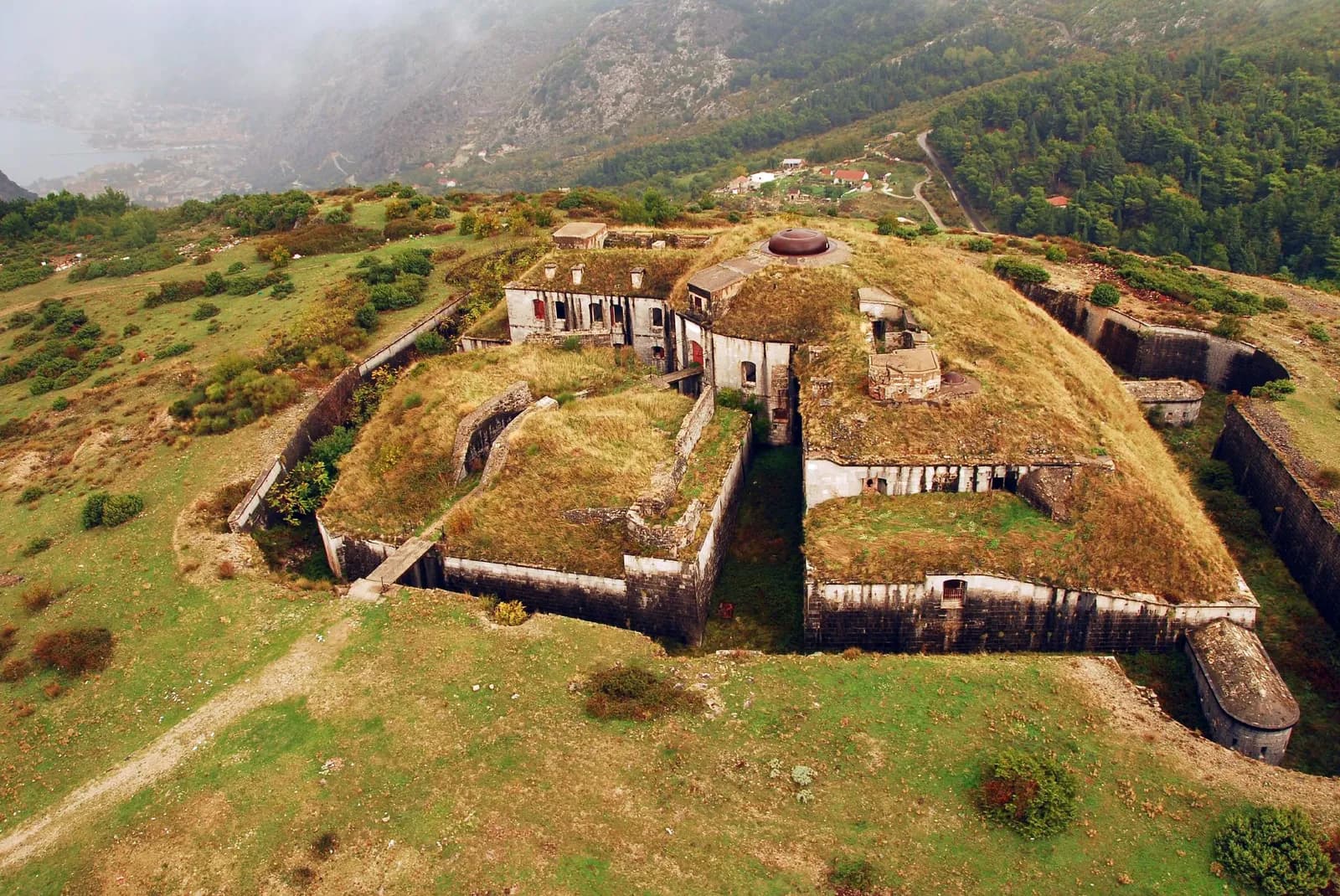
- The Gruson turret. The rust-red dome. About a hundred tonnes of chilled cast iron, rotating a full circle on a two-man crank, and the last surviving turret of its type in the world. It is the reason this fort matters beyond Montenegro.
- The barrack range. The one part of the fort that looks like a building. Everything else is deliberately shaped not to: rows of windows here, and vaults buried under earth everywhere else.
- The earth roof. Grass growing on top of bomb-proof vaults. From a gun's point of view the fort is a low hill with a dome on it, which is exactly what the designers were aiming for.
- The ditch and its caponiers. The angled stone walls running around the outside. The ditch is swept along its length from the projecting corners, so there is nowhere in it to shelter.
- What it was aimed at. The Bay of Kotor in the haze. Gorazda watched the water and, from 1914, duelled with Montenegrin batteries on Lovćen behind the camera.
1914 – 1916
Duelling with a mountain
In the First World War Gorazda was used in artillery duels against Montenegrin batteries on Mount Lovćen. The Montenegrins were unable to destroy it, and in 1916 an Austrian offensive pushed them out of range altogether.
That is the same story as Fort Vrmac along the ridge, and the same story, in reverse, as every earlier fortification in this series. Forte Mare and Španjola were built to stop men climbing a wall. Gorazda and Vrmac were built to survive a shell arriving from a mountain several kilometres away, fired by people the garrison would never see.
After the empire
Seventy years as a warehouse
The Yugoslav Army used Gorazda as a depot as recently as the early 1990s. Then it stopped, and the fort was abandoned. It is open now, and anyone can walk in.
The long depot years are probably why the turret is still on the roof. Armour was always the most valuable thing on any of these forts — Vrmac's four Škoda cupolas are long gone — but Gorazda spent the scrap-metal decades as an army store with a gate on it. A hundred tonnes of chilled iron is also a great deal of trouble to move off a mountain.
The result is that a small hill above Kotor holds a piece of nineteenth-century military technology that exists nowhere else, unfenced, unlit and unlabelled.
1884 → today
The full timeline
Dated events only. Where sources disagree, the conflict is stated in the entry rather than resolved silently.
Austro-Hungarian
1884–1918before 1884
An earlier structure on the site
1884–1886
The fort is built
One of the first of the new Austrian works around the Bay of Kotor. Bomb-proof vaulted casemates under an earth roof, with a dry ditch and caponiers.
1880s
The Gruson turret is installed
About 100 tonnes, German-made, rotating 360° on a two-man crank. The last surviving example of its type in the world.
1914–16
Artillery duels with Lovćen
The Montenegrins cannot destroy the fort and are pushed out of range by an Austrian offensive in 1916.
Yugoslav
1918–1991to the early 1990s
Used as an army depot
Which is very likely why the turret was never cut up for scrap.
Abandoned
1991–todaytoday
Abandoned and open
No fence, no ticket and no interpretation, on a hill above a UNESCO World Heritage town.
Corrections
What the internet gets wrong
These claims circulate widely online and do not survive checking. If you have read about Fort Gorazda elsewhere, you have probably met at least one of them.
Widely missed
The turret is not one of several.
It is the last surviving Gruson turret of its type anywhere. Descriptions that treat Gorazda as one more ruined Austrian fort are missing the only genuinely unique object in the Bay of Kotor's fortifications.
Not powered
It turned by hand.
A hundred tonnes rotated by two men on a crank. No engine, no hydraulics.
Check before you go
Unlit, unfenced, unsigned.
The fort is abandoned and freely accessible, with open interior spaces and no lighting. Treat it as a ruin.
Sources and image record
Dates and interpretations are tied to the archive and research sources below. Where they conflict, the conflict is named in the text rather than smoothed over.
- Wikipedia — Fort Gorazda
The 1884–86 construction, the Gruson turret as the last of its type, WWI and the depot years
- Military Wiki — Fort Gorazda
The turret's weight and manual operation; the fort's role in the Kotor naval base
- Wikimedia Commons — Fort Gorazda aerial view
wanus · CC BY-SA 2.0 · the annotated photograph
- Plan (archaeology) — the phasing convention
The colour-by-period phase plan this page’s visual system borrows