The story
Named after the side that lost
Španjola is the largest fortification above Herceg Novi, it took nine years to build, and it is named after people who were there for one of them.
In 1538 the Holy League fleet under Andrea Doria took Castelnuovo and left a Spanish garrison in it. Those men understood immediately what the Ottomans had understood before them: the town is not defensible from the waterline alone. Whoever holds the hill behind it holds the town. They began fortifying Bajer at once.
They had twelve months. In July 1539 Hayreddin Barbarossa arrived with an army that ended the Spanish presence in the Bay of Kotor permanently, and the garrison of Castelnuovo died more or less to a man. What they left on the hill was an unfinished circuit — and, because the local population went on calling it after them, a name.
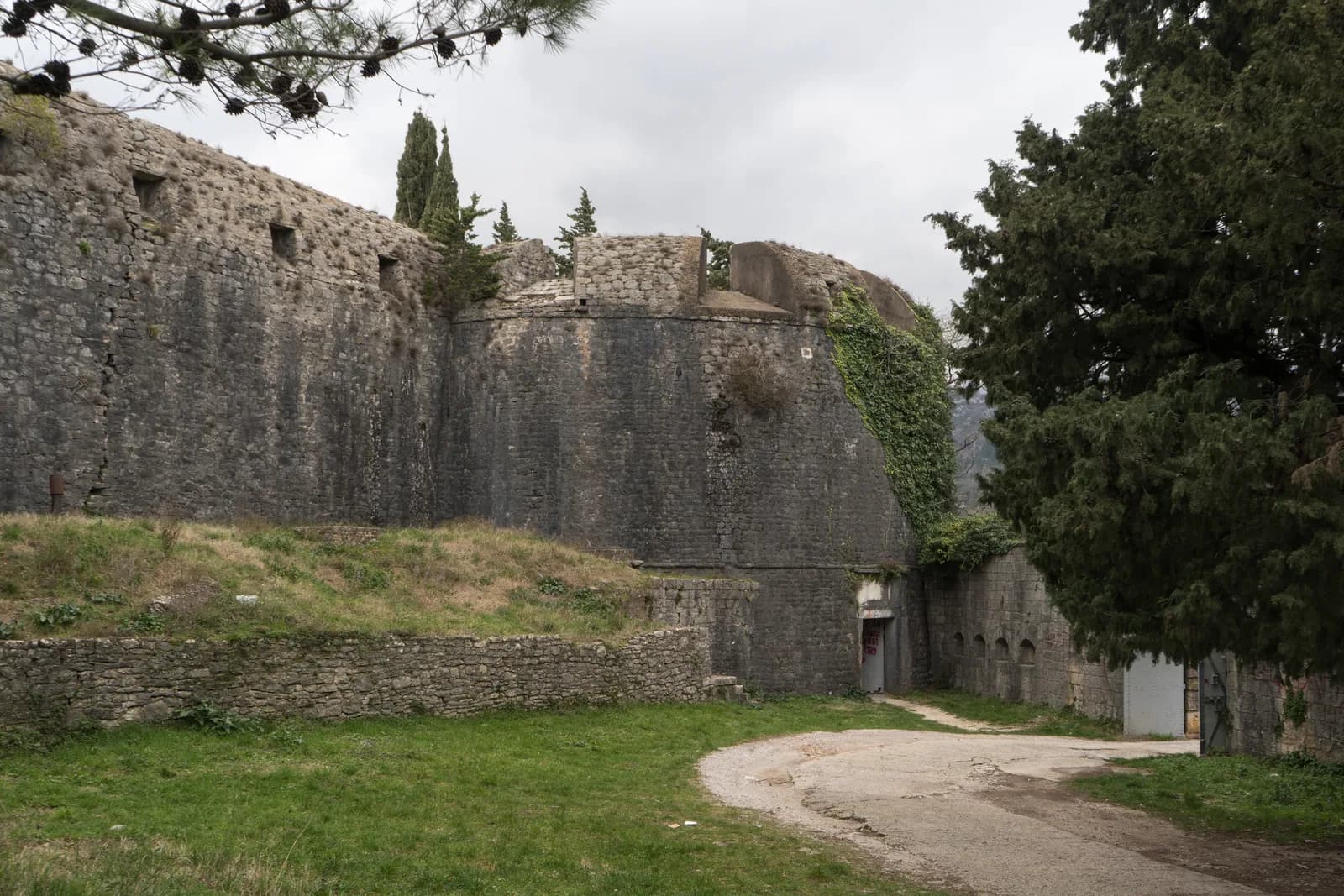
- One of the four bastions. A circular tower at the corner of the square circuit. There are four, one per corner — the shape that makes Španjola legible from the air and gives the plan drawing above its whole structure.
- Gun embrasures. The small rectangular slots stepping along the wall head are openings for guns, spaced to cover the ground below. They are the difference between a wall that stops a ladder and one that fights back.
- The battered curtain. The wall leans outward as it falls. That slope is anti-artillery design: it thickens the wall where the guns are aimed and deflects shot upward. The Spanish began this line in 1538; the Ottomans finished it.
- The way in. A small doorway at the base of the bastion, dwarfed by what it pierces. A fortress this size needs an entrance small enough to defend with a handful of people.
- Ivy, and the end of use. Nothing has been garrisoned here in a century. The ivy, the loose stone and the spray paint below are what an unroofed fortress looks like when it is left open and free to enter.
1539 – 1548
Nine years, four bastions
The Ottomans did not start again somewhere else. They built on the line the Spanish had traced, and kept building for nine years — from 1539 to 1548 — which is a very long time to spend on one fortress and tells you how much the hill mattered.
What they produced is a square circuit of massive walls with a circular bastion at each of the four corners. That geometry is not decorative. A round tower deflects shot that a square corner catches, and a bastion at each corner means every stretch of wall can be covered by fire from the towers on either side of it. Nothing can approach the wall without being shot at from two directions.
It has been described as the best-preserved Ottoman fortification on the Adriatic — a claim worth attributing rather than asserting, but not an unreasonable one when you are standing in front of it.
What came after
Venice took the town in 1687 and the hill with it. The Austro-Hungarians filled the courtyard with barrack blocks and used the shell as accommodation. Then the empires ran out, and so did the reasons to keep a fort on Bajer.
Today
The largest ruin above the town
Nobody has garrisoned Španjola in a hundred years. The curtain is breached in places, the courtyard is overgrown, the interior is roofless and the walls carry a good deal of spray paint. There is no ticket office and no opening time.
That is worth stating plainly rather than apologetically. Forte Mare is restored, ticketed and programmed; Kanli Kula seats a thousand people. Španjola is the one that was left alone, and it is the only place in Herceg Novi where you can put your hand on sixteenth-century military engineering that nobody has tidied.
The walk up is steep — the fortress sits at about 170 metres, above the Savina district — and the reward at the top is the entire entrance to the Bay of Kotor in a single view: Forte Mare below, the strait, Luštica opposite, and Mamula out at the mouth. Every fortification in this article can be seen from the roof of this one, which is the clearest possible statement of what the system was for.
1538 → today
The full timeline
Dated events only. Where sources disagree, the conflict is stated in the entry rather than resolved silently.
Spanish
1538–1539 · one year1538
The Holy League takes Castelnuovo
Andrea Doria’s fleet takes the town; a Spanish garrison stays. Sources differ on the month — the tourist board says June, the siege literature October.
1538–39
The Spanish begin fortifying Bajer hill
A circuit traced on the high ground behind the town. It gives the fortress its name and very little else.
Jul–Aug 1539
Barbarossa ends the Spanish year
The garrison of Castelnuovo is destroyed. Around 200 men survive out of 3,500–4,000.
Ottoman
1539–16871539–1548
The Ottomans build the fortress that stands today
Nine years of work on the Spanish footprint: massive walls, four circular corner bastions, gun embrasures along the curtain.
1608
Earthquake damages the city
Venetian
1687–179730 Sep 1687
Venice takes Herceg Novi, and the hill with it
1687 →
Repairs and a gate on the town side
Austria · Russia · France
1797–18141797–1814
Four flags in seventeen years
Venice falls; Austria, Russia and France follow in turn; Montenegrin and Bokelj forces hold the town briefly in 1813–14.
Austro-Hungarian
1814–191819th c.
Barrack blocks in the courtyard
The shell is used as accommodation; the walls matter less than the roofs inside them.
1918
Habsburg rule ends
Yugoslav & Montenegrin
1918–today20th c.
Abandonment
The fortress loses its last military function and is not converted to anything else.
today
Open, unticketed, unrestored
A roofless ruin at about 170 m with the best single view of the fortress system it belonged to.
Corrections
What the internet gets wrong
These claims circulate widely online and do not survive checking. If you have read about Španjola elsewhere, you have probably met at least one of them.
Widely repeated
The Spanish did not build Španjola.
They began a circuit in 1538 and were destroyed in 1539. The fortress standing on the hill is Ottoman work of 1539–1548, built on the Spanish line. The name records who started it, not who built it.
Dates differ
June or October 1538.
Herceg Novi’s tourist board says Doria’s fleet arrived in June 1538; the siege literature dates the capture to October. The one-year span before Barbarossa returned is not in dispute.
Attribute
“The best-preserved Ottoman fortification on the Adriatic.”
A claim made by Herceg Novi’s own sources and repeated widely. Plausible, and not independently established — worth citing as their assessment.
Check before you go
There is no ticket, and no handrail.
Španjola is an unrestored ruin, open and free. The climb is steep and the interior is uneven, unlit and unfenced. Treat it as a ruin, not a monument with a visitor centre.
Sources and image record
Dates and interpretations are tied to the archive and research sources below. Where they conflict, the conflict is named in the text rather than smoothed over.
- Opština Herceg Novi — Znamenitosti
The municipal inventory of the fortress system, with dates and functions
- Opština Herceg Novi — The history
Sovereignty timeline; 1979 earthquake damage across the fortresses
- Urbs incognita: Stari grad Herceg-Novi
Masonry survey and phasing; the 1493 / 1508 / 1551 campaigns; critique of the post-1979 restoration
- Wikipedia — Siege of Castelnuovo
The 1538–39 Spanish year in detail: forces, dates, terms, casualties
- Wikipedia — Herceg Novi
Precise sovereignty dates 1798–1918; the 1608 earthquake
- JUK Herceg Fest — Festivals
Programming at Kanli Kula and Forte Mare; the festival lineage from 1987
- Plan (archaeology) — the phasing convention
The colour-by-period phase plan this page’s visual system borrows
- Herceg Novi Tourist Organisation — Španjola
The 1538 Spanish start, the 1539–48 Ottoman construction, the four circular bastions
- Wikimedia Commons — Fortress Spanjola, 2024
Alexkom000 · CC BY 4.0 · the annotated photograph