The story
It is a door before it is a clock
Everyone photographs the Sahat kula for the clock, which it did not originally have, and almost nobody notices that they are standing in front of a fortified gate — the only way into a walled town, sixteen metres of Ottoman masonry with a hole cut through the bottom.
It went up in 1667, and carries an Arabic inscription recording that it was raised by order of the sultan by one Mustafa Aga, described as a servant in the sultan’s mosque. It was not built on an empty site: local accounts place it on an older medieval gate of Tvrtko I’s town, the same foundation that produced Forte Mare. The Ottomans replaced the door, not the idea of one.
For the rest of Ottoman rule this was the main city gate. A mosque stood beside it. Clock faces on several sides marked the times of the daily prayers — which is how a gatehouse ends up named after its timepiece.
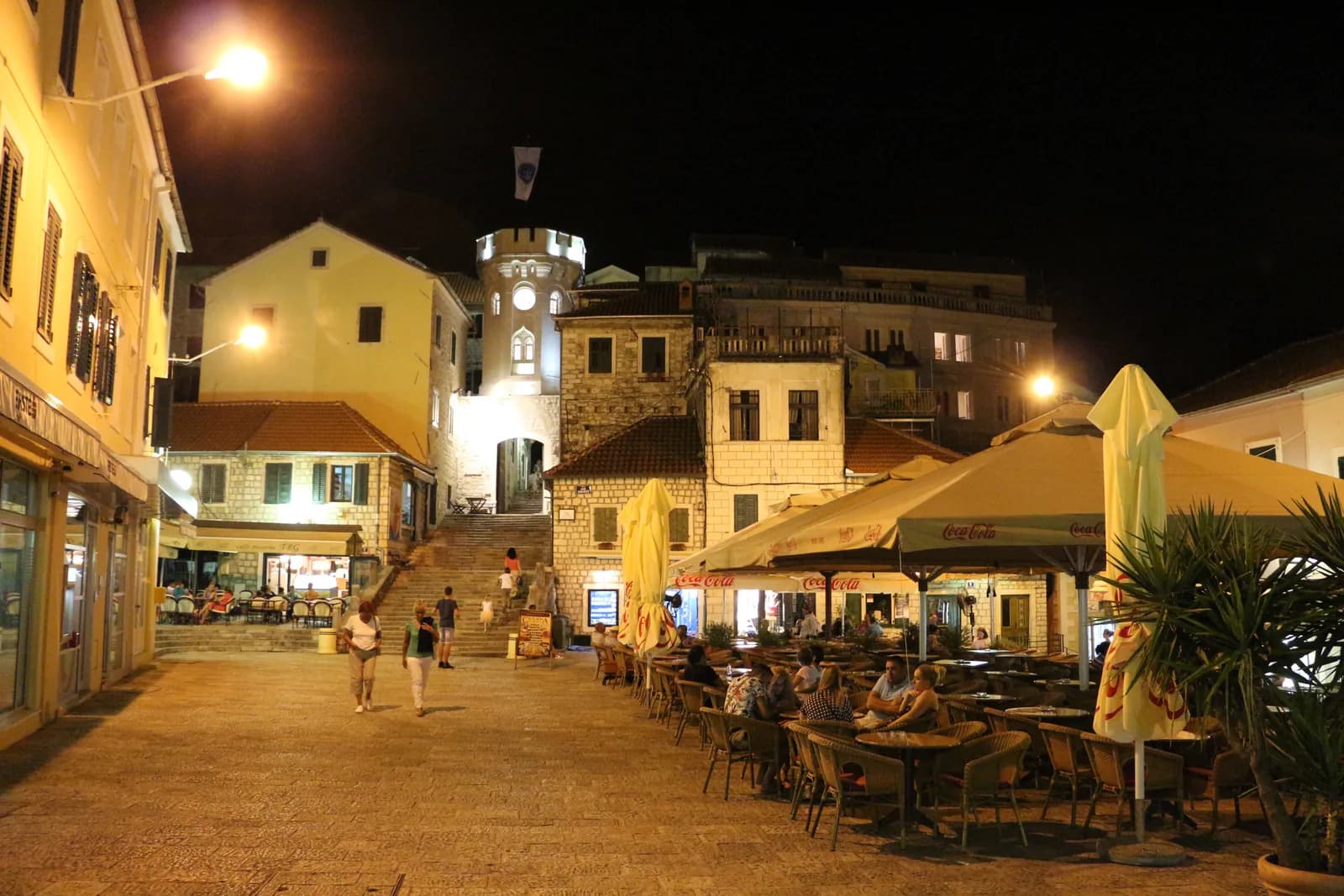
- The crenellated top. Sixteen metres up. The merlons are a fortification detail on what is, by function, a doorway — this was the main gate of a walled town, and it was built to look like it.
- The clock face. Mechanical faces were fitted on several sides. Under Ottoman rule they marked the times of prayer; the movement behind this one has been electric since 1995.
- The passage through the base. The dark arch is the point. Everything entering the Old Town came through here, and still does. The Black Madonna relief is kept inside the tower above it.
- The steps. Herceg Novi is built on a slope, and the gate sits at the top of a stair. An attacker coming up these steps arrives out of breath, below the defenders, and one at a time.
- The square below. What was the approach to a fortified gate is now the town’s main café terrace. The tower is on the coat of arms and the flag; it is the building Herceg Novi uses to mean itself.
Two problems
The dates that cannot both be right
This building comes with two stories that are repeated everywhere in Herceg Novi, and both of them have a chronological hole in the middle. Neither is a reason to disbelieve the objects — the inscription is on the tower and the bell is in it — but they are a good reason to be careful about the labels.
Which sultan?
Local sources render the inscription as recording the tower’s construction in 1667 by order of Sultan Mahmud. The sultan reigning in 1667 was Mehmed IV, who held the throne from 1648 to 1687. The first Ottoman sultan named Mahmud came to power in 1730, sixty-three years after the date carved on the building. One of the two — the name or the year — is not being read correctly.
Which empress?
The bell is dated 1753 and is attributed to the Russian empress Catherine II. Catherine did not become empress until 9 July 1762. In 1753 she was Grand Duchess Catherine Alekseyevna, the wife of the heir, with no throne and no obvious reason to be sending bells to a Venetian town on the Adriatic.
There are ordinary explanations for both — a bell cast in 1753 could easily have been given later, and inscriptions get miscopied and mistranslated across three centuries and two alphabets. What there is not, at least in the sources available here, is a resolution. So the objects are real, the dates are on them, and the attributions should be quoted rather than asserted.
1667 → today
The full timeline
Dated events only. Where sources disagree, the conflict is stated in the entry rather than resolved silently.
Ottoman
1667–1687before 1667
A medieval gate on the site
Local accounts place the tower on an earlier town gate from the time of Tvrtko I.
1667
The tower is built
Sixteen metres high, with an Arabic inscription recording its commissioning by Mustafa Aga on the sultan’s order. It serves as the main city gate; a mosque stands beside it.
30 Sep 1687
Venice takes the town
Twenty years after the gate is finished.
The bell
17531753
The bell
A bell dated 1753, attributed locally to Catherine the Great — who did not become empress until 1762. It hangs in the tower to this day.
Austro-Hungarian
1814–191819th c.
The clock becomes the identity
Mechanical faces on several sides. The building is known by its clock rather than its gate.
Yugoslav & Montenegrin
1918–today1995
An electric movement
The original clock, which had run for generations, is replaced.
today
On the coat of arms and the flag
The tower is the symbol Herceg Novi uses for itself, and still the way into the Old Town.
Corrections
What the internet gets wrong
These claims circulate widely online and do not survive checking. If you have read about Sahat kula elsewhere, you have probably met at least one of them.
Chronology
“Built in 1667 by order of Sultan Mahmud.”
The sultan reigning in 1667 was Mehmed IV (1648–1687). The first Sultan Mahmud took the throne in 1730. Either the year or the name in the inscription is being misread — quote the inscription, don’t assert the attribution.
Chronology
“A bell given by Catherine the Great in 1753.”
Catherine II became empress on 9 July 1762. In 1753 she was Grand Duchess. The bell and its date are real; the donor attribution as usually stated cannot be.
Often missed
It is a gate, not a monument.
The Sahat kula is the entrance to the Old Town and still functions as one. Guides routinely describe it as a clock tower and skip what it was built to do.
Sources and image record
Dates and interpretations are tied to the archive and research sources below. Where they conflict, the conflict is named in the text rather than smoothed over.
- Opština Herceg Novi — Znamenitosti
The municipal inventory of the fortress system, with dates, dimensions and functions
- Opština Herceg Novi — The history
Sovereignty timeline; 1979 earthquake damage across the fortresses
- Plan (archaeology) — the phasing convention
The colour-by-period phase plan this page’s visual system borrows
- Herceg Novi — Sat kula
16 m height, the 1667 date, the gate function, the 1753 bell, the Mother of God figure, the 1995 clock
- Wikipedia — Mehmed IV
Reigned 1648–1687 — the sultan on the throne in 1667
- Wikipedia — Catherine the Great
Empress from 9 July 1762 — nine years after the date on the bell
- Wikimedia Commons — Torre dell’orologio, 1667
Sailko · CC BY 3.0 · the annotated photograph