The story
Four centuries, one hill
Tajno brdo — Secret Hill — is not on the municipality’s list of fortresses, and it is the most heavily fortified thing in this series. It is not a building. It is a hill that four different powers dug into, and the only site here whose most important structures are underground.
It starts as ground rather than architecture. On 15 September 1687, while Venice was besieging Herceg Novi, an Ottoman relief army under the vizier Husein Topal-pasha came down toward the town and was ambushed at Kotobil by Venetian, Perastian, Herzegovinian and Montenegrin forces. Over three hundred Ottoman soldiers were killed and twelve standards taken. Two weeks later Herceg Novi fell, and two centuries of Ottoman rule ended.
In the nineteenth century Austria-Hungary put a battery position on the summit — defensive walls, cannon positions, wire obstacles — one of four covering the approach to Herceg Novi from Crkvica. Mamula and Arza closed the sea; this closed the land. And then they dug tunnels into the hill beneath the guns, which is where the name stops being decorative.
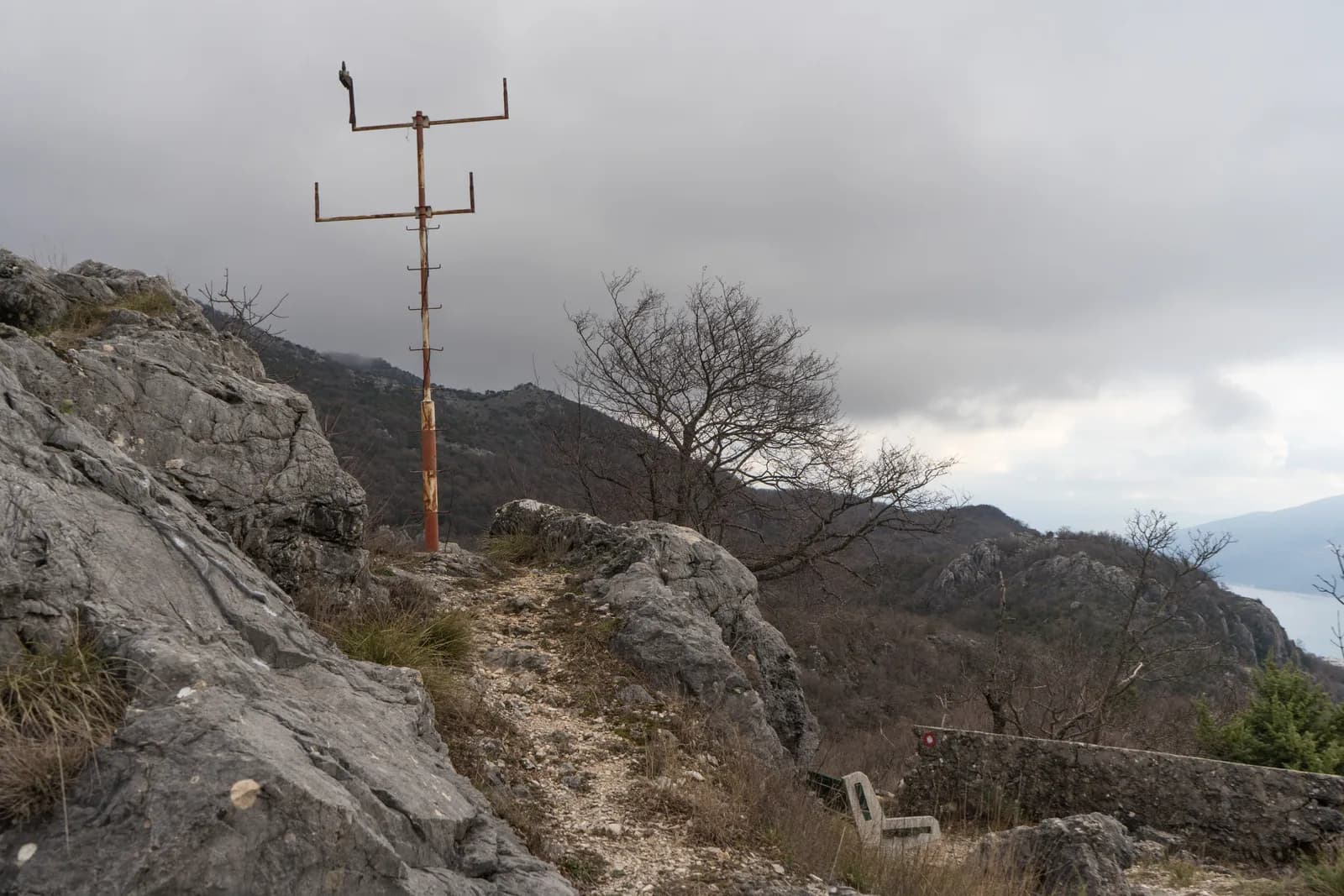
- The battery works. Defensive walls and cannon positions of the Austro-Hungarian battery — one of four positions covering the inland approach to Herceg Novi from Crkvica.
- Cut into the hill. The works go down as well as up. Tunnels were driven into the rock beneath the summit, and a large concrete shelter was added underground in the Yugoslav period.
- Left open. The site is abandoned and freely accessible, protected as a cultural monument since 1961 and revalued in 2013 for national heritage status. There is no fence, no lighting and no supervision.
- The view that mattered. At about 490 metres the hill sees the whole approach to Herceg Novi. That is why an Ottoman relief army was ambushed below it in 1687 and why an empire put guns on it two centuries later.
1941 – 1944
The road from the island ends here
Between 1941 and 1944 prisoners from the Mamula and Prevlaka concentration camps were brought up to this hill and executed. A memorial plaque marks it.
It is worth stating the connection plainly, because the two places are usually described separately. Mamula is an island with a hotel on it and a recorded death toll of 130. Tajno brdo is an overgrown hill above a village with a plaque on it. Some of the people counted in the first number were killed in the second place. The camp and the execution ground are one system, about eleven kilometres apart.
That is also the reason this hill belongs in a series about fortifications rather than in a separate article about the war. Every other site here was built to keep an enemy out of the town. This one was used, for three years, on people who were already prisoners.
After 1945
Digging against a different weapon
The last layer is socialist. In the Yugoslav period a monumental reinforced-concrete shelter was built underground on Tajno brdo, connected into the older Austro-Hungarian tunnel system.
The sequence is worth reading in order. The hill was fought over because it commanded the approach; then fortified against ships and armies; then used as a killing ground; then hollowed out against the bomb. Four different ideas of what a threat looks like, cut into the same 490 metres of limestone.
Nothing on the summit is signposted, and the underground works are unlit and unsafe. What the hill offers instead is the clearest view in the municipality of the thing this whole series is about: the entrance to the bay, the town below it, and every reason anyone ever had to fortify either.
1687 → today
The full timeline
Dated events only. Where sources disagree, the conflict is stated in the entry rather than resolved silently.
Venetian & allies
1687–179715 Sep 1687
The Battle of Kotobil
Venetian, Perastian, Herzegovinian and Montenegrin forces ambush the Ottoman relief army of vizier Husein Topal-pasha below the hill. Over 300 Ottoman dead; 12 standards taken.
30 Sep 1687
Herceg Novi falls to Venice
Two weeks after the ambush. Some accounts date the town’s liberation to 1688; the documented capitulation is 30 September 1687.
Austro-Hungarian
1814–191819th c.
A battery position on the summit
Defensive walls, cannon positions and wire obstacles — one of four positions covering the Crkvica–Herceg Novi approach.
19th c.
Tunnels driven into the hill
Occupation
1941–19441941–44
Executions on the hill
Prisoners from the Mamula and Prevlaka camps are brought here and killed. A memorial plaque marks the site.
Yugoslav & Montenegrin
1944–today1961
Protected as a cultural monument
Under the name Tajni vrh – Kameno.
Yugoslav era
A monumental underground shelter
Reinforced concrete, cut beneath the hill and joined to the older Austro-Hungarian tunnels.
2013
Revalued for national heritage status
today
Abandoned and open
No fence, no lighting, no supervision. The underground works are unsafe.
Corrections
What the internet gets wrong
These claims circulate widely online and do not survive checking. If you have read about Tajno brdo elsewhere, you have probably met at least one of them.
Widely repeated
“Herceg Novi was liberated in 1688.”
The town capitulated to Venice on 30 September 1687, two weeks after the ambush at Kotobil. The 1688 date appears in some accounts of the battle and does not match the siege record.
Often omitted
This hill was an execution site.
Between 1941 and 1944 prisoners from the Mamula and Prevlaka camps were killed here. Descriptions that present Tajno brdo purely as a scenic viewpoint with old tunnels leave out what the plaque is for.
Check before you go
The underground works are unlit and unsafe.
The site is protected but abandoned: no fence, no lighting, no supervision. The tunnels and shelter are not a visitor attraction.
Sources and image record
Dates and interpretations are tied to the archive and research sources below. Where they conflict, the conflict is named in the text rather than smoothed over.
- Opština Herceg Novi — Znamenitosti
The municipal inventory of the fortress system, with dates, dimensions and functions
- Opština Herceg Novi — The history
Sovereignty timeline; 1979 earthquake damage across the fortresses
- Plan (archaeology) — the phasing convention
The colour-by-period phase plan this page’s visual system borrows
- Tajne Tajnog brda
Protected status from 1961; the Austro-Hungarian battery; the Battle of Kotobil; the 1941–44 executions
- Monumentalno podzemno sklonište iz doba SFRJ
The Yugoslav-era underground shelter and the Austro-Hungarian tunnels
- Wikimedia Commons — Tajno Brdo fortress
Alexkom000 · CC BY 4.0 · the annotated photograph