The story
Not a fort with a town — a town that was a fort
Everything else in this series is a building. Stari Bar is a city: four and a half hectares of walled town on a hillside, with the circuit running up to a fortress at the summit, and at its peak some two hundred and forty structures inside it — houses, churches, mosques, palaces, bathhouses, shops.
It sits four kilometres inland under Rumija, which tells you it was never about the sea. The Venetians returned in 1443 and held it until 1571, when the Ottomans took it; the town then spent three centuries as an Ottoman provincial centre and reached its greatest extent.
Water came in from outside, along an aqueduct. A sixteenth-century Ottoman aqueduct still stands just beyond the walls. Remember it.
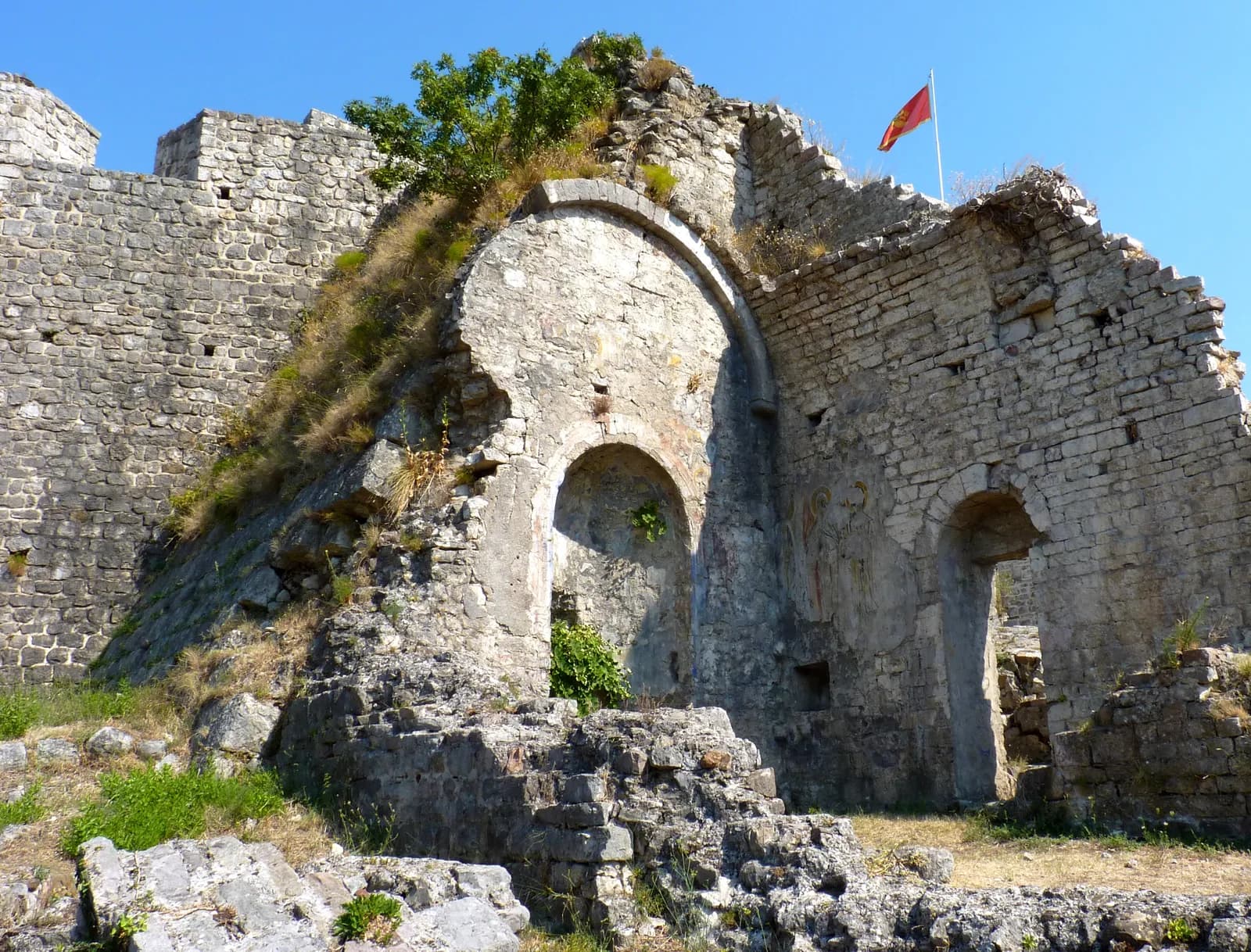
- Roofless, all of it. Not one building in the walled town has a roof. Around 240 structures stood here at the peak — houses, churches, mosques, palaces, bathhouses, shops — and every one of them is open to the sky.
- The slope. The town climbs. The circuit runs around a hillside and up it to a fortress at the summit, which is why the ruins are stacked in terraces rather than laid out flat.
- Standing to waist height. What survives is mostly the lower courses — enough to read the street plan of a whole medieval and Ottoman town, which is precisely why the site matters archaeologically.
- The flag over an empty town. Nobody has lived inside these walls for over a century. The flag is the only thing here that is maintained.
- Rumija behind. The mountain the town sat under, four kilometres inland from the sea. Old Bar was never a port; the harbour town on the coast is a separate, much later place.
January 1878
Four days, and a water supply
In 1878, during the Montenegrin war of independence, Montenegrin forces besieged and bombarded Bar. The walls held. What did not hold was the water.
On 5 January 1878 the besiegers detonated 225 kilograms of explosive inside the Bar aqueduct, cutting off the town's supply. Ibrahim Bey surrendered on 9 January. The siege of a town that had stood for the better part of a thousand years was decided in four days by an engineering problem outside its walls.
After the surrender much of the population — by then predominantly Albanian and Turkish — fled or was expelled. The town was looted and largely abandoned. That is the end of the story: not a battle, but a departure.
Since 1878
The one that was never reoccupied
Kotor was rebuilt. Budva was rebuilt. Herceg Novi was repaired. Nobody has lived inside the walls of Stari Bar for over a hundred years.
A new Bar grew up on the coast four kilometres away and became the country's main port, and the old town was simply left where it was. The result is the thing that makes the site extraordinary: an entire fortified town, of every period from antiquity to the nineteenth century, with nothing built on top of it since.
There is one more detail worth knowing, and it connects Stari Bar to almost every other article in this series. The Montenegro earthquake of 15 April 1979 — the shock that destroyed the Citadela at Herceg Novi, cracked Kanli Kula, damaged Kotor into a UNESCO danger listing and levelled the walls of Budva — had its epicentre about six kilometres east of here. The place that had already been abandoned for a century was the place the whole thing started.
to 1 → today
The full timeline
Dated events only. Where sources disagree, the conflict is stated in the entry rather than resolved silently.
Early occupation
to 1443antiquity onward
A layered site
Fortifications, palaces, religious buildings and infrastructure from antiquity to the 19th century, over 4.5 hectares.
Venetian
1443–15711443
The Venetians return
They hold Bar for the next 128 years.
Ottoman
1571–18781571
The Ottomans take the town
16th c.
The aqueduct
An Ottoman aqueduct brings water in from outside the walls. It still stands.
peak
About 240 structures inside the walls
Houses, churches, mosques, palaces, bathhouses, shops and public buildings, packed inside a circuit climbing to a fortress at the summit.
Montenegrin
1878–today5 Jan 1878
The aqueduct is blown up
Montenegrin forces detonate 225 kg of explosive inside it, cutting off the town's water.
9 Jan 1878
Ibrahim Bey surrenders
Four days later. The population, predominantly Albanian and Turkish, flees or is expelled; the town is looted.
since
Never reoccupied
A new Bar grows on the coast. Nobody has lived inside the old walls for over a century.
15 Apr 1979
The earthquake starts here
The epicentre of the Montenegro earthquake lay about 6 km east of Stari Bar.
Corrections
What the internet gets wrong
These claims circulate widely online and do not survive checking. If you have read about Stari Bar elsewhere, you have probably met at least one of them.
Two Bars
Stari Bar is not the port.
The walled town is four kilometres inland under Rumija and has been empty since 1878. The modern city and Montenegro's main port is a separate place on the coast.
Attribute
“The largest medieval site in the Balkans.”
Widely stated and plausible given the 4.5 hectares, but it is a claim rather than an established ranking. Cite it as the claim it is.
Widely missed
The siege was won on the water, not the walls.
The decisive act of January 1878 was destroying the aqueduct outside the town, not breaching the fortifications. The surrender came four days later.
Sources and image record
Dates and interpretations are tied to the archive and research sources below. Where they conflict, the conflict is named in the text rather than smoothed over.
- Wikipedia — Stari Bar
The Venetian and Ottoman periods, the 1878 siege, the aqueduct charge and the abandonment
- MonteGuide — Old Bar
The scale of the site, the 240 structures and the climb to the citadel
- Wikipedia — 1979 Montenegro earthquake
Magnitude 6.9, 15 April 1979, epicentre about 6 km east of Stari Bar
- Wikimedia Commons — Ruins with flag in Stari Bar
Dudva · CC BY-SA 3.0 · the annotated photograph
- Plan (archaeology) — the phasing convention
The colour-by-period phase plan this page’s visual system borrows