The story
A geometry problem in concrete
Forte Mare answers a bay mouth. Španjola answers a hill. Fort Vrmac answers a different question entirely: how do you build something that a modern rifled gun cannot destroy?
The answer, in the 1890s, was to stop building tall. Vrmac sits at 480 metres on the ridge that divides the Bay of Kotor into two almost equal halves, and it is low, wide and buried — reinforced stone and concrete, two levels, an irregular pentagon ringed by a ditch. There is no keep, no crenellation and nothing to knock down. The Austrians called this the Vogl period, and the whole point of it was to present as little as possible.
The site had been fortified from 1860; the fort standing today was rebuilt and enlarged between 1894 and 1897. Its armament was the modern part: four rotating steel cupolas by the Škoda works at Plzeň, each with a 10 cm gun, eight 15 cm howitzers in casemates, and twelve machine-gun mounts on the roof. Five officers and 177 men lived inside.
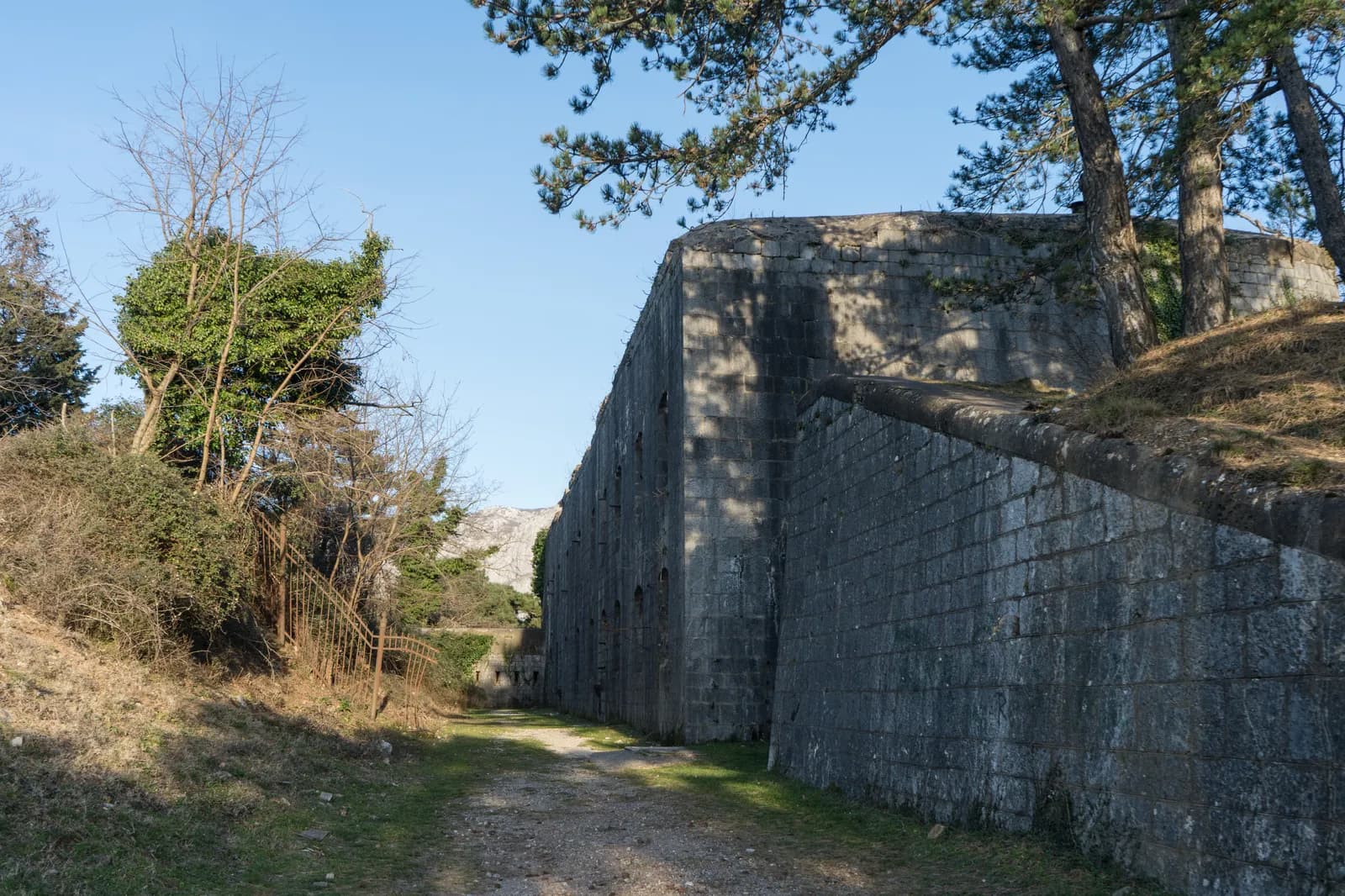
- The front. Reinforced stone and concrete, in the pattern the Austrians used through the 1890s. The openings along it are casemates for the 15 cm howitzers, not windows.
- Where the cupolas sat. Four rotating Škoda turrets stood on the roof, each with a 10 cm gun. Their armour was worth more than the building under it, which is why so few survive anywhere.
- The ditch. A defensive ditch runs the whole way round the pentagon, swept from caponiers at its corners. An attacker who reaches the wall has to get into the ditch first, and the ditch is covered by fire along its length.
- The direction the shells came from. Montenegrin batteries on the high ground to the west shelled this fort for two years with guns up to 24 cm. The garrison could not reach them until the Austrians took Lovćen in 1916.
- Left open. No fence, no ticket, no lighting. Vrmac is one of the most complete Austro-Hungarian forts on this coast and one of the least managed.
1914 – 1916
Shelled by an army it could not reach
In the First World War the fort did exactly what it was designed to do, which was to be hit and keep working.
Montenegrin batteries on the high ground to the west bombarded Vrmac with guns of up to 24 cm calibre. The fort was heavily damaged. Its garrison could not silence the guns shelling it, because those guns were on a mountain the Austrians did not hold.
That changed in the spring of 1916, when the Austrians took Lovćen and pushed the Montenegrin artillery out of range. The damage was then fully repaired — which is a quiet way of saying that two years of bombardment by the heaviest guns available did not take the fort out of service permanently.
The fortress was heavily damaged, and after the Montenegrins were driven out of range the damage was fully repaired.
The First World War at Fort Vrmac, in one sentence
After 1918
Obsolete on completion
The empire that built Vrmac lasted twenty-one years after the fort was finished. That is the recurring joke of late fortification everywhere in Europe: the more sophisticated and expensive the work, the shorter the window in which it mattered.
The cupolas are long gone — armour of that quality was always worth more as scrap than the building was as a building. What is left is the concrete: the pentagon, the ditch, the casemates and the empty turret wells, on an open ridge with no fence and no ticket.
It is one of the most complete Austro-Hungarian forts on this coast, and one of the least managed. Read it next to Mamula, forty years older and now a hotel, and you have the whole range of what happens to military architecture when the war it was built for never quite arrives.
1860 → today
The full timeline
Dated events only. Where sources disagree, the conflict is stated in the entry rather than resolved silently.
Austro-Hungarian
1860–19181860
The ridge is fortified
A first work on the southern end of the Vrmac ridge, in the early Austrian programme around the bay.
1894–1897
Rebuilt as an armoured fort
Reinforced stone and concrete, irregular pentagon on two levels, surrounded by a ditch. Four Škoda cupolas with 10 cm PH M05 guns; eight 15 cm MinSchKan M 80/85 howitzers in casemates; twelve machine-gun mounts.
1914–16
Bombarded from Montenegrin territory
By guns up to 24 cm calibre. Garrison of 5 officers and 177 men. The fort is heavily damaged.
spring 1916
Lovćen falls, and the shelling stops
The Austrians drive the Montenegrin artillery out of range and the damage is fully repaired.
Yugoslav
1918–19911918
The empire ends
The fort passes to the new Yugoslav state along with the rest of the bay's defences.
Montenegrin
1991–todaytoday
Open, unlit, unmanaged
One of the most complete Austro-Hungarian forts on the coast. The cupolas are gone; the concrete is not.
Corrections
What the internet gets wrong
These claims circulate widely online and do not survive checking. If you have read about Fort Vrmac elsewhere, you have probably met at least one of them.
Two forts
Vrmac is not Fort Trojica.
There is more than one Austrian work on the heights around Kotor and photographs get swapped. Vrmac is the pentagon on the ridge between Kotor and Tivat, at about 480 m.
Dates differ
1860, or 1894–97.
Both are correct and they mean different things: the site was first fortified in 1860, and the fort standing today was rebuilt and enlarged in 1894–97.
Check before you go
It is an unlit ruin.
No fence, no signage, no lighting, and open shafts where the turrets stood. Take a torch and watch your feet.
Sources and image record
Dates and interpretations are tied to the archive and research sources below. Where they conflict, the conflict is named in the text rather than smoothed over.
- Wikipedia — Fort Vrmac
Establishment in 1860, the 1894–97 rebuild, the armament, the garrison and the WWI bombardment
- Fort-Net — Vrmac Fortress
The fort in the European context of armoured fortification
- Wikimedia Commons — Fort Vrmac, 2024
Alexkom000 · CC BY 4.0 · the annotated photograph
- Plan (archaeology) — the phasing convention
The colour-by-period phase plan this page’s visual system borrows