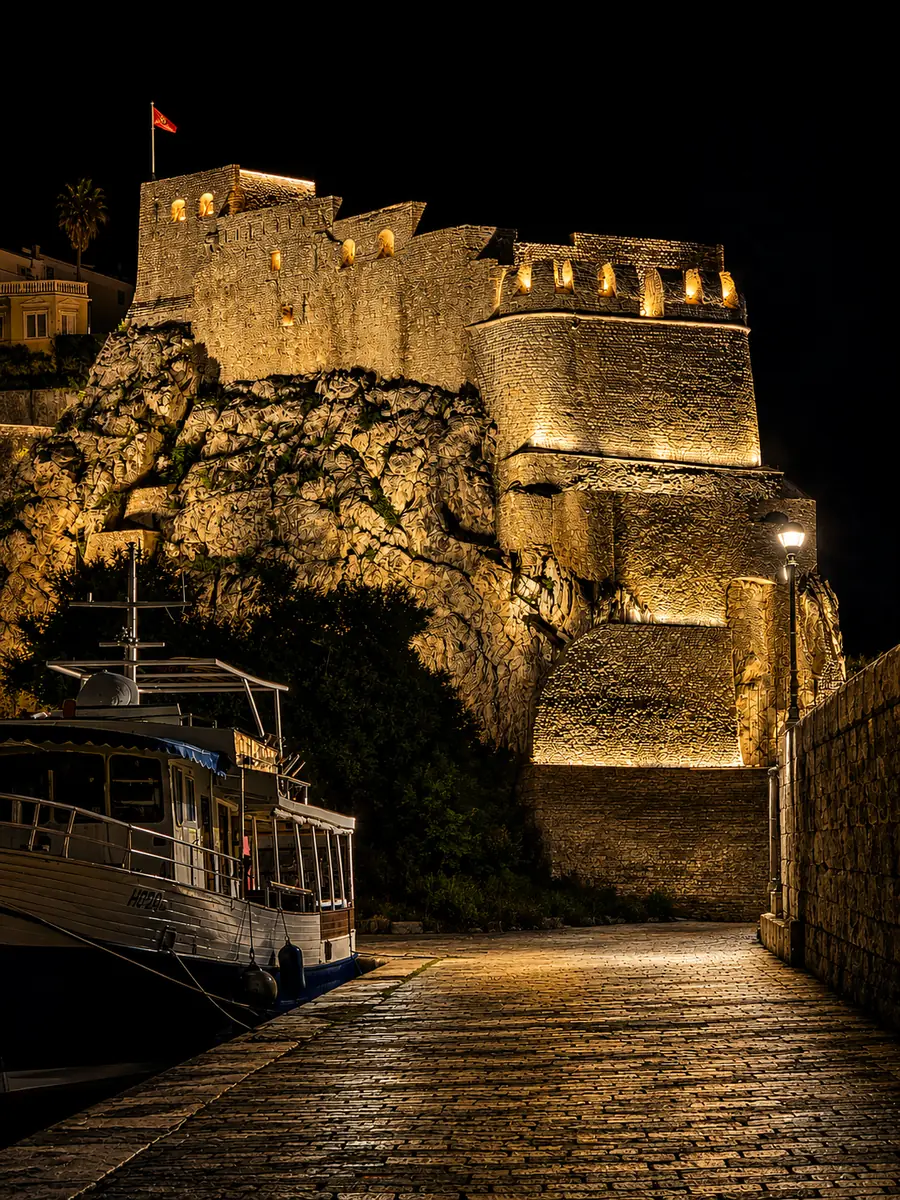
The story
A fortress built for salt
In 1382 Tvrtko I Kotromanić, King of Bosnia, founded a fortified settlement at the mouth of the Bay of Kotor and dedicated it to Saint Stephen. Nobody used that name for long. In the records it is simply Novi — the new one — and in Latin and Italian hands Castrum Novum, Castelnuovo.
The motive was commercial before it was military. Tvrtko wanted a saltworks and a salt harbour outside the grip that Dubrovnik and Kotor held on the trade. A king who intends to move salt past two hostile republics needs a gun platform at the water’s edge — and that platform is the origin of Forte Mare. The fortress and the town were one project from the first day, which is why the fortress is older than almost everything around it, including the city’s own name.
That name arrived sixty-seven years later. In 1448 the regional magnate Stjepan Vukčić Kosača took the title herceg, upgrading it a year later to Herceg of Saint Sava after the saint buried in his lands. Novi became a Kosača winter residence, and eventually the duke’s title was welded onto the town: Herceg Novi. His son Vlatko inherited in 1466 and held on until the Ottoman army arrived.
The strong tower
Ottoman forces took Novi in 1481–82 and held it, with one violent interruption, for a little over two centuries. The fortress changed language along with its owner: Jaka kula and Kula Abaspaše. This is the period that did the heavy building. Archival work on the Old Town records fortification campaigns in 1493–94 and 1508, and a further expansion around 1551 that added fortress belts with artillery platforms — walls thick enough to stand a cannon on, which is a different engineering problem from walls built to stop a ladder.
The consequence is worth stating plainly, because most descriptions of Forte Mare skate past it. When you photograph this fortress you are mostly photographing Ottoman military engineering wearing a nineteenth-century Austrian hat. Its bulk, its wall height, its crenellated crown and its gun ports are all Ottoman work.
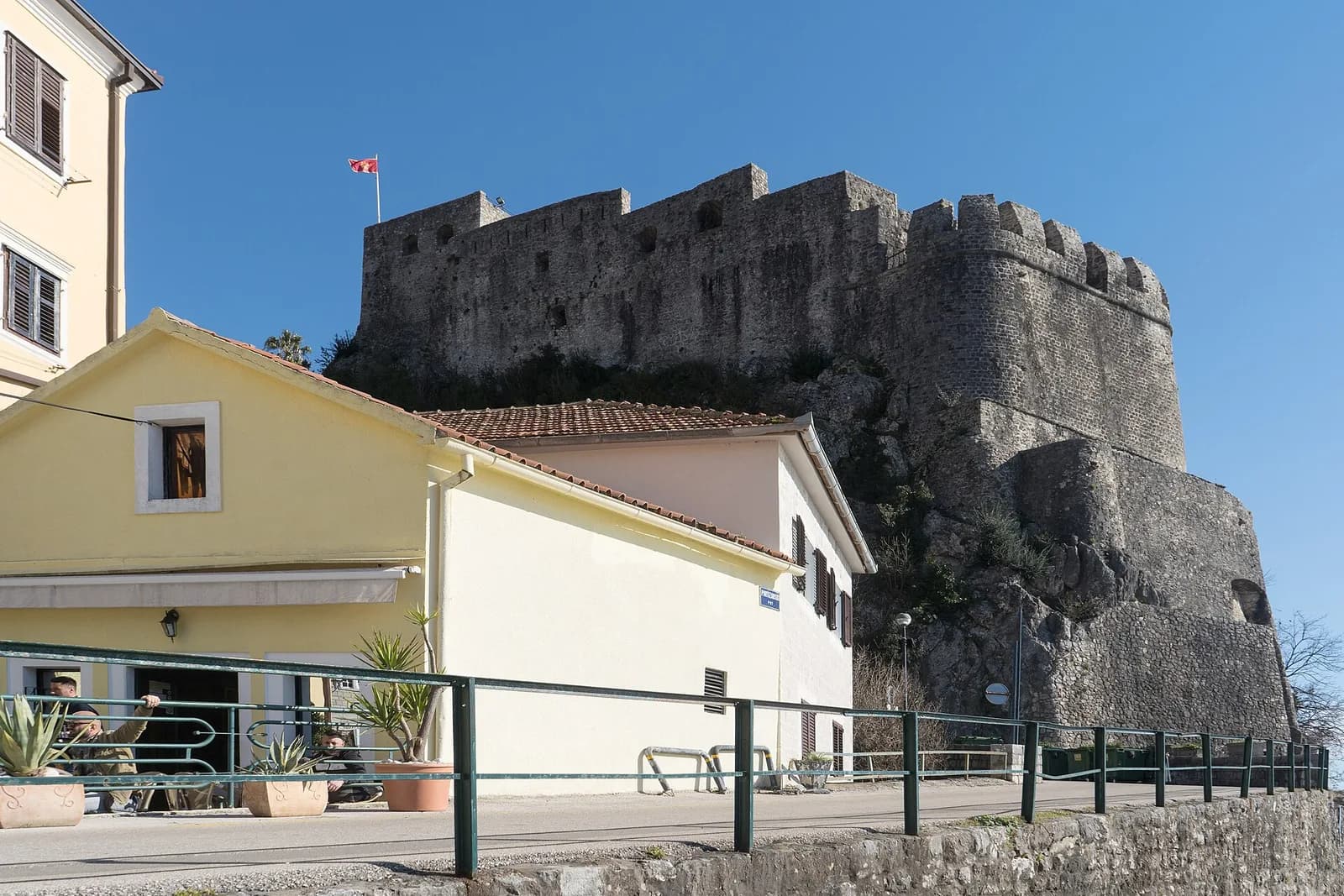
- The crenellated crown. Merlons and the gaps between them — Ottoman work of the great rebuild after 1539, raised further by the Habsburgs in the nineteenth century.
- The round eastern bastion. A rounded face deflects cannon shot where a square corner catches it. The narrow stair at its foot is one of the two surviving fourteenth-century fragments.
- The battered lower wall. The outward slope at the base is anti-artillery design — it thickens the wall exactly where a besieger’s guns aim. The Spanish rampart of 1538–39 ran 2.50–2.70 m thick.
- The living rock. The fortress is not built on the hill; it is built out of it. Bare limestone runs straight into masonry with no foundation course between.
- The town, below and after. Herceg Novi grew downhill from the fortress, not the other way round. These roofs are the consequence of a salt-trade decision made in 1382.
1538 – 1539 · the red slice
Twenty days that outlived four empires
In October 1538 the Holy League fleet under Andrea Doria — Genoese, Venetian, Spanish and Papal galleys — took Castelnuovo and left roughly 3,500 Spanish veterans in it, the Tercio of Castelnuovo, under Francisco de Sarmiento. Then the alliance came apart. It had already lost at Preveza; Venice withdrew; the garrison was left on a rock at the mouth of a bay with no fleet coming.
Hayreddin Barbarossa arrived on 18 July 1539 with something on the order of 50,000 men, 200 ships and 44 heavy siege guns.
The garrison, day by day
Effective defenders, from the landing to the fall. Figures are the ranges given by the surviving Spanish accounts, so read the shape, not the pixel.
18 Jul
Barbarossa lands.
Roughly 50,000 men, 200 ships, 44 heavy siege guns. Five days of trenching follow.
23 Jul
The offer, and the refusal.
Safe passage to Italy, weapons and colours retained, twenty ducats a man — just leave the artillery. The Spanish reply that they would rather die in the service of God and His Majesty. They already know no relief is coming.
24 Jul
Saint James’s Day.
An assault lasting the whole day: about 1,500 Ottoman and 500 Spanish dead. The breaches are plugged overnight and the next morning’s attack repelled. A 600-man Spanish sortie panics the Ottoman camp badly enough that Barbarossa’s guard moves him back to the galleys.
4–5 Aug
The upper fort falls.
Of the officers, only Captains Masquefá, Munguía and Haro and Corporal Galaz are left standing. A mine meant to bring down a captured tower explodes early and kills its own sappers.
6 Aug
The last morning.
Rain ruins the remaining powder and every matchlock. The last 600 fall back to the lower castle and find the doors walled shut. Sarmiento, wounded by three arrows in the face, is offered a rope down to safety and refuses to leave his men. Castelnuovo falls by nightfall.
After the fall
A poem outlived the garrison
Around 200 men of 3,500–4,000 survived. Half the prisoners and all the clergy were executed to satisfy an army that had lost somewhere between 8,000 and 20,000 dead. Captain Machín de Munguía, whom Barbarossa had watched fight at Preveza, was offered a command in the Ottoman fleet, declined it, and was beheaded on the beak of the admiral’s galley. Twenty-five of the enslaved survivors escaped Constantinople six years later and reached Messina.
Militarily it ended the League’s eastern Mediterranean project. Culturally it did the opposite of disappearing.
Their blessed death deserved envy more than any victory.
Gutierre de Cetina, A los huesos de los españoles muertos en Castelnuovo — to the bones of the Spaniards who died at Castelnuovo, written within a generation of the siege
Herceg Novi is still, to Spanish military memory, Castelnuovo. A fortress on the Montenegrin coast has a permanent address in another country’s literature because of twenty days in 1539.
1687 onward
The siege that was won by killing a spring
The Venetian siege opened on 1 September 1687, during the Morean War. Girolamo Corner, Venice’s Captain-General at Sea, worked with Montenegrin forces under Vuceta Bogdanović, beat the Ottomans in the field outside the town, and pressed the fortress for a month. The detail that decided it is small and brutal: the Holy League drained the spring at the foot of the fortress. The garrison capitulated on 30 September, ending two centuries of Ottoman rule.
Venice repaired the walls and renamed the sea tower Forte di Mare. It is a bureaucratic act with an extraordinarily long tail. The Republic died in 1797; Austria, Russia, France, Austria again, Yugoslavia and Montenegro have all held this rock since — and every one of them kept calling it by its Venetian name.
Under Venice the fort softened. Herceg Novi was administered as part of Albania Veneta; the town became a port rather than a frontier. In 1702 Venice closed the promontory below with the Citadela, also called Macel or Mezzaluna, the crescent — the southernmost element of the medieval defensive system, in the form it would keep for the next 277 years.
The Habsburg silhouette
The Habsburgs treated Forte Mare as live infrastructure. They raised and reinforced the upper works so the fortress could cover the entrance to the bay properly, reworked the northern entrance, and used it as a military signalling and communications point in a bay stiff with naval installations.
A restoration in 1833 carries a striking local claim: that cement was used at the fortress entrance for the first time anywhere in the Austro-Hungarian empire, and was afterwards applied to Old Town façades for waterproofing. The claim comes from Herceg Novi’s own heritage and tourism sources and has not been corroborated elsewhere.
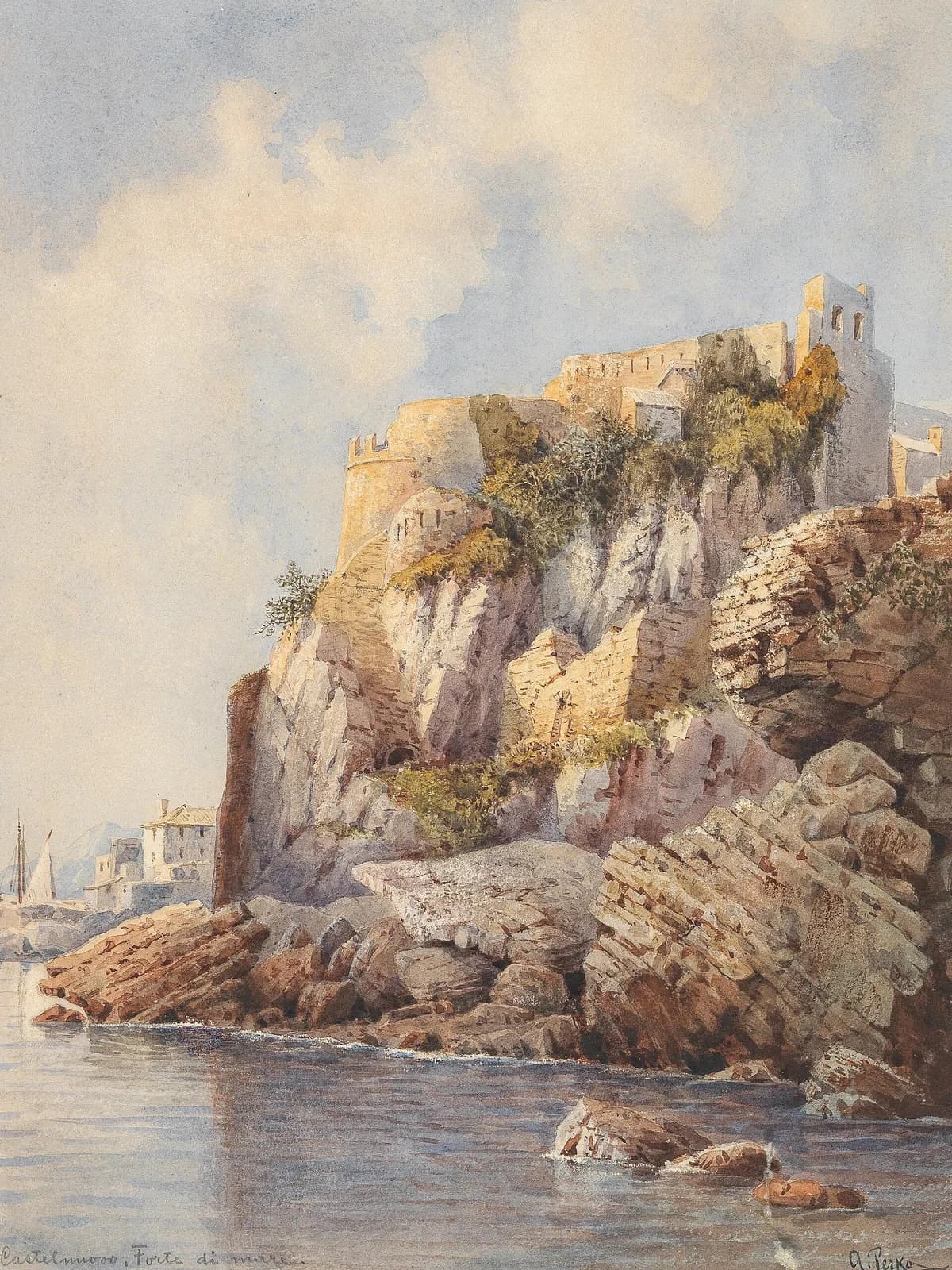
Reading the pair
These two images are not a before-and-after. Perko painted the fortress from the water; the 2024 photograph above was taken from the land. Presenting them as a matched slider would be a lie about the evidence, so they are presented as what they are: the two faces of the same object, a century apart.
What the pair does show is the constant. In both, the masonry stops and the bare rock begins with no transition — and in both, the crenellated crown sits at the top. That crown was already old when Perko painted it, and it is what your eye finds first today.
What it cannot show is the Citadela. Perko’s viewpoint is north of it; the 2024 photograph is inland of it. The building that the 1979 earthquake took is absent from both, which is its own kind of accurate.
1944 → today
The projector, the earthquake, the ticket
Italy annexed the town in 1941 and Germany followed; it was liberated on 28 October 1944. Seven years after that, the fortress found the job it still does. In 1952 Forte Mare was converted into a summer stage, and film screenings have run there every season since — by common reckoning one of the oldest open-air cinemas in Europe still in use. For a stretch of later decades it also worked as a night-time disco, which is its own kind of heritage.
On 15 April 1979 the Montenegro earthquake hit the coast. Forte Mare was badly damaged. The Citadela below it was almost entirely destroyed and has never been rebuilt; its stone still spills off the promontory into the sea, visible from the fortress wall.
Reconstruction followed a 1984 project supervised by the Republic Institute for the Protection of Cultural Monuments of Montenegro. Later heritage scholarship has been openly critical of it: the restoration applied one uniform masonry treatment across every construction phase, so a building that had spent six centuries visibly disagreeing with itself now reads as a single object. If you go looking for the argument between empires in the stonework, what you are largely looking at is 1984 — which is precisely why a phase drawing is worth making.
Today the fortress is a cultural venue run through the municipal institution JUK Herceg Fest. It is a principal open-air screen of the Herceg Novi Film Festival — Montenegro Film Festival, whose line runs back to the first Yugoslav Festival of Film Direction in 1987. It opens daily in season for a small entrance fee, and the terrace looks straight down the throat of the bay toward Mamula and Luštica — which is, after all, exactly what it was built to do.
1382 → today
The full timeline
Dated events only. Where sources disagree, the conflict is stated in the entry rather than resolved silently.
Bosnian & Kosača
1382–14821382
Tvrtko I Kotromanić founds the town
Dedicated to Saint Stephen, immediately known as Novi — Castrum Novum, Castelnuovo. Conceived as a salt port to break the Dubrovnik–Kotor monopoly. The sea fortress is laid out with it.
14th c.
The only surviving original fabric
A stretch of wall at the south-eastern corner and a narrow stair at the foot of the eastern bastion.
1448–49
Stjepan Vukčić Kosača takes the title herceg
Upgraded in 1449 to Herceg of Saint Sava. Novi becomes a Kosača winter residence; the title is eventually fused to the town’s name.
1466
Vlatko Hercegović inherits
The second and last Herceg of Saint Sava.
Ottoman
1482–15381481–82
Ottoman conquest
The fortress is renamed Jaka kula and Kula Abaspaše. Wikipedia dates the fall to before 14 December 1481; Herceg Novi’s own sources give 1482.
1493–94
First documented Ottoman fortification campaign
1508
Tower work and strengthening
Spanish
1538–1539 · one yearOct 1538
Andrea Doria takes Castelnuovo
The Holy League fleet — around 130 galleys and 15,000 infantry — seizes the town as a beachhead. Roughly 3,500 Spanish veterans stay behind under Francisco de Sarmiento.
1538–39
The Spanish thicken the eastern wall
Eastern rampart 2.50–2.70 m thick, dressed stone in white lime mortar. The same garrison breaks ground on a separate hill fort 600 m away — the future Španjola — which the Ottomans will finish.
18 Jul – 6 Aug 1539
The siege of Castelnuovo
Barbarossa’s terms refused on 23 July; the great assault on Saint James’s Day; the fortress falls on 6 August. Around 200 survivors from 3,500–4,000; Ottoman losses put at 8,000–20,000.
Ottoman, again
1539–1687after 1539
The largest reconstruction in the fortress’s history
It receives the dimensions and wall height it still has, plus the crenellated crown and the openings cut for cannon.
c. 1551
Fortress belts and artillery platforms
Walls widened to carry guns; the Old Town’s western walls and gates probably belong to this campaign.
1608
Earthquake devastates the city
1664
Evliya Çelebi visits
He describes Novi as a resting place, a sanctuary and a safe haven for pirates.
Venetian
1687–17971 Sep 1687
The Morean War siege opens
Girolamo Corner with Montenegrin forces under Vuceta Bogdanović defeats the Ottomans outside the town and invests the fortress.
30 Sep 1687
Castelnuovo surrenders
Decided by draining the spring at the fortress’s foot. Two centuries of Ottoman rule end. Some guide sites claim a three-month siege; the documented dates give one month.
1687 →
Venice repairs, and renames
The sea tower becomes Forte di Mare; Kanli Kula is repaired at the same time. Herceg Novi is administered as part of Albania Veneta.
1702
The Citadela is completed
Macel, Mezzaluna — the crescent — the southernmost element of the defensive system. It keeps this form until 1979.
Austria · Russia · France
1797–18141797
The Venetian Republic falls
24 Jul 1798
Austria formally annexes the Bay
26 Dec 1805
Treaty of Pressburg cedes Boka
28 Feb 1806
Russian occupation begins
In alliance with Montenegro; runs to 12 August 1807.
12 Aug 1807
Tilsit hands the Bay to France
Napoleonic rule, later within the Illyrian Provinces.
1813–14
Montenegrin and Bokelj forces take the town
A joint assembly sits briefly before Austria reasserts control.
Austro-Hungarian
1814–19181833
Restoration — and the cement claim
Herceg Novi’s heritage and tourism sources state that cement was used at the fortress entrance for the first time in the Austro-Hungarian empire — a local claim, not corroborated elsewhere.
19th c.
The upper works are raised
Reinforced to cover the sea entrance; the northern entrance reworked. Forte Mare serves as a military signalling point. This is the silhouette in every modern photograph.
by 1905
Anton Perko paints Castelnuovo, Forte di Mare
1918
Habsburg rule ends
Boka Kotorska passes into the Kingdom of Serbs, Croats and Slovenes.
Yugoslav & Montenegrin
1918–today1941–44
Italian annexation, then German occupation
The town is liberated on 28 October 1944.
1952
Forte Mare becomes a summer stage
Films have run every season since. In later decades it also worked as a night-time disco.
15 Apr 1979
The Montenegro earthquake
Forte Mare badly damaged. The Citadela below is almost entirely destroyed and never rebuilt; its stone still spills into the sea.
1984
The reconstruction project
Under the Republic Institute for the Protection of Cultural Monuments of Montenegro. Criticised for applying one uniform masonry treatment across all phases.
1987
The film festival begins
The first Yugoslav Festival of Film Direction is held in the Herceg Novi fortresses; it survives as the Montenegro Film Festival.
today
A fortress with a box office
Programmed by JUK Herceg Fest; open daily in season; a principal open-air screen of the festival.
Corrections
What the internet gets wrong
These claims circulate widely online and do not survive checking. If you have read about Forte Mare elsewhere, you have probably met at least one of them.
Widely repeated
Forte Mare is not a UNESCO World Heritage Site.
Several travel pages say it is. The inscribed property is the Natural and Culturo-Historical Region of Kotor, and it stops inside the Verige strait. Herceg Novi lies in the buffer zone only.
A local claim
“First use of cement in the Austro-Hungarian empire, 1833.”
Repeated by Herceg Novi’s own municipal and tourism sources, and corroborated nowhere else. A striking claim, and quite possibly true — but it rests on the city’s word alone.
Often wrong
The 1687 siege lasted about a month, not three.
A widely copied guide site says three months. The documented dates run 1–30 September 1687, and the municipality says thirty days.
Check before you go
The entrance fee.
Current sources quote anything between €1 and €5, and summer hours vary by season. Check with JUK Herceg Fest before you travel rather than trusting a number printed online.
Sources and image record
Dates and interpretations are tied to the archive and research sources below. Where they conflict, the conflict is named in the text rather than smoothed over.
- Opština Herceg Novi — The history
Sovereignty timeline; 1979 damage to Forte Mare and Kanli Kula
- Wikipedia — Stjepan Vukčić Kosača
The herceg title, 1448–49, and the origin of the town’s name
- Opština Herceg Novi — Znamenitosti
Construction phases; the two surviving 14th-century fragments
- Urbs incognita: Stari grad Herceg-Novi
Masonry survey; the 1493 / 1508 / 1551 campaigns; critique of the post-1979 restoration
- Wikipedia — Siege of Castelnuovo
1538–39 in detail: forces, dates, terms, casualties, Munguía, Cetina’s sonnet
- Herceg Novi Tourist Organisation — Forte Mare
The spring drained in 1687; the Sea Gate; 1833 cement; the 1952 summer stage
- Wikipedia — Herceg Novi
Precise sovereignty dates 1798–1918; the 1608 earthquake; 1943–44
- Citadela, Macel, Mezzaluna
The Citadela’s destruction in 1979 and its non-restoration
- UNESCO — Natural and Culturo-Historical Region of Kotor
Property boundary: Herceg Novi is buffer zone, not inscribed
- JUK Herceg Fest — Festivals
Programming at Forte Mare and Kanli Kula; the festival lineage from 1987
- Plan (archaeology) — the phasing convention
The colour-by-period phase plan this page’s visual system borrows