The story
The last point of defence, which never defended anything
In 1833 Petar II Petrović Njegoš — prince-bishop, poet, and the closest thing nineteenth-century Montenegro had to a state — built a round tower on the rise above Cetinje Monastery. It was to be the last defensive point of the capital, holding twenty-four guards and their cannon.
It was never completely finished, and it never fought. What it actually did, for most of its life, was fire ceremonial salutes when important visitors arrived. That is a fair summary of Cetinje's whole position in the period: a capital that was mostly symbol, defended by a tower that was mostly gesture.
The ground beneath it is older than either. A fortified settlement is presumed to have stood on this rise as early as the sixth century, which puts the Tablja in the same category as almost everything else in this series — the newest object on a hill that people have been climbing for defensive reasons for well over a thousand years.
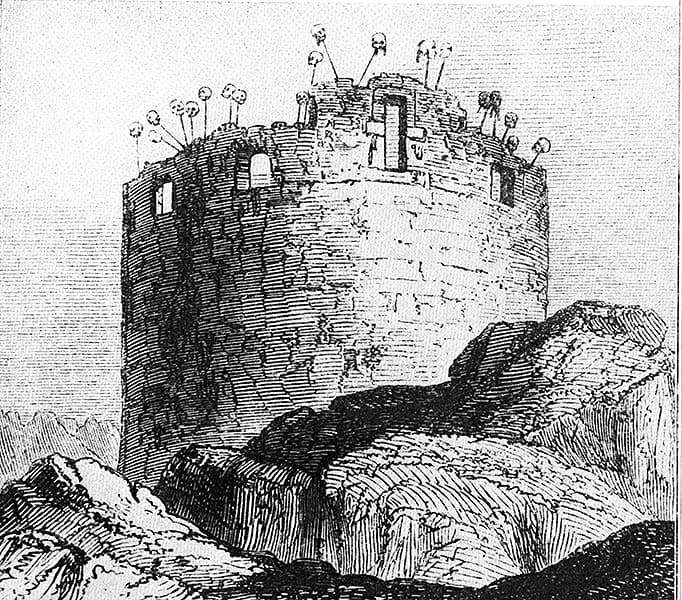
- The parapet. The heads of killed Ottoman soldiers, mounted on spikes around the top of the tower. The practice ended in 1850, two years after this was drawn — which makes this engraving a record of it rather than a memory of it.
- The cross-shaped opening. Cut through the upper wall. A cross-shaped loop gives a defender a wide arc for a firearm while presenting almost nothing to shoot back at.
- The openings below. Square-headed embrasures at the level where the twenty-four men and their cannon were meant to be. The tower was designed for a garrison it seems never to have properly held.
- The unfinished crown. The top is rough and uneven, not a built parapet. The accounts say the Tablja was never completely finished, and this is what that looked like fifteen years after it was begun.
- Bare rock. The tower stands directly on the outcrop above Cetinje Monastery, where a fortified settlement is presumed to have stood as early as the sixth century. The rock is still there. Nothing else in this picture is.
Until 1850
What was on the parapet
There is no way to write about the Tablja without this. Until 1850, the severed heads of Ottoman enemies were displayed on the tower as war trophies.
It is stated plainly in Cetinje's own tourism material, and it belongs in any honest account of the building. This was the practice of a small mountain polity in near-permanent war with a vastly larger empire, and it was not unique to one side of that war — but it happened here, on this tower, within living memory of people whose grandchildren saw it demolished.
The practice stopped in 1850. The tower then became a bell tower, carrying a bell of 1,631.5 kilograms donated by Laza Urošević of Zemun, rung for religious holidays and to honour distinguished guests. The same structure, in the space of a generation, went from displaying heads to ringing for Easter.
1938
Demolished for a building that is another story
The Tablja was pulled down in 1938, during the levelling of a plateau intended for the construction of a new cathedral church. A simpler belfry on four pillars was afterwards built from the material that remained.
Some accounts give 1937 rather than 1938, and some attribute the demolition to a political motive — that the tower was too strong a symbol of Montenegrin identity to be left standing. Cetinje's own account gives 1938 and a civic reason: they needed the ground. Both readings circulate; only one of them is documented, and this article uses that one while noting the other exists.
What is not in dispute is the outcome. Of the ten fortifications in this series, two are gone: the Citadela at Herceg Novi, taken by an earthquake in ninety seconds, and the Tablja, taken by a works crew over rather longer. One of those two was somebody's decision.
pres → today
The full timeline
Dated events only. Where sources disagree, the conflict is stated in the entry rather than resolved silently.
Older occupation
presumed from the 6th century6th c.?
A presumed fortified settlement
On the rise above what became Cetinje Monastery. Presumed rather than established.
Prince-Bishopric & Montenegro
1833–19181833
Njegoš builds the Tablja
A circular tower for 24 guards and their cannon, as the last defensive point of Cetinje. Never completely finished.
to 1850
War trophies on the tower
The severed heads of Ottoman enemies are displayed on it until 1850.
19th c.
It becomes a belfry
Carrying a bell of 1,631.5 kg donated by Laza Urošević of Zemun, rung for holidays and distinguished guests.
Yugoslav & Montenegrin
1918–today1938
The tower is demolished
During the levelling of a plateau planned for a new cathedral church. Some accounts give 1937, and some give a political motive.
after 1938
A belfry on four pillars
Built from the material left over from the tower.
Corrections
What the internet gets wrong
These claims circulate widely online and do not survive checking. If you have read about Tablja elsewhere, you have probably met at least one of them.
Dates differ
1938, not 1937.
Cetinje's own tourism account gives 1938 and states the reason: the levelling of a plateau planned for a cathedral. The 1937 date circulates widely and is not the one the local record uses.
Contested
Why it was pulled down.
Some accounts hold that the tower was destroyed because it was too strong a symbol of Montenegrin identity. The documented reason is the plateau. Both readings are in circulation; only one is on the record.
Often omitted
It never defended anything.
The Tablja was designed as the last defensive point of Cetinje, was never fully completed, and spent its working life firing ceremonial salutes. It is a fortification in intention rather than in use.
Sources and image record
Dates and interpretations are tied to the archive and research sources below. Where they conflict, the conflict is named in the text rather than smoothed over.
- Visit Cetinje — Cetinjska Tablja
1833 construction by Njegoš; circular, for 24 guards; never finished; heads displayed until 1850; the 1,631.5 kg bell; demolition in 1938
- John Gardner Wilkinson, “Dalmatia and Montenegro” (1848)
The 1848 engraving of the tower, p. 511. Public domain — the only known image of the Tablja
- Wikipedia — Cetinje
The monastery, the town and its role as the old royal capital
- Wikipedia — Biljarda
Njegoš's residence below the tower, built 1838, for context on his building programme
- Plan (archaeology) — the phasing convention
The colour-by-period phase plan this page’s visual system borrows