Short answer: budget roughly €45–60 per person per day for backpacking, €90–140 mid-range and €200+ for luxury — bed, food, local transport and one activity included. A mid-range couple's week in September runs about €700–900 for two, flights excluded. The two things that move that number most are the month you come and the town you sleep in, and July and August on the coast run roughly a quarter to a third above a May price on average — more for a private apartment on the busiest beaches, where a single listing can climb far higher.
The same week, priced across the Mediterranean
The three lines the source actually measures, city by city. The dashed ring is Budva at 100%; wherever a web crosses outside it, that is what you'd pay extra for the same thing. Per person, per day, in your month and style.
StayFoodGetting aroundBudva = 100%
Build the holiday you'd actually take — the room, the meals out, the buses — then price that basket across seventy coastal destinations in the month you'd go. Every price is what travellers reported spending; the seasonality is real regional demand, fitted to measured room prices.
The six corners
| City | Stay | Food | Getting around | Day |
|---|---|---|---|---|
| Budva | €39 | €56 | €20 | €115 |
| Dubrovnik | €69 | €79 | €22 | €171 |
| Split | €90 | €99 | €23 | €212 |
| Athens | €66 | €67 | €27 | €161 |
| Venice | €129 | €119 | €27 | €274 |
| Naples | €61 | €72 | €21 | €154 |
| Palermo | €61 | €55 | €6 | €121 |
Side by side
7 nights in August, 2 travellers, 1 room: hotel room + breakfast out + lunch out + dinner out + coffees + local transport. Flights excluded. Compared against Budva.
Los AngelesCalifornia
€256 per person per day
€3,578+122%
MiamiFlorida
€222 per person per day
€3,107+93%
SplitCroatia
€212 per person per day
€2,965+84%
DubrovnikCroatia
€171 per person per day
€2,390+48%
AthensGreece
€161 per person per day
€2,250+39%
KotorMontenegro
€140 per person per day
€1,959+21%
BudvaMontenegro
€115 per person per day
€1,614baseline
▎ where mid-range travellers actually spend, per the sourcebar = your basketsparkline = that region's price curve, dot = your monthtap a row for detail
Best month for BudvaGoing in January rather than August saves 9% — €138 on this trip.
Cheapest of your listBudva at €1,614, 55% below Los Angeles for the identical basket.
| Destination | Hotel room | Breakfast out | Lunch out | Dinner out | Coffees | Local transport | Season | Trip total |
|---|---|---|---|---|---|---|---|---|
| Los Angeles | €253/rm | €18/pp | €25/pp | €45/pp | €7/pp | €34/pp | ×1.06 | €3,578 |
| Miami | €247/rm | €12/pp | €17/pp | €31/pp | €5/pp | €33/pp | ×0.93 | €3,107 |
| Split | €180/rm | €19/pp | €26/pp | €47/pp | €8/pp | €23/pp | ×1.07 | €2,965 |
| Dubrovnik | €139/rm | €15/pp | €21/pp | €38/pp | €6/pp | €22/pp | ×1.07 | €2,390 |
| Athens | €133/rm | €13/pp | €18/pp | €32/pp | €5/pp | €27/pp | ×1.05 | €2,250 |
| Kotor | €105/rm | €15/pp | €20/pp | €37/pp | €6/pp | €9/pp | ×1.07 | €1,959 |
| Budva | €78/rm | €11/pp | €15/pp | €27/pp | €4/pp | €20/pp | ×1.07 | €1,614 |
Unit prices at the mid-range setting for August. /rm is per room per night, /pp per person per day. Season is that region's price factor for the month, 1.00 being what the typical traveller pays. "fill" marks a destination with a price we derived.
Destinations
BudvaKotorSplitDubrovnikAthensMiamiLos Angeles
Travel style
Currency
In the basket
How much could it actually cost?
Averages hide the spread. This runs your trip 4,000 times, drawing every price from its range, for the month you've chosen.
Nine trips in ten land between €1,501 and €1,731, with a typical run at €1,616.
€1,475the middle 90% · August€1,753
cheap run · 5th pct€1,501
typical · median€1,616
dear run · 95th pct€1,731
spread · 95th ÷ 5th1.15×
What drives the spread
The room, booked once83%
Meals, day by day10%
Coffee & transport7%
Share of total variance. The room is one draw you live with all week; 14 separate meal draws mostly cancel out.
6 of ~30numbers per city are measured; the rest is the source's arithmetic on those six. Every derived line is marked.
±0.05error of the seasonality model against Eurostat's measured room-price index across four countries, after fitting one constant.
1%how much restaurant prices move with the season, per the same index. Rooms carry the swing; menus do not.
48 of 65source cities whose components reconcile with their own daily total within 10%. The rest carry a mark and say why.
These are reported-spending figures, not shop prices — a place can look dear because visitors do dear things there. Hotel is a room, so a party is charged one room per two people; everything else is per person. The source publishes no sample sizes, so treat any single row as indicative and the ranking as the finding. Five Montenegrin towns and Albania's national figure are derived and labelled. Flights are excluded throughout.
Prices: Budget Your Trip, traveller-reported, fetched 10 Sep 2026. Seasonality: Eurostat nights spent by region (2023–24), fitted to the HICP accommodation price index (2022–25). FX: ECB reference rates, 9 Sep 2026.
Now price your own Montenegro trip ↓Backpacker
€45–€60
per person per day
$52 · £39 — $70 · £52
Mid-range
€90–€140
per person per day
$105 · £77 — $163 · £120
Luxury
€200+
per person per day
$233 · £172
€700–€900 for a week for two — mid-range, September, flights excluded.
- Best value: May–June, September–October
- 13–17% cheaper than Croatia
- Rooms 25–40% dearer in July–August
- Tourist tax €1 per night
Montenegro has a reputation as one of the Adriatic's last affordable corners — a place where you can watch superyachts glide into Kotor Bay without spending superyacht money. It is broadly true. Everyday prices here sit roughly below those in Germany and comfortably under neighbouring Croatia, which grew pricier after adopting the euro in 2023. But "cheap" is relative, and a July beach week in Budva costs a good third more than the same week in May — and the gap is almost all in the room. This 2026 breakdown gives you realistic daily budgets — backpacker, mid-range and luxury — plus the sample prices you actually need to plan.
Three daily budgets for 2026
Your biggest variable is travel style, closely followed by season. Below are per-person, per-day figures covering accommodation, food, local transport and one activity — the numbers most travellers land on in practice.
Backpacker: roughly €45–60 per day
A dorm bed runs about €18–22 a night, and you eat mostly street food and self-catering: a burek pastry for €2, a plate of ćevapi for around €5, groceries for the rest. Get around by public bus, and budget travellers realistically spend around €40–60 a day. Skip peak July–August and this holds easily.
Mid-range: roughly €90–140 per day
This is the sweet spot for most visitors: a private room or apartment for two (€50–80 split between you), a sit-down konoba dinner with a glass of local wine (€18–25), a coffee or two, occasional taxis, and a boat trip or museum. Mid-range travellers typically spend €80–150 per day depending on how often you dine out.
Luxury: €200+ per day
Sea-view suites, fine dining in Porto Montenegro or Sveti Stefan, private transfers and skippered boat charters push you past €200 a day — and there is no real ceiling once you reach the marinas of Tivat. Even so, comparable luxury in Italy or the French Riviera would cost noticeably more.
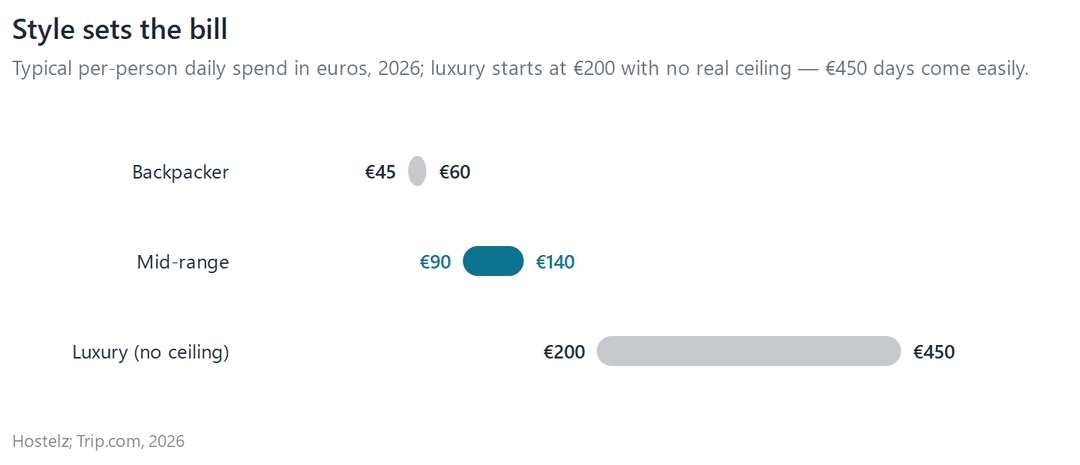
| Travel style | Per day | Sleeping | Eating | Getting around |
|---|---|---|---|---|
| Backpacker | €45–60 | Dorm bed €18–22 | Burek €2, čevapi ~€5, groceries | Public bus |
| Mid-range | €90–140 | Room or apartment €50–80 for two | Konoba dinner €18–25 with wine | Buses, occasional taxis |
| Luxury | €200+ | Sea-view suites | Fine dining in Porto Montenegro, Sveti Stefan | Private transfers, boat charters |
Price your trip
Move the month and the town. Those two decide a Montenegrin budget more than anything else.
| Accommodation | €351 | |
|---|---|---|
| Food and drink | €419 | |
| Getting around | €98 | |
| Things to do | €167 | |
| Sojourn tax | €14 |
Total trip
€1,049
€75 per person per day
old town commands a premium
The same trip costs €99 more in August than in January.
Modelled from prices checked on 2026-09-10, in euros; other currencies are indicative. Planning estimates, not quotes — the coast reprices sharply in July and August.
Sample prices — what things actually cost
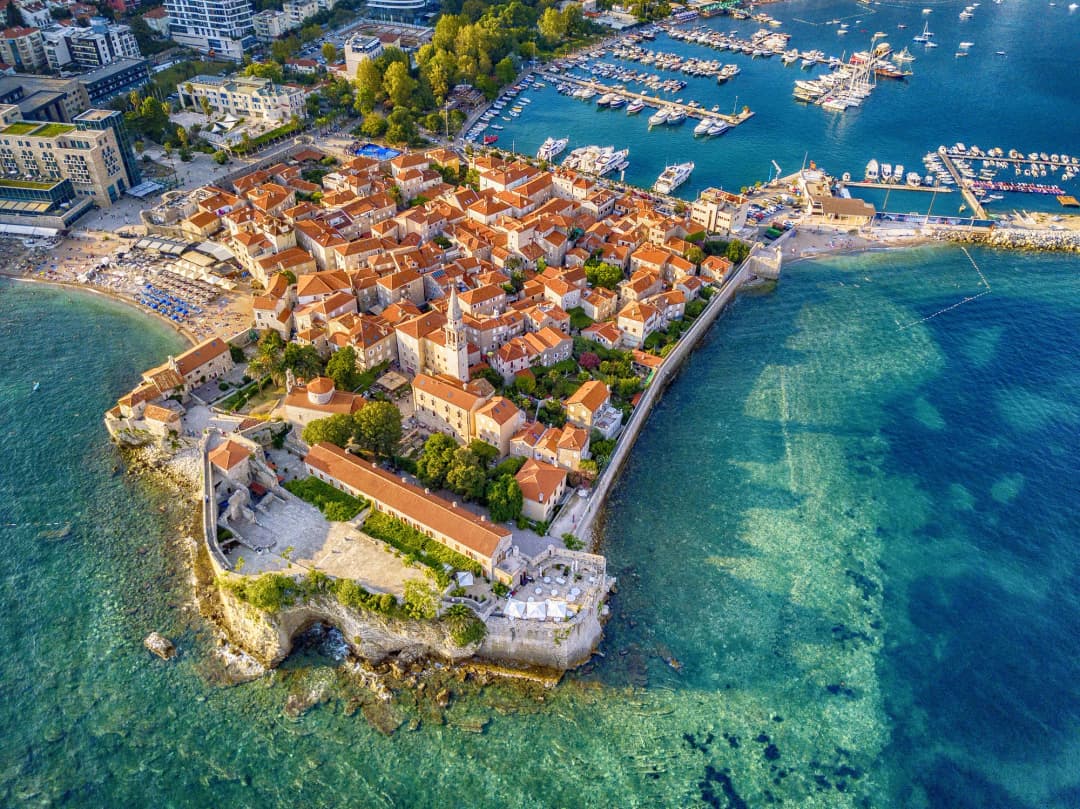
Here is a quick reference of typical 2026 prices along the coast. Inland towns like Podgorica or Nikšić tend to run 10–20% cheaper.
- Espresso in a café: around €1.50
- Street food (burek, slice of pizza): €2–3
- Plate of ćevapi: about €5
- Mid-range restaurant dinner for two with wine: €35–45
- Bus, Kotor to Budva: €4–5
- City taxi (short hop): €5–8; Tivat airport to Kotor: €20–28 metered
- Blue Cave speedboat tour: from €40–45 per person
- Our Lady of the Rocks church museum: €2 entry
- Kotor Old Town entry: free to walk in; the city-walls climb to San Giovanni fortress costs €8 off-season, €15 in peak summer, cash only
- Hostel dorm bed: €18–22 · Private apartment for two: €50–80
- Local beer (half a litre, in a bar): €2.50–4
- Restaurant main course: €8–18, more at upscale coastal places
- Sunbed rental in season: €10–25 a pair on an ordinary beach, more at a beach club
- Museum or attraction entry: €3–10
- A day's supermarket basics — bread, water, fruit, cheese: €8–15
Where you sleep changes the price more than how you travel
Montenegro is small enough that people treat it as one price level. It is not. The same September week costs about a third more in Sveti Stefan than in Herceg Novi, and nearly twice as much as the identical trip run out of Žabljak. Moving your base is the cheapest saving available after moving your dates — and unlike the season, it costs you nothing.
| Base | Relative cost | Why |
|---|---|---|
| Sveti Stefan | +38% | The most expensive address in the country |
| Tivat | +20% | Porto Montenegro pulls the whole town's average up |
| Budva | +16% | Busiest and priciest stretch of coast |
| Kotor | +12% | The old town commands a premium; Dobrota next door does not |
| Herceg Novi | baseline | The bay at close to the national average |
| Ulcinj | −8% | Long sand, softer prices |
| Bar | −10% | A working town rather than a resort |
| Podgorica | −15% | Capital prices, no beach premium |
| Kolašin | −14% | Mountains — though this inverts in ski season |
| Žabljak | −18% | The cheapest base in the country in summer |
The practical move on the bay is to sleep one town along from the one you came to see. Dobrota instead of Kotor, Bijela or Đenovići instead of Budva: ten minutes on a bus, and a different price list.
How Montenegro compares to its neighbours
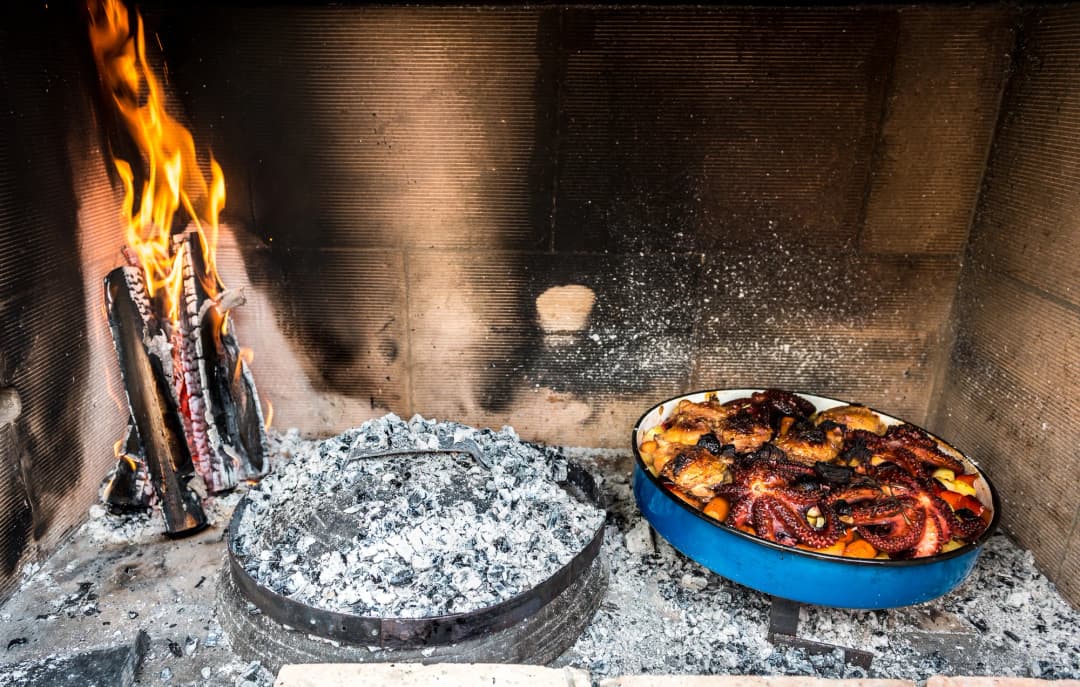
The headline for value-conscious travellers is simple: you get an Adriatic coastline every bit as dramatic as Croatia's or Italy's, for less money. Consumer prices in Montenegro run roughly 13–17% below Croatia, a gap that widened after Croatia joined the eurozone. Against Germany, rents alone are about 28% lower, and overall living costs sit well under Western-European levels. Montenegro adopted the euro unilaterally in 2002 — it is not an EU member, and Brussels never signed off — so there is no currency exchange to puzzle over, and card payments are widely accepted in towns (though carry some cash for markets, small buses and rural konobas; our money and ATM guide covers the fees worth dodging).
What a whole trip actually totals
Daily ranges are the standard way to answer this question and the least useful, because nobody books a day. These are whole trips for two people sharing a room, in September, based on the bay — the flights are not included, and neither is anything you buy to take home.
| Style | 3 nights | 7 nights | 14 nights |
|---|---|---|---|
| Backpacker | €290–380 | €650–850 | €1,300–1,700 |
| Mid-range | €430–560 | €980–1,250 | €1,950–2,500 |
| Comfortable | €700–900 | €1,600–2,050 | €3,200–4,100 |
| Luxury | €1,500+ | €3,500+ | €7,000+ |
Shift the same trip into August and add roughly 25–35% to the accommodation line. Shift it into late October and take 5–10% off. That single decision outweighs every money-saving tip further down this page put together.
Money-saving tips that genuinely work
Travel in shoulder season
This is the single biggest lever. Peak July–August coastal accommodation typically runs about a quarter to a third above the May or September rate, and individual listings on the busiest beaches can jump much further — one seasonal price guide shows an apartment at €40 in June and €140 in August. Late May, early June, September and October give you warm sea, thinner crowds and prices 15–25% lower. The weather in these months is arguably better for hiking Lovćen and Durmitor anyway.
Self-cater and shop local
Green markets (pijaca) in Kotor, Budva and Bar sell fruit, cheese, pršut and olives for a fraction of restaurant prices. An apartment with a kitchen — the norm on Montenegro's rental market — lets you cook breakfast and picnic lunches, saving €15–25 a day per person while still splurging on the occasional seafood dinner.
Ride the buses
Montenegro's intercity buses are cheap, frequent and scenic. The coastal route linking Herceg Novi, Kotor, Budva and Bar costs only a few euros per leg, versus €20–35 for the equivalent taxi. For day trips, a public bus plus your own two feet often beats a packaged tour.
Book activities as groups, not privately
A shared group boat tour to the Blue Cave costs €40–45; the same route chartered privately runs into the hundreds. Many of Montenegro's best experiences — hiking the free Ladder of Kotor trail above the paid ramparts, swimming off the rocks, wandering Perast — are free or nearly so.
The costs nobody budgets for
Every figure above is the cost of the trip you planned. These are the ones that turn up anyway, and together they add more to a week than most people expect.
- Sojourn tax — about €1 per adult per night, collected by your accommodation and usually not in the price you saw online. Halved for 12- to 18-year-olds, free under 12. A fortnight for two is roughly €28.
- Accommodation VAT went up. In January 2025 the rate on lodging rose from 7% to 15% as part of an EU-alignment reform, so a price you remember from 2024 is not the price you will be quoted.
- Sunbeds — €10–25 a pair on an ordinary beach in season, considerably more at a managed beach club. On a busy stretch in August, sitting down is a paid activity.
- Parking — €1–3 an hour in coastal towns in season, and Kotor's old town is closed to cars entirely. If you rent, price the parking at your accommodation before you book it, not after.
- ATM and card fees — the independent machines in tourist areas charge a withdrawal fee and offer a poor conversion if you let them convert for you. Always choose to be charged in euros.
- Cash-only walls — some attractions and most small konobas and market stalls take cash only. The Kotor city-walls climb is the well-known one.
- The one-way rental fee — picking up at Tivat and dropping at Podgorica, or the reverse, usually carries a surcharge that dwarfs the fuel saving.
Putting it together: a sample week
A mid-range couple spending seven nights in September — apartment, a mix of self-catering and dining out, buses plus one boat trip and a couple of taxis — should budget around €700–900 for two, excluding flights. Backpackers can do the same week for under €450; a luxury traveller can easily spend that in a single day. For a sense of how many visitors Montenegro now draws and how demand shapes prices, see our 2026 tourism by the numbers overview.
€700–900
a mid-range couple’s entire September week for two — apartment, meals, buses and a boat trip, flights excluded
Two fixed costs deserve a line in any budget. Every visitor pays Montenegro's sojourn tax — about €1 per adult per night, half that for teenagers, collected by your accommodation; our tourist-tax and white-card guide covers the fine print. And lodging carries more tax than it used to: in January 2025 Montenegro raised the VAT on accommodation from 7% to 15% as part of an EU-alignment tax reform, so a 2024 price memory may no longer match a 2026 quote.
Whatever your budget, the recipe is the same: come outside high summer, base yourself in a self-catering apartment in Kotor or Budva, lean on the bus network, and save your euros for the experiences that matter. Ready to price out your own trip? Browse apartments and villas across the coast and map out the details with our trip planner.
Common questions about costs in Montenegro
How much does a trip to Montenegro cost per day?
Roughly €45–60 per person per day backpacking, €90–140 mid-range and €200+ for luxury, outside peak season — bed, food, local transport and one activity. July and August push the accommodation line up by a quarter or more on the coast.
Is Montenegro cheaper than Croatia?
Yes. Consumer prices run roughly 13–17% below Croatia, a gap that widened after Croatia adopted the euro in 2023. The difference is largest on accommodation and restaurant dining along the coast.
What does a week cost for two people?
A mid-range couple spending seven nights in September should budget around €700–900 for two, excluding flights. The same week in August costs substantially more.
What is the tourist tax?
A sojourn tax of about €1 per adult per night, collected by your accommodation. Halved for 12- to 18-year-olds, free for under-12s, and usually not included in the rate you see online.
When is the cheapest time to visit?
Late autumn to early spring is cheapest outright. For warm-weather value the window is May, early June, September and October, when coastal accommodation runs 15–25% below the peak — and the sea is warmer in September than in May.
Do I need cash?
Montenegro uses the euro and cards are widely accepted in towns. Carry cash for green markets, small buses, rural konobas and some attraction entries — the Kotor city-walls climb is cash only.
How these figures were put together
Prices were checked in September 2026 against published tariffs, menus, timetables and accommodation listings, and cross-read against Numbeo's Montenegro dataset and the sources listed below. They describe the coast unless a line says otherwise; inland towns run 10–20% cheaper. Flights are excluded throughout, because what you pay to arrive depends far more on where you start than on anything in Montenegro.
Everything here is a planning estimate rather than a quote. Two figures in particular move fast: coastal accommodation, which reprices week by week through the summer, and anything sold on a beach.