Herceg Novi, Montenegro: The Complete Travel Guide to the City of Sun and Stairs
The city of sun and stairs gets some 200 sunny days a year. Plan 3-4 days around Forte Mare, Kanli Kula, Savina Monastery and the seafront promenade.
30,824residents
1382first recorded
€8a sunbed
Jul–Augthe busy months
Updated Originally published 35 min readby Pavle Obradović
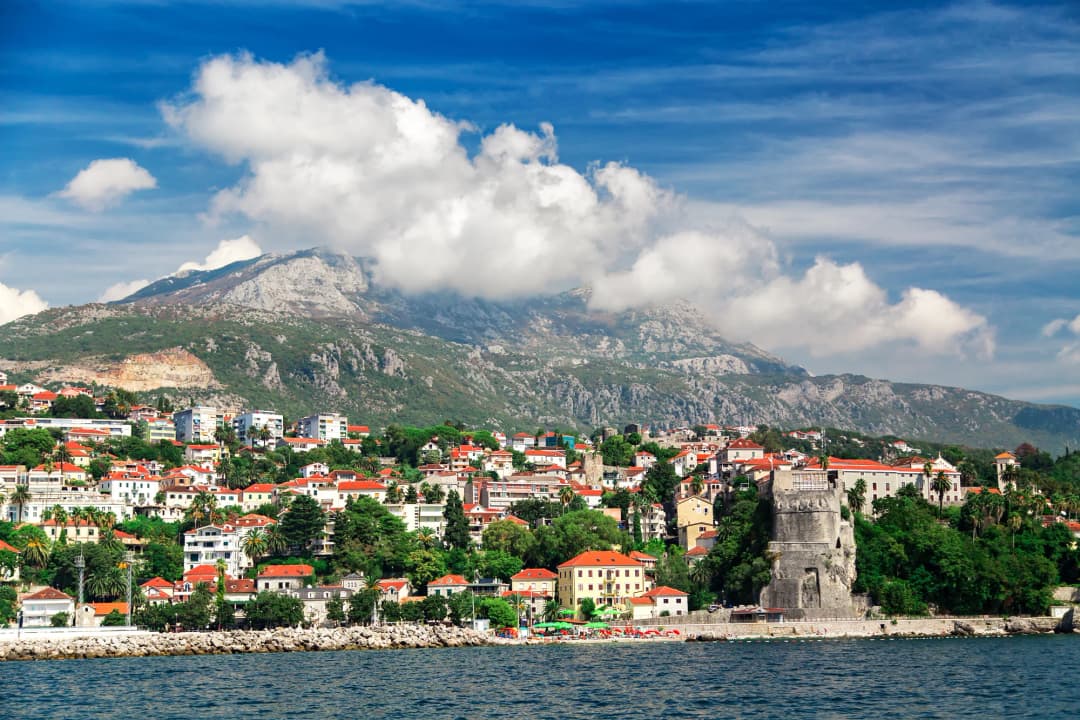
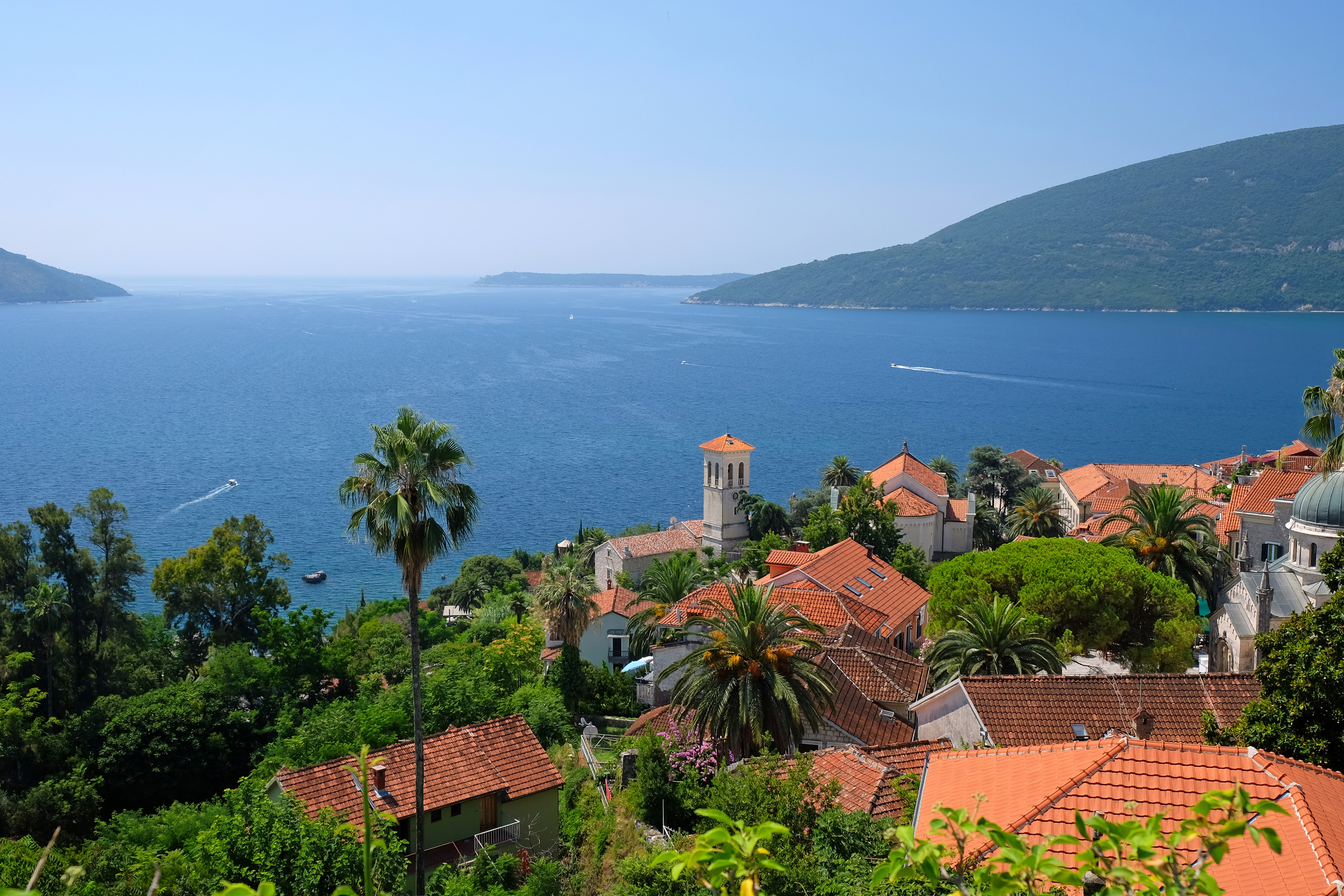
Herceg Novi is the first town inside the Bay of Kotor and the last before the Croatian border, founded in 1382 by the Bosnian king Tvrtko I as a salt-trading port. Its Old Town climbs the hillside in stairways past four fortresses: the Sahat Kula clock-tower gate, Forte Mare on the waterline, Kanli Kula at 85 metres and Španjola at about 170 metres. Below it the flat, free Pet Danica promenade runs about 7 km from Igalo to Meljine, and boats leave Škver harbour for Mamula, the Blue Cave, Žanjice and Rose. With around 200 sunny days a year and gardens planted by sailors and the Austrians, it is a garden town rather than a party town.
Herceg Novi at a glance
Old Town (Stari grad) — entered through the Sahat Kula clock tower (1667, free); roughly a thousand public steps.
Fortresses — Španjola free and always open; Forte Mare a small unpublished fee; Kanli Kula by event ticket, performances July–August.
Pet Danica promenade — about 7 km from Igalo to Meljine on the old Zelenika railway bed, flat and free, completed on 20 June 2025.
Beaches — Gradska plaža below Forte Mare; pebble and concrete at Igalo, with free healing mud at Blatna plaža; Žanjice and Mirište on Luštica by taxi boat.
Boat trips — half-day to Mamula, the Blue Cave and Žanjice €30 (€15 ages 6–11), from Škver at 09:05 and 12:40; taxi boat to Rose about ten minutes, €5–10 each way.
Airports — Dubrovnik 28 km (plus the border); Tivat 20–25 km via the Kamenari–Lepetane ferry or 46 km round the bay; Podgorica 113–133 km.
Getting around — town bus €1.50 a journey, taxis €0.90 per kilometre; parking is free on Sundays except from 1 July to 1 September.
Best time — June and September; the Mimosa Festival runs through February and March, every year since 1969.
Population — 30,824 in the municipality (2023 census), the biggest in the Boka.
The Old Town and its fortresses
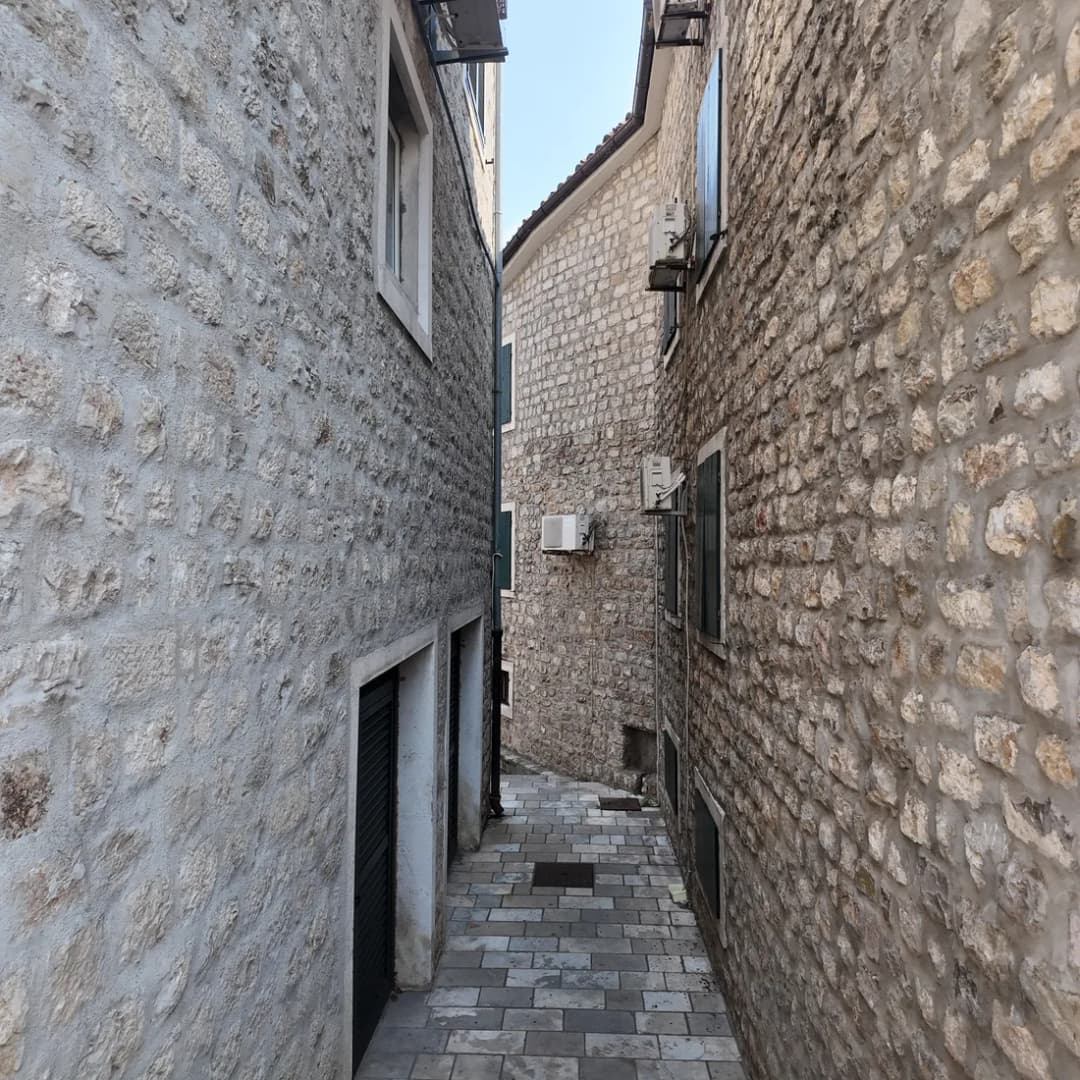
Herceg Novi is the city of stairs. The Old Town climbs the hillside in narrow stairways, arched passages and small squares shaded by oleander and bougainvillea; locals give directions in skalinade rather than street names, and roughly a thousand public steps stitch the town to the sea. The “100,001 steps” on souvenirs is a boast, not a count. Wear comfortable shoes.
The four fortresses are the town's own defensive system, read from the water upwards, and they are priced very differently:
Fortress
Height
Admission
When you can get in
Sahat Kula (clock tower)
16 m tall
Free — it is a gate you walk through
Always
Forte Mare
At the waterline
A small fee; the amount is not published
Daily in season
Kanli Kula
85 m above the sea
Not published; normally an event ticket
Ramparts in season; performances July–August
Španjola
About 170 m above the sea
Free
Always — there is no gate and no gatekeeper
Forte Mare and Kanli Kula are programmed by the municipal institution JUK Herceg Fest rather than run as ticketed monuments, and neither the tourist organisation nor Herceg Fest publishes a standing admission price; summer hours move with the season too. Ask at the fortress door, or call Herceg Fest before you plan an evening around it.
Sahat Kula (the clock tower)
The natural starting point is Sahat Kula, the Ottoman clock tower that serves as the main gateway into the historic quarter and the symbol of Herceg Novi. Built in 1667 by order of Sultan Mehmed IV, this 16-metre octagonal tower was designed to announce the hours of daily prayer. Clock faces decorate all four sides, and the tower appears on the city's coat of arms and flag.
Forte Mare
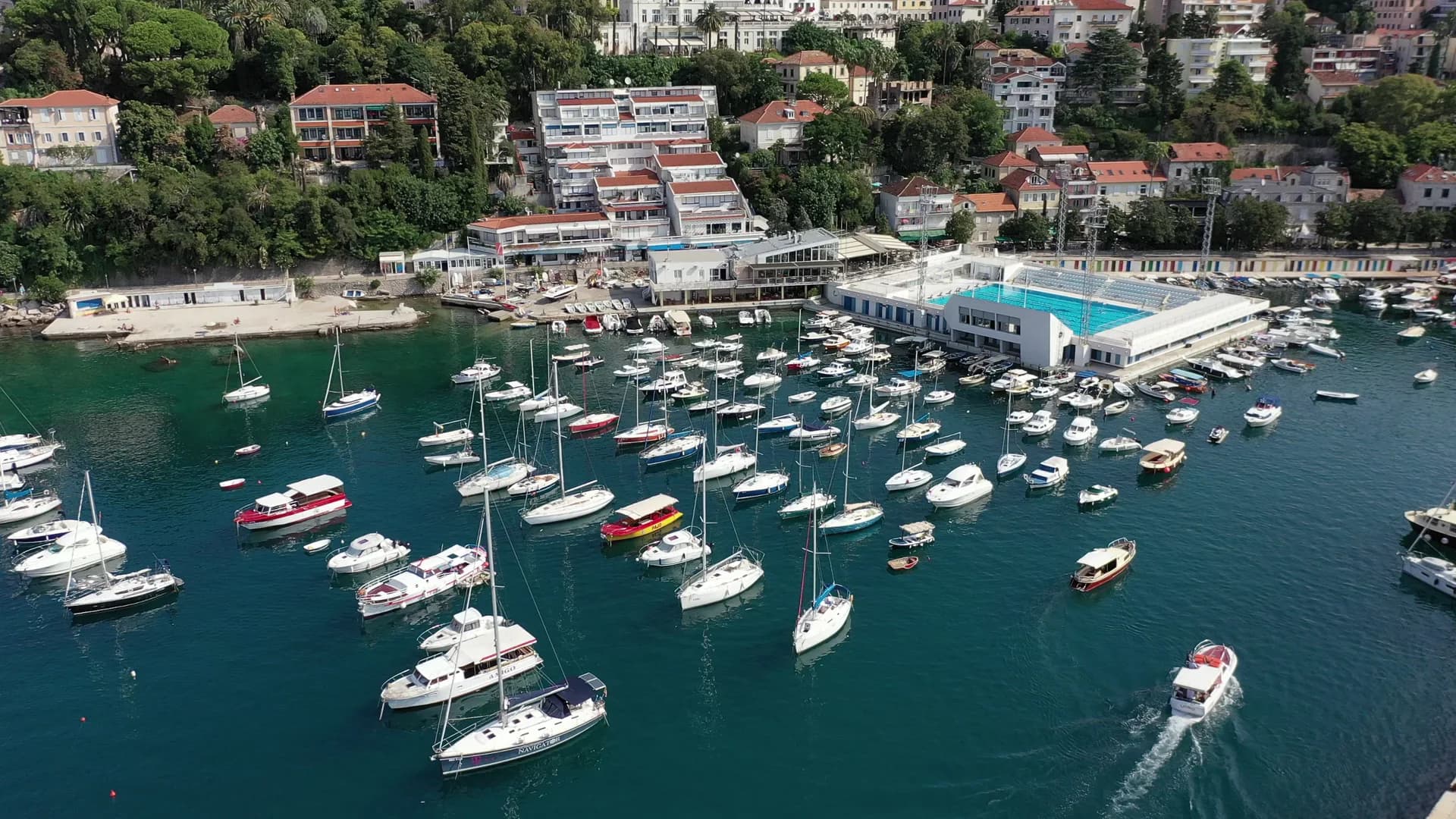
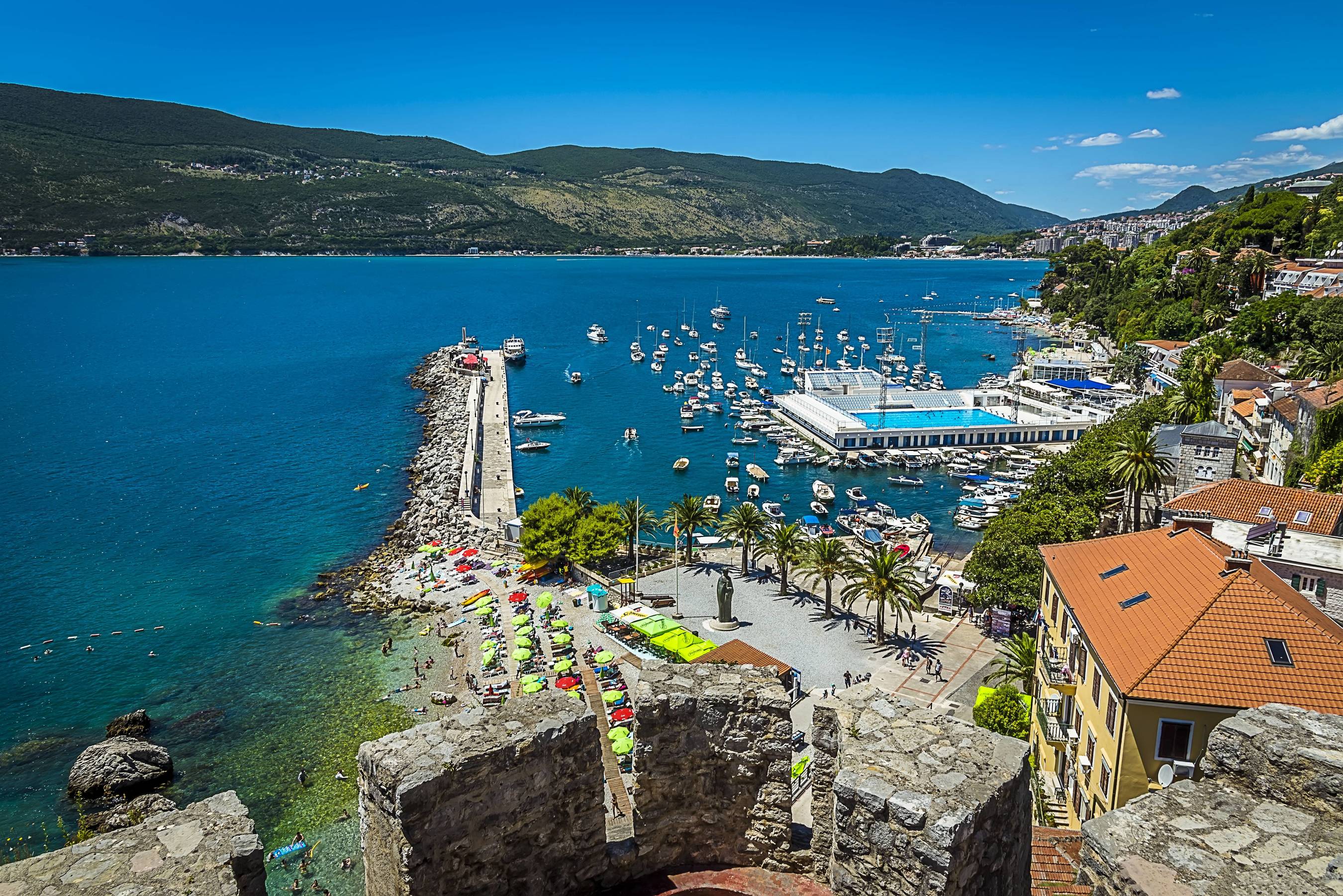
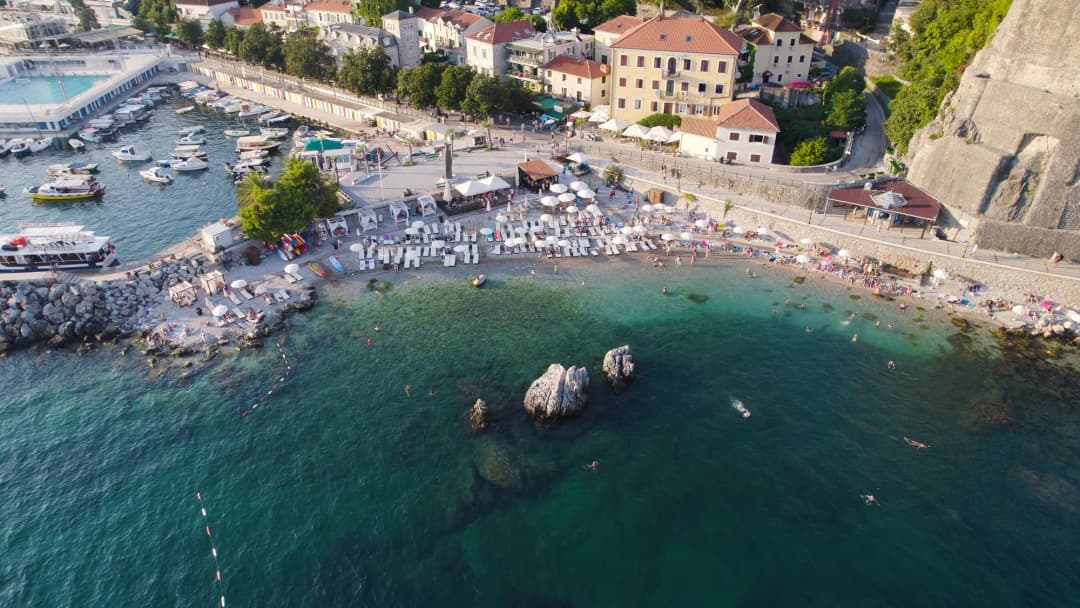
Directly below the Old Town at the waterline sits Forte Mare, the sea fortress, above the Gradska plaža (town beach) and the harbour, Škver. Its foundations date to the 14th century, but it reached its current form under Ottoman rule, when cannons and defensive walls were added. Venice took the town on 30 September 1687 and gave the fortress its Italian name; Austria then raised and reinforced the upper works, the silhouette you photograph today. It became a summer stage in 1952 and films have run there every season since, which makes it one of the oldest working open-air cinemas in Europe. The 1979 earthquake damaged it badly and the rebuild followed a 1984 project. Today it has a summer cinema, a cafe built into the walls and a view down the bay toward Mamula and Luštica. Nearby are the Kusturica cineplex-cinema "Aurora", the house of the painter Vojo Stanić and the pool of the water polo club "Jadran".
Kanli Kula
Higher up is Kanli Kula, the "bloody tower," built in 1539 at 85 metres above sea level after the Ottoman recapture of the town. It served as stronghold and prison, controlling the town and the entrance to the bay: where Forte Mare guards the sea, Kanli Kula guards the land.
The interior became a summer stage in 1960 and an open-air amphitheatre by 1966. The tourist organisation puts the seating at 1,000, expandable to 1,500; the summer programme runs to film, concerts, opera and theatre.
Španjola (the Spanish fortress)
At the very top of the Old Town, in what was once the Upper Town, the Spanish Fortress commands the highest ground. The Spanish captured Herceg Novi from the Ottomans in 1538 and began building this hilltop fortification. They held the town for only nine months before the Turks recaptured it, but they left behind the foundations of a fortress that still bears their name. The Ottomans completed the construction a decade later.
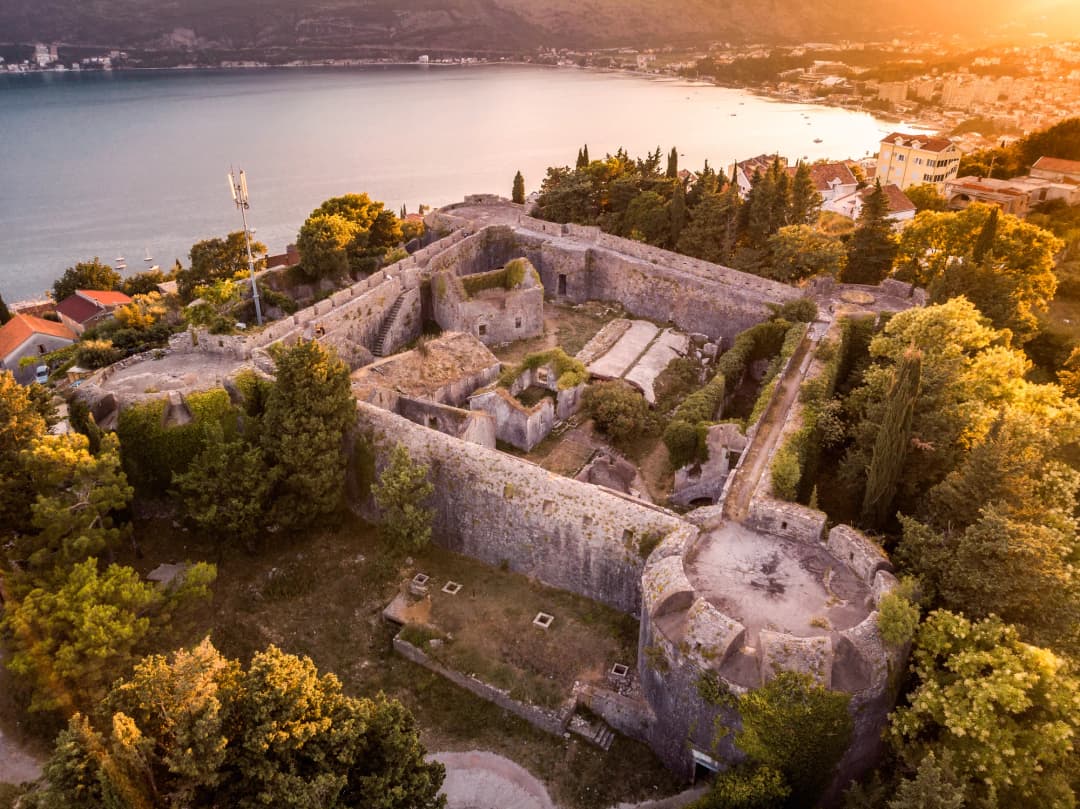
The climb is steep — the fortress sits at about 170 metres, above the Savina district — and the reward is a 360-degree panorama of the bay, the mountains and the open Adriatic. There is no ticket office and no opening time. Nothing has been garrisoned here in a century, the curtain wall is breached in places, the interior is roofless and there is a good deal of spray paint. Nobody will stop you falling off it either, so keep away from the wall heads in wind and take a torch if you go near dusk. Underground passages once connected Španjola to both Kanli Kula and Forte Mare. Walkers heading further uphill can use the Mountain House – Subra, the base for hiking in the hills behind the town.
What to do in Herceg Novi
Squares, churches and streets
Herceg Novi has two main squares. The lower one, Trg Nikole Đurkovića, formerly Salt Square after the trade the town was founded on, is the everyday social heart. Up through the Clock Tower is Belavista, the “beautiful view” square, in the heart of the Old Town.
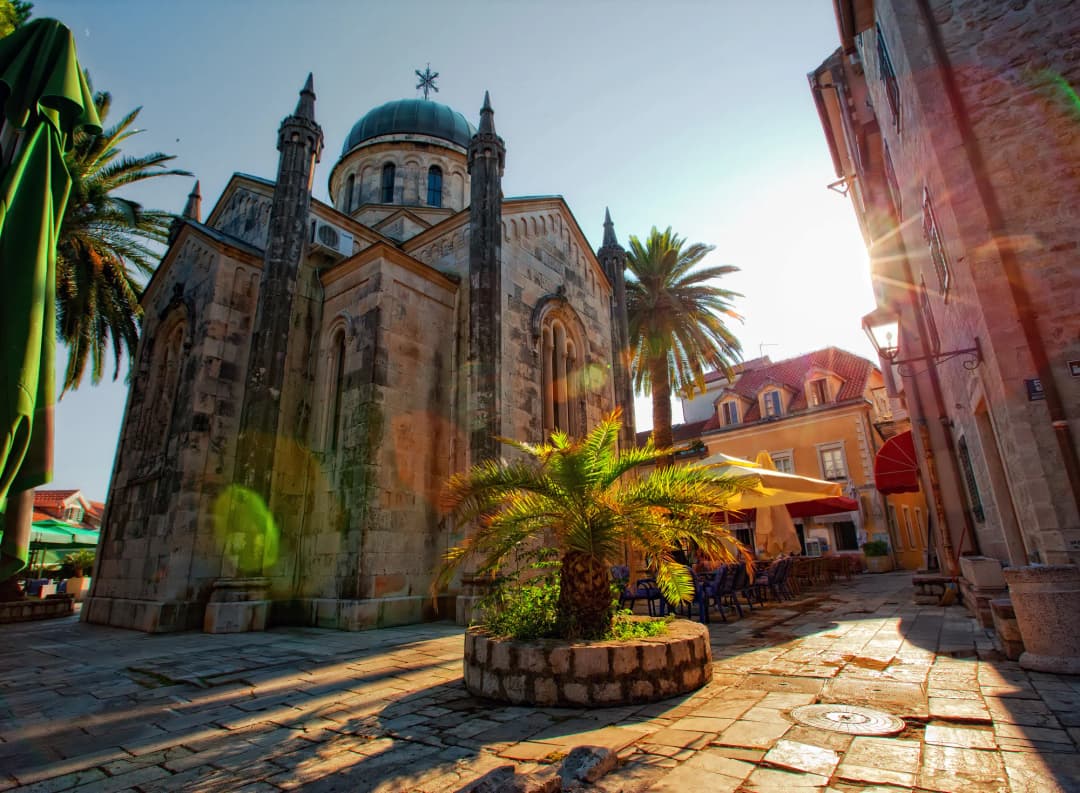
Belavista is dominated by the Orthodox Church of St. Archangel Michael, built in the Byzantine style with elements of the Orient and unique for its stone iconostasis; the city Archives, the Library, Radio Herceg Novi and an art gallery stand around it.
Down the stairs from Belavista are the Catholic Church of St. Jerome, which holds a rich treasury, and the church of St. Leopold Mandić, the Novljanin. A Ginkgo biloba grows in the street-staircase named after the writer Marko Car. In the church of St. Ascension of Christ, in the former suburb of Toplo, Petar II was once taught to read.
The main street, Njegoševa, runs from the square all the way to Igalo, past boutiques, the City Tavern, the City Park and the Main Post Office, and is crossed again and again by the streets-stairs for which the city is famous.
A botanical garden by the sea
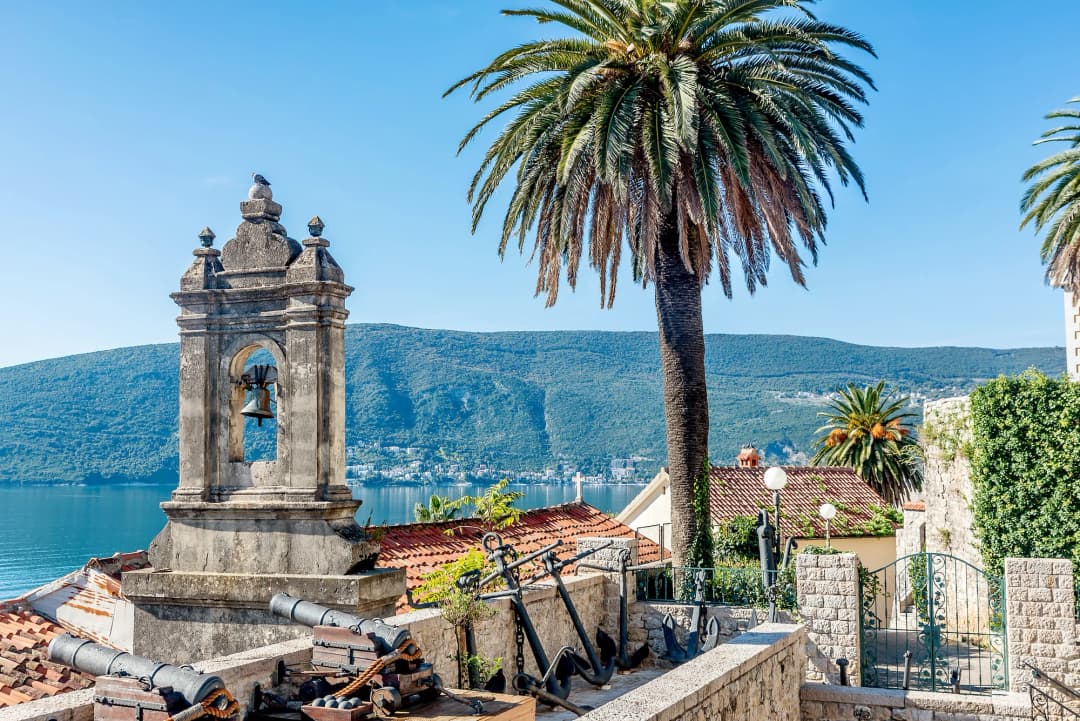
For centuries sailors brought home seeds of exotic plants, which is why Herceg Novi, the City of Greens, became a botanical garden over time. The seafront promenade carries the largest outdoor exhibition of exotic plants in the country: palms, cacti, bananas, magnolias, mimosas, wild oranges, camellias, pittospores, oleanders and eucalyptus.
Savina Monastery
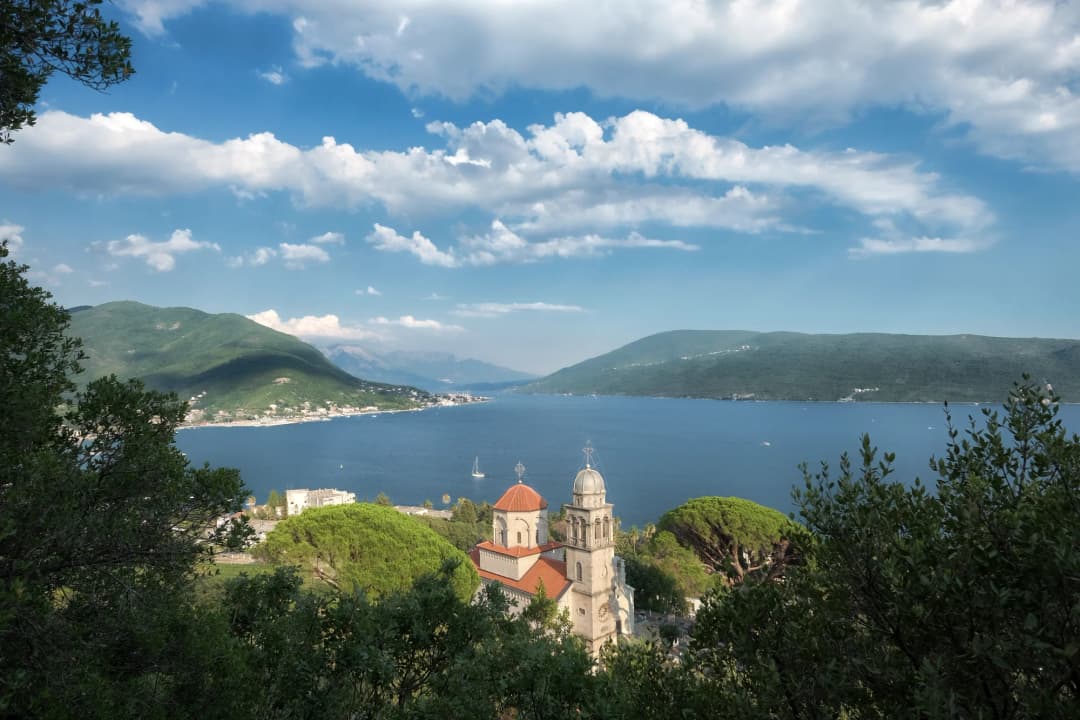
A 20-minute walk east of the Old Town, on a wooded hillside, Savina Monastery is one of the most important Serbian Orthodox monasteries on the Adriatic coast. The site dates back to the 11th century; its current form took shape in the 17th and 18th centuries, when monks fleeing the Ottoman conquest of Bosnia and Herzegovina found refuge here.
The complex contains three churches. The oldest is the Small Church of the Dormition, traditionally dated to 1030 from an inscription added in 1831. The Church of St. Sava Srpski, on a nearby hill, is believed to have been built by Saint Sava himself in the 13th century. The Great Church, also dedicated to the Assumption, was built between 1777 and 1799 by Nikola Foretić of Korčula, in a blend of Byzantine, Romanesque and Dalmatian Baroque. Its iconostasis is by Simeon Lazović. Much of the treasury arrived with monks fleeing the Ottoman conquest of Herzegovina, who brought it from the monastery of Tvrdoš.
The monastery treasury and library house a crystal cross attributed to Saint Sava from the 13th century, a handwritten Gospel from 1375, silver-gilt icons and historical documents.
Dress modestly — covered shoulders and knees — and keep quiet during services. Entry is free and there is no ticket office; donations are welcomed. No opening hours are published: the churches are normally open through the day and the treasury is shown at the monastery’s discretion, so a weekday morning is the safe bet.
Museums and galleries
City Museum (Mirko Komnenović Museum): archaeological, ethnographic and maritime collections in a historic villa with a botanical garden.
Mikhail Bulgakov Museum: opened in 2020, the first international museum dedicated to the Russian writer.
Ivo Andrić House: the Nobel laureate's seaside residence, now the Writers' Club and a garden stage.
Villa Galeb: the former summer residence of Yugoslav president Josip Broz Tito, on the waterfront in Igalo.
Art galleries: the “Josip Bepo Benković” gallery and the Sue Ryder gallery showcase regional and international art.
The Pet Danica promenade and beaches
Šetalište Pet Danica
The seafront promenade, Šetalište Pet Danica, stretches from Igalo to Meljine: about 7 km, laid along the bed of the old Zelenika railway, and free from end to end. The 5 km and 6 km figures still in circulation predate the final section. The municipality completed the walk on 20 June 2025 by opening the last 1.7 km, Hotel Plaža at Savina to Hotel Lazure in Meljine — a €1.5m job that paved and lit the promenade along its whole length for the first time since it was built. Counted with its spurs, from Njivice in the west to Bijela in the east, the walkable seafront corridor runs 18.1 km. At an unhurried seaside pace the 7 km core is about an hour and a half one way, and it is the one walk in Herceg Novi with no stairs.
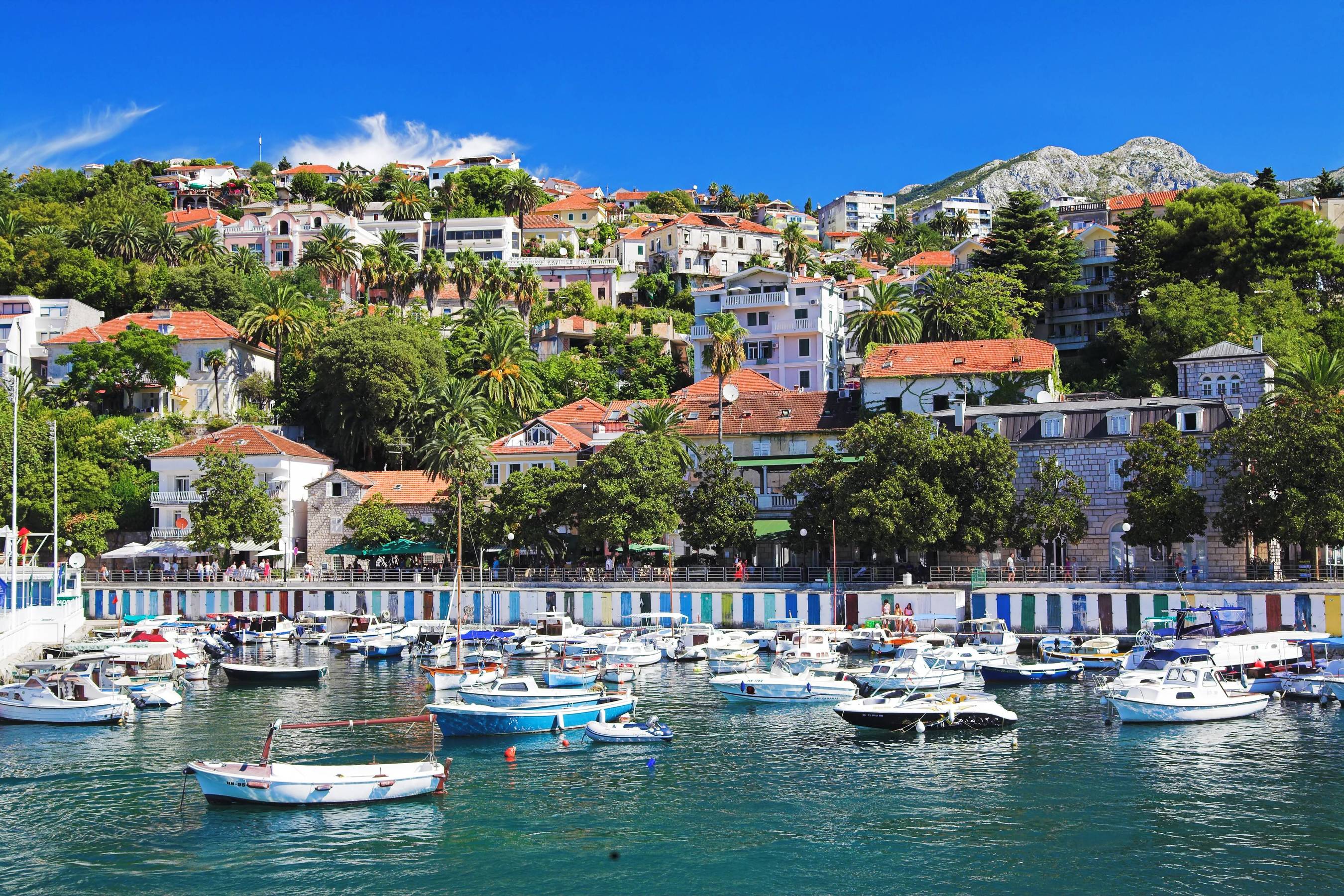
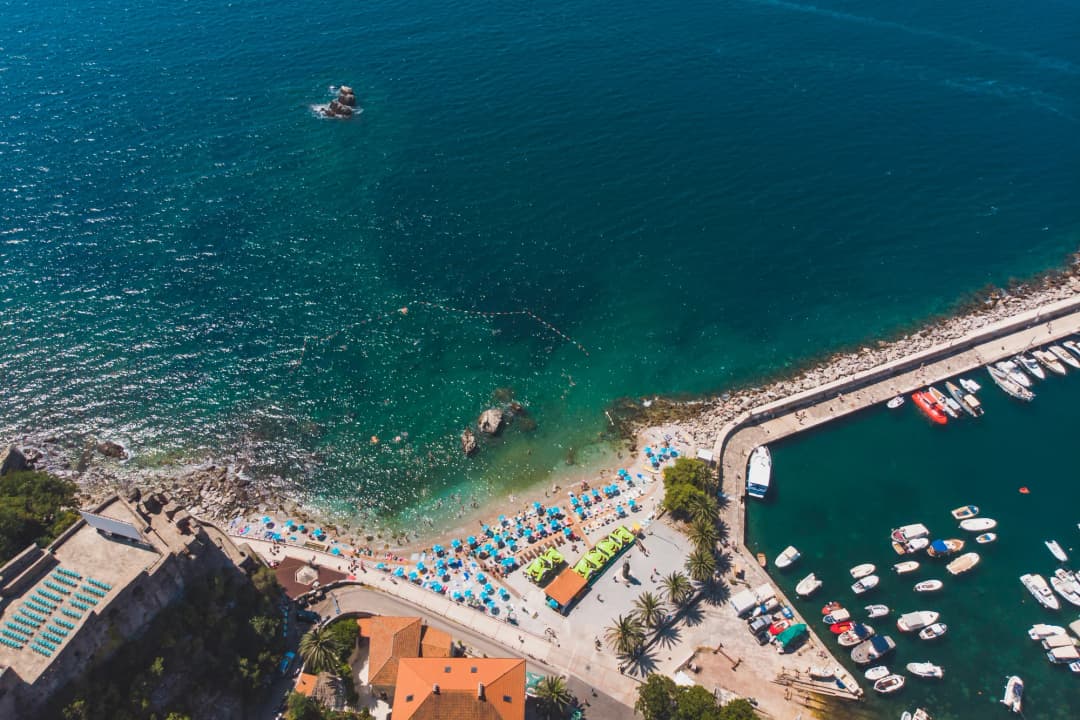
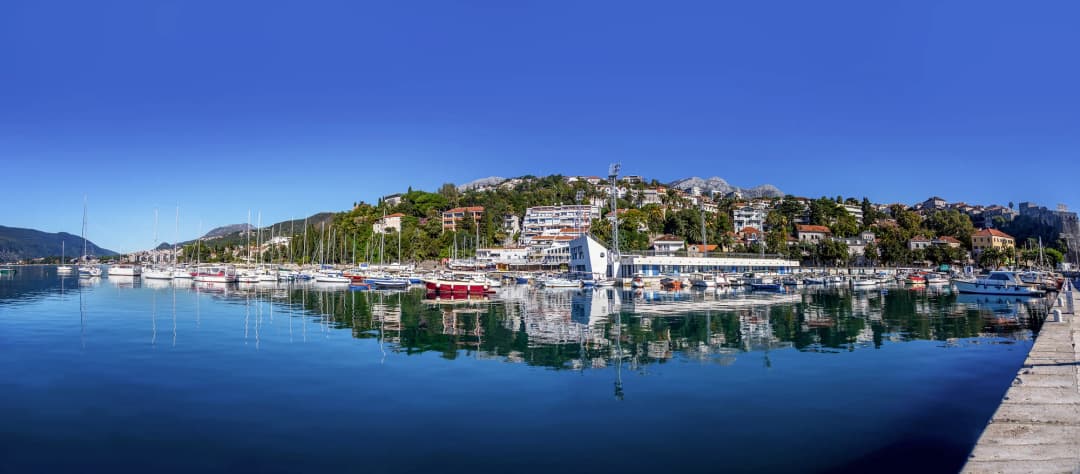
Along the way you pass the harbour, Škver, which means Shipyard, because a shipyard used to stand there.
The promenade is the natural evening walk, linking the cafe terraces end to end.
Beaches
At the entrance to the bay, the water is among the cleanest in the Bay of Kotor, refreshed by open Adriatic currents. There are no long sandy stretches: expect pebbly coves, concrete bathing platforms and spots reachable only by boat.
Much of the swimming here is straight off the built waterfront rather than from a beach.
Gradska plaža, the main town beach, sits directly below Forte Mare and the Old Town — a concrete and pebble affair, fine for a quick swim and steps from cafes and restaurants.
Igalo is the family end, and it is not sandy, whatever you read. The national tourist board measures the shore at 1,500 metres of pebble and concrete bathing platforms; what makes it work for children is the gradient: the water shelves so gently that a toddler can wade a long way out. The therapeutic mud collects at the western end, at Blatna plaža (Mud Beach), which the tourist board lists with a mud surface of 9,000 m². Using it costs nothing; two sunbeds and an umbrella on an organised stretch run about €8–14. Locals also call the mud beach Stara Banja or “the beach by Tito’s villa”.
Pebbles rather than sand, so water shoes and a mat are worth packing.
Žanjice, on the Luštica Peninsula across the strait, is widely regarded as one of the most beautiful beaches in the Bay of Kotor: about 300 metres of white pebbles sloping into very clear water, with views to Mamula Island, sun loungers, restaurants and changing facilities. Most visitors arrive by taxi boat from the Herceg Novi waterfront, a 20-minute ride. It is the beach stop on the scheduled half-day excursion, and a local shuttle runs from it to the Blue Cave and back with a swim stop for about €10–15.
Mirište, next to Žanjice but quieter, is a pebble cove with good snorkelling. You can swim out to a small island with a chapel dedicated to Our Lady of Mirište, and the ruins of the Arza Fortress are nearby. Further along, the Luštica coast has smaller coves reachable only by boat or on foot, with no facilities at all.
Nearby: Igalo, the riviera, Rose and boat trips
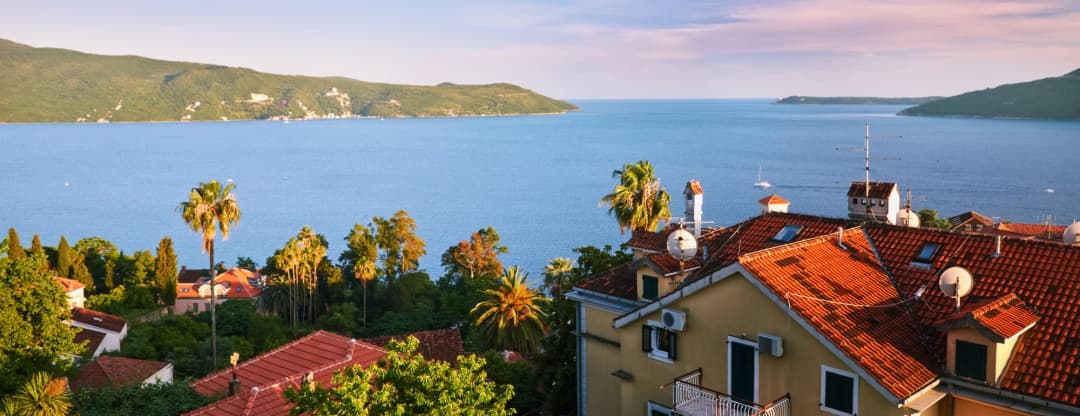
Herceg Novi anchors a riviera stretching 25 kilometres along the northern shore of the Bay of Kotor, a string of smaller settlements connected by the coastal road and the waterfront promenade.
The rocky stretches stay quieter than the organised beaches even in August.
Igalo, joined to Herceg Novi by the promenade, is built on health tourism: mineral-rich sea mud and natural mineral springs. Its centrepiece is the Institut Dr Simo Milošević, founded in 1949 and now one of the largest institutions for physical medicine and rehabilitation in southeastern Europe. It counts 767 accommodation units and about 19,000 users a year on its own front page (more on its history pages, so read these as scale). Its physiotherapy college of 1976 became the Faculty of Applied Physiotherapy in 2004, making the Institute a member of the University of Montenegro.
It publishes its prices. On its last list, therapy came as a daily package on top of the room in three tiers — roughly €45, €57 and €74 a day — with a half-board room from about €64 per person per day out of season, more in summer. Packages are only for guests staying at the Institute and single treatments are not listed, so ask when you write with your dates.
The mud, igaljsko blato, collects in the shallows along the shore. The Institute dates the scientific confirmation of its properties to 1935, at Vichy in France, though locals had used it for joint pain, skin conditions and rheumatic complaints for generations. At Blatna plaža it is, as the state tourist board says, a free treatment on a public beach, a few hundred metres from a clinic that charges for the same mineral. Mineral springs called igaljske slatine emerge along the shoreline and have long been drunk for digestion.
Meljine, Zelenika, Njivice and the riviera villages
Njivice, to the west, is where the 18.1 km seafront corridor begins. Meljine, three kilometres east at the end of the promenade, has its own beaches and the Lazareto, a former quarantine station that is one of the oldest in Europe. Zelenika, further east, is named after a Mediterranean evergreen and has the first hotel ever built in Montenegro, from 1902. Kumbor (from the Italian conborgo, suburb) has some of the best-placed waterfront restaurants. Djenovići claims a Greco-Roman history; Baošići, at the peak of Boka seafaring, had over 30 ships and 50 captains. Bijela, the easternmost settlement, is the starting point for the Kamenari-Lepetane ferry crossing to the other side of the bay.
Portonovi and Luštica Bay
At Portonovi, in Kumbor, a superyacht marina is paired with the One&Only Portonovi resort and an Espace Chenot wellness spa. Across the bay, Luštica Bay combines a marina, an 18-hole golf course, the Chedi hotel and residential villages.
Rose is a tiny fishing village at the tip of the Luštica Peninsula, about ten minutes by taxi boat from the Herceg Novi waterfront at €5–10 each way. It was Venice’s quarantine port before Meljine took the job, and it is now essentially a lunch with a hamlet attached: grilled fish on a single waterfront, reckon €40–70 for two. Some tours also visit a nearby former Yugoslav submarine tunnel carved into the cliffs.
Boat trips: Mamula, the Blue Cave and Žanjice
The classic route leaves the Pet Danica promenade or Škver harbour and heads south along the Luštica coastline to Mamula Island, the Blue Cave and Žanjice beach. What it costs depends entirely on which of these quite different products you buy, and the ranges get quoted interchangeably, so here they are separated:
Most excursions leave from these berths, and skippers post departure times on boards at the quay.
Trip
What it is
Fare
Leaves
Scheduled half-day: Mamula, Blue Cave, Žanjice
A named operator on a timetable — Petar Boats runs the version most visitors take
€30 per person · €15 age 6–11 · under 6 free
Škver 09:05 and 12:40; La Bamba, Igalo 08:55 and 12:30
Taxi boat to Rose
The ten-minute hop across to the fishing hamlet, for lunch
€5–10 each way
On demand from the waterfront
Žanjice–Blue Cave shuttle
A short run from the beach with a swim stop, once you are already over there
€10–15
Through the day in season
Private hire
Your own skipper and your own stops
Quoted €30–60 for a long day
By arrangement
Prices checked September 2026. Plan against the scheduled fare. The €15–25 you will see quoted for a “short trip” is the beach shuttle or a share of a private hire, not the timetabled boat.
Mamula is a small rocky island with a circular fortress built in the 1850s by the Austrian general Lazar Mamula, an internment camp under Italian occupation and now a hotel, Mamula Island by Banyan Tree. Excursion boats circle it but do not land; the hotel runs its own transfer from Mirišta on Luštica for guests.
The Blue Cave (Plava Spilja) is a sea cave where sunlight enters through an underwater opening and lights the interior blue. It is a protected site and viewing only: boats stop at the mouth, then anchor behind the cave for a swim. The effect is strongest on sunny mornings, which is the argument for the 09:05 departure from Škver over the 12:40.
Getting there and around
The nearest airport is in another country and the nearest domestic one is across the water, so the difference between a good journey and a bad one is usually a queue rather than a distance.
By air: three airports, three routes
Airport
Road
Driving
Cost
The catch
Dubrovnik (DBV / Ćilipi), Croatia
28 km
about 30 minutes
Transfer or taxi; bus and car combinations from €4
The Debeli Brijeg border. Thirty minutes becomes ninety in an August queue.
Tivat (TIV) — via the Kamenari–Lepetane ferry
20–25 km
about 35–45 minutes
Taxi €50–65; bus from €1
Depends on the ferry. In peak season the ramp queue is the journey.
Tivat (TIV) — the long way round the bay
46 km
about 1 h 10 m
Same
No queue, no crossing. Use it when the ferry is backed up.
Podgorica (TGD)
113 km measured; the municipality’s own sheet says 133 km
about 2 h 25 m
Bus €7–50; Alo Express three times daily
Furthest, but no border and the most domestic connections.
The tourist organisation gives Tivat as “about 20 km” and our own record says 25 for the ferry route; the road round the bay is 46 km. The two Podgorica figures are the measured road distance and the municipality’s own sheet.
The Kamenari–Lepetane ferry
Kamenari → Lepetane
Verige Strait crossing
By ferry5 min
Round the bay45 min
Car, passengers included
€4.50
Motorcycle
€2
On foot
€1
Runs 24 hours a day, all year, with a boat every 10 to 15 minutes.
0006121824
No wait
Up to one sailing
30–45 min queue
This ferry is the key link between Herceg Novi and the rest of the Montenegrin coast. It crosses the Verige strait, 350 metres wide at the narrowest point of the Bay of Kotor, and saves roughly 30 km of driving round the shore. In peak season boats leave as soon as they are full; the tourist organisation lists the route as running 24 hours a day.
Vehicle
One way
Source
Foot passenger
Free
Our own 2026 check at the ramp
Bicycle
€1
Our own 2026 check at the ramp
Motorcycle
€2
Municipal tourist organisation tariff
Car or van
€4 or €5 — the sources disagree
Tourist organisation publishes €4.00; our own 2026 check came back €5
Larger vehicles
€8–25
Our own 2026 check
Carry €5 in coins for a car and you are covered either way; the €4.50 that circulates matches no published tariff. Crossing times of five, ten and fifteen minutes are all quoted, but the queue is what costs you the morning: on an August Saturday allow half an hour at the ramp, and take the long way round if the line is past the bend.
By bus, taxi and car
The bus station has regular services to Kotor (1 to 1.5 hours), Budva (2 hours), Podgorica (2.5 hours), and Dubrovnik (1.5 hours). The town bus is €1.50 a journey along the riviera; taxis are metered at €0.90 per kilometre, both figures from the tourist organisation. Water taxis run to the Luštica beaches in summer. In town, walk, and prepare for stairs. Parking near the Old Town is the hard part of a summer visit.
Parking, in four colours
The municipality runs four paid zones, and the useful thing is not the price but the time limit:
Zone
Where
Time limit
Rate
Purple
The busiest streets of the strict centre; runs all year
1 hour, re-parking allowed after 60 minutes
Not published
Red
Centre, by the post office and the banks
None — pay by the hour, or buy a day ticket
Not published
Blue
Central Igalo
None
Not published
Yellow
Quieter streets, parts of both Igalo and Herceg Novi
None
Not published
No rate is published: the tourist organisation sets out the zones, the SMS payment codes and the charging periods, but the tariff lives with the operator, parkinghn.me, and on the machine at the bay.
When you pay: 07:00–21:00 from 1 October to 1 June, and 07:00 to midnight through June and through September — both bands every day except Sunday, which is free. From 1 July to 1 September it is 07:00 to midnight every day, Sundays included. If you are arriving in high summer and the Old Town is your target, park once in a no-limit zone and walk — the purple hour will beat you.
Small fixed costs and practical tips
Residence tax: €1.00 per adult per night, €0.50 for ages 12–18, nothing under 12. Your host collects it; it is usually not in the room rate.
Excursion tax: €1.00 a head on organised groups visiting the Old Town, again free under 12. It does not apply to you if you arrive under your own steam.
Free, and worth knowing: the Pet Danica promenade, Španjola fortress, Savina Monastery, the mud at Blatna plaža and the Orjen nature park. That is most of the best of Herceg Novi at no charge.
Currency and language: the euro; cards are accepted at most restaurants and hotels, but smaller shops and konobas may prefer cash. English is widely spoken in tourist-facing businesses.
Water and safety: tap water is safe to drink and the town is very safe. The steep Old Town streets can be slippery after rain.
Accessibility: the 7 km promenade is flat the whole way, but the Old Town is steep and full of stairs.
Emergencies: police 122, fire 123, ambulance 124, roadside assistance 19807. Tourist information offices open Monday to Saturday; the two in Igalo, the one on the main square and the one at Meljine stay open to 21:00, while the desks at the bus station, Škver, Zelenika, Baošići and Kamenari shut at 14:30.
Best time to visit and festivals
June and September offer the best balance of warm weather, swimmable seas and fewer crowds. July and August are hottest and liveliest. May and October are excellent for sightseeing and hiking. February and March bring the Mimosa Festival. The climate is Mediterranean, averaging 16.2 C over the year, with more than 200 sunny days.
Mimosa Festival (Praznik Mimoze)
Held annually since 1969, the Mimosa Festival is Herceg Novi’s signature event. Celebrated across February and March, it marks the blooming of the city’s mimosa trees – yellow-flowered plants originally brought from Australia by Boka sailors. The programme runs to parades and masquerades through the Old Town, flower exhibitions, sports events, concerts and folklore, and the “Fešta od mimoze, ribe i vina” (Feast of Mimosa, Fish, and Wine), which draws approximately 20,000 visitors.
It is a carnival as much as a flower show: masquerade balls, brass bands and majorettes along the promenade, and at the end a life-size effigy burned on the waterfront to see winter off. The mimosa flower has become the enduring symbol of the city itself [19][21][22].
Herceg Fest posts the programme each January and it moves with the bloom and the carnival calendar, so do not book flights around a specific parade. The Fešta weekend is the one to aim at.
Herceg Novi Film Festival (Montenegro Film Festival)
Montenegro's most significant film festival, held for over three decades, shows more than 60 productions in feature, documentary and student competitions under the slogan “All colors of film.” Features screen in Kanli Kula fortress, documentaries in the garden of the House of Nobel laureate Ivo Andric [23].
It is run by JUK Herceg Fest, the municipal institution that has programmed the town’s culture since its founding in 1996. Herceg Fest dates the idea of a festival on Kanli Kula to 1987, when the First Yugoslav Festival of Film Directing was held there. Admission is by event ticket, priced per edition.
The festival calendar
Herceg Novi programmes almost every month of the year. Herceg Fest runs eight of the festivals below; the Music Scale Festival and Sunny Rocks are town fixtures it does not:
Festival
When
Since
Where
Mimosa Festival (Praznik mimoze)
February and March
1969
Old Town, promenade, harbour
HAPS — Herceg Novi April Theatre Festival
April
1996
Town venues
Days of Music (international art music)
10–20 July
Long-running
Town venues
Music Scale Festival
July
—
Kanli Kula
Guitar Art Summer Fest
15–20 August
—
Kanli Kula
Herceg Novi Film Festival
Summer
Idea from 1987
Kanli Kula; Andrić garden for documentaries
Operosa Montenegro Opera Festival
Summer
Organisation founded 2006
Open-air stages
Jazz Bay
The last ten days of August
2013
Waterfront stages
Herceg Novi Comic Art Festival
Six days from the first Friday in September
2007
Town venues
Sunny Rocks
Summer
—
Kanli Kula
The Music Scale Festival takes its name from the town’s streets-stairs. Exact dates and ticket prices are set per edition and go up on hercegfest.me.
Evenings
Herceg Novi is not a party town in the way that Budva is. Evenings mean cinema in a sea fortress, open-air opera and long hours at waterfront cafes; both squares fill on summer nights, and espresso is €1.30–1.80. A few waterfront bars stay open late with cocktails and live music.
Suggested itineraries: how many days in Herceg Novi?
The Old Town is compact, but the coast, mountains and islands reward a longer stay. Allow 3-4 days to enjoy the town without rushing; four to five days adds beach time and a day trip to Kotor or Dubrovnik; a full week suits hiking on Mount Orjen or Igalo's spa treatments.
One day in Herceg Novi
Start with a morning coffee on Belavista (Herceg Stjepan) Square, then climb up to Kanli Kula for panoramic views before exploring the Old Town, the Clock Tower (Sahat Kula) and Forte Mare. Walk a stretch of the Šetalište Pet Danica seafront promenade, stop for fresh seafood at a konoba such as Konoba Škver, and finish with an evening drink at one of the waterfront cafés like Fabrika or Koffein.
Two days
Add a half-day boat trip to the Blue Cave, Žanjice beach and Mamula Island, then spend the afternoon at the Savina Monastery and unwinding in Igalo, home to the healing sea mud and the Dr Simo Milošević Institute spa.
Three to four days
With more time, take a day trip deeper into the Bay of Kotor (Perast and Our Lady of the Rocks), hike in the Orjen mountains, tour a local winery, and visit the village of Rose on the Luštica Peninsula.
Day trips from Herceg Novi
Distances and driving times are Rome2Rio’s measured figures; bus fares are the ranges its listed operators charge.
Destination
Road
Driving
By bus
Risan (Roman mosaics)
21 km
about 40 minutes
€3–10
Perast and Our Lady of the Rocks
25 km
about 45 minutes
€7–20
Kotor
38 km
about 60 minutes
€6–16
Dubrovnik
47 km
about 53 minutes plus the border
€7–24
Mount Orjen (Veliki kabao, 1,894 m)
Trailheads above the town
—
No entrance fee
Kotor is a UNESCO World Heritage Site and one of the best-preserved medieval centres in the Mediterranean, with the San Giovanni fortress climb behind it; the Kamenari–Lepetane ferry cuts the corner, and buses run all day.
Perast is a tiny baroque town of palaces and bell towers on the eastern shore. Boats to Our Lady of the Rocks leave from its waterfront: the island is man-made, and its church holds votive paintings left by sailors and a tapestry a local woman is said to have stitched over twenty-five years using her own hair.
Risan, the oldest settlement on the bay and once the capital of the Illyrian queen Teuta, has Roman mosaics from the 2nd century, including a rare depiction of the Greek god Hypnos.
Dubrovnik: the Debeli Brijeg border is about 9 km from Herceg Novi and the drive itself is 53 minutes, but plan on about 90, because in July and August the border can take twenty minutes or an hour and a half. Go early.
Mount Orjen rises directly behind the town; Veliki kabao (1,894 m) is the highest point of the coastal Dinarides and of the Montenegrin littoral, and this is one of the wettest places in Europe. There is no entrance fee and no gate; the Mountain House at Subra, above Španjola, is the usual base. Carry water: the karst holds none at the surface.
Where to stay
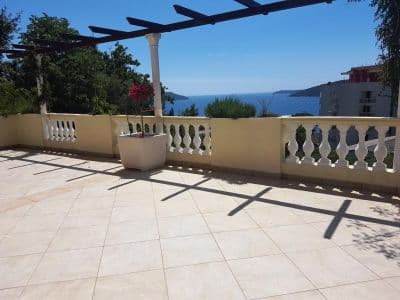
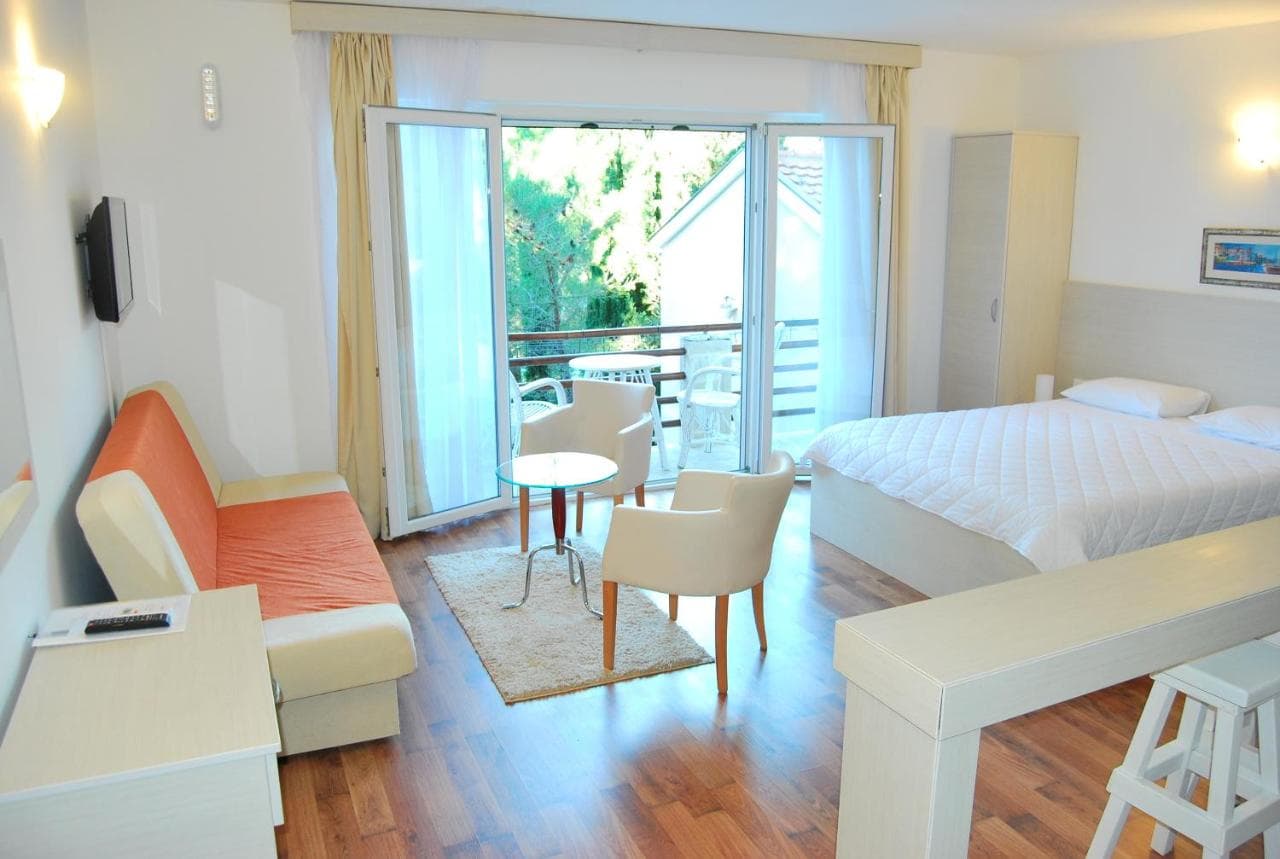
Old Town: boutique hotels and stone apartments steps from the fortresses, but steep. Igalo: the family and wellness end, flat, with the Institut Dr Simo Milošević at hand. Savina: quieter and residential, with long views down the bay. Meljine: the eastern end of the promenade, three kilometres out — five minutes by car, about forty on foot along the seafront, not the fifteen minutes often quoted.
Six places to start, one for each way of using the town:
Private apartments (apartmani) are good value in all these areas. For the hinterland, Planinska kuća Vrbanj sits in the Orjen foothills above the town.
Where to eat and drink
Seafood dominates: fresh fish, grilled octopus, mussels, black risotto and the local speciality buzara. The promenade and Škver harbour are lined with fish restaurants, most buying directly from local fishermen; inside the Old Town, terraces serve Montenegrin dishes. Street prices in the summer of 2026:
Item
Herceg Novi
At the Portonovi marina
Espresso
€1.30–1.80
€2.50–4.00
Beer, 0.5 l
€2.50–3.50
—
Dinner for two, konoba, with wine
€30–45
€60–120
Mussels buzara, a kilo, from the bay’s own farms
€12–15
—
Two sunbeds and an umbrella
€8–14 (Igalo)
€25–50 (beach club)
The Portonovi column is nine kilometres up the same shore, and it prices in the yachts. That gap is the single most useful thing to know about eating on this riviera.
Gradska Kafana, the City Tavern, in an Empire-style building on Njegoševa, has served since 1924: a coffeehouse with a terrace upstairs, the restaurant below, both facing the sea.
The konobas (traditional taverns) serve buzara (shellfish in wine, garlic, and breadcrumbs, or in a tomato-based sauce), black risotto, grilled fish and Njeguški steak stuffed with prosciutto and cheese. Try Konoba Kruso (seafood on the Pet Danica promenade), Konoba Feral (Mediterranean and grilled meats) and Tri Lipe (traditional Montenegrin fare), and a glass of Vranac, Montenegro's signature red.
Wineries
Small family wineries in the hills and on Luštica offer tastings with cheese, olive oil, prosciutto and figs; the Savina neighbourhood has gained particular attention:
Savina Winery: set beside the historic Savina Monastery, known for whites and rosés.
Castel Savina: producing award-winning Merlot, Chardonnay, Cabernet Sauvignon, and Rose wines [25][26].
Delić Wines: a respected boutique producer focused on indigenous Montenegrin grapes.
Damarius & Malvasija Karaman: Luštica-area cellars producing the local Malvasija white among other varieties.
The city of writers, and how it compares with Kotor
Herceg Novi is also called the City of Writers: Aleksa Šantić, Simo Matavulj, Ivo Andrić, Mihailo Lalić, Stevan Raičković, Dušan Kostić and Zuko Džumhur all worked here. Andrić's house is now the Writers' Club, with the Native Museum beside it, and contemporary writers turn up at the bookshop Knjižara So on the main square.
Its other nicknames are City of the Sun, City of a Thousand Steps, City of Mimosa and City of Greens. Kotor is dominated by Baroque stone palaces; Herceg Novi by villas and gardens.
What visitors say tends to repeat:
“A hidden gem” – none of the mass tourism of Kotor or Dubrovnik [20].
“Much cheaper than Dubrovnik” – lower prices and less crowding, even in July and August [20].
“The stairs are real” – charming and physically demanding [9][10].
“Stunning bay views everywhere” – nearly every terrace looks over the Bay of Kotor [6].
“A city that feels alive, not a museum” – the Old Town has a lived-in quality, with local residents going about daily life [20][26].
“Perfect base for exploring” – for boat trips to the Blue Cave, Mamula Island, and Lustica Peninsula, and day trips to Kotor and Dubrovnik [33].
Living in Herceg Novi
Herceg Novi has an established expatriate and retiree community and is generally cheaper than Budva or neighbouring Croatia. A couple can live comfortably from roughly €1,300–1,600 a month, with one-bedroom rents in the centre around €500–650. Asking prices run about €2,000–2,800 per square metre, against €4,500–7,000 at the Portonovi residences. Buying property of almost any value can qualify foreigners for temporary residency, and US, UK and Canadian citizens can stay visa-free for 90 days in any 180.
A brief history of Herceg Novi
Six flags in six centuries, and every one of them left a fortress.
1382: a king who needed a salt port
In 1382 the Bosnian king Tvrtko I Kotromanić, having failed to seize Kotor, and squeezed by a Ragusan trade embargo, raised a new fortress on a fishing settlement at the mouth of the bay and declared it a salt-trading centre — the youngest medieval town on the eastern Adriatic, and the reason its name means “new”. He called it after Saint Stephen, Sveti Stefan, but locals said simply Novi. After his death the town passed to the Kosača lords of Hum, and Duke Stjepan Vukčić Kosača held the title of herceg. Combine the title with the name and you have Herceg Novi, the duke's new town.
1482–1687: two Ottoman centuries, and one Spanish year
The Ottomans took the town in 1482, destroyed it again in 1493 and again in 1508, and then held it for two hundred years. They gave the place its skyline: the clock tower at the gate, the bulk and the crenellated crown of the sea fortress, the gun ports cut into it, and a further expansion around 1551. In 1538 a Spanish force took Herceg Novi by surprise and began a fortress on the high ground; they held the town for nine months before Hayreddin Barbarossa, admiral of the Ottoman fleet, retook it in 1539. The Ottomans finished the fortress the Spanish had started, and it has been called Španjola ever since.
1687–1797: Venice at the mouth of the bay
Venice opened its siege on 1 September 1687, during the Morean War. Girolamo Corner, with Montenegrin forces under Vuceta Bogdanović, beat the Ottomans outside the walls and pressed the fortress for a month. The Holy League drained the spring at the foot of the fortress, and the garrison capitulated on 30 September. Venice held the town until the Republic itself collapsed in 1797, renamed the sea fortress Forte Mare, and built the quarantine station down the shore at Meljine between 1729 and 1732.
1797–1918: the Austrian century
From 1797 the town changed hands almost annually: Austria to 1806, Russia to 1807, France to 1814, and from 1813 the short-lived Government of Boka Kotorska and Montenegro. Austria then settled in for a hundred years and planted. The subtropical gardens, the villas, the baroque layer over the Ottoman and Venetian stone, and the reinforced upper works of Forte Mare are all Habsburg work. So is the railway to Zelenika, whose bed the seafront promenade now runs along.
1918–2006: Yugoslavia, and the coast becomes a cure
In 1918 Herceg Novi went into the new Yugoslav state, and lived under Italian and then German occupation during the Second World War; it was liberated on 28 October 1944. In 1949 the state founded a rehabilitation institute on the mud flats at Igalo. In 1952 Forte Mare was converted into a summer stage; Kanli Kula followed in 1960, rebuilt as an open-air amphitheatre by 1966. The Mimosa Festival opened its first February in 1969. The earthquake of 15 April 1979 damaged both fortresses badly and destroyed the Citadela below Forte Mare outright.
2006: an independent Montenegro
Montenegro voted to leave its union with Serbia on 21 May 2006 and the fortresses acquired a seventh flag. Since then Portonovi opened on the old naval base at Kumbor in 2020 and the One&Only followed in 2021, the Meljine hospital came back into the public system on 1 March 2023 after fifteen years in private hands, and the last 1.7 kilometres of the Pet Danica promenade — Savina to Meljine — opened on 20 June 2025. The 2023 census counted 30,824 people in the municipality, the biggest population in the Boka.
Quick answers
When is the best time to visit Herceg Novi?+
June and September offer the best balance of warm weather, swimmable seas and fewer crowds. July and August are hottest and liveliest. May and October are excellent for sightseeing and hiking . February and March bring the Mimosa Festival.
The nearest airport is in another country and the nearest domestic one is across the water, so the difference between a good journey and a bad one is usually a queue rather than a distance.
At the entrance to the bay, the water is among the cleanest in the Bay of Kotor, refreshed by open Adriatic currents. There are no long sandy stretches: expect pebbly coves, concrete bathing platforms and spots reachable only by boat.
Seafood dominates : fresh fish, grilled octopus, mussels, black risotto and the local speciality buzara . The promenade and Škver harbour are lined with fish restaurants, most buying directly from local fishermen; inside the Old Town, terraces serve Montenegrin dishes.
Old Town: boutique hotels and stone apartments steps from the fortresses, but steep. Igalo: the family and wellness end, flat, with the Institut Dr Simo Milošević at hand. Savina: quieter and residential, with long views down the bay.
Distances and driving times are Rome2Rio’s measured figures; bus fares are the ranges its listed operators charge. Kotor is a UNESCO World Heritage Site and one of the best-preserved medieval centres in the Mediterranean, with the San Giovanni fortress climb behind it; the Kamenari–Lepetane ferry cuts the corner, and buses run all day.
The municipality runs four paid zones, and the useful thing is not the price but the time limit: No rate is published: the tourist organisation sets out the zones, the SMS payment codes and the charging periods, but the tariff lives with the operator, parkinghn.me, and on the machine at the bay.
Pavle Obradović is from Herceg Novi. He was Manager of Montenegro.com, then Director of the Herceg Novi Tourism Organization, and is now Coordinator for Investment and Development Projects at the Municipality of Herceg Novi. He holds a BSc in International Hospitality and Service Management from the Rochester Institute of Technology (RIT).
···
Updated · Originally published
Montenegro Travel Newsletter
Get weekly stories, guides, and insider tips about Montenegro delivered to your inbox.