Sveti Stefan, the 15th-century island village 6 km from Budva: what you can and cannot visit, the pink-pebble beaches either side, Miločer park, stays nearby.
1442first recorded
170 mof beach
2offshore islets
28 kmto the airport
Updated Originally published 29 min readby Pavle Obradović
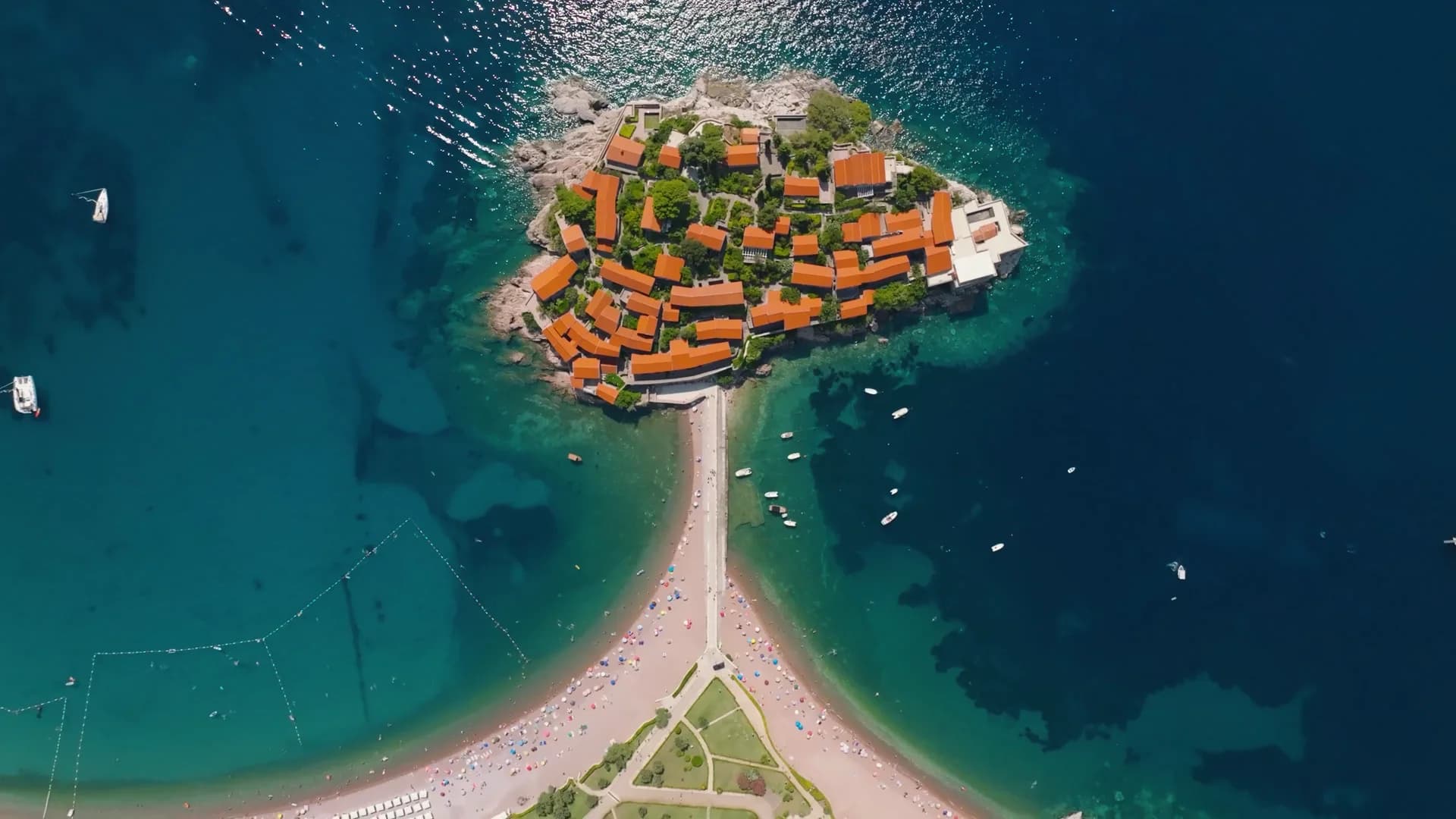
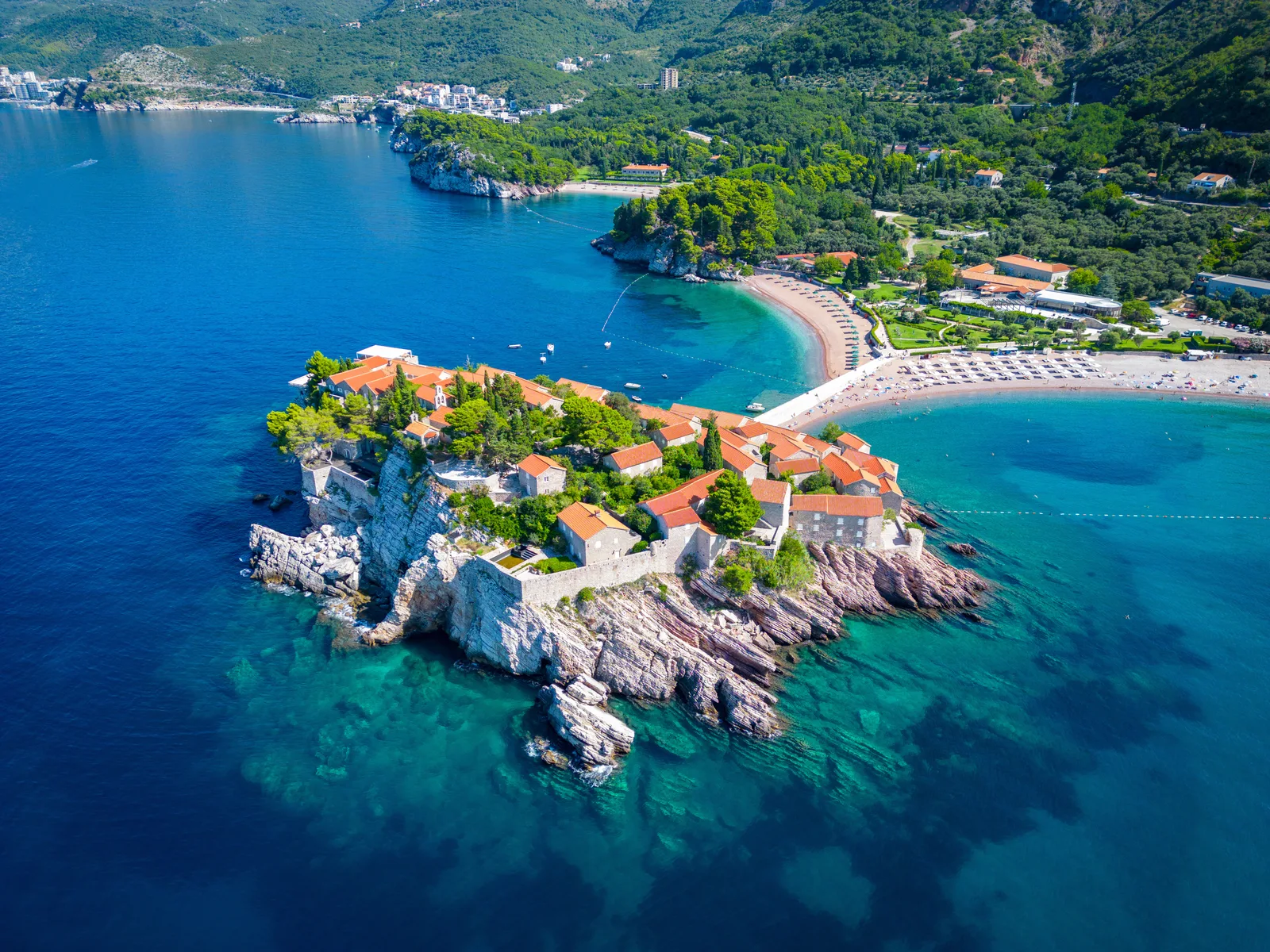
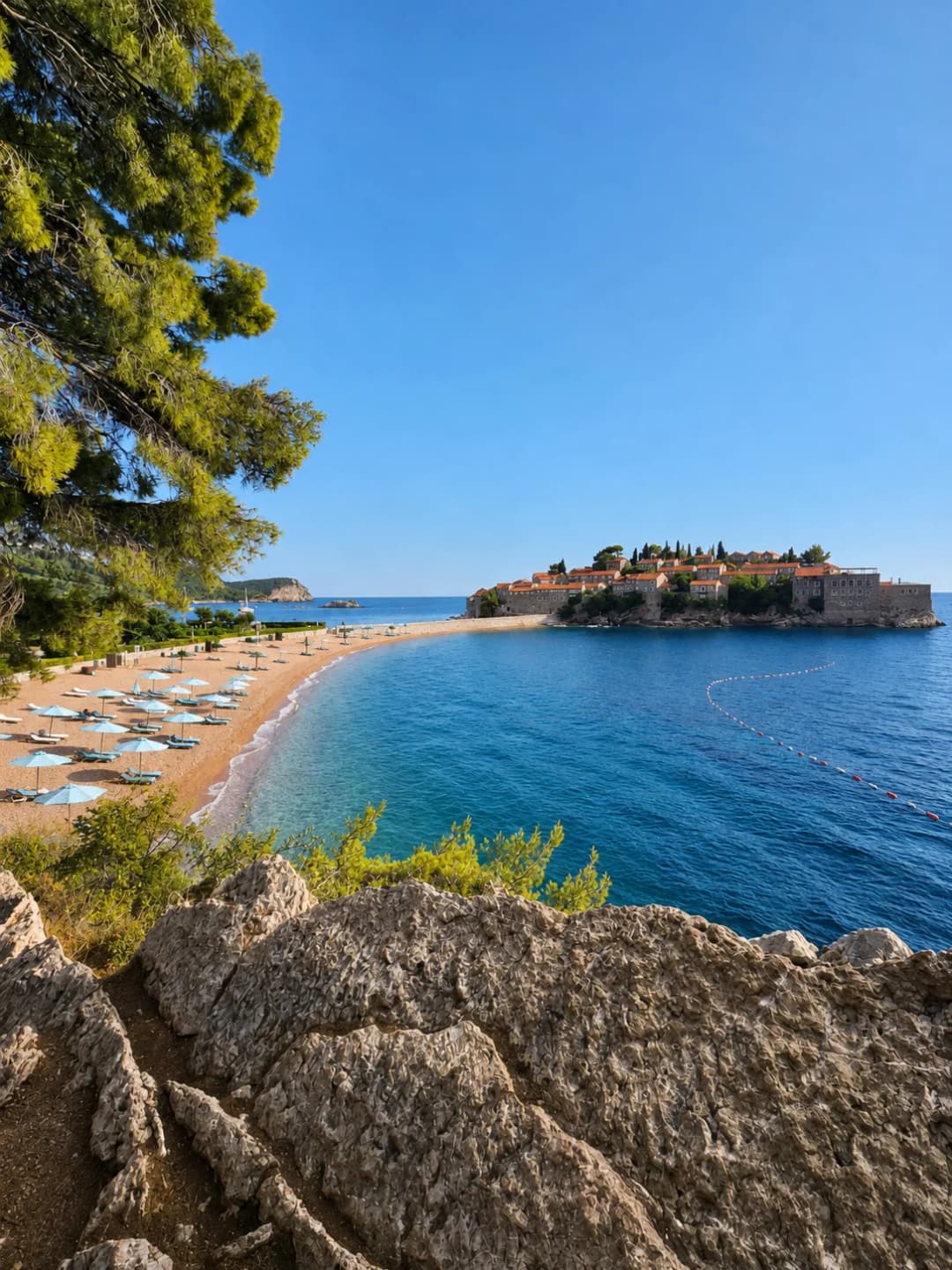
Sveti Stefan (Saint Stephen) is a fortified islet of 15th-century stone houses on the Budva Riviera, about 10 km down the coast from Budva, joined to the mainland by a narrow sandy causeway [3][6][16]. The whole island is the Aman Sveti Stefan hotel, which reopened for the summer season on 1 July 2026 after five years shut, and only overnight guests, diners with a reservation and booked tours can go through its gate [22][23][28]. Everyone else can walk the causeway to the gate, swim from the public side of Sveti Stefan Beach and from Miločer (King’s) Beach, walk Miločer park and photograph the island from the coast road above, all without paying. The one beach that stays closed to the public by day is Queen’s Beach, reserved for hotel guests from 8 a.m. to 8 p.m. [29].
Sveti Stefan at a glance
The island — open only to hotel guests, diners with a reservation and booked tours. The resort runs two guided walks a day, at 11:30 and 16:00, lasting 30–40 minutes, at 25 EUR per person.
Entry and costs — the causeway, Miločer park and the viewpoints are free. A serviced set of two loungers and an umbrella costs €220 a day on the hotel beach and €240 on King’s Beach [29].
Public beaches — the public side of Sveti Stefan Beach (free) and Miločer (King’s) Beach, both open under the May 2026 settlement, plus Pržno. Queen’s Beach is for hotel guests from 8 a.m. to 8 p.m.
The viewpoint — a layby on the Jadranski put (E65) on the hillside above the island, as you approach from Budva; it costs nothing but a pause.
Distance from Budva — about 10 km, roughly 20 minutes by road [28]. Tivat airport is 28 km away [30].
Getting there — direct buses from Budva about every 15 minutes, around 27 minutes, €2; a taxi is €18–22.
Parking — about €2 an hour by the beach access; the small lot fills early in July and August.
Best time — June or September; May and October for walking and photography. Early morning or late afternoon for light on the island.
Can you visit Sveti Stefan island?
Only with a reservation. The whole islet — all 1.64 hectares of it — is the hotel, and the island is open only to hotel guests, diners with a reservation and booked tours. You cannot cross the gate for a casual look around without one. The resort runs two guided walks a day, at 11:30 and 16:00, lasting 30–40 minutes, at 25 EUR per person. A table at one of the island’s restaurants is the other way a non-guest gets through the gate.
The causeway itself is public. You can walk its full length to the gated island entrance and photograph the village from either side of the sand, whether or not the resort is taking guests. Numbers on it are capped so resort guests can pass and visitors can photograph the island.
What is on the island
The islet contains stone houses, four churches, narrow streets, lanes, small squares, and gardens spread across its compact footprint; a tiny chapel occupies the highest point [21]. Under the 2007 lease the fishermen’s cottages were restored and reconfigured within the medieval village plan, original detail was kept wherever it survived, and the resort counts 33 cottages and suites today [28]. The island sits between Pržno and the Sveti Stefan settlement on the mainland, and together with Miločer park and the royal villa it forms one of the most significant cultural landscapes on the Adriatic coast.
Access rules in 2026
The rules changed in 2026 and they are specific. This is what applies now [23][28][29]:
The island — overnight guests, diners with a reservation and booked guided tours only. Everyone else walks the causeway to the gate, which is where the photograph is taken in any case. The island resort has been open for the season since 1 July 2026.
Villa Miločer — open year-round since 22 May 2026, the first time the estate has traded through a winter.
Sveti Stefan Beach — public under the settlement. The western half is the hotel’s own; a set of two loungers and an umbrella costs €220 there, and part of the furniture on it is reserved for residents.
Miločer (King’s) Beach — public under the settlement, part of the furniture reserved for residents, €240 for a set with service.
Kraljičina plaža (Queen’s Beach) — hotel guests only between 8 a.m. and 8 p.m. Outside those hours it is open like any other beach.
The park promenade — free, except that a fence by Kraljičina plaža closes the Sveti Stefan–Miločer stretch during the same 8 a.m. to 8 p.m. window. It went back up on 23 May 2026 against a standing removal order, and the Sveti Stefan local council has filed a criminal complaint in Kotor [32].
Also open to anyone: the E65 viewpoint above the island, Pržno village and its beach, and Praskvica Monastery, 3 km uphill by the old stone road. What is no longer true, and is still repeated in a good deal of older writing about the place, is that all the beaches are free for the asking. That was the position during the closure years; it ended with the settlement [29].
Aman Sveti Stefan
The resort took guests again from 1 July 2026, with 33 cottages and suites on the island and eight more in Villa Miločer on the mainland. The Aman Spa is not on the island at all: it sits in the private bay of Queen’s Beach, with four double treatment rooms, a 24-metre indoor pool and three hydrotherapy areas — steam room, sauna and either a cold plunge or a bath — and a 140-square-metre fitness centre beside it with a pilates and yoga studio [28][29].
The rooms are the restored fishermen’s cottages themselves — exposed stone, wooden beams, sea or garden views. The largest, the Sveti Stefan Suite, has its own pool, a separate living room, a dining area and a steam room. There are two pools on the island, one of them adults-only, and a booking includes breakfast, in-room soft drinks, tea and coffee, snorkelling gear and paddle boards.
Before the closure, reviews were mixed. Reviewers praised the setting – restored 15th-century fishermen’s cottages on a private island – the secluded terraces, the spa, the private beaches and the dining. Some noted that service did not always meet Aman’s global standards, with one suggesting guests “leave expectations for Aman level service at the end of the causeway.” Room rates were in the ultra-luxury bracket, typically exceeding €1,000 a night in high season [6][7][25].
Why it was closed, and the 2026 settlement
The pandemic closed the 2020 season, and the resort did not come back: the whole complex — the island, Villa Miločer and the beaches around them — stayed shut from 2021 for five years. What kept it shut was not the virus but an escalating dispute between Adriatic Properties/Aman Resorts and the Montenegrin government over beach access rights and the terms of the lease. Local residents demanded that the exclusive beaches (particularly Queen’s Beach / Kraljicina Plaza) be opened to the public, and Aman refused to reopen without guaranteed privacy for guests. Adriatic Properties went to arbitration in London in November 2022, claiming €100 million in damages [12][22][28][29].
Novak Djokovic, a global ambassador for Aman, personally lobbied Prime Minister Milojko Spajić to reopen what he called the “pearl” of Montenegro’s coast; reports indicate he is planning to invest in the companies that have leased Sveti Stefan and may manage the resort going forward [22]. Spajić announced the settlement on 6 May 2026, the government having concluded that a loss in London could cost more than €100 million [28][29]. Under the deal the lease was extended by four years to offset the lost revenue, the state will receive a 10% share of the resort's profits, and no further construction was allowed in Miločer park beyond the permits already issued. Sveti Stefan Beach and Miločer (King's) Beach are open to the public again, while Queen's Beach remains reserved for resort guests during the day. Villa Miločer reopened as a year-round destination on 22 May 2026, and the island resort reopened for the summer season on 1 July 2026 [22][23].
Sveti Stefan beaches
Four beaches sit within a 20-minute walk of each other, and since May 2026 they are precisely regulated. The differences that matter are length, surface and who is allowed on which part of the sand. Sveti Stefan’s own sand is split in two by the hotel line, so it takes two rows.
Compare
The beaches, to scale
Kraljičina plaža500 m
Sand
Miločer Beach280 m
Sand
Sveti Stefan Beach170 m
Amenities · Sand · Pebble
Sveti Stefan beaches170 m
Amenities · Sand · Pebble
Beach
Length
Surface
Access in 2026
Two loungers and an umbrella
Sveti Stefan, public side
170 m
pink pebble and sand
public and free under the settlement
local concessions; no published rate
Sveti Stefan, western (hotel) beach
—
pink pebble
resort service, part of the furniture kept for residents
€220 a day
Miločer / King’s (Kraljeva)
280 m, 7,400 m²
fine sand
public under the settlement, part of the furniture kept for residents
€240 a day with service
Kraljičina / Queen’s
120–200 m, sources differ
fine sand
hotel guests only, 8 a.m. to 8 p.m.
not sold to non-guests
Pržno
—
coarse sand and shingle
public and free
local concessions
The lengths come from Aman’s own 2026 material and from the Serbian-language records of Miločer and Kraljičina plaža; the lounger prices were quoted to Vijesti by the leaseholder in June 2026 [28][29][30][31]. Two cells are empty because nobody publishes a length for the hotel beach or for Pržno. The public-side lounger price is set by local concessions season by season, and has to be asked on the sand.
Sveti Stefan Beach
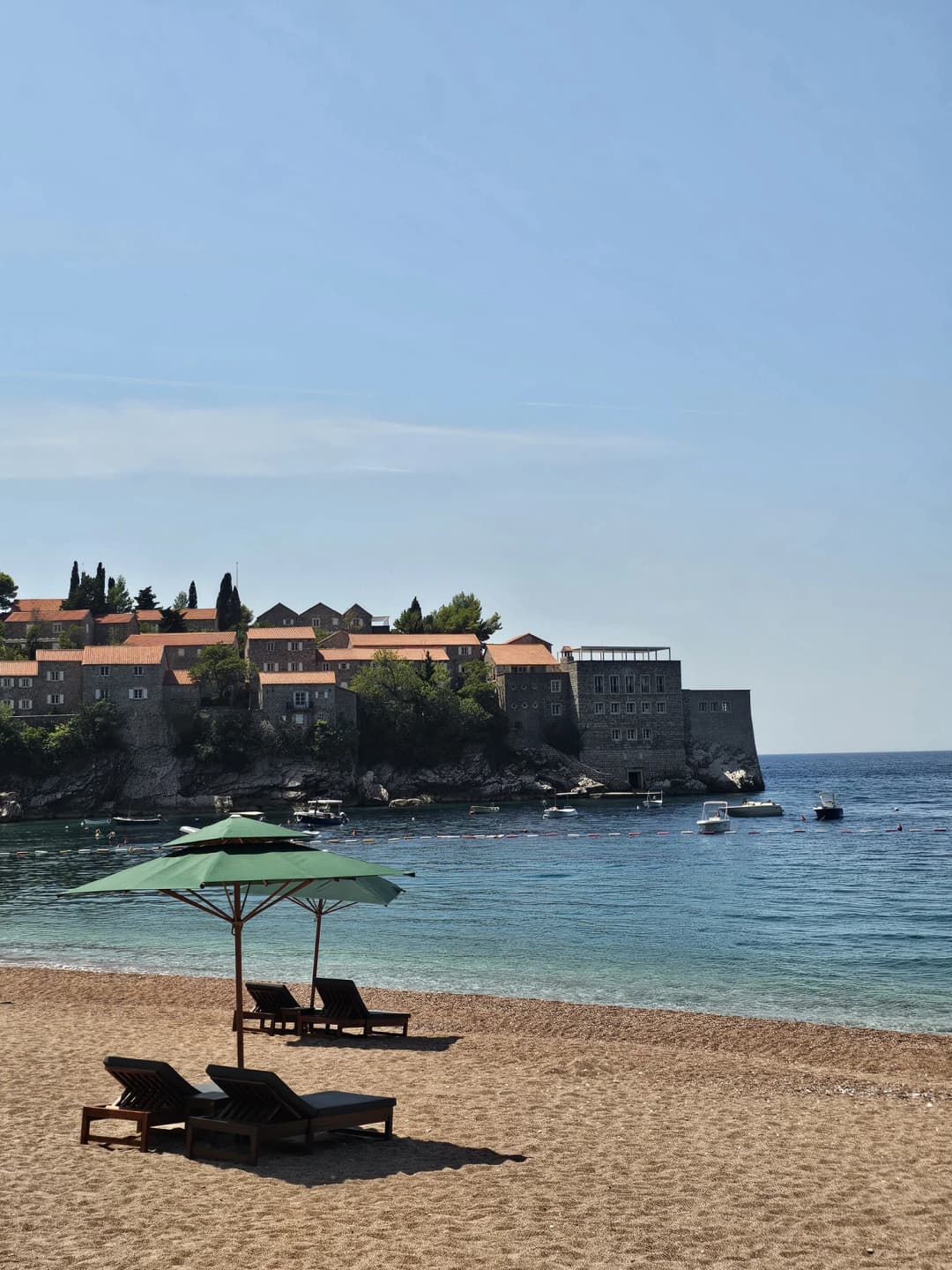
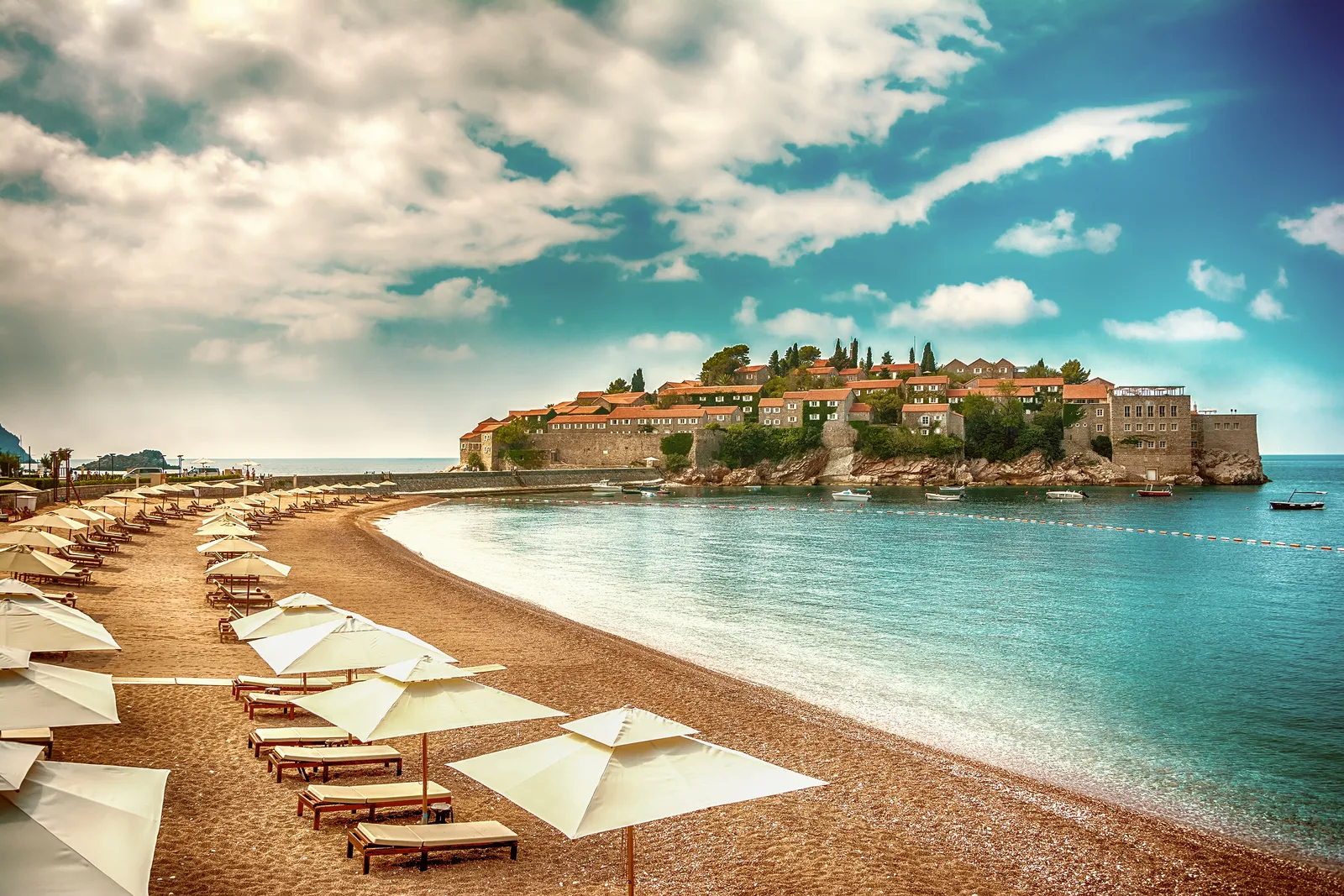
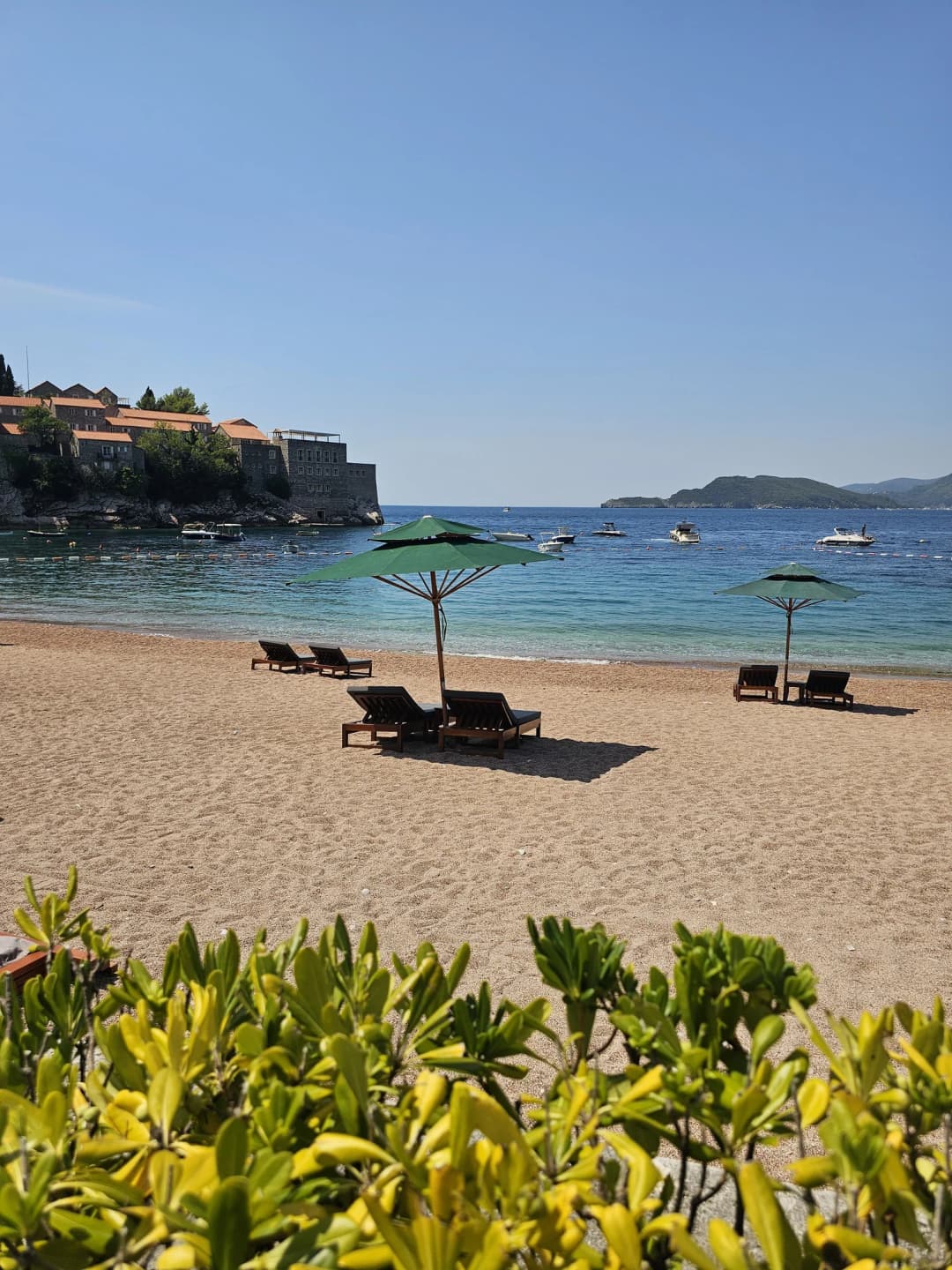
The causeway splits the sand into two crescents, and the public one — 170 metres of pinkish-gold sand and fine pebbles [28] — is the one to head for. It curves around a small bay with the island as a backdrop, the water clean and calm, shading from pale turquoise near shore to deep blue further out. The pale-pink colour comes from fragments of calcium-rich shells and sea creatures [21]. The entry is gentle and suits children; water shoes help where the sand turns to pebbles.
The other crescent — the western, or hotel, beach — belongs to the resort again, at €220 a day for two loungers and an umbrella, with part of the furniture reserved for residents [29]. The public side stays free, but facilities are thin. Through the closure years visitors noted no showers, toilets or changing rooms, and the verdict was consistently beautiful but basic [12][14]. Bring a towel and water.
Walking northwest through Miločer park, you reach Miločer Beach, a compact beach directly in front of Villa Miločer, the 1930s royal summer residence. It takes its name from King Aleksandar I Karađorđević, who used it as his private retreat. The sand is soft and golden and backed by pines and cypresses; it runs 280 metres and covers about 7,400 square metres, the largest beach on this stretch. Restricted to resort guests before the closure, it is public again under the May 2026 settlement, with part of the beach furniture kept for residents. A set of two loungers, an umbrella and beach service costs €240 a day [28][29]. Under Aman before the closure the whole bay carried no more than fifteen sets of loungers, which is the density to expect [14][17].
Kraljičina plaža (Queen’s Beach)
Queen’s Beach is not on the causeway at all. It lies about 500 metres northwest of the island, at the far end of Miločer park, past King’s Beach [30]. It is a small cove of fine sand — between 120 and 200 metres of shoreline depending on which record you read — tucked into a hollow and screened by cypress and olive, which is what gives the water its emerald cast. It is counted among the most beautiful beaches in Montenegro, and its Serbian-language record places it among the finest on the Mediterranean. Behind the sand stands the former summer residence of King Nikola I Petrović-Njegoš, a different royal house from the Karađorđević villa at King’s Beach next door [31].
Under the 2026 agreement Kraljičina plaža is reserved for hotel guests from 8 a.m. to 8 p.m., and the Aman Spa occupies its bay. Outside those hours it is a beach like any other. The nearest sand you can simply pay to lie on is King’s Beach next door [28][29].
The name belongs to Queen Marija Karađorđević, who bathed here in the 1930s. A chair was set for her on the rock above the cove, and that outcrop has been the Kraljičina stolica — the Queen’s Chair — ever since; from it you see Budva’s old town, the island of Sveti Nikola and the Sveti Stefan peninsula in one sweep.
Pržno Beach
A short walk further along the coast, Pržno Beach fronts the fishing village of Pržno: fishing boats pulled up on the sand and tavernas along the waterfront. It is public and free, and a good place for a swim followed by a long seafood lunch.
Sun is intense from June through September and there is little natural shade on any of the beaches. Bring an umbrella and sunscreen, or swim in the morning or late afternoon.
The best viewpoints
The Jadranski put viewpoint
The most famous viewpoint is on the Jadranski put, the main coastal road running along the hillside above Sveti Stefan. As you approach from Budva, a layby and viewing area appear where the road curves to reveal the island below. This is the classic postcard shot: the island centred in the frame, the causeway stretching to the mainland, both beaches visible, and the open Adriatic beyond. It sits on the E65, the stretch most people drive between Budva and Petrovac, so it costs nothing but a pause. There is usually space to pull over and park briefly. On TripAdvisor it is rated a must-see, and visitors describe the scene as “postcard-perfect” and “unlike anything else in Europe” [16].
Come early in the morning or in the late afternoon; the view is best at sunset, and midday light flattens the scene.
From Pržno
Pržno, on a small headland to the northwest, offers a different angle. From the waterfront or the path leading south toward Miločer, you see the island framed against the open sea with the Paštrovići mountains rising behind. It works best in late afternoon; morning light suits beach level and Pržno.
From Crvena Glavica
Southeast of Sveti Stefan — the opposite direction from Queen’s Beach — lies Crvena Glavica (Red Head), a headland named for the reddish colour of its rock, with a chain of small coves reached by steps down from the road. The viewpoint gives a slightly elevated perspective from the island's southern side, with deep blue water, red-tinged rock and pale stone in one frame. It is less visited than the main road viewpoint, and a better choice for photographing without crowds.
Miločer Park and Praskvica Monastery
Miločer Park and Villa Miločer
Between Sveti Stefan and King’s Beach, Miločer park covers approximately eighteen hectares of hillside between the road and the sea. Its shaded paths are the place to be on a summer afternoon. The park is free to enter and open year-round, though it is at its best from April through October.
The park was established in the early twentieth century when King Aleksandar Karadjordjevic chose this coastline for his summer residence. The royal family commissioned a villa in the French style and surrounded it with landscaped gardens: formal pathways, stone staircases and a nineteenth-century bridge. The villa was built between 1934 and 1936 as the summer residence of Queen Marija Karađorđević, on a 32-hectare plot planted with some 800 olive trees — a larger holding than the 18-hectare park that shelters it. It now holds eight suites, six in the main house and two in a separate building, with balconies over King’s Beach.
The planting is the point. Rare and exotic species were brought here from the Mediterranean, Asia, Africa, and the Americas. Olive groves, some with trees estimated at several hundred years old, share space with umbrella pines, Aleppo pines, and Italian cypresses, and tropical mimosa, cedar of Lebanon, Japanese medlar, magnolia, agave and several kinds of cactus grow in the open air [30].
A network of paths links the beaches. The route that matters runs from Sveti Stefan past King’s Beach to Kraljičina plaža: about 500 metres of made path, 10 minutes at a stroll [30]. The whole shore walk from Pržno to the causeway is roughly 1.5 km and takes 20 to 25 minutes, through canopy, past clifftop viewpoints and down to quiet coves. The paths involve some steps and uneven surfaces, so walking shoes or sturdy sandals beat flip-flops.
Walk early. A fence across the promenade by Kraljičina plaža went back up on 23 May 2026 and closes that stretch of the walkway between 8 a.m. and 8 p.m. The Sveti Stefan local council has filed a criminal complaint over it in Kotor, citing a 2020 removal order upheld by the Administrative Court in 2022 — the path is the only pedestrian link between Sveti Stefan and Pržno recorded in the land register, and has been used for centuries. Until that is resolved, the through walk is a before-eight or after-eight proposition [29][32].
Praskvica Monastery
In the hillside village of Čelobrdo above Sveti Stefan, Praskvica is a Serbian Orthodox monastery first documented in 1307 (though legend places its founding in 1050). It served as the spiritual and political centre of the Paštrovići clan. The main church, dedicated to Saint Nicholas, was built by Balša III and his mother Jelena in 1413. Four churches on Sveti Stefan island belong to the monastery, including the Church of Saint Stephen where Novak Djokovic married in 2014. Jegor Stroganov, a one-armed Russian military officer who became a monk at Praskvica, spent ten years building a 3-kilometre stone road from Sveti Stefan to the monastery; you can walk up it, or drive to Čelobrdo [18][19].
Getting there, parking and costs
Sveti Stefan sits about 10 km down the coast from Budva on the Jadranski put, the old Adriatic highway — roughly 20 minutes by road [28].
From Budva
By bus — direct buses from the Crvena Zgrada stop leave about every 15 minutes and take around 27 minutes; €2.
By taxi — about 20 minutes, €18–22.
By car — 20 minutes on the coast road; parking near the beach access runs about €2 an hour and the small lot fills early.
On foot — the Seven Bays shore walk, 11.4 km and about 2 hours 30 minutes through Bečići, Rafailovići, Kamenovo, Pržno and Miločer park [33].
By boat — excursion boats run down from Budva in season; there is no scheduled service.
From the airports
Tivat Airport is 28 km away, about 40 minutes by road through Budva, and it is the practical arrival point for this coast — European charters through the summer, year-round flights to Belgrade, and taxis, transfers and rental desks at the terminal [30]. Podgorica Airport is about 57 km away and 1 hour 15 minutes by car, over the interior and down through a mountain tunnel to the coast.
Parking
Parking is the pinch point in July and August. The small area by the beach access fills early, roadside space above it is limited, and the honest alternative is to leave the car in Budva and come in by bus or taxi.
Costs
What
Summer 2026
Guided walk on the island
€25 per person
Two loungers, umbrella and service, King’s Beach
€240 a day
Two loungers and umbrella, western Sveti Stefan (hotel) beach
€220 a day
Loungers on the public Sveti Stefan beach
no published rate
Miločer park, the causeway, the viewpoints
free
Bus from Budva
€2
Taxi from Budva
€18–22
Parking
about €2 an hour
Espresso
€2–3
Dinner for two, Pržno seafront
€50–80
Aman nightly rate
typically over €1,000 in high season before the closure
The beach-service figures were quoted to Vijesti by the leaseholder in June 2026 [29]. Montenegro uses the euro. Most restaurants accept cards, but carry cash for smaller beach bars, parking, and tips.
How long to spend. A half-day — 3 or 4 hours — covers the main viewpoints, a walk through Miločer park, and a swim. A full day lets you explore Pržno, try different beaches, and have a long lunch. Two or three days lets you settle into the rhythm of this coast.
Recommended: June or September (warm weather, fewer crowds, better value)
Shoulder months: May and October are the best of it for walking and photography — lower prices and easier parking, though the water is still cool
Time of day: early morning or late afternoon for the best light from the E65 viewpoint, and early morning for the park paths, which are empty then and outside the fence hours
Out of season: Villa Miločer and its restaurant are open year-round; the island resort opens for the summer season
Things to do nearby: walks, Pržno and day trips
Coastal walking paths
A coastal footpath connects Sveti Stefan to Pržno through Miločer park and continues toward Budva. The full Seven Bays walk from Budva’s old town is 11.4 km and takes about 2 hours 30 minutes, running through Bečići, Rafailovići, Kamenovo, Pržno and Miločer park, past eight beaches and through two tunnels; the 8 km figure often quoted for it describes only a shorter variant. It is mostly flat, with one short climb into Sveti Stefan and a narrow stretch with drops between Kamenovo and Pržno [24][33].
Pržno village
Pržno is the quieter counterpart to Sveti Stefan: a small fishing village a kilometre and a half to the northwest that has kept much of its traditional character as tourism has grown around it. The waterfront is a crescent of sand and pebbles, a handful of fishing boats, and a row of stone buildings housing restaurants and cafes. Locals still fish from the beach in the early morning.
The village is known for its seafood restaurants, which draw visitors from across the Budva Riviera. Grilled fish and a glass of Montenegrin Vranac at a waterfront table runs at about €50–80 for two, and an espresso on the seafront is €2–3. Pržno also makes a good base, with family-run guesthouses and sea-view apartments generally cheaper than properties directly around Sveti Stefan.
Photography
The E65 viewpoint – the elevated panorama of the island, causeway, and beaches
The causeway – close-up perspectives walking out toward the island
The coastal path – angles on the island from the Pržno direction
Queen’s Beach and Miločer – forest-framed beach scenes with the island in the background [16]
Crvena Glavica – the southern side, with fewer people
Day trips
Budva Old Town (10 km, 20 minutes) — one of the oldest settlements on the Adriatic, with roots stretching back 2,500 years: narrow streets, stone churches, and the Citadela fortress with its views over the coast. In summer the Old Town hosts an international theatre and music festival. It is the one day trip that needs no car: 27 minutes by bus, or 11.4 km on the Seven Bays shore path [24][33].
Petrovac (11 km, 20 minutes) — a quieter alternative to Budva, with a long sandy beach backed by olive groves. The Venetian fortress of Kastio guards the bay, and two small islands are visible offshore. It is a starting point for coastal walks toward the wild beaches of Buljarica and along the Reževići trail.
Kotor (31 km, 45 minutes) — the Bay of Kotor is a fjord-like inlet surrounded by sheer mountains. Kotor's walled Old Town is a UNESCO World Heritage Site, and the climb to the San Giovanni fortress ends in a wide view over the bay. Nearby Perast, a tiny baroque village, is less crowded.
Where to stay
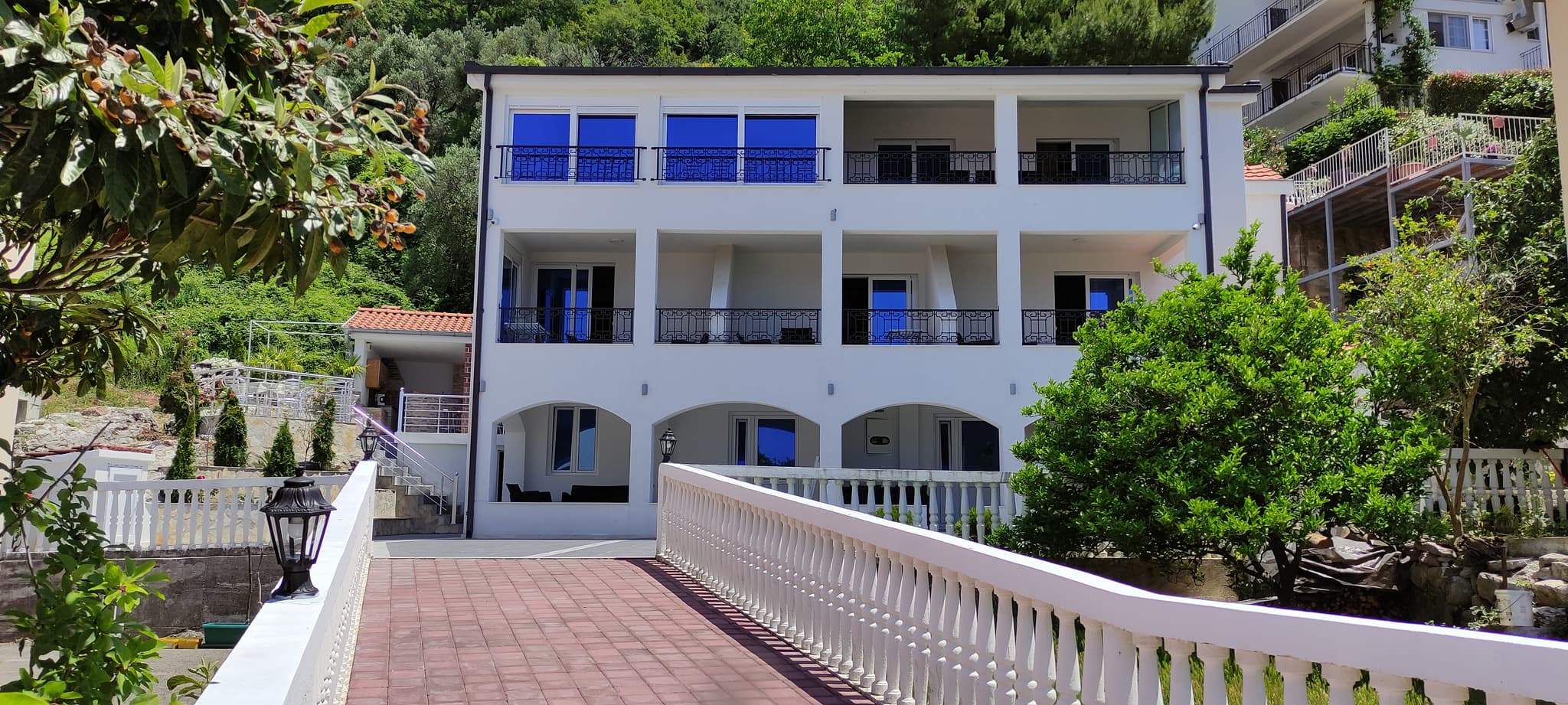
Sleeping here divides three ways. The resort itself is the island and Villa Miločer, booked through Aman and open for the season only on the island side. The slope directly above the causeway is where the view is. Pržno and Miločer are where the village is — konobas, a working harbour and the park path — at a fraction of the price and ten minutes further from the postcard.
Maestral Resort, between Pržno and Miločer, is the largest conventional hotel on this stretch if pools, a spa and several restaurants under one roof are what you want.
Where to eat
On the island
A reservation at any of these is also the only way a non-guest gets through the island gate, apart from a booked tour.
Arva – Italian cooking on two terraces over the bay, dinner only, with a rakija bar on the upper one
Piazza – bar, taverna, enoteca and antipasti counter in one, doing rustic Mediterranean plates for breakfast and lunch
Cliff Pool Bar – beside the adults-only pool
Villa Miločer Restaurant – on the mainland above King’s Beach and the only one open year-round, breakfast to dinner, across a mix of classic and contemporary Adriatic dishes [6][28]
On the mainland
Dinner for two with wine runs about €50–80 along the Pržno seafront and in the village above the causeway.
Konoba More (Pržno) – fish restaurant in an old stone building on the waterfront, with tables by the water between the village’s two small beaches
Bankada – 1 km from Sveti Stefan on an elevated position with panoramic views, known for Mediterranean cooking at affordable prices
Drago Restaurant – the most visited restaurant in the village centre, serving Balkan, European, and Mediterranean dishes
Pastrovica Dvori – family-run restaurant with outdoor terrace views, serving grilled seafood, veal, and Mediterranean dishes at affordable prices
Famelja Kentera – intimate, with an outdoor terrace, known for grilled meats, fresh fish, and competitive prices [20]
Zuma – a seasonal pop-up of the international group, opened opposite the town-hotel in June 2026 [29]
Nammos – in the space that was the Pod maslinom restaurant, opened the same summer [29]
History
1400160018002000
The Paštrovići and the Bankada
Sveti Stefan was built by the Paštrovići, a clan that controlled this stretch of coast. Their name is first attested in 1355, in a document referencing the nobleman Nikolica Pastrovic in the service of Serbian emperor Stefan Dusan. Independent since the twelfth century, the community became a protectorate of the Republic of Venice in 1423 out of fear of Ottoman attack, keeping considerable autonomy and paying no tribute [2][8]. Sveti Stefan itself is first mentioned in 1442, as a coastal fortification from which the Paštrovići, led by vojvoda Radic, repulsed the forces of Stjepan Vukcic Kosaca during his offensive in Zeta [1][2].
Local legend says the island was fortified with treasure taken from the Turks. The Paštrovići sent some 1,000 men to help defend Kotor against an Ottoman siege and, on the way home near Jaz beach, attacked Turkish galleys and seized rich spoils. That money built the first 12 houses, one for each family of the clan [3][8].
For nearly 300 years the island was a trade and transport centre and the seat of the Bankada, the Paštrovići tribal court and governing assembly. It stayed under Venetian protection, with periodic Ottoman interruptions, until the fall of the Republic in 1797, then became part of the Kingdom of Dalmatia (1815-1918) and then Yugoslavia [2][8].
The fishing village
As its military role faded, the fortress became a fishing village. People began settling permanently in the 1800s, and the village grew to approximately 400 people. Most of the stone cottages, lanes and communal spaces seen today date from that period [1][4].
The hotel-town and its celebrity years (1955–1980s)
In 1955 the Yugoslav authorities relocated the remaining inhabitants to the mainland and converted the whole village into a hotel, turning the fishermen’s cottages into guest rooms while keeping their historic character. The town-hotel opened on 13 July 1960 [1][4][10][29]. Four years later Life put Sveti Stefan among the ten most exclusive hotels in the world; it took the Golden Apple, international tourism’s main prize, in 1972, and the AVNOJ Award, Yugoslavia’s highest state honour, in 1980 [29]. By the 1960s and 1970s it was being called the “St. Tropez of the Adriatic” [10].
Guests included Marilyn Monroe, Sophia Loren and Carlo Ponti (regular visitors), Kirk Douglas, Elizabeth Taylor, Orson Welles, Princess Margaret, German Chancellor Willy Brandt, Monica Vitti, Claudia Schiffer and the Swedish skiing champion Ingemar Stenmark [1][4][5].
The Fischer–Spassky rematch (1992)
In 1992 Sveti Stefan hosted the unofficial World Chess Championship rematch between Bobby Fischer and Boris Spassky, a replay of their 1972 match. Play began on Sveti Stefan before moving to Belgrade. Fischer won 10-5 (with 15 draws) and took $3.35 million of the $5 million purse. Because the match was played in the Federal Republic of Yugoslavia during UN sports sanctions, the US issued an arrest warrant for Fischer, who never returned to America [11].
Decline, the Aman lease and the closure (1990s–2026)
The resort declined during the 1990s amid the breakup of Yugoslavia and eventually closed. On 31 January 2007 the Montenegrin government signed a 30-year lease with Adriatic Properties (backed by Aman Resorts) covering the town-hotel, Villa Miločer and the Kraljičina plaža hotel: €1.6 million in guaranteed rent a year and €50 million to rebuild Sveti Stefan. After a full restoration of the island and Villa Miločer, it reopened as Aman Sveti Stefan [1][7][10]. The pandemic, the beach-access dispute and the 2026 settlement are covered above under Can you visit Sveti Stefan island?
Heritage status and the Europa Nostra listing (2024)
Sveti Stefan holds national cultural heritage status in Montenegro. In 2024 Europa Nostra and the European Investment Bank Institute listed the Cultural Landscape of Sveti Stefan, Pastrovici among Europe’s 7 Most Endangered Heritage Sites. Experts cited privatisation effectively disenfranchising citizens from their own public heritage, and unauthorised modifications within Miločer park – including construction of a large-scale condo-hotel – that have compromised the site’s cultural and natural integrity [9].
Culture and events
Sveti Stefan is the single most recognisable image of Montenegro: the island and its causeway appear on more postcards, tourism campaigns and travel publications than any other site in the country [3][10][16]. Lonely Planet calls it “the poster child of the Montenegrin coast,” and the 2024 Europa Nostra listing has added urgency to the conversation about preserving it [9][10][16].
Novak Djokovic married Jelena Ristić here in July 2014, within a fortnight of winning that year’s Wimbledon title. Accounts of the day disagree — both Villa Miločer and Kraljičina plaža appear in print as the site of the civil ceremony, on dates two days apart — but the religious ceremony was held in the Church of Saint Stephen on the island [13][31]. Employees signed confidentiality agreements, mobile phones were banned, and wedding photo rights were sold to Hello magazine with proceeds going to charity [13].
Quick answers
When is the best time to visit Sveti Stefan?+
Peak season : July-August (warmest water, most crowded, highest prices, hardest parking) Recommended : June or September (warm weather, fewer crowds, better value) Shoulder months : May and October are the best of it for walking and photography — lower prices and easier parking, though the water is still cool Time of day : early morning or late afternoon for the best light from the E65 viewpoint, and early morning fo
A coastal footpath connects Sveti Stefan to Pržno through Miločer park and continues toward Budva. The full Seven Bays walk from Budva’s old town is 11.4 km and takes about 2 hours 30 minutes, running through Bečići, Rafailovići, Kamenovo, Pržno and Miločer park, past eight beaches and through two tunnels; the 8 km figure often quoted for it describes only a shorter variant.
Sleeping here divides three ways. The resort itself is the island and Villa Miločer, booked through Aman and open for the season only on the island side. The slope directly above the causeway is where the view is.
The beach-service figures were quoted to Vijesti by the leaseholder in June 2026 [29]. Most restaurants accept cards, but carry cash for smaller beach bars, parking, and tips. A half-day — 3 or 4 hours — covers the main viewpoints, a walk through Miločer park, and a swim.
Budva Old Town (10 km, 20 minutes) — one of the oldest settlements on the Adriatic, with roots stretching back 2,500 years: narrow streets, stone churches, and the Citadela fortress with its views over the coast.
Parking is the pinch point in July and August. The small area by the beach access fills early, roadside space above it is limited, and the honest alternative is to leave the car in Budva and come in by bus or taxi.
Pavle Obradović is from Herceg Novi. He was Manager of Montenegro.com, then Director of the Herceg Novi Tourism Organization, and is now Coordinator for Investment and Development Projects at the Municipality of Herceg Novi. He holds a BSc in International Hospitality and Service Management from the Rochester Institute of Technology (RIT).
···
Updated · Originally published
Montenegro Travel Newsletter
Get weekly stories, guides, and insider tips about Montenegro delivered to your inbox.