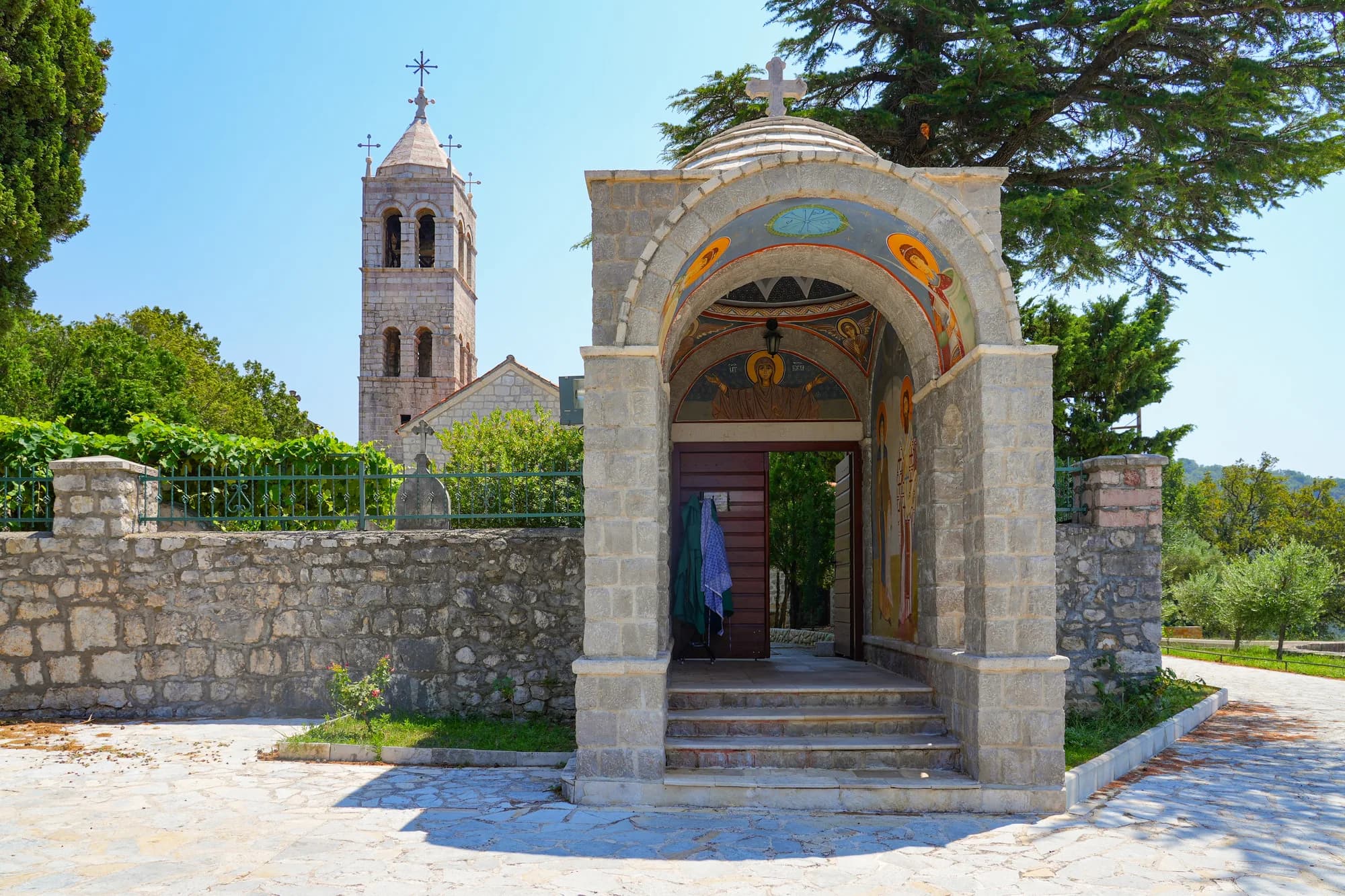
Reževići Monastery is not a set of untouched medieval churches and its famous “stone cup” is not a surviving object visitors can expect to find. The complex above the Budva–Petrovac coast has three church layers, a residential wing and service buildings. The municipal museum describes two churches plus remains of Saint Stephen; the church authority says Saint Stephen was restored in 2016–17. Its history combines medieval foundation traditions, later construction, important wall painting and a roadside story about wine offered to strangers.
The distinction matters. The small Dormition church carries the oldest fabric and royal tradition. The large Holy Trinity church was begun in 1770, completed or comprehensively repaired in 1814, and received its bell tower in 1839. Historic wall and fresco fragments survive at Saint Stephen even though the Metropolitanate reports a modern restoration. Reževići is also a living Orthodox monastery: the Metropolitanate documented a hierarchal liturgy here in June 2026, so a visit must work around worship rather than treat the compound as an always-open museum.
| Question | What to know | Do not assume |
|---|---|---|
| How many churches? | Three church layers; Saint Stephen combines historic remains and modern restoration | Three intact medieval interiors |
| Who founded it? | Royal founders belong to local and church tradition | 1223/1226 and 1351 are confirmed construction dates |
| What was the wine custom? | A stone pillar held a jug for travellers, according to tradition | A surviving hollow cup or proven six-century operation |
| Is it UNESCO-listed? | No; it has national cultural-property protection | Domestic protection equals World Heritage status |
| Can visitors enter? | Assess worship, signs and permission on arrival | Fixed hours or unrestricted interiors |
Start with the plan: why the church count conflicts
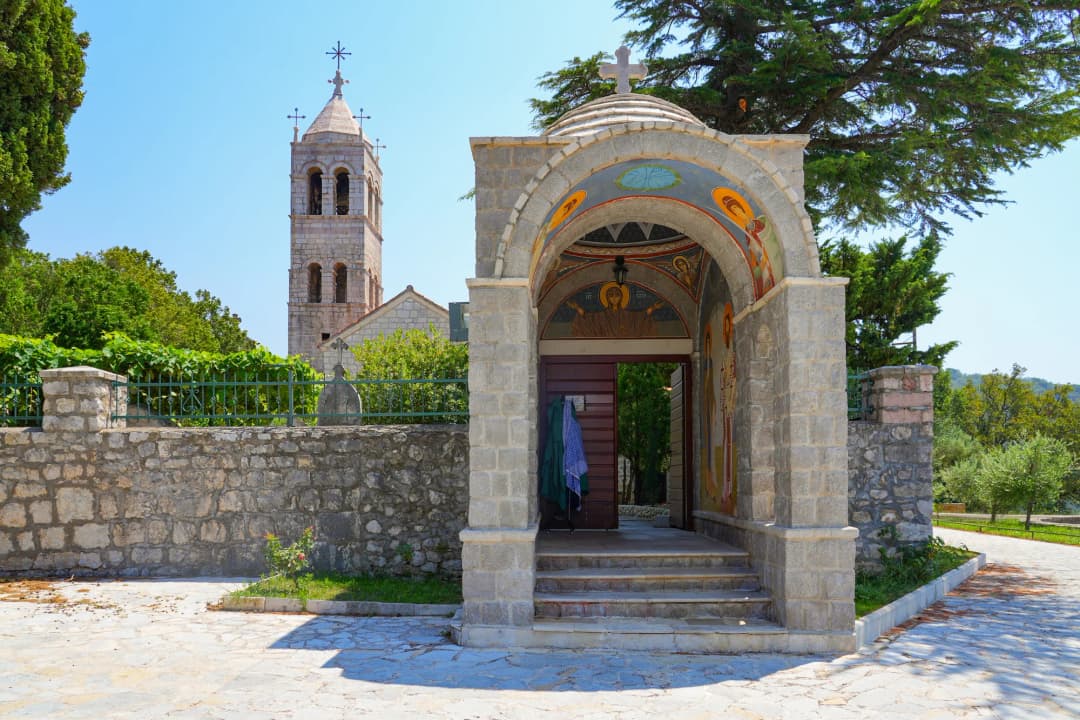
The Museums and Galleries of Budva describes two churches, remains of a third, and a konak, or residential building. The Metropolitanate says the Church of Saint Stephen was restored in 2016–17. The complex therefore has three church layers, with the restored Saint Stephen site incorporating surviving historic wall and painted fragments.
The small Church of the Dormition of the Mother of God is the patronal church. The Metropolitanate describes it as a single-nave building with a barrel vault, semicircular apse and a small one-opening bell-cote. Its western bay was added later. The larger Holy Trinity church has a cross-shaped plan, broad apse and a tall square bell tower. At Saint Stephen, preserved wall and painted fragments sit beside the residential wing, while the 2016–17 restoration added newer fabric.
| Church | Standing structure | Dating / works | Note |
|---|---|---|---|
| Dormition | small standing church | 17th-century main | painting layer |
| Holy Trinity | large standing church | 1770 → 1814 | tower 1839 |
| Saint Stephen | historic fragments | restored 2016–17 | per Metropolitanate |
| Caveat | Reconstruction and surviving historic fabric are not the same | — | — |
Source: muzejiigalerijebd.me, mitropolija.com
Royal traditions and the first written records
Tradition says Stefan the First-Crowned ordered the Dormition church after travelling through Reževići. Dates of 1223 and 1226 both circulate in institutional and church accounts. A later tradition connects Emperor Dušan with the Church of Saint Stephen in 1351. These stories are central to how the monastery understands itself, but they are not equivalent to surviving construction charters.
The municipal museum calls the Dormition foundation traditional and dates the first reliable monastery document to the 15th century. The Metropolitanate also labels the royal accounts as folk tradition. The exact foundation year therefore remains part of tradition rather than a securely dated construction event.
The Saint Stephen remains clarify part of the chronology. The Metropolitanate dates the preserved saints and medallion frieze stylistically to the late 16th century and says the building itself was clearly older. That makes a medieval origin plausible; it still does not prove that Dušan personally ordered it in 1351. The church was destroyed in 1785, in the account of Mahmud Pasha Bushatli’s attack, and a surviving section was incorporated near the residential structure. The Metropolitanate says Saint Stephen was restored in 2016–17; that modern intervention must not be mistaken for intact medieval fabric.
| Date | Evidence |
|---|---|
| 1223/1226 + 1351 | royal foundation traditions |
| 15th century | first reliable document |
| late 16th century | Saint Stephen fresco style |
| 1770–1839 | dated building sequence |
| Rule | Tradition preserves memory; dated records establish chronology |
Source: muzejiigalerijebd.me, mitropolija.com
Holy Trinity explains the skyline
Much of what dominates the exterior is later than the medieval stories. The official church history says Nikodim Vuković raised the larger Holy Trinity church in 1770; Dimitrije Perazić repaired and fully completed it in 1814. Funds obtained through Perazić’s Russian connections supported construction of the bell tower in 1839. The church therefore spans an eighteenth-century beginning and major early-nineteenth-century completion.
Holy Trinity developed in three main phases: construction began in 1770, major completion or repair followed in 1814, and the tower rose in 1839. The church was damaged in the 1979 earthquake, and the Metropolitanate says the bell tower was restored afterward. Today’s harmonious stone ensemble is the result of repeated rebuilding, not a single medieval construction programme.
Paintings and icons
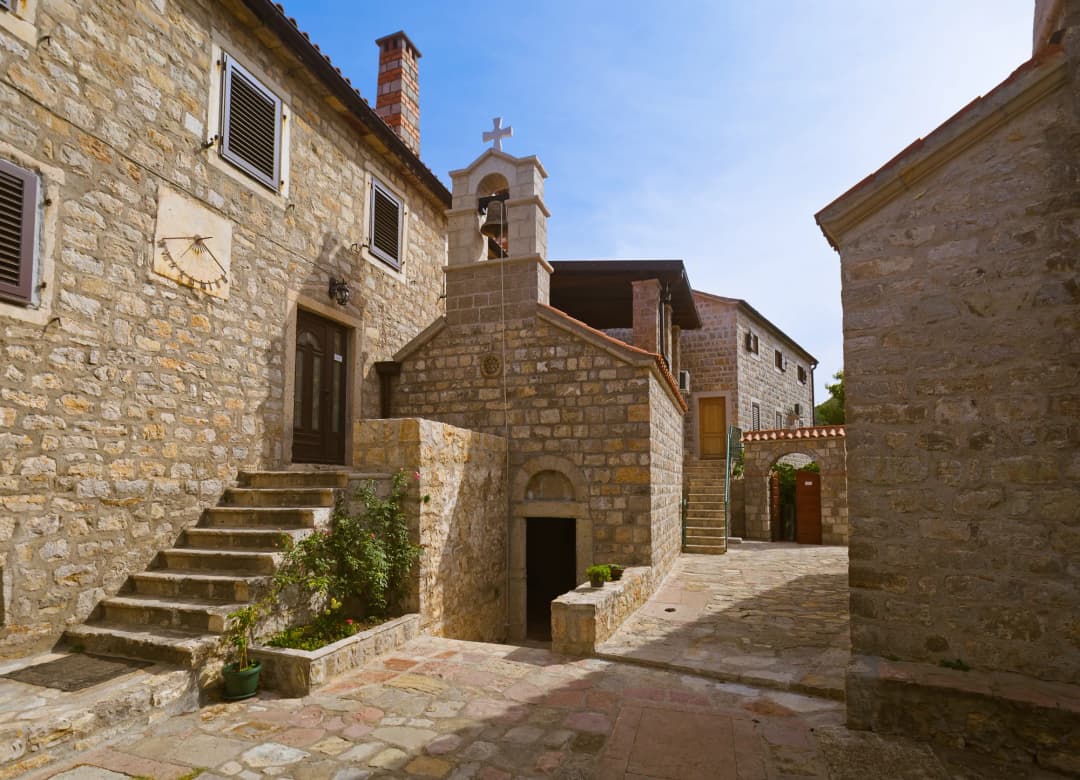
Inside the Dormition church, the Metropolitanate describes a main wall-painting layer from the 17th century. Small older fragments survive on the eastern wall and apse, but their date remains undetermined. The programme includes standing saints, holy warriors, healer saints, the Deesis, feast scenes and the Passion. The visible interior spans more than one period.
The Museums and Galleries of Budva catalogue records an 1833 Saint Stephen fragment and an 1833 Mother of God with Christ fragment by Aleksije Lazović. It also catalogues three Reževići icons dated 1857: Mother of God with Christ, Holy First Martyr Stephen and Holy Trinity. A government exhibition announcement confirms that Reževići works appeared with icons from Praskvica and Gradište, spanning local, Greek, Venetian and Russian workshops.
The large Holy Trinity church’s iconostasis is attributed by the municipal museum and Metropolitanate to the Petrovac painter Marko Gregović at the end of the 19th century. Dates belong to individual objects and layers; they should not be generalized into one age for the whole interior. Ask before photographing, and never use flash around painted surfaces.
| Date | Author / place | Work |
|---|---|---|
| 17th c. | Dormition | wall paintings |
| 1833 | Lazović | fragments |
| 1857 | three catalogued | icons |
| late 19th c. | Gregović | iconostasis |
| Rule | Date the object or layer—not the room by appearance | — |
Source: muzejiigalerijebd.me, gov.me, mitropolija.com
The wine story: a jug on a pillar, not a surviving stone cup
The Tourism Organisation of Budva says a stone pillar beside the important road had a depression for a jug of wine left for travellers. Its account presents the custom as tradition and connects Stefan the First-Crowned with drinking from the jug.
That is different from a hollow stone vessel used directly as a communal cup. It also does not prove that the custom operated without interruption for roughly six centuries. The pillar and jug remain a powerful memory of Paštrovići hospitality, but current visitor information does not list the object as an attraction or wine as a visitor service. Do not arrive expecting a tasting, and treat alcohol as part of a monastery visit only when explicitly offered in an appropriate setting.
Dušan's Code: later manuscript, real legal memory
Tourism material says the Paštrovići Statute, also called the Zagreb manuscript of Dušan’s Code, was found at Reževići in 1860 and is held in Zagreb. That discovery is historically important. It does not validate the literal legend that Emperor Dušan handed the surviving text to the Paštrovići when founding Saint Stephen’s church.
A peer-reviewed study of Dušan’s Code manuscripts concludes that a separate recension including the Reževići text arose no earlier than the second half of the 17th century, adapting legal material for Orthodox church or local self-government under foreign rule. The legal memory is therefore richer than a single royal gift: medieval law was copied, localized and used much later.
The legal text belongs to the wider history of Paštrovići self-government under Venetian sovereignty. A nearby assembly landscape appears in our Drobni Pijesak history and visitor guide.
Protected in Montenegro, not UNESCO World Heritage
Budva’s municipal programme lists Reževići among the municipality’s protected sacred properties and supplies its mapped coordinates. That is domestic cultural-heritage status. It should not be advertised as UNESCO protection. The UNESCO World Heritage Centre’s current Montenegro page lists four inscribed properties and six tentative sites; Reževići is on neither list.
National protection is not second-rate. It is the legally accurate framework for conservation and intervention. The monastery has survived attack, wartime damage and the 1979 earthquake, followed by reconstruction. Visitors help by not touching frescoes, leaning objects against stonework, moving furniture, lighting candles outside designated places or crossing into residential areas.
Practical visit guide for 2026
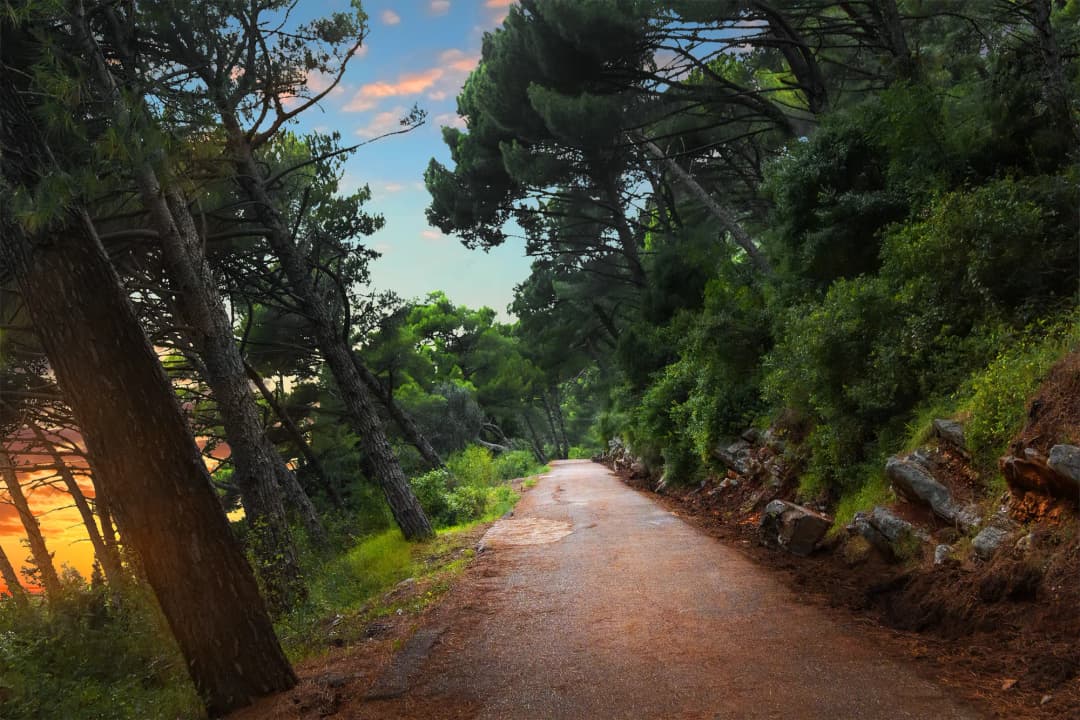
Reževići sits beside the Adriatic Highway between Sveti Stefan and Petrovac, above Perazića Do. The entrance is visually prominent, but the road environment needs attention. If driving, slow early and use only a lawful, clearly designated stopping or parking place. Never stop in a live lane or reverse blindly onto the highway. Parking capacity at the gate is not guaranteed.
What the sources say
The official Budva transport page lists Reževići on the Budva–Petrovac local-bus corridor, between the Sveti Stefan area and Perazića Do. Confirm the current departure, direction, stop position and return before boarding; a route name does not prove every bus stops at the monastery entrance. The Tourism Organisation also operated a seasonal Reževići information office from 15 June to 15 September 2026, useful for current local guidance while in season.
Do not improvise a walk on the highway shoulder. The Perazića Do tunnel guide explains the lower coastal route and its own hazards, but no signed, step-free connection to the monastery is published. If the final approach feels unsafe, use a taxi or change the plan.
| Check | Best action | Reason |
|---|---|---|
| Service in progress | Enter only to worship, or wait quietly outside | Reževići is an active religious community |
| Church door closed | Do not open private doors or seek another entrance | No fixed interior hours are published |
| Photography | Ask before interiors, people, clergy or worship | Courtyard access does not imply image permission |
| Clothing | Cover shoulders and knees; remove hats where appropriate | Respect for an Orthodox sacred place |
| Residential wing | Stay within evident visitor areas | The konak is not an exhibition corridor |
| Mobility | Assess steps and stone paving before proceeding | No step-free visitor route is published |
| Step | Action |
|---|---|
| 1 | verify route and return |
| 2 | arrive lawfully |
| 3 | read worship and signs |
| 4 | ask before interiors |
| 5 | leave quietly |
| Rule | Closed door or active service = do not force a sightseeing visit |
| Emergency | Montenegro emergency number: 112 |
Source: mitropolija.com, budva.travel, gov.me
Pair it with the coast without rushing
A focused visit can take in the entrance, courtyard, the Dormition and Holy Trinity churches when invited, the Saint Stephen site and historic fragments where visible, and the relationship between bell tower, olive landscape and sea. Do not attach a guaranteed duration: worship, closures and individual interest change the stop.
For a full Petrovac day, combine the monastery with the Petrovac and Bar coast guide. The Mirišta Roman mosaics provide a different archaeological layer, while Lučice Beach and the Buljarica wetland guide need their own access and environmental checks. One monastery visit should not become an unsafe roadside race among unrelated sites.
Frequently asked questions
Are there two or three churches at Reževići?
Say three church layers. The municipal museum describes two churches plus remains of Saint Stephen, while the Metropolitanate says Saint Stephen was restored in 2016–17. The restored site includes historic wall and fresco fragments, but visitors should not read all visible fabric as three intact medieval interiors.
Was Reževići founded in 1223 or 1226?
Both dates circulate in traditions linking Stefan the First-Crowned with the Dormition church. The municipal museum identifies the royal foundation as tradition and places the first reliable monastery document in the 15th century.
Can I see the stone wine cup?
Current visitor information does not confirm a surviving cup. The tradition describes a stone roadside pillar with a depression holding a jug of wine for travellers. It is a hospitality story, not a present visitor service.
Is Reževići Monastery a UNESCO World Heritage Site?
No. It is a protected Montenegrin cultural property, but UNESCO’s current list of Montenegro’s inscribed and tentative sites does not include Reževići.
What are the most important artworks?
The 17th-century Dormition wall paintings, late-16th-century fragments associated with Saint Stephen, Aleksije Lazović’s 1833 iconostasis fragments, 1857 icons and Marko Gregović’s late-19th-century Holy Trinity iconostasis form the key documented layers.
Is the monastery open every day?
The monastery does not publish dependable daily visitor hours. The site is active, not a conventional museum. Check the official church contact, respect services and accept that an interior may be closed when you arrive.
Can I get there by bus?
The official Budva route lists Reževići on the Budva–Petrovac corridor. Confirm the current departure, exact stop, road crossing and return; do not assume every bus stops at the monastery gate.
Reževići is most rewarding when its layers remain distinct. Medieval royal memory, a later stone church and tower, damaged fresco fragments, 19th-century icons, a legal manuscript tradition and a jug offered to travellers make the monastery one of the strongest cultural stops above the Petrovac coast.

.JPG&w=2048&q=75)
