Buljarica is not simply “a 300-hectare wetland behind a two-kilometre beach.” Those rounded figures blend several overlapping things: a beach protected as a natural monument, a scientifically defined bird area, a smaller wetland study focus, agricultural ground, reed beds, forest fragments and marine water now associated with Katič Nature Park. The distinctions matter because each boundary carries different evidence and different protection.
The site is still exceptional. A 2023 BirdLife-network review identifies Buljarica as Important Bird and Biodiversity Area ME006. Current conservation projects are updating turtle and habitat data while working toward stronger formal protection. But Buljarica is not a Ramsar Site, and an IBA label is not a permit, visitor centre or national reserve by itself. This 2026 guide explains the real status, the birds and habitats, and how to visit without disturbing the wetland.
Buljarica at a glance
| Question | Evidence-backed answer | Important limit |
|---|---|---|
| Beach scale | 2,250 m long; 72,850 m² on Budva Tourism’s page | Beach dimensions do not define the wetland |
| Bird area | IBA ME006; 205 ha in the 2023 network review | IBA is a science-led designation, not the whole legal regime |
| Wetland study focus | About 58 ha in a recent ecology overview | Different studies draw boundaries for different questions |
| Broad landscape | Older birding material uses about 300 ha | This includes a wider ecological complex |
| Ramsar status | Not one of Montenegro’s three listed Ramsar Sites | Meeting or being proposed for criteria is not designation |
| Current work | Research and community projects run through 2026–27 | Ongoing study is not completed legal protection |
Why Buljarica has several area figures
What the sources say
Area is the first fact that needs repair. BirdLife’s 2023 network-strengthening report defines Buljarica IBA ME006 at 205 hectares. A current Montenegrin Ecologists Society overview focuses on about 58 hectares of lagoons, canals, wetland and dense reeds. An older ornithological profile describes a 300-hectare landscape combining marsh, agriculture, coast and surrounding habitat. Budva Tourism separately measures the beach at 72,850 square metres.
These numbers are not interchangeable, and they need not prove that one source is “wrong.” A bird-area polygon can include feeding, breeding and buffer habitats. A wetland project can focus on the most hydrologically sensitive core. A landscape profile can draw a broader ecological unit. A cadastral or protected-area record answers yet another question. Before using a hectare figure in planning or policy, ask: boundary of what, drawn by whom, for which purpose, and in what year?
A habitat mosaic, not one permanent lake
BirdLife summarizes the IBA’s main habitats as forest, wetland reed bed, agricultural areas and marine coast. The ecology society adds freshwater and brackish lagoons, canals, ponds and pools. Water level and salinity can vary across that system, so “wetland” does not mean a single sheet of open water year-round. Reeds may conceal channels and soft ground even when the landscape appears dry from a beach approach.
The ecological value comes from connections. The beach and coastal strip receive wave, wind and visitor pressure. The brackish and freshwater elements support aquatic life. Reed beds offer cover and feeding structure. Fields and remaining woodland expand the available niches. Altering drainage in one part can affect vegetation, amphibian breeding space and bird use elsewhere; the mosaic functions as a system.
| Layer | What it is |
|---|---|
| Marine | Nearshore water |
| Beach | Sand · pebble |
| Wetland | Pools · canals; brackish + fresh |
| Reeds | Cover · feeding |
| Fields | Agriculture |
| Woodland | Forest fragments |
birdlife.org · drustvoekologa.me
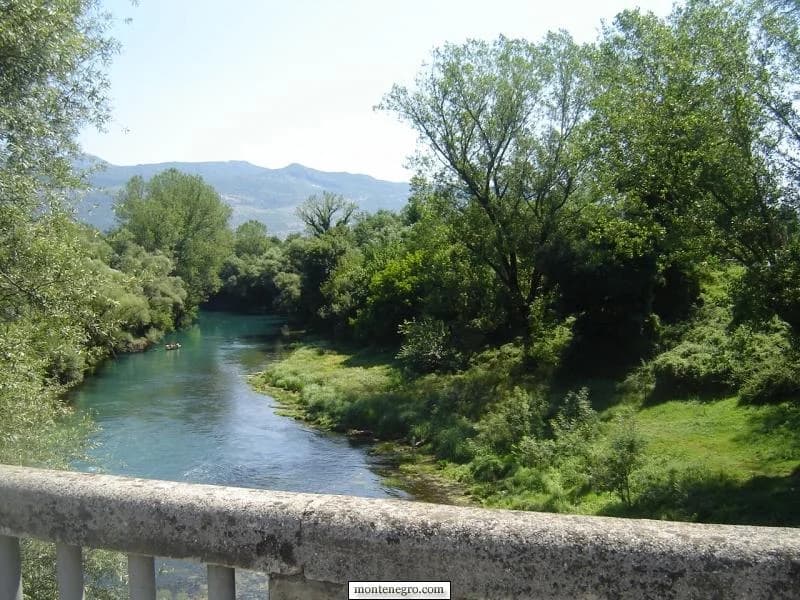
A licensed photograph from another Montenegrin river landscape helps show why visual resemblance is not enough for identification.

What the bird evidence actually says
The strongest recent summary is more specific—and more restrained—than many destination pages. BirdLife’s network report lists Buljarica as IBA ME006 and identifies the moustached warbler (Acrocephalus melanopogon) as the trigger species. It gives an estimated 400–800 individuals for 2016 and places the site among Montenegro’s top five for the species under criterion C6. That is a dated population estimate, not a 2026 live count and not a promise that a casual visitor will see one.
The underlying conservation assessment says Buljarica is smaller and less rich in overall bird diversity or abundance than the country’s largest coastal wetlands. Many ducks, egrets, herons and waders migrate through, but not all stop in large numbers. Woodland fragments support breeding habitat for species such as Levant sparrowhawk and Syrian woodpecker. The key discovery was the importance of the reed bed for moustached warblers during autumn migration.
| Element | Detail |
|---|---|
| Site code | ME006 · Important Bird Area |
| Area | 205 hectares |
| Trigger species | Moustached warbler |
| Why it counts | Autumn migration value |
| Estimate | 400–800 individuals |
| Date | 2016 · not a live count |
birdlife.org · rsis.ramsar.org
Montenegro’s national tourism organisation suggests looking for Levant sparrowhawk and Eurasian reed warbler at Buljarica. Treat that as a field prompt, not an itinerary guarantee. Season, time, wind, water level, observation skill and simple chance all matter. For a managed wetland comparison, the Tivat Solila field guide explains how a Ramsar reserve differs in status and visitor expectations; the Lake Skadar wetland guide adds a much larger hydrological system.
Beyond birds: surveys and knowledge gaps
The recent ecology overview reports 41 dragonfly species, 11 amphibian species and 93 bird species from existing data. Those are survey tallies with methods and boundaries behind them, not a complete census of every organism currently present. The same source highlights freshwater and brackish habitats and identifies Buljarica as valuable for the Balkan terrapin (Mauremys rivulata) and European pond turtle (Emys orbicularis).
A 2025–26 project is now updating information on those two turtle species, assessing habitat pressures and preparing restoration recommendations for degraded freshwater sites. A separate 2025–27 initiative is combining field studies with an ecosystem-services assessment and building an advisory board involving community, institutions, scientists and civil society. The existence of current projects is itself evidence that major management questions remain open.
Protection: beach, sea and wetland are not the same
The protection story needs equal precision. Government consultation records say Buljarica Beach was declared a Natural Monument in 1968. The Government’s current Katič page confirms a nature park of more than 2,500 hectares, declared in 2021, protecting marine habitat and divided into three management zones. But the 2021 consultation response explicitly said the adjacent existing protected area “Plaža Buljarica” could not be integrated into the Katič procedure, and a proposal to expand protection over connected land ecosystems was not accepted in that process.
The IBA and Important Plant Area labels express scientific significance. Emerald recognition or nomination connects the site to a Council of Europe conservation framework. Potential Natura 2000 value anticipates the type of evidence used for future EU network selection. None should be casually described as a national park, a completed Natura 2000 site or comprehensive protection of every wetland parcel.
Ramsar is the most common error. Older conservation writing says Buljarica may satisfy several Ramsar criteria. The Convention on Wetlands’ current country profile lists only three Montenegrin Ramsar Sites, and Buljarica is not among them. “Ramsar-quality” or “meets criteria” is an argument for designation, not the legal result of designation.
| Layer | Instrument | Status |
|---|---|---|
| Beach | Natural Monument | Since 1968 |
| Marine zone | Katič Nature Park | Declared 2021 |
| Bird value | IBA ME006 | Science-led designation |
| Full wetland coverage | Buljarica Ramsar Site | Not established |
gov.me · wapi.gov.me · birdlife.org · ramsar.org
Development pressure is a current planning issue
Pressure is not merely an old story about hypothetical hotels. A July 2025 BIRN analysis reported opposition to government tender and investment ideas affecting Buljarica and quoted civil-society concern about the Natural Monument and wetland. A July 2025 complainant submission by the Montenegrin Ecologists Society and partner NGOs, hosted in a Bern Convention case file, alleged a conflict in which plan text recommended protection for Emerald site ME0000005 while a spatial map designated the area for development.
These are reported planning and policy disputes, not proof that a specific resort has approval, financing or a construction date. The responsible conclusion is narrower: development scenarios and conservation boundaries were actively contested in 2025, while 2025–27 projects are still building evidence and community processes for formal wetland protection.
This tension is best understood as a landscape decision, not a slogan. The Buljarica cultural-landscape guide adds settlement and heritage context. The Piva landscape analysis offers a separate example of how infrastructure choices reorganize nature and community; it is a comparison, not a prediction that Buljarica will follow the same path.
| Year | Step |
|---|---|
| 1968 | Beach monument |
| 2021 | Katič declared |
| 2023 | IBA update |
| 2025 | Planning dispute |
| 2025–27 | Research + board |
wapi.gov.me · gov.me · birdlife.org · birn.me · rm.coe.int · drustvoekologa.me
Practical visit plan for beach and birding
What the sources say
Budva Tourism places Buljarica about two kilometres from Petrovac in the direction of Bar and describes a 2,250-metre beach that is sandier toward the Petrovac end and mainly pebble or stone elsewhere. It also lists a campground, restaurants and cafés behind the beach. That corrects the inherited promise of a supply-free “wild” shore. Individual businesses, parking arrangements, toilets, shade, lifeguard coverage and road access can still change; check the official map and local conditions on the day.
- Choose the purpose. For swimming, use the managed public beach area and current local safety information. For birds, prioritize quiet observation from an established public edge rather than pushing into reeds.
- Bring optics, not playback. Binoculars let you watch from distance. Avoid recorded bird calls, drones, nest approaches and repeated flushing for photographs.
- Respect land and water. Do not assume a track through fields is public. Never enter canals or reed beds; soft ground, concealed water and wildlife disturbance are real risks.
- Use light and season intelligently. Early morning can reduce heat and human activity. Migration may improve bird variety, but no month or hour guarantees a target species.
- Leave no trace. Carry out waste, keep dogs controlled under local rules, avoid fires and do not collect plants, shells, reptiles or amphibians.
| Mode | Practice |
|---|---|
| Beach visit | Public beach approach |
| Beach visit | Current swim guidance |
| Beach visit | Verify services |
| Bird observation | Established edge |
| Bird observation | Binocular distance |
| Bird observation | No playback or drone |
| Turn back when | Access is unclear |
| Turn back when | Ground is flooded |
| Turn back when | Birds are displaced |
budva.travel · montenegro.travel · rsis.ramsar.org
Build a resilient Petrovac day. Pair a confirmed public Buljarica approach with the Lučice Beach guide, the Kastio history guide or the recently corrected Mirišta archaeology guide. If continuing south, the Montenegro-to-Albania route guide handles transport logic; it should not be confused with a bird-migration itinerary.
How to read the seasons
Migration is the main ornithological reason to visit, especially because the moustached-warbler result concerns autumn movement. Winter can change water coverage and bring waterbirds, while summer concentrates beach use and disturbance. Yet broad seasonal labels cannot replace recent field data. A dry-looking visit does not prove the wetland has ceased to function, and one flooded day does not establish a permanent lake.
Plan with three variables: habitat condition, bird sensitivity and visitor pressure. If water is high, keep farther from channels. If birds repeatedly lift or alarm, increase distance or leave. If the beach is busy, accept that the birding experience may be limited. Conservation recommendations in the wild-bird assessment specifically call for marked trails, clear signage, careful visitor management and restricted-access areas.
| Season | Signal | Caveat |
|---|---|---|
| Spring | Migration passage | Nesting sensitivity |
| Summer | Beach pressure | Heat + disturbance |
| Autumn | Warbler passage | Key IBA evidence |
| Winter | Variable flooding | Waterbird potential |
rsis.ramsar.org · montenegro.travel
Frequently asked questions
Is Buljarica a Ramsar Site?
No. Montenegro’s current Ramsar country profile lists three sites; Buljarica is not one. Older claims that it meets criteria describe designation potential, not completed designation.
Is the wetland 58, 205 or 300 hectares?
Those figures refer to different study or landscape boundaries. Cite the 205-hectare IBA when discussing ME006, the approximately 58-hectare focus when discussing the recent ecology overview, and about 300 hectares only for the older broad landscape profile.
What bird makes Buljarica an IBA?
The 2023 BirdLife-network review identifies the moustached warbler as the trigger species and reports an estimated 400–800 individuals for 2016. That estimate is historical evidence, not a daily count.
Is the whole wetland legally protected?
No single reviewed instrument cleanly supports that claim. The beach has Natural Monument status; Katič protects marine and coastal areas; the IBA and Emerald layers express ecological significance. Current projects still seek stronger formal wetland protection.
Can I walk through the reeds?
Do not. Use established public approaches and observe from the edge. Reeds can conceal channels and soft ground, and entering them can disturb roosting, feeding or nesting wildlife.
Is Buljarica an undeveloped beach with no services?
That description is outdated and too absolute. Budva Tourism lists a campground, restaurants and cafés behind the beach. Verify what is operating on your date and still bring water, sun protection and a low-impact plan.

.JPG&w=2048&q=75)
