Mirišta is important because it is not one frozen “Roman villa.” Archaeology records a coastal residence built around the end of the first or beginning of the second century, enlarged over several generations, converted after destruction into a working estate with olive-oil equipment, repaired again in late antiquity and finally abandoned in the early seventh century. Its mosaics preserve only part of that long sequence.
The responsible 2026 answer to “Can I visit?” is less simple. A municipal report documents a reopening in 2017, but the national conservation centre described the site as being in very poor condition in 2019. Budva’s current tourism page says adequate protection and presentation have not been secured. No current public timetable or guaranteed walk-in access was found during this review. Treat Mirišta as an archaeological location whose access must be confirmed, not as an always-open mosaic museum.
Mirišta at a glance
| Question | Evidence-backed answer | Important limit |
|---|---|---|
| Where? | About 300 metres from the coast at Petrovac | This is a locality description, not a public route or entrance |
| When built? | Late 1st or early 2nd century; used into the early 7th | The complex changed function and form repeatedly |
| What survives? | Villa remains, pools, painted-plaster evidence and mosaic floors | Several mosaic fragments were removed or disappeared |
| Main mosaic? | Room M, divided into 12 decorated fields | Published area measurements differ: 35.7 and about 37.5 m² |
| Can you enter? | Confirm directly with Budva Museums before travelling | A 2017 reopening notice is not a current schedule |
From a 1902 report to systematic archaeology
The Montenegrin Academy’s art lexicon dates the discovery to 1902 and places it in an olive grove about 300 metres from the sea. Its archaeology lexicon adds an uncomfortable part of the story: early work led by Johan Pressel was not published, the building was damaged and looted during the Austro-Hungarian period, and mosaics and other material were removed. Some objects are now held by the Archaeological Museum in Split.
Partial investigations followed in the early 1960s. The first systematic campaigns ran from 2006 to 2011; Mladen Zagarčanin’s research report is the key excavation publication. Those campaigns replaced the old image of a single decorative floor with a stratified complex on six height levels. Fourteen rooms, nine pools or piscinae, domestic and imported ceramics, glass, metalwork, painted plaster and production features provide the context that a detached mosaic photograph cannot.
| Date | Event | Note |
|---|---|---|
| 1902 | public report | |
| 1960s | partial work | mosaic protected |
| 2006–11 | systematic excavation | |
| 2017 | shelter repaired | site reopened then |
Source: leks.canu.ac.me, nadcg.me, budva.me
How the villa changed over six centuries
The earliest recognized phase belongs to the late first or early second century. In the second and third centuries, the residence expanded westward. The Academy’s archaeology entry calls these first two stages a villa urbana: a well-appointed residence rather than the finished “olive farm” imagined in many short summaries.
A destructive event around the middle of the fourth century changed the complex. Buttresses and new rooms were added; three millstones and a workshop point to olive-oil production, while another building had an economic function. This is the phase for which villa rustica is useful. It describes a changed working estate, not necessarily the building’s identity from day one. Repairs and levelling in the sixth century show continued reuse before destruction early in the seventh.
| Period (century) | Phase | Detail |
|---|---|---|
| Late 1st–early 2nd | first building | terraced ground |
| 2nd–3rd | westward growth | residential emphasis |
| After mid-4th | olive workshop | economic rooms |
| 6th–early 7th | repairs and reuse | final destruction |
Source: leks.canu.ac.me
Nine pools further complicate the picture. Some were mosaic-paved in an early phase and later covered with waterproof mortar; others used stone slabs, mortar or clay. Amphorae and fine wares linked the household to Mediterranean exchange, but they do not by themselves prove a particular owner, export volume or named trade route. The two funerary inscriptions carrying the nomen Cordius are real evidence; they are not enough to identify the villa’s proprietor.
How to read the Room M mosaic
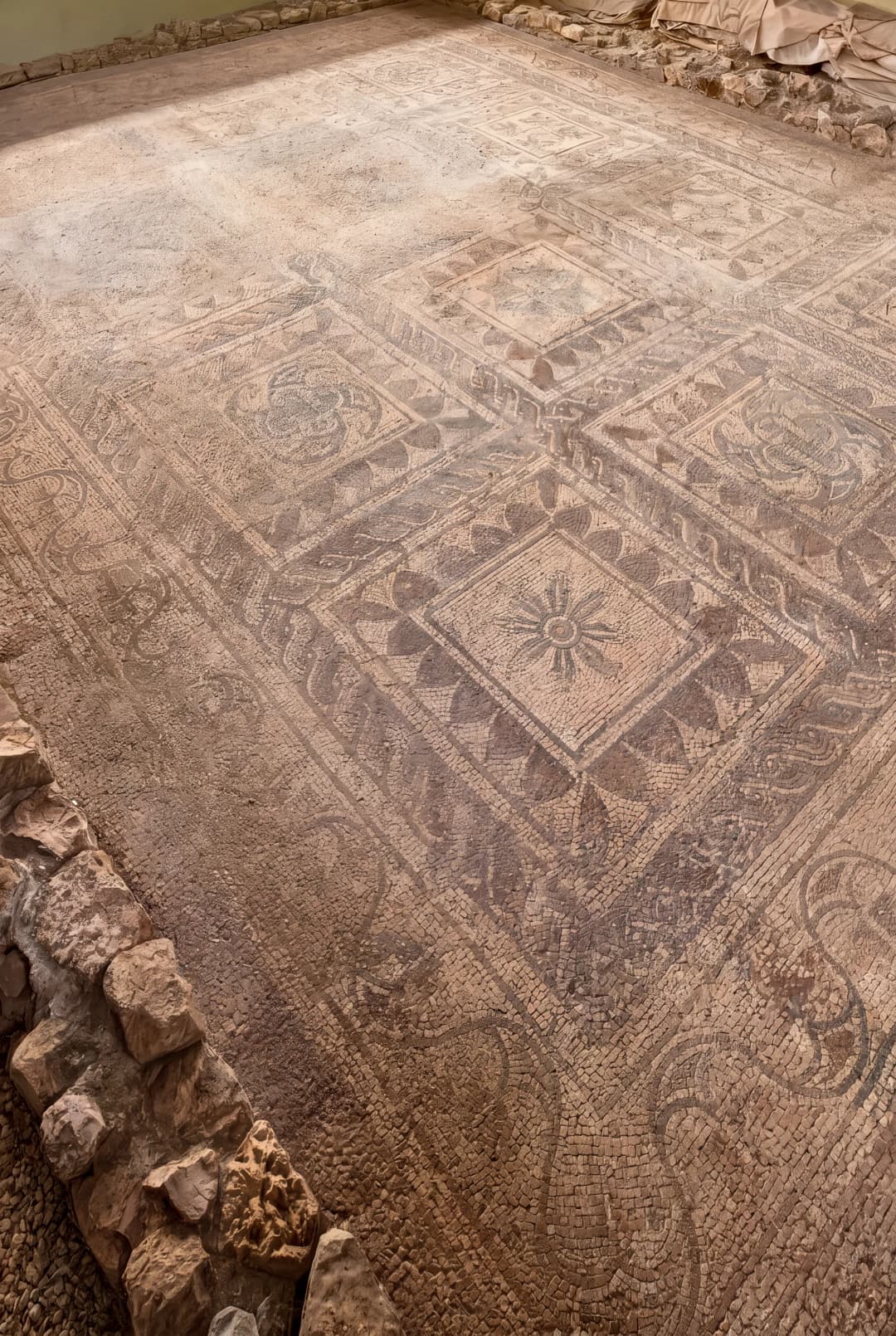
The best-preserved floor belongs to Room M, identified as the complex’s most representative room or triclinium. A braided border divides the composition into 12 fields. The Academy’s art lexicon lists rosettes, a Solomon knot, a wheel, a kantharos, flowers and stylized vine leaves, made with grey, black, green, pink and red stone tesserae. The archaeology lexicon also records damage to some fields.
These patterns matter because they organize a reception space: repeated geometry creates rhythm while vessels and vegetation evoke abundance. They do not give us a portrait of the owner or a complete religious program. Comparing Mirišta with the Roman mosaics at Risan is useful, but the two sites should not be merged. Risan’s celebrated figurative floor and Mirišta’s multi-phase coastal estate answer different archaeological questions.
| Field | Motif |
|---|---|
| 1 | rosette |
| 2 | knot |
| 3 | vine leaves |
| 4 | wheel |
| 5 | flower |
| 6 | kantharos |
| 7 | geometry |
| 8 | rosette |
| 9 | plant motif |
| 10 | damaged |
| 11 | geometry |
| 12 | damaged |
Source: leks.canu.ac.me, budva.me
The lost triple-fish fragment
A separate fragment showed three fish sharing one head. It is one of Mirišta’s most repeated images—and one of the easiest to misrepresent. The Academy says some maritime fragments were removed early in the twentieth century and others disappeared in the 1960s. Budva Municipality’s 2017 account explicitly says the triple-fish fragment was not preserved. You cannot expect to see it at the site.
Local heritage writing has interpreted the image within an early-Christian artistic tradition. That reading should remain attributed, not presented as a universally settled label. With the fragment lost, visitors cannot inspect its context or workmanship in situ. The safer description is a documented maritime motif that has received an early-Christian interpretation.
Two measurements and a dating question
Even official or scholarly summaries do not always use the same number. The Academy’s art lexicon gives 35.7 square metres for the preserved decoration in Room M; Budva Municipality’s 2017 account says approximately 37.5 square metres. The discrepancy may reflect what was measured or a transposition, but the sources do not resolve it. “About 36–38 square metres in published accounts” is more honest than choosing whichever figure sounds precise.
Dating also requires care. The Academy places the western residential mosaics broadly in the third and fourth centuries and identifies Room M’s mosaic as fourth-century. The municipal account argues for the mid-fourth century. A CNR volume, drawing on stylistic comparisons, places the mosaic toward the end of the third century. This is a dating range and interpretation issue—not evidence that one of the sources describes a different Petrovac site.
Protection history is not an opening-hours page
Budva Municipality reported that repairs to the structure over the mosaic allowed visitors back in October 2017 after a long closure. Two years later, the national Centre for Conservation and Archaeology recorded conservation work beginning on 6 November 2019 and said the locality was found in very poor condition after previous repairs. Budva Tourism’s current attraction page says archaeological research is unfinished and adequate protection and presentation have not been secured.
A 2025 government decision lists a €12,000 protection-and-presentation design project for the floor mosaic but records that no application was submitted for that project. A budget line is therefore not proof that a new presentation system was built. Together, these records explain why a past reopening, an old shelter photograph or an undated map pin cannot establish present access.
| Point in time | Status | Detail |
|---|---|---|
| 2017 | shelter repaired | visitors received |
| 2019 | very poor condition | conservation action |
| Current page | presentation not | adequately secured |
| Your visit | confirm directly | respect all barriers |
Source: budva.me, ckacg.me, budva.travel, wapi.gov.me
How to plan a responsible visit in 2026
- Contact the responsible institution first. Ask Budva Museums and Galleries whether Mirišta is receiving visitors on your exact date, whether entry is guided, and where visitors should report. A map listing is not confirmation.
- Ask about the route. The archaeological description gives distance from the coast, not a signed step-free path. Check surface, steps, parking and mobility conditions before setting out.
- Stay outside barriers. Do not move covers, cross fencing, touch tesserae, climb walls or enter an olive plot because a phone map draws a line through it. The remains and surrounding land are not an informal shortcut.
- Bring a substitute plan. If access is unavailable, use the day for Petrovac’s Kastio fortress, the town exhibition space, or a documented coastal walk.
Do not search for a “Roman road” underfoot. Budva’s institutional pages connect the villa with the historical Epidaurus–Scodra corridor, but no cited source establishes a publicly visible road segment at Mirišta. The broader idea—that coastal estates depended on regional movement—is plausible; a preserved path visitors can follow is a different claim.
Build a Petrovac half-day that still works
Start with a confirmed museum answer. If Mirišta is accessible, make it the single fragile-heritage stop and follow the staff’s route. Then return to the waterfront and read Kastio’s later defensive and quarantine history. The town’s stone lanes also reward attention to Montenegro’s historic doors and portuni, but later masonry should never be used as a visual reconstruction of a Roman villa.
If the archaeological site is unavailable, choose landscape rather than trespass. The Lučice guide covers the nearby cove and current practical checks; the Buljarica wetland guide explains why the coast behind the beach deserves care. For wider chronological context, the guide to prehistoric and ancient evidence in Boka shows how archaeology is assembled from sites, objects and later research rather than one picturesque ruin.
Practical visit decision for 2026
Make the access decision before leaving your accommodation. If the museum confirms a time and meeting point, follow those instructions and allow for the fact that a conservation site may close at short notice. If staff cannot confirm entry, do not convert uncertainty into permission: use the waterfront alternative. If entry is confirmed but the route or site conditions do not work for someone in the group, choose the substitute together. This keeps a cultural stop from becoming an unsafe scramble or an intrusion onto protected or private ground.
| Step | Check | Then |
|---|---|---|
| 1 · Confirm entry | exact date and time | meeting point |
| 2 · Check route | surface and steps | group comfort |
| 3 · Visit or pivot | follow staff | or use public alternative |
Montenegro.com editorial framework
Frequently asked questions
Are the Mirišta mosaics open in 2026?
No dependable public timetable was found in this review. A 2017 municipal page records reopening at that time; later conservation and current tourism records do not justify assuming daily access. Confirm with Budva Museums and Galleries for the exact date.
Can I see the three-fish mosaic?
No. Published institutional accounts say the fragment was not preserved or disappeared. Images in a lexicon document the motif; they do not prove it remains on display.
Is this the Hypnos mosaic?
No. The Hypnos floor belongs to Risan. Mirišta’s principal preserved composition is a 12-field geometric and vegetal mosaic associated with Room M.
Was Mirišta a luxury villa or an olive farm?
Both labels describe different periods. It began with the characteristics of a residential villa urbana; after fourth-century destruction it gained olive-processing and economic spaces associated with a villa rustica.
Why do sources give two mosaic sizes?
The Academy publishes 35.7 m²; the 2017 municipal account gives about 37.5 m². Without the underlying measurement records, the discrepancy cannot responsibly be “corrected.”
What is the safest takeaway?
Mirišta is a nationally important, multi-period archaeological complex, not a guaranteed roadside attraction. Learn its evidence before going, verify access, and let conservation rules decide how close you get.

.JPG&w=2048&q=75)
