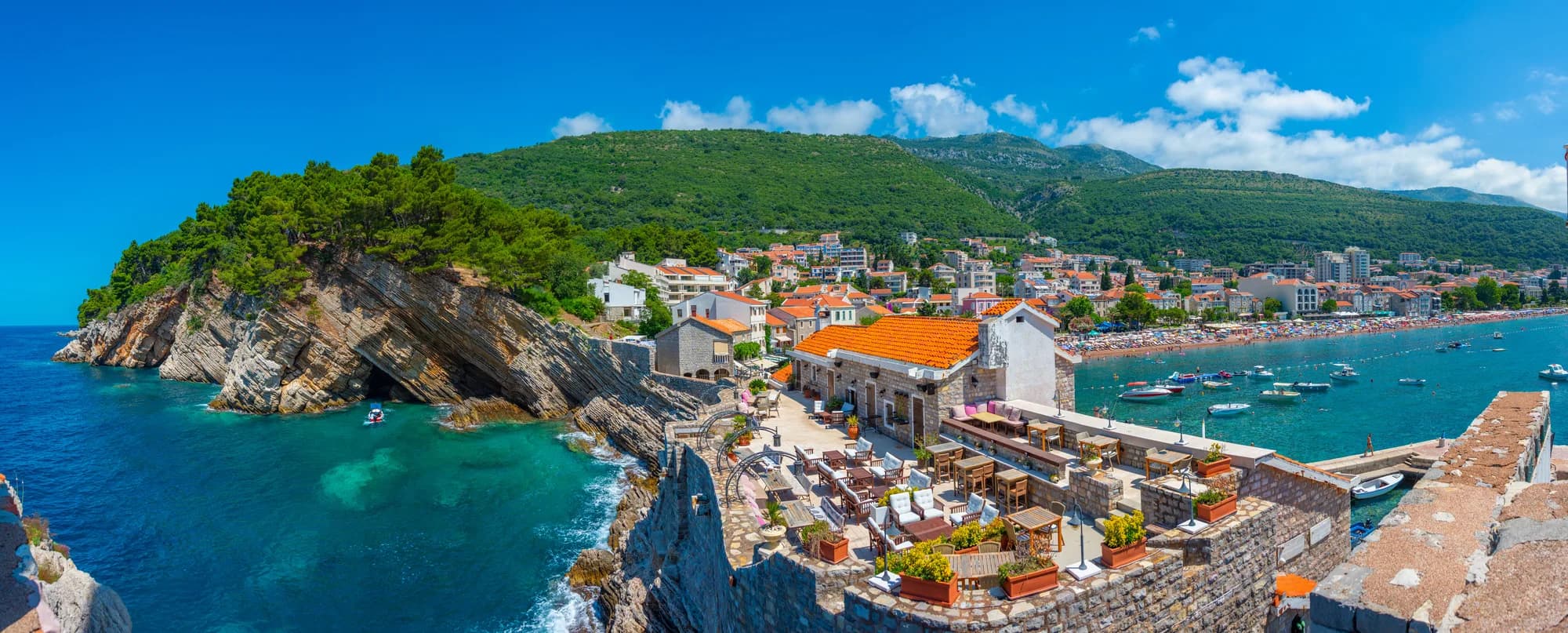
Kastio is Petrovac’s best-known silhouette, but the low walls above the harbour are not an intact Venetian castle. The documented story has three physical layers: a 16th-century Kastelo tower that was later demolished, a Lazaret quarantine complex reshaped under Austrian rule, and memorials added in the 20th century. Reading those layers separately makes the headland more interesting—and prevents a pleasant viewpoint from becoming bad history.
This evidence-checked 2026 guide also corrects practical overclaims. The exterior is easy to locate from Petrovac’s seafront, but no primary source reviewed on 30 August 2026 confirmed unrestricted entry to every terrace or room, current hospitality opening hours, or a fixed admission policy. Walk to the site, read any barrier or sign on arrival, and treat the sea-facing rock as an exposed historic place rather than an amusement platform.
| Layer | Documented role | What a visitor sees | Important limit |
|---|---|---|---|
| Kastelo | 16th-century Venetian defensive tower and garrison | Low remains and an upper terrace | The tall tower was demolished under Austrian rule |
| Lazaret | Quarantine, then military administration and storage | The larger stone ranges around the harbour headland | Sources disagree on its construction date |
| Memorials | Commemoration of Paštrovići lost in 20th-century wars | Prominent vertical monument and plaques | Not one generic “WWII obelisk” |
| Visitor use | Heritage landmark and adapted hospitality space | Promenade approach, harbour and bay views | Access and business status must be checked on site |
First correction: Kastelo and Lazaret are not one building
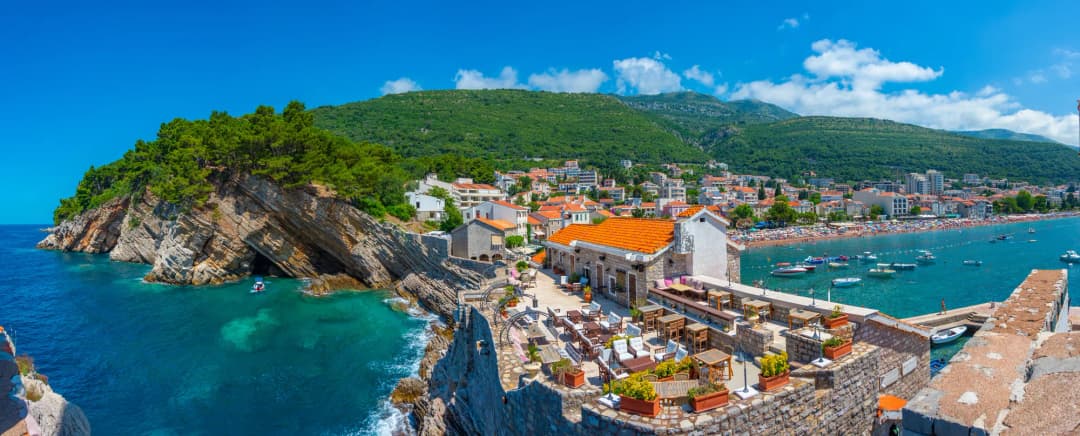
Official visitor summaries often compress the headland into “Kastio and Lazaret.” That is convenient for navigation but misleading as architecture. The Tourism Organisation of Budva’s 2025 fortifications monograph describes Kastelo as a tall defensive tower with subsidiary rooms on the area now occupied by the upper Lazaret terrace. A suspended iron bridge on its northern wall was raised at night. Beneath it, cellars held weapons, wine and olive oil for the soldiers.
The Lazaret was a different institution. Its purpose was sanitary control: people and goods arriving from ports associated with epidemic risk could be separated before entering the settlement. The detailed monograph describes four linked two-storey buildings, cisterns and a cannon platform. It identifies local pink stone, black-pine timber and cut stone around openings brought from Korčula. Those details belong to the quarantine complex, not automatically to the lost Kastelo tower.
| Layer | Built form | Later change |
|---|---|---|
| Kastelo | tower + garrison | bridge + cellars; tower lost |
| Lazaret | quarantine ranges | cisterns + platform; fabric altered |
| Memorial layer | WWII memorial | 1996 plaques; public memory |
Source: budva.travel, muzejiigalerijebd.me
Why Venice put a garrison above Petrovac Bay
What the sources say
The Tourism Organisation’s monograph places construction of Kastelo in the 16th century, with permission from the Paštrovići Bankada, the local assembly and court. Venice controlled the coast, but the permission matters: this was not empty territory receiving a foreign fort. It was a Paštrovići settlement with its own political institutions inside a larger Venetian maritime system.
A permanent garrison occupied the tower. The same source gives unusually specific staffing: five soldiers plus a captain until 1657, then a force increased to 20. The commander, or castellan, came from the Medin family; the related Kašćelan family retained a privilege to live there until the fall of the Venetian Republic in 1797. Historical headcounts should not be mistaken for a floor plan, but they reveal that this small rock was an operating post rather than a decorative lookout.
The fort also supported exchange. Budva’s official attraction page mentions warehouses for wine and other goods intended for export, while the more detailed monograph describes wine and olive oil stored for soldiers alongside weapons. These claims are compatible only at a broad level: the headland joined defence, storage and harbour traffic. It does not follow that every cellar served one continuous commercial export function.
The national sailing guide adds the geographical logic. It describes Castellum Lastva as a defence against seaborne attack and warns that Petrovac Bay is exposed to winds from the second and third quadrants. That is a pilotage statement, not proof of a particular pirate battle. It also explains why a lookout above a small harbour mattered—and why present visitors should take waves and wind seriously.
The Lazaret date is genuinely disputed
There is a conflict inside otherwise authoritative local material. The Tourism Organisation’s attraction page and the Museums and Galleries of Budva overview place the Lazaret broadly in the 16th century alongside Kastelo. The 2025 fortifications monograph’s detailed section instead dates the four-building quarantine complex to the late 18th century. An earlier structure, later rebuilding, or summary-level compression could explain the difference, but the reviewed sources do not settle it.
The responsible wording is therefore precise: Kastelo is securely presented as a 16th-century Venetian fortification; the Lazaret served Venetian quarantine, but the date of the standing complex is contested in institutional sources. This article follows the detailed monograph for the surviving complex while keeping the disagreement visible. It does not turn a disputed date into a fact by repetition.
Function is clearer than chronology. The detailed study says travellers arriving from the Levant were quarantined at Petrovac while their ships waited near Sveti Nikola by Budva. In maritime Montenegro, quarantine was part of port infrastructure: controlled waiting protected settlement and trade. For comparison—not as proof of Petrovac’s construction date—our history of the larger Meljine Lazaret shows how another Venetian sanitary station organized movement near the Bay of Kotor.
| Source type | Date given | Scope |
|---|---|---|
| Institutional summaries | 16th c. | Kastelo and Lazaret grouped |
| Detailed monograph | late 18th c. | surviving four-building complex |
Source: budva.travel, muzejiigalerijebd.me
Austrian alterations explain today’s low profile
After Venice fell in 1797, political control changed repeatedly before Austrian administration became established. The 2025 monograph says the Austrians considered Kastelo’s high tower unnecessary, demolished it and created the upper terrace. An old Venetian cannon was moved to the lower fortification and pointed east, toward Montenegro. The Lazaret became military storage and administration, with a separate kitchen on the western side.
This is the key to looking at the site today. The prominent terrace is not simply a preserved tower roof; it belongs to the transformation that followed the tower’s removal. The standing stone ranges carry multiple phases of repair, reuse and 20th-century adaptation. A photograph cannot date each wall, and a visitor should resist doing so.
Stefan Mitrov Ljubiša helped secure construction of a harbour in 1880, according to the same monograph, addressing dangerous rocks below Kastelo and Lazaret. Harbour improvement reinforced the headland’s practical role even as its military architecture changed. Petrovac’s modern waterfront grew around this relationship between landing place, storage buildings and town.
From Lastva to Kastel Lastva to Petrovac
The fortress changed the settlement’s name. Lastva was the older place-name; Kastel Lastva joined it to the Venetian stronghold, while local speech shortened the landmark to Kastio or Kašćel. In 1918, the local council unanimously chose Petrovac in honour of King Peter I, according to the fortifications monograph. Some cultural summaries use 1919 around the transition, so both years may appear in secondary accounts.
The older name did not disappear from memory. “Kastio” remains the useful local name for the harbour headland, even though the town is Petrovac. For the wider sequence—from Roman mosaics through Lastva and the modern resort—use our evidence-checked Petrovac guide. The nearby Mirišta mosaics are a separate archaeological site and should not be used to date Kastelo.
| Date | Event |
|---|---|
| 16th c. | Kastelo |
| 1657 | garrison grows |
| 1797 | Venice falls |
| 1880 | harbour works |
| 1918 | Petrovac name |
| 1958 | protected |
| 1970s | adaptation added another visible layer |
Source: budva.travel, montenegro.travel
The memorial is a layered ensemble
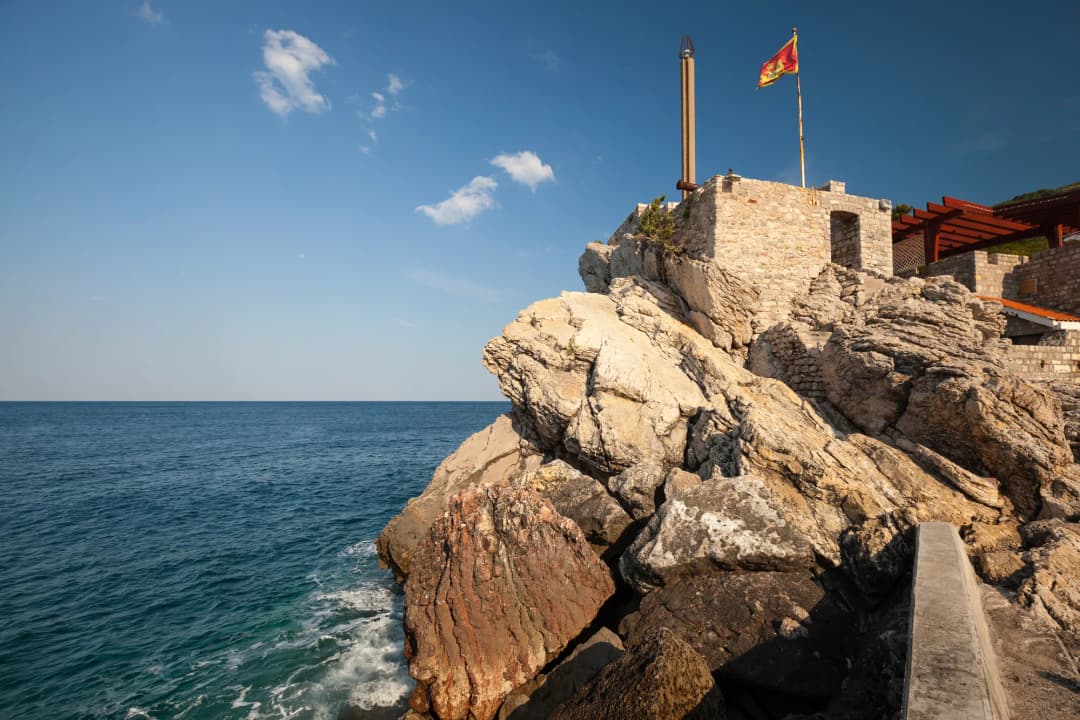
The vertical monument above the rock is often described online as a WWII obelisk. Budva municipality’s memorial register supports a more careful account. It identifies an existing monument to Paštrovići killed in the Second World War and records two white-marble plaques installed in 1996 for 52 Paštrovići who died in the wars of 1912–1918. The municipality is listed as responsible for maintenance.
That makes the platform a memorial ensemble spanning different conflicts and installation dates. Read inscriptions where access permits, do not sit on plaques, and avoid using the monument as a prop. The fortifications collection also describes monuments on Kastelo and Lazaret dedicated to Paštrovići lost in the Balkan Wars and both World Wars. The exact object and dedication matter more than the convenient label “obelisk.”
| Element | Dedication | Period |
|---|---|---|
| Existing monument | Paštrovići killed | in World War II |
| Plaques added 1996 | 52 Paštrovići killed | during 1912–1918 |
Source: api.budva.me, muzejiigalerijebd.me
What protection since 1958 means
Budva’s cultural-monuments list records the remains of Kastel/Kastio and Lazaret as protected profane architecture under the older category system. A Montenegro government cultural programme marked 2018 as the 60th anniversary of protection, establishing 1958 as the protection year. Museums and Galleries of Budva and Petrovac’s local community used the anniversary for an exhibition, lecture, site visit and publication work.
Legal protection does not make every surface publicly climbable. It means alterations, interpretation and use sit inside a heritage framework. Stay on an evident maintained route, obey closed gates and event controls, and do not enter roofless rooms or private hospitality areas simply because an old article called the fort “free and open.”
Practical visit plan for 2026
Kastio is at the western end of Petrovac’s beachfront promenade, above the small harbour. The simplest plan is to reach central Petrovac and walk along the public seafront toward the headland. Do not drive to the final rock or rely on waterside parking; the last approach belongs to pedestrians, harbour activity and venue servicing.
The official Budva transport page listed year-round local buses between central Budva and central Petrovac when checked on 30 August 2026. It published multiple daily departures, but copied timetables age quickly. Recheck the official page on the travel date and confirm the exact stop and return service, especially late in the evening. For accommodation trade-offs and neighbourhood context, see where to stay in Petrovac.
| What you find | Best response | Why |
|---|---|---|
| Open maintained approach | Walk carefully and remain within it | Historic stone can be uneven and polished |
| Closed gate, barrier or private-use sign | View from the public promenade | No reviewed source guarantees entry |
| Strong wind or spray | Stay back from exposed edges | The bay is open to hazardous weather sectors |
| Event setup | Follow steward instructions and posted hours | Temporary controls may change circulation |
| Mobility concern | Use the level promenade view first | No audited step-free route was verified |
| Step | What it means |
|---|---|
| Petrovac | centre |
| promenade | approach |
| signs + weather | check before going on |
| maintained route only | stay on it |
| turn back | closed route or rough sea = exterior view only |
Source: new.budva.travel, montenegro.travel, gov.me
Build a better Petrovac walk around it
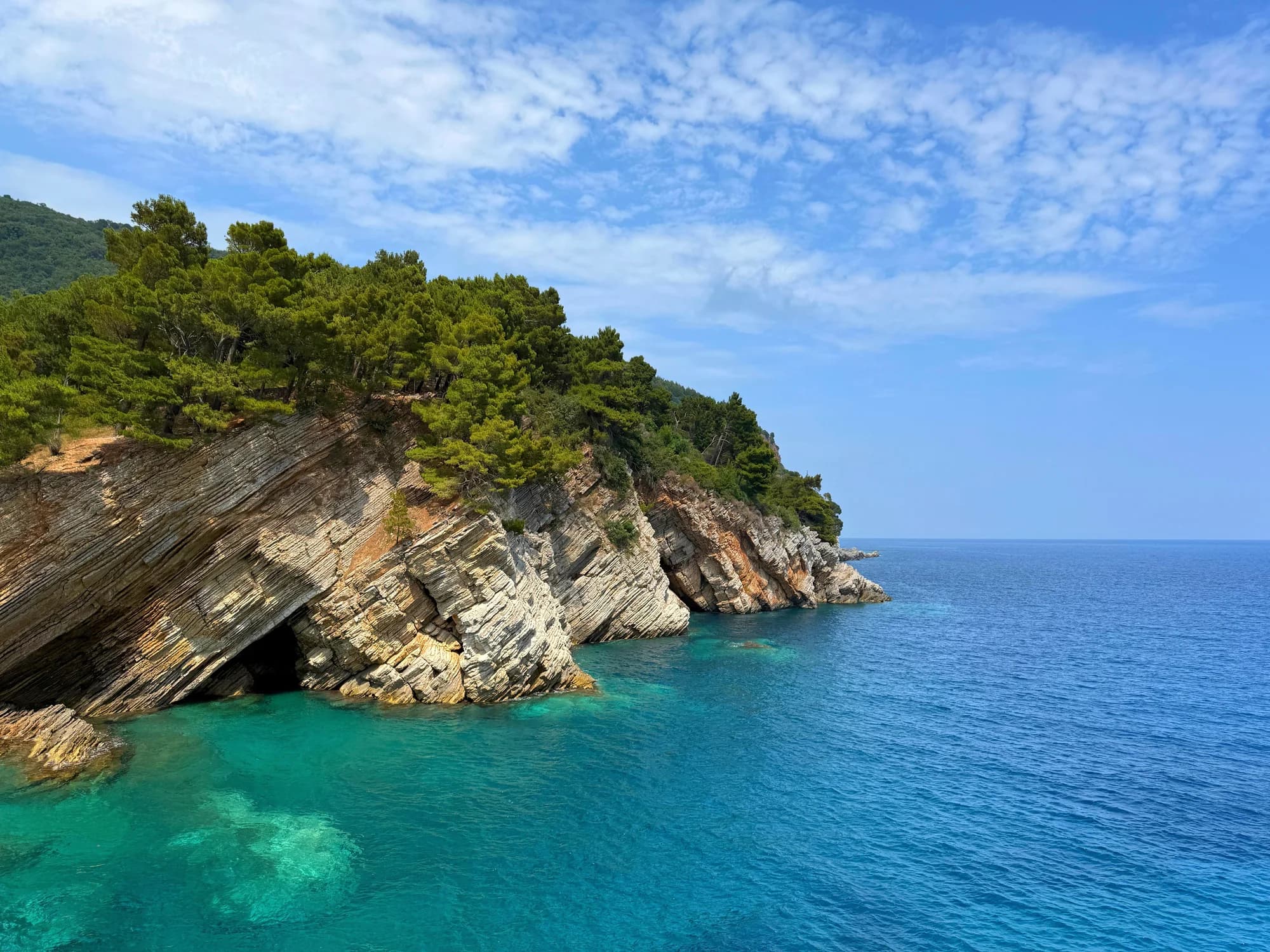
Allow time to look outward. Katič and Sveta Nedjelja sit offshore inside a protected nature-park landscape; our Katič and Sveta Nedjelja guide explains why the islets are more than scenery and why landing, boating and wildlife disturbance need current rules. The headland also reveals the harbour, beach and the town’s close relationship with steep coastal geology.
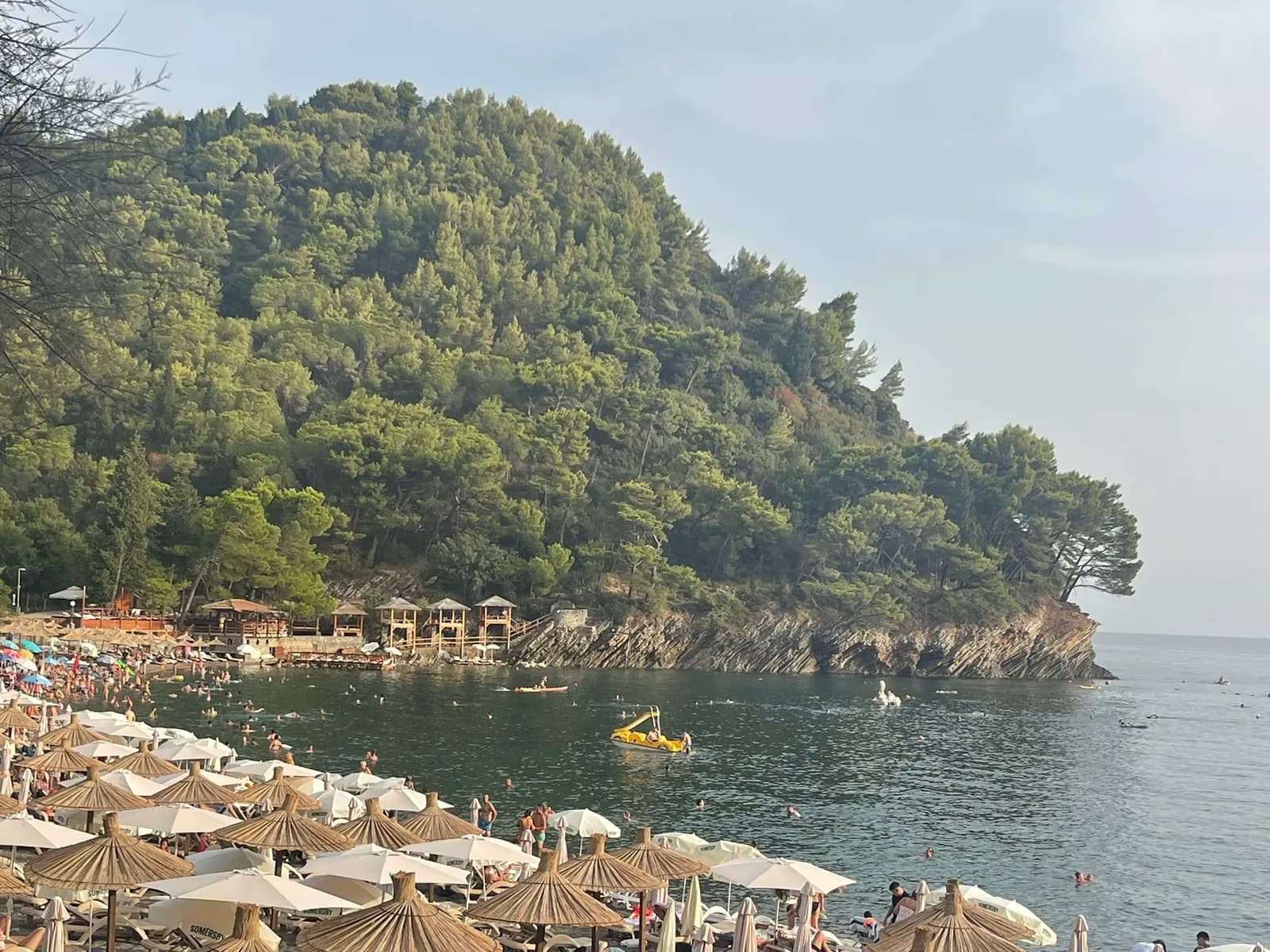
Continue along the promenade rather than treating Kastio as a drive-by photo. The wider Petrovac and Bar coast guide helps connect the stop with Reževići, Buljarica and Bar without cramming them into one short walk. If you add a swim, use a managed beach area and current local conditions; do not enter the water from the fort rock.
Frequently asked questions
Is Kastio an intact Venetian fortress?
No. The 16th-century Kastelo was a tall tower with supporting spaces, but the 2025 fortifications monograph says Austrian authorities demolished the tower and created a terrace. Low remains survive beside the much larger Lazaret complex.
When was the Lazaret built?
The sources disagree. Short institutional summaries place it in the 16th century, while the detailed monograph dates the surviving four-building quarantine complex to the late 18th century. Venetian quarantine use is well supported; one exact construction date is not.
Can I enter Kastio for free in 2026?
Do not rely on that promise. The public promenade reaches the harbour headland, but no reviewed primary source confirmed a fixed 2026 admission policy or unrestricted access to every terrace and room. Follow the signs and barriers present when you arrive.
Is the terrace bar open?
Heritage sources document hospitality adaptation from the 1970s and later use, but they do not establish the current operator, season or hours. Check locally and do not treat a venue area as public when closed.
What does the monument commemorate?
Municipal records describe a WWII memorial to fallen Paštrovići and two plaques added in 1996 for 52 Paštrovići killed in the wars of 1912–1918. The platform therefore holds several layers of commemoration.
Is Kastio suitable for reduced mobility?
The level seafront provides an exterior view, but no audited step-free route to upper areas was found. Historic stone, steps and changing access controls can be barriers; assess the entrance on arrival and avoid unsafe assistance on exposed edges.
When is the best time to visit?
Choose daylight and calm conditions if history and safe footing are the priorities. Evening may bring attractive light and more promenade activity, but neither sunset access nor a venue seat is guaranteed. In wind or spray, remain on the safer public seafront.
Kastio deserves to be seen as evidence, not scenery alone. The lost Venetian tower, disputed Lazaret chronology, Austrian alterations and layered memorials explain why Petrovac’s smallest headland carries so much history. A careful visitor can appreciate all of that without inventing an intact castle—or stepping beyond what the site safely permits.

.JPG&w=2048&q=75)
