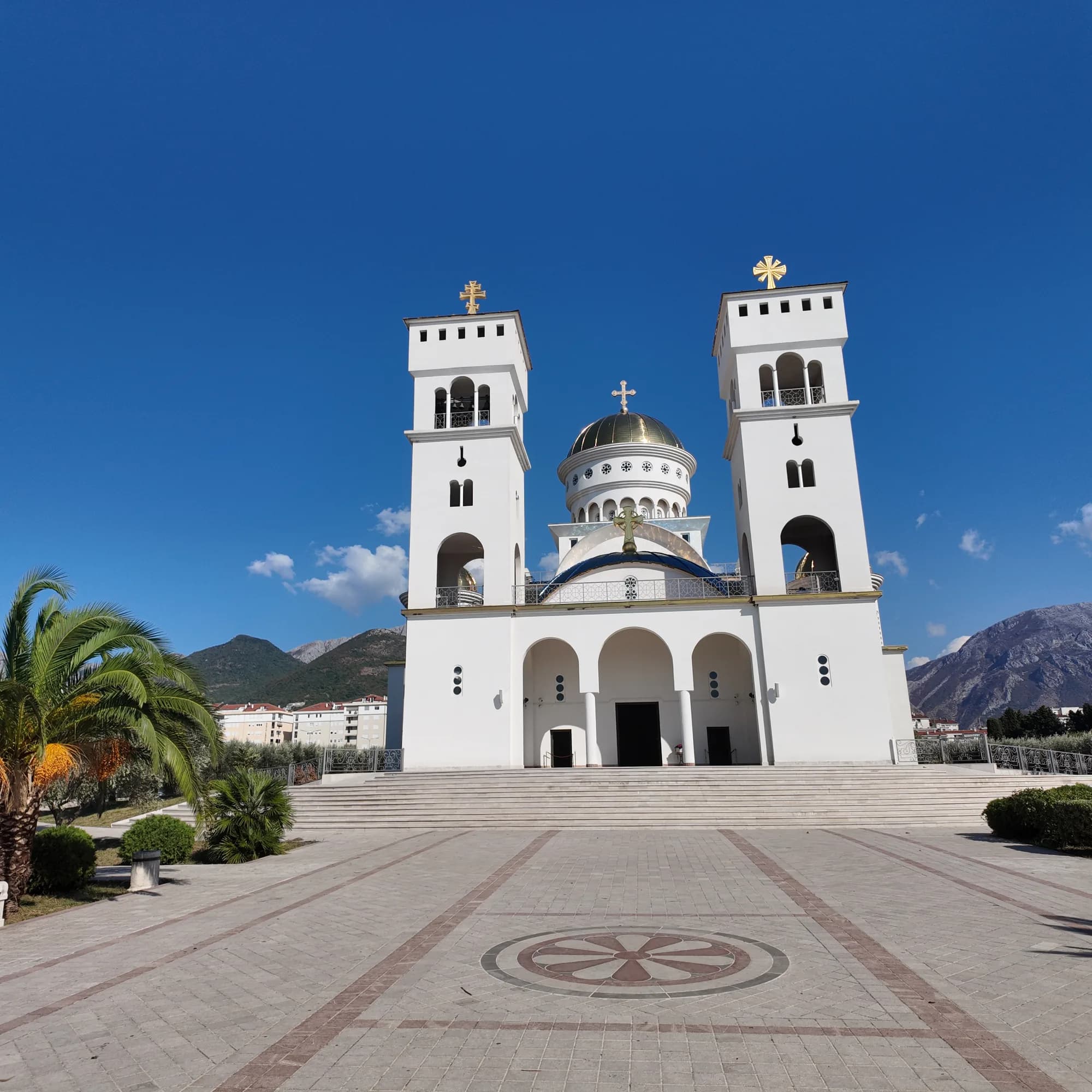
The Cathedral of Saint Jovan Vladimir is the white church with two bell towers and a gilded dome that stands in an olive grove in the middle of new Bar, and it is exactly ten years old this week: consecrated on 25 September 2016, the thousandth anniversary of the death of the ruler of Duklja it is named for. It took thirty-seven years from the first request for a site to the first liturgy, its walls carry nearly half a hectare of true fresco, and the story of its saint was written down in this town seven centuries ago by Bar’s Catholic archbishop. This guide is built from the parish’s own record, the lead painter’s account, the municipal and church press, and our visit on 20 September 2026.
Research checked 22 September 2026, largely against the parish website hrambar.com. Service times are the parish’s published schedule; there are no posted visitor hours, and the church is a place of worship first.
The cathedral at a glance
| Question | Answer |
|---|---|
| Name | Saborni hram Svetog Jovana Vladimira — the Cathedral of St Jovan Vladimir, Serbian Orthodox, Metropolitanate of Montenegro and the Littoral |
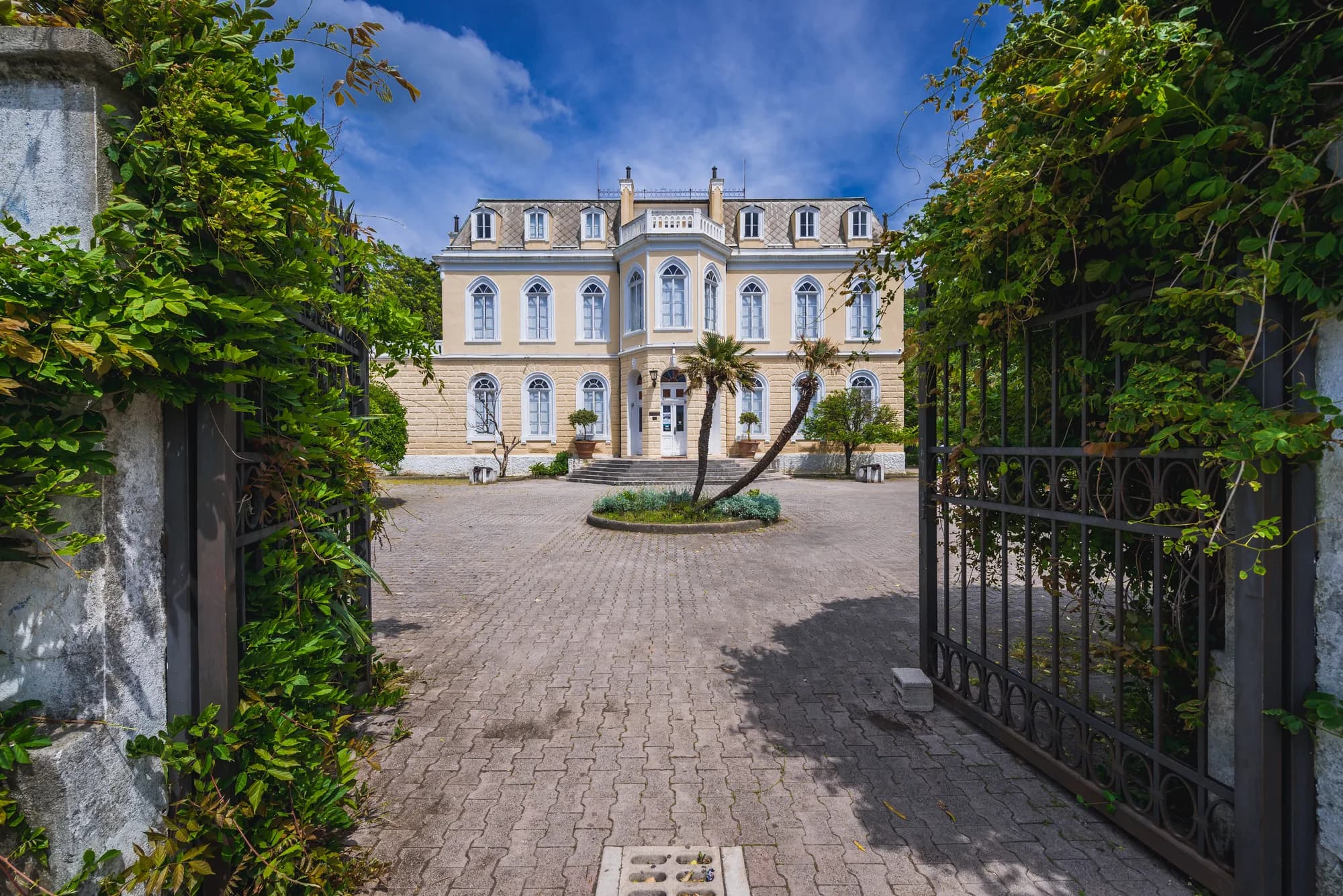
| Where | Jovana Tomaševića 38, Topolica, central Bar; 42.1012 N, 19.0942 E. King Nikola’s Palace is 240 m away, the ferry port 640 m, the bus and railway stations about 1.7 km |
| Built | Cornerstone 4 June 2002; permit and excavation 2006; first concrete 3 July 2009; cross on the dome 28 October 2012; consecrated 25 September 2016 |
| Size | 54 × 36.8 m, a footprint of 1,370 m², 44.5 m to the tip of the cross, room for about 1,200 people. The parish calls it the largest Orthodox church in Montenegro; other reports rank it second after Podgorica |
| Inside | About 4,800 m² of true fresco painted in under a year and a half by five teams under Anastasije Radović; an 18.5-m marble iconostasis; a 1,700-m² mosaic floor designed by Dušan Stanojević; a crypt dedicated to St Alexander Nevsky |
| Bells | Eleven, cast at the Vera foundry in Voronezh, from 800 kg down to 10 kg, tuned as a scale |
| Services | Liturgy Sundays and feasts 09:00, other days 08:00; Matins Sundays 08:00; Vespers daily 18:00 (20:00 in summer) |
| Feast | 4 June (22 May in the Julian calendar), with an evening procession through the streets of Bar; the consecration anniversary is kept in late September |
| Entry | No fee is published anywhere; the church is open around services. No photography policy is posted — ask, and never during a service |
Thirty-seven years to a church
Modern Bar was laid out on its present site in 1976, four kilometres from the old town abandoned in 1878, and by the parish’s own account it grew into a planned city of boulevards without a church. The first request for a plot was made by the priest Bogić Femić shortly after the 1979 earthquake. The authorities offered him a site “somewhere on the slopes of the surrounding hills, as far as possible from the centre”; the old Metropolitan Danilo petitioned the municipality four times and his vicar bishop once, in vain.
The break came in 1991. An initiative committee was formed on 17 March with the blessing of the new Metropolitan, Amfilohije. On 12 May, St Basil of Ostrog’s day, Fr Bogić stood on the first slab of the future lodgings at the Ribnjak monastery and called on the people of Bar to protest. Then he carried a table and a chair onto the main square and sat there for three days without food or water, under a hand-lettered sign: “I am asking for a place for God’s church, I am asking for a place for prayer.” More than 5,000 people signed the notebook on his table — over half the town, the parish notes, and not only its Orthodox: Roman Catholics and Muslims signed too. A rally in front of the town assembly followed, and the municipality gave the church a little over two hectares in the centre of Bar, beside the post office and the Hotel Topolica.
A wooden cross went up on the plot that summer and a concrete one replaced it on St Nicholas’ day; for years Fr Bogić served vespers at that cross on the eve of every Sunday and feast, in wind and rain, and liturgy at St Nicholas in Stari Bar. The cornerstone was laid on 4 June 2002, the saint’s feast. The building permit came on 24 August 2006 and the excavation began that October, but the money ran out and the work stalled — until May 2009, when Amfilohije formed a building committee under the engineer Momčilo Stanojević, who was just finishing the cathedral in Podgorica. The first concrete went into the foundation slab on 3 July 2009; on 29 August the Metropolitan served liturgy on the bare slab; by Easter 2010 the crypt was in use. The people of Bar paid for it largely themselves, at donor evenings — “a great deal of money went into the foundations, the phase of building that is barely visible and costs a lot,” the parish record says. “The people of Bar gave on trust.”
| Date | Milestone |
|---|---|
| 1979–80 | Fr Bogić Femić asks for a site after the earthquake; refused |
| 17 March 1991 | Initiative committee formed under Metropolitan Amfilohije |
| May 1991 | Three-day hunger strike on the square; 5,000 signatures; the site at Topolica is granted |
| 4 June 2002 | Cornerstone laid, on the saint’s feast day |
| 24 August 2006 | Building permit; excavation begins 3 October |
| 3 July 2009 | First concrete in the slab; building committee under Momčilo Stanojević |
| Easter 2010 | Crypt of St Alexander Nevsky in use |
| 28 October 2012 | Cross placed on the central dome; structure complete |
| May 2015 | Fresco painting begins |
| 25 September 2016 | Consecration by Patriarch Theophilos III of Jerusalem |
| 25–26 September 2026 | Tenth anniversary: book presentation, liturgy, concert |
The consecration on 25 September 2016 was set for the thousandth anniversary of the saint’s martyrdom and was led by Patriarch Theophilos III of Jerusalem and All Palestine — the first visit of a Patriarch of Jerusalem to Montenegro — with the Serbian Patriarch Irinej, Archbishop Anastasios of Tirana and All Albania and Archbishop John of Ohrid concelebrating. Eighteen archbishops and metropolitans from the Orthodox churches, twelve Serbian bishops, and representatives of the Macedonian and Armenian churches, the Roman Catholic church and the Islamic community attended; the press counted some 5,000 faithful. Particles of three relics were sealed in the altar table: of St Sabbas the Sanctified, brought by Theophilos, of the Jasenovac martyrs, and of St Jovan Vladimir himself. The cross of St Jovan Vladimir was carried out of its hiding place for the day. A new Order of St Jovan Vladimir was given for the first time at the lunch that followed — to the patriarch and archbishops, to the family of the late Fr Bogić, to Mile Andrović, eldest of the family that keeps the cross, and to the two architects and the master builder.
The building
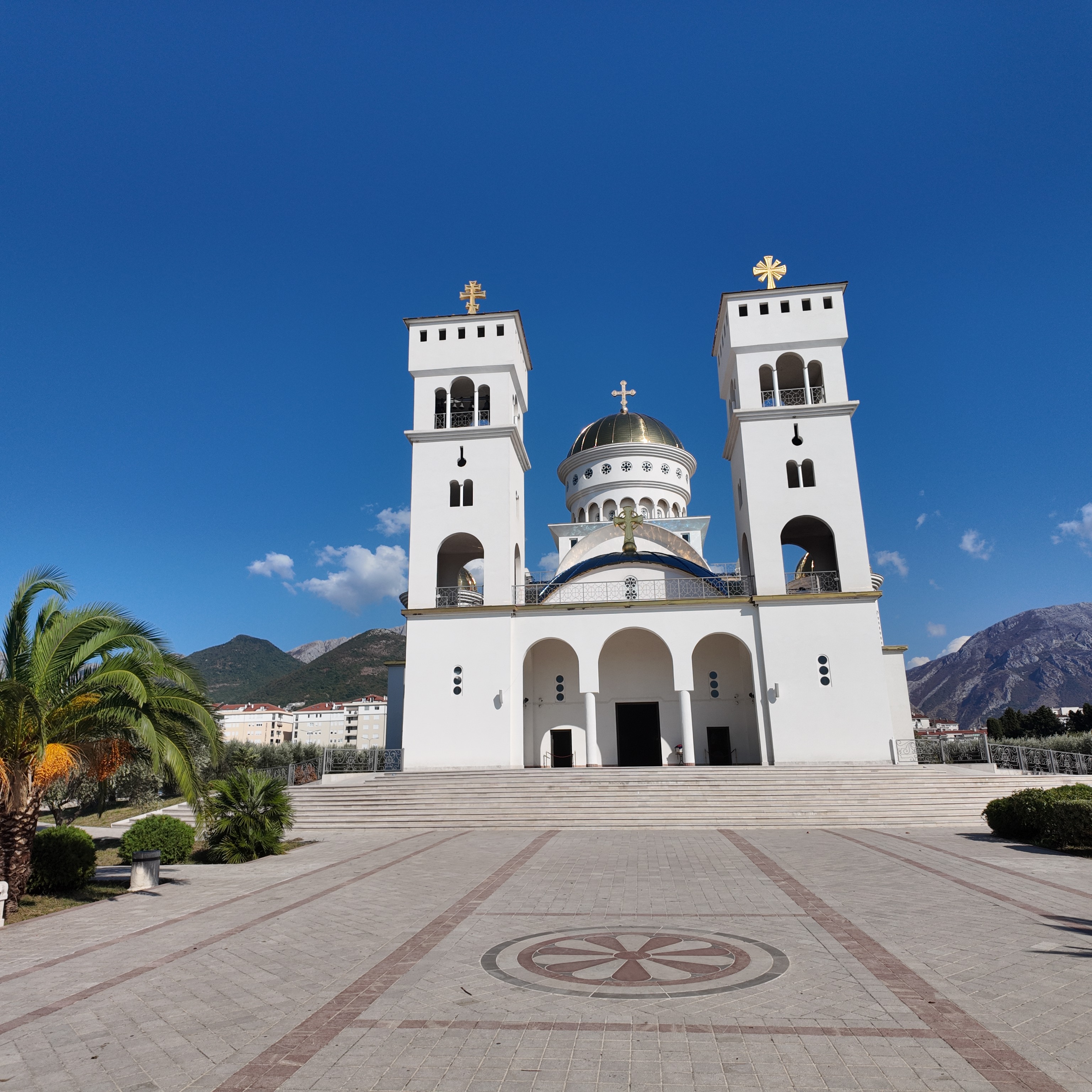
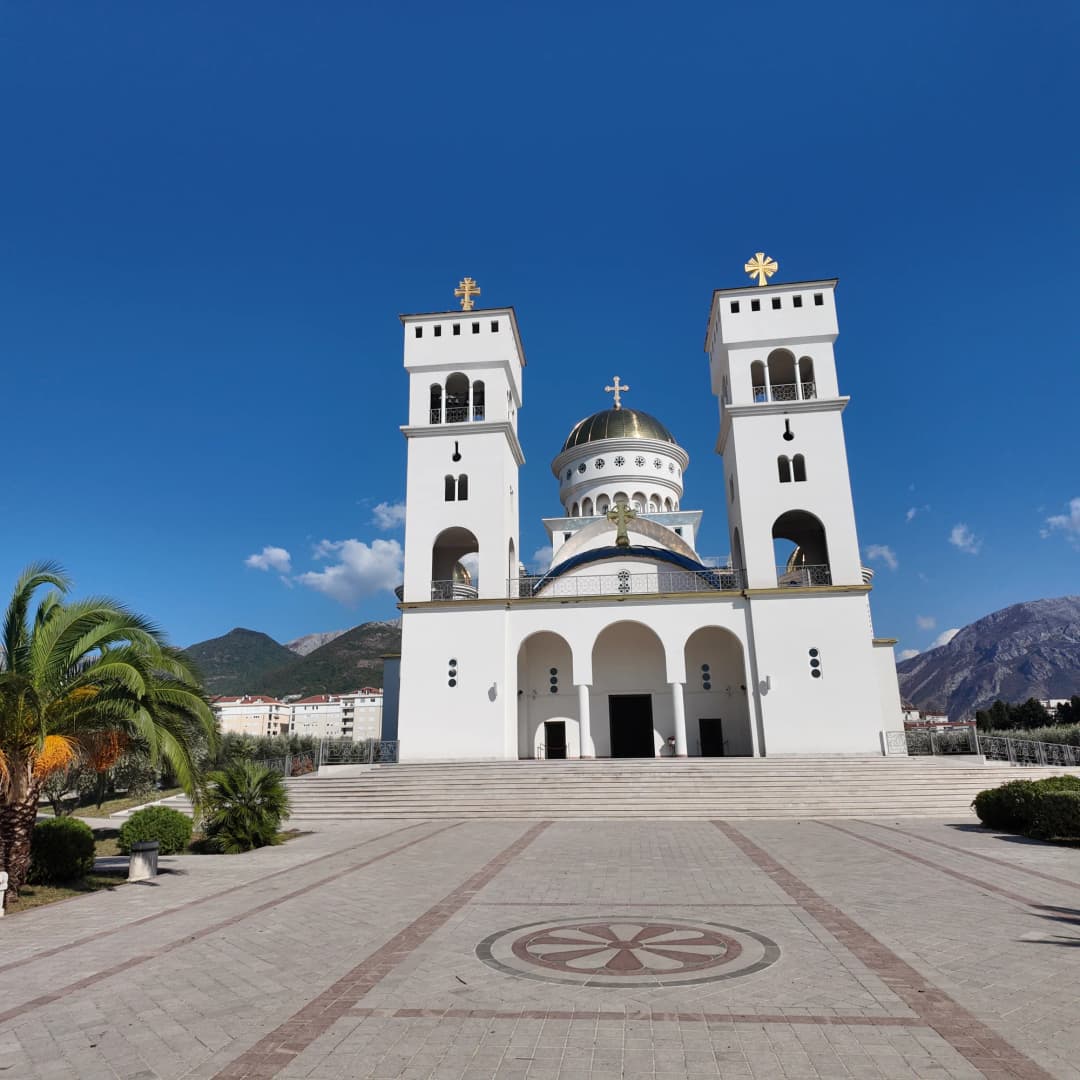
The conceptual design is by Predrag “Peđa” Ristić, the most prolific church architect of the late-twentieth-century Serbian Orthodox world, and the executed project by Svetislav Popović; Stanojević, who directed the work, is styled the church’s protoneimar, master builder. The style is the Serbian-Byzantine of the medieval Raška and Morava churches, at a scale none of them attempted: 54 metres long, 36.8 wide, 1,370 square metres on the ground and 44.5 metres to the top of the cross on the central dome, with room for about 1,200 people.
The parish calls it the largest church in Montenegro, “larger by a few square metres than the cathedral in Podgorica”; Serbian Wikipedia makes that 100 m² and 3 m of height. The Belgrade press at the consecration ranked it second after Podgorica, and a Bar paper calls it the largest Orthodox church on the Adriatic coast. The honest answer is that it and Podgorica’s Resurrection cathedral are the two biggest in the country and the order depends on what you measure. The gilded cross on the dome, at a height of over 40 metres, is 4.6 metres tall and weighs about 380 kilograms; it is a replica of the cross of St Jovan Vladimir, and its placing on 28 October 2012 marked the end of the structural work.
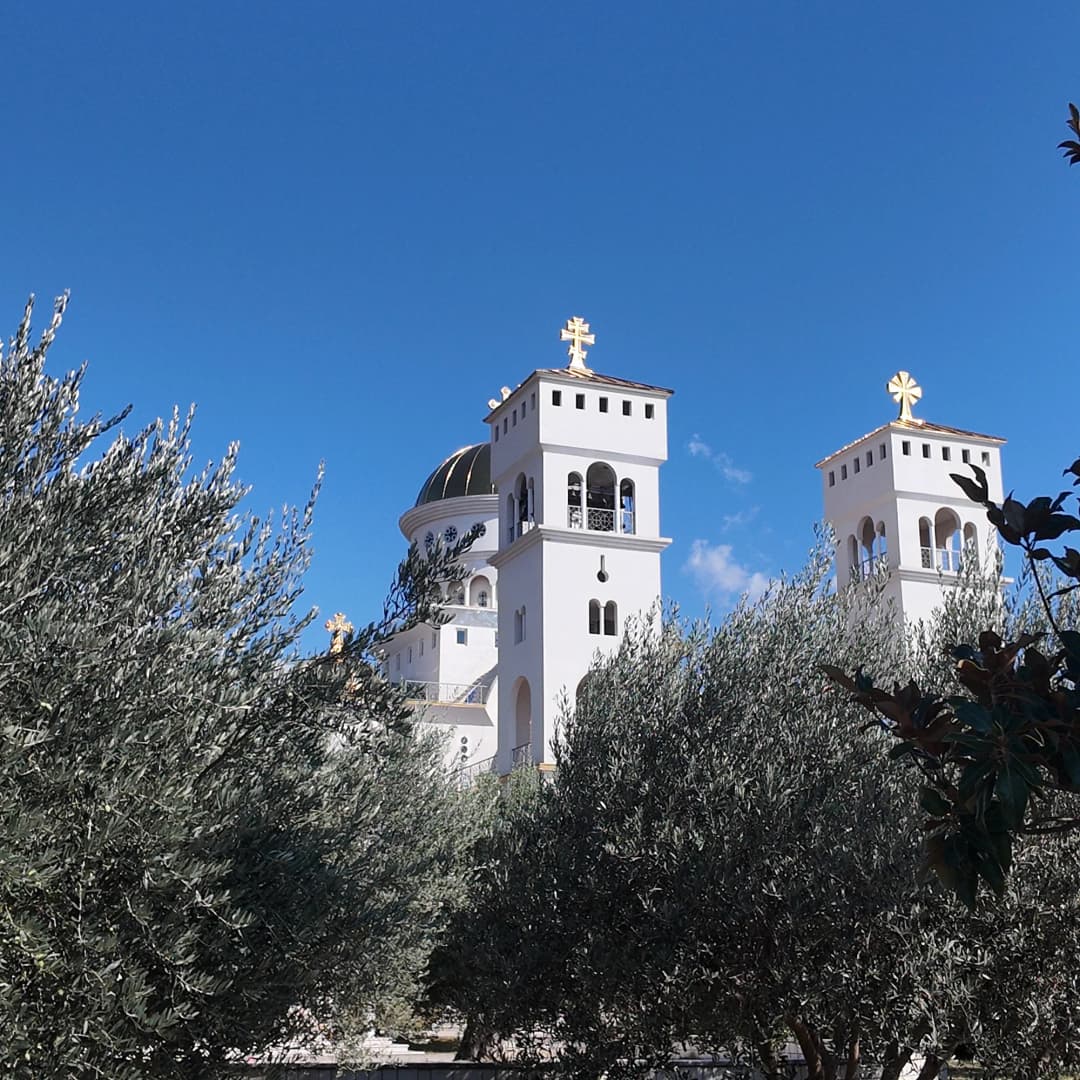
The two bell towers are not decoration: they are dedicated, one to Sts Constantine and Helena, the other to Sts Cyril and Methodius, and between them they hang eleven bells cast during the construction at the Vera foundry in Voronezh — a converted military plant that once built Katyusha rocket launchers. The largest weighs 800 kg and carries an icon of the saint and Gospel texts; the smallest is 10 kg; together they form a scale on which melodies can be rung. Eleven, the parish adds, is not the final number planned.
Everything that could be made of stone was. The iconostasis is 18.5 metres long, in white marble from Macedonia, onyx from Sijarinska Banja and an Italian stone the masons call gvatamala; the floor is a mosaic of about 1,700 m², designed by the architect Dušan Stanojević; the windows — 1,240 oculi alone — the altar table and the bishop’s throne are stone; twenty-eight columns are clad in it; there are seven bronze doors and nine wooden ones. The stonemasons, led by Ivan Stefanović and Dragiša Krkeljić, worked for three years, up to ten at a time. The pavements and paths around the church — the plaza you cross to reach the doors, with its stone roundel in front of the west door — are red and grey stone from Nikšić, and the whole enclosure is ringed by a low stone wall, about knee height, topped with a wrought-iron railing. Under it all is the crypt, dedicated to St Alexander Nevsky, in liturgical use since 2010 and used today for parish life down to blood-donation drives; on the plateau in front of the cathedral stands a small chapel dedicated to Njegoš, where the liturgy moves when the main church cannot be used.
The frescoes: half a hectare on fresh lime
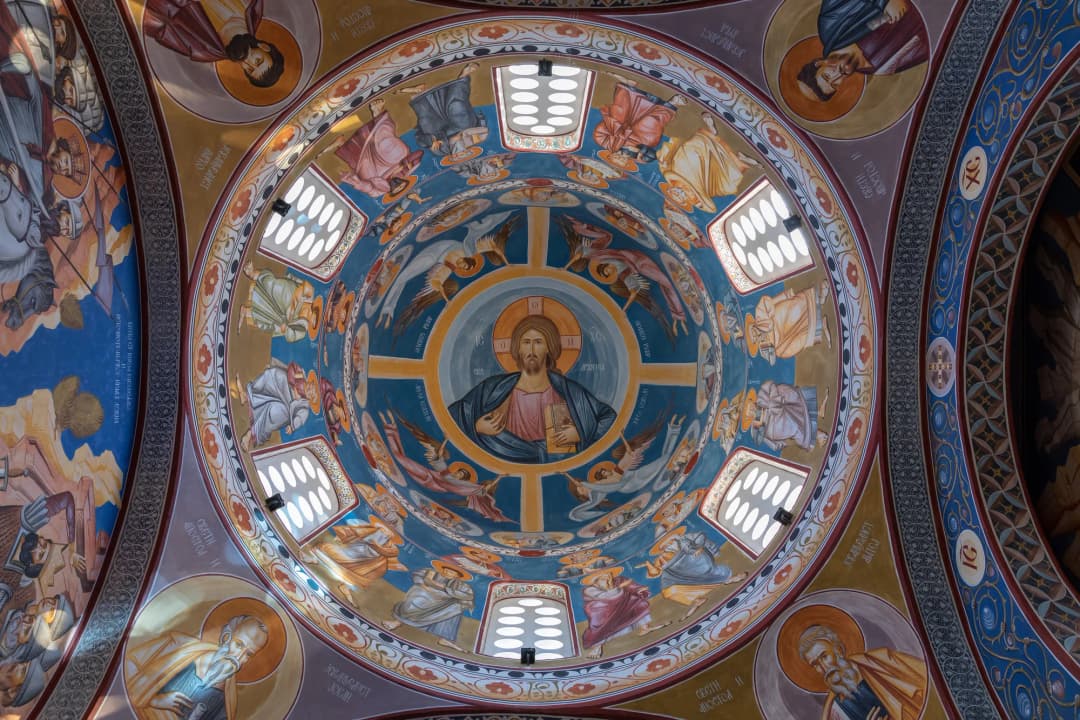
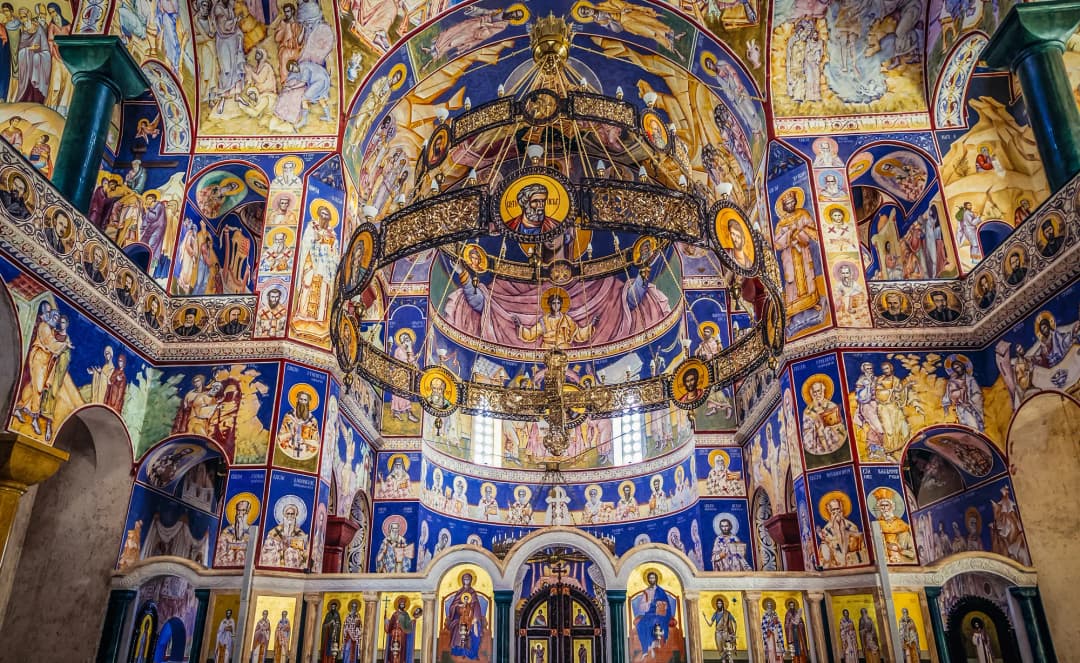
What makes the interior unusual is not its size but its technique. The walls — 4,860 m² by the parish’s count, “about 4,800” by the lead painter’s, “nearly half a hectare” either way — are painted in true fresco, pigment on wet lime plaster, a method the painters say had been neglected for three hundred years. The lime for that plaster must be at least four years old and improves with age; in the old lime works near Spuž, where marble is quarried today, they found lime more than forty years old. A fresco on lime of that quality does not fade, the parish record says, and goes on maturing for up to two hundred years. Five teams under the fresco painter Anastasije Radović worked almost day and night from May 2015; his own team with Vuk Dabetić did about four fifths of the surface, and Miloš Janićijević, Damir Mladenović and Boris Markuš painted separate zones. By the consecration about 90 per cent was done. Some 800 m² — two ground-floor apses and two galleries — remained for afterwards; whether they have since been completed is not recorded in anything we could find. For scale, Radović pointed out, Dečani, with roughly the same interior area, took sixteen years.
Read the programme from the top. The central dome, at 40 metres, holds the Ascension of the Lord rather than the Pantocrator; below it the Mother of God with the twelve apostles, then the four evangelists — about 600 m² of painting in the dome alone. The cathedral has a proper narthex, an architectural rarity here, and its own 200-m² dome carries the descent of the Holy Spirit at Pentecost, with the vertical walls beneath given to the “equal-to-the-apostles” saints of every nation on earth: about 130 saints on one wall and 130 on the other. In the sanctuary apse the Mother of God “Wider than the Heavens” covers 80 m² on her own. The icons on the iconostasis are painted in the old manner on lime wood, with gold leaf in the haloes burnished to a mirror.
The olive grove and the plaza
The cathedral does not stand in a car park. It stands in a grove of olives on the two hectares the town granted in 1991 — and the grove is younger than the church. The plot had old trees on it: during the construction Metropolitan Amfilohije gave the Tvrdoš monastery in Herzegovina an olive from the site reckoned at more than 330 years, and it grows there now as a memento. What surrounds the cathedral today is a planting of a hundred young olives, laid out as part of the landscaping and good enough that in November 2021 the jury of Bar’s Maslinijada, the olive festival, gave the cathedral’s grove its prize for the best young plantation in the district and called it a model estate for young growers. So the trees in these photographs are a decade old, in a town that grew up in the 1970s around groves that were centuries old. A white cross stands among them in front of the west door.
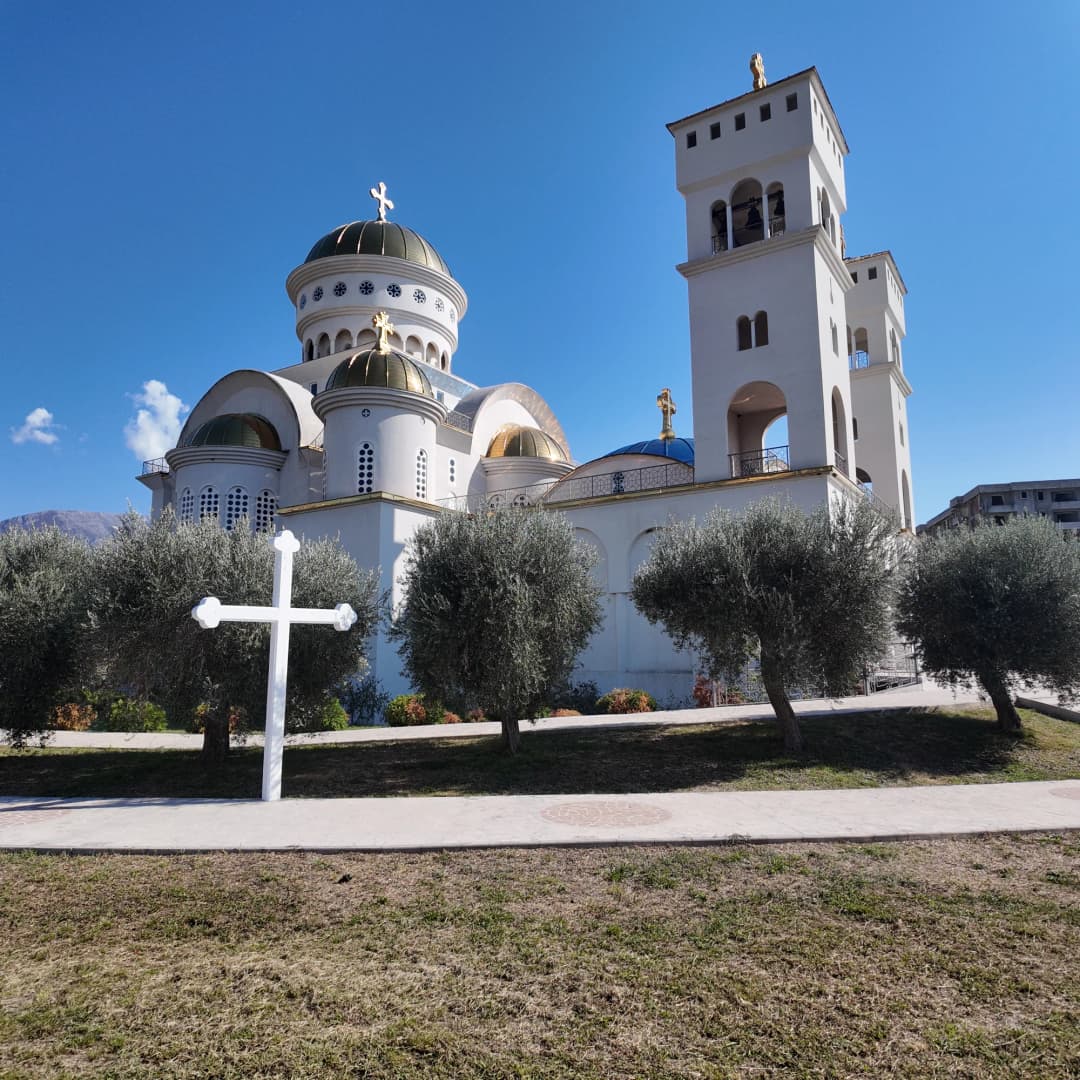
The 2,800 m² of external works produced the paved plaza in front of the west door, and the plaza has been a public stage from the first day: the consecration was followed by a cultural programme on it and, the next evening, a concert by Jelena Tomašević; the parish’s book presentations happen “in the porta”; the tenth-anniversary book is launched there on 25 September 2026. On the plateau beside the Njegoš chapel stands a bronze bust of King Nikola I on a block of stone brought down from Lovćen, by the Belgrade sculptor Miodrag Živković with Dragan Radenović, unveiled and blessed by Metropolitan Amfilohije on 9 January 2018 for the 140th anniversary of Bar’s liberation from the Ottomans; its plaque carries four lines of the king’s poem “The Poet and the Vila” that end with him gazing “upon the Serbian sea” — a pointed choice in this town, though no public dispute about it has been recorded. It is one of two monuments to kings in the centre of Bar, not to be confused with the other: Trg Vladimira i Kosare, Vladimir and Kosara Square, a short walk away, holds Nenad Šoškić’s four-metre bronze of “King Jovan Vladimir” from 2001 and, since its 2022 rebuilding, a fountain; the feast-day procession walks from the cathedral to the square and back.
Who Jovan Vladimir was — and why Bar
Jovan Vladimir ruled Duklja, the principality on Lake Skadar and the coast that became Montenegro, from about the year 1000, inheriting from his father Petrislav while still a boy; his court stood on the hill of Kraljič near Koštanjica, above the lake. When Tsar Samuel of Bulgaria attacked in 1009 or 1010, Vladimir surrendered — to spare his people “famine and the sword”, the chronicle says — and was imprisoned at Prespa, where Samuel’s daughter Kosara fell in love with him and secured their marriage and his return to Duklja as Samuel’s vassal. After Samuel’s death his nephew Ivan Vladislav seized the throne and summoned Vladimir to Prespa, sending a golden cross as a pledge of safety. Vladimir’s answer is the heart of his story: “Our Lord Jesus Christ, who suffered for us, was not crucified on a cross of gold or silver, but on one of wood. If your faith and your words are true, send me a wooden cross in the hands of religious men, and I will come.” Two bishops and a hermit brought the wooden cross; he kissed it, went, prayed in the church at Prespa, and was cut down by Vladislav’s soldiers at its door. The chronicle gives the day, 22 May, and no year; Byzantine chronology supplies 1016, though the Serbian Church’s own liturgical texts say 1015, which is why the 2016 millennium was itself a choice. He was recognised as a martyr and saint almost at once, by acclamation, the first ruler of a Serbian state to be — and he is claimed with equal conviction as a Bulgarian saint, entered among the “ancient Bulgarian tsars” in Boril’s Synodikon of 1211, and as the first Albanian saint. All three framings are alive today.
The only near-contemporary witness, the Byzantine historian John Skylitzes, gives none of this — no Kosara, no cross, no date, only “a man of integrity, peace and virtue” who trusted an oath and was killed. The story everyone knows comes from chapter 36 of the Chronicle of the Priest of Duklja, the Ljetopis popa Dukljanina, and here is the cathedral’s deepest claim on this town: that chronicle was written in Bar, between 1299 and 1301, by Rudger, the Roman Catholic Archbishop of Bar, summarising a lost eleventh-century Life of the saint composed when Duklja’s rulers were petitioning the Pope to raise the bishopric of Bar to an archbishopric. The saint of the Orthodox cathedral was first written down by a Catholic archbishop of the same town — and never recognised as a saint by Rome. Bar has kept him as its heavenly protector ever since.
The cross, the mountain and the relics
The wooden cross of the story survives, or a cross does: yew wood plated with silver, 45 by 38 centimetres and 2.5 thick, with a brass ball on the lower arm to take a carrying pole. It has been in the keeping of the Andrović family of Velji Mikulići, above Bar, for centuries — handed to them, the tradition says, by the Mrkojevići when that clan converted to Islam and judged a Christian house the fitter place for it. Between feasts it is kept in a secret place; once only the two eldest men of the family knew it, and since about 2000 a family committee guards it. On Trinity Sunday, after a midnight liturgy at St Nicholas in Velji Mikulići, an Andrović carries it at the head of a procession up the steep path to the 1,593-metre summit of Rumija, the mountain behind Bar. Nobody may step in front of the cross. Each pilgrim carries a stone, in the belief that the church of the Holy Trinity that the Ottomans destroyed on the summit will be rebuilt when enough stone has been brought, and the marchers chant, “I carry the cross, I pray to God, Lord have mercy.” Catholics and Muslims of the district have traditionally walked with it; in the past the Muslim standard-bearer of the Mrkojevići walked beside the cross with a knife in his right hand against anyone who tried to take it. Yugoslavia discouraged the procession and it was not held between 1959 and 1984.
In 2005 that shared tradition became a dispute. On 18 June a three-tonne prefabricated metal church was set on the summit by army helicopter; Amfilohije consecrated it on 31 July. The state ordered its removal in 2009 and never enforced the order; a 2011 survey found 43 per cent against demolition and 24 per cent for it; in 2018 the little church was clad in the stones the pilgrims had carried up. Montenegro has since declared the cult of St Vladimir a protected intangible cultural good, naming the Andrović family as its bearers — and listed “relocation of the church from the summit of Rumija” among the measures for its protection. Whether Catholic and Muslim neighbours still climb with the cross as they once did is contested in the reporting; a 2024 fieldwork study in the journal Fieldwork in Religion is titled, tellingly, “Carrying the Cross of Discord”. The cathedral faces the mountain, and the procession is part of its year; it is living heritage, not a folklore tableau.
The saint’s body is not in Bar. Kosara brought it from Prespa to the Prečista Krajinska monastery above Lake Skadar, where she was later buried beside him as the nun Theodora; around 1215 the relics were taken to Durrës, and from 1381, when the Albanian lord Karl Thopia rebuilt a church near Elbasan in his name with an inscription in Greek, Latin and Serbian, they lay in the monastery of St Jovan Vladimir there — Shin-Gjon to its Albanian neighbours, where Christians and Muslims alike still come on 4 June. Under Albanian communism the reliquary went to a church-museum in Elbasan (1967), then to the Orthodox cathedral in Tirana and the National History Museum, and in 2021 back to the monastery. Montenegrin reports in 2016 placed the head at the Bulgarian monastery of Zograf on Mount Athos and a forearm at St Nicholas in Ohrid. What Bar has are particles: sealed in the altar at the consecration, and one displayed in the church for veneration. The main reliquary did not come for the consecration; the Albanian church could not obtain the permits.
The cathedral’s year
The parish publishes its schedule: Divine Liturgy at 09:00 on Sundays and feasts and at 08:00 on other days, Matins at 08:00 on Sundays and feasts, Vespers every day at 18:00 (20:00 in the summer months), with the Akathist to the Mother of God after Friday vespers. The patronal feast is 4 June, and it anchors a week of “Days of St Jovan Vladimir” that ties the cathedral to every Vladimir site in the district: liturgy on Rumija and in the cathedral on Trinity Sunday, at the ruined monastery of Ratac, at Prečista Krajinska in Ostros, at the ruined church of All Saints on Veliki Pijesak, a blood-donation drive in the crypt, book presentations in the grove. On the evening of the feast itself a procession leaves the west door and walks the streets of new Bar — IV Crnogorske brigade, Jovana Tomaševića, Vladimira Rolovića, the new boulevard, Branka Čalovića, Makedonska, Rista Lekića, Bulevar revolucije — with the Gospel read at four stations: at the early-Christian Trikonhos, at the crossroads of Bulevar 24. novembra, at the municipality building, and in front of the church. On Christmas Eve the badnjak, the Yule log, is laid before the west door at 15:00 and the Metropolitan serves; on Christmas Day Matins is at 07:00 and Liturgy at 08:00.
The consecration anniversary is kept each September. This year’s is the tenth: on Friday 25 September 2026 at 19:00 a commemorative book, Dugo očekivani dan — “The long-awaited day” — is presented in the cathedral grounds with Metropolitan Joanikije; on Saturday 26 September the Metropolitan leads the liturgy at 09:00, and at 20:00 the ensemble Fenečki biseri gives a concert in the Cultural Centre.
The cathedral was also the assembly point of Bar’s share in the 2019–2020 processions against Montenegro’s law on religious communities, whose disputed articles would have transferred pre-1918 church property to the state. Built between 2006 and 2016, the cathedral was never itself at issue; but on 12 January 2020, after the liturgy, some 2,000 people by the police count and 6,000–7,000 by the organisers’ walked from its doors to Trg Vladimira i Kosare and back behind Metropolitan Amfilohije, peacefully, in the largest gathering the town had seen since the protests began. The contested articles were deleted by the new parliament on 29 December 2020.
Visiting
The cathedral is at Jovana Tomaševića 38 in Topolica, the centre of new Bar; the parish phone is +382 30 308 427, and the city bus stop at the gate is called, simply, Hram. It is open around the services above — third-party listings give 07:00 to 21:00, which the parish has never published, so treat it as a guess — and there is no admission charge that any source mentions. Nothing is posted about photography: ask a member of staff, never photograph a service or worshippers without consent, and leave the flash off. Dress as you would for any Orthodox church — covered shoulders and knees — and if a service, baptism or funeral is under way, wait outside or keep to the back. Nobody has published a step-free audit; the plaza is level and the west doors are at grade, but confirm anything essential with the parish.
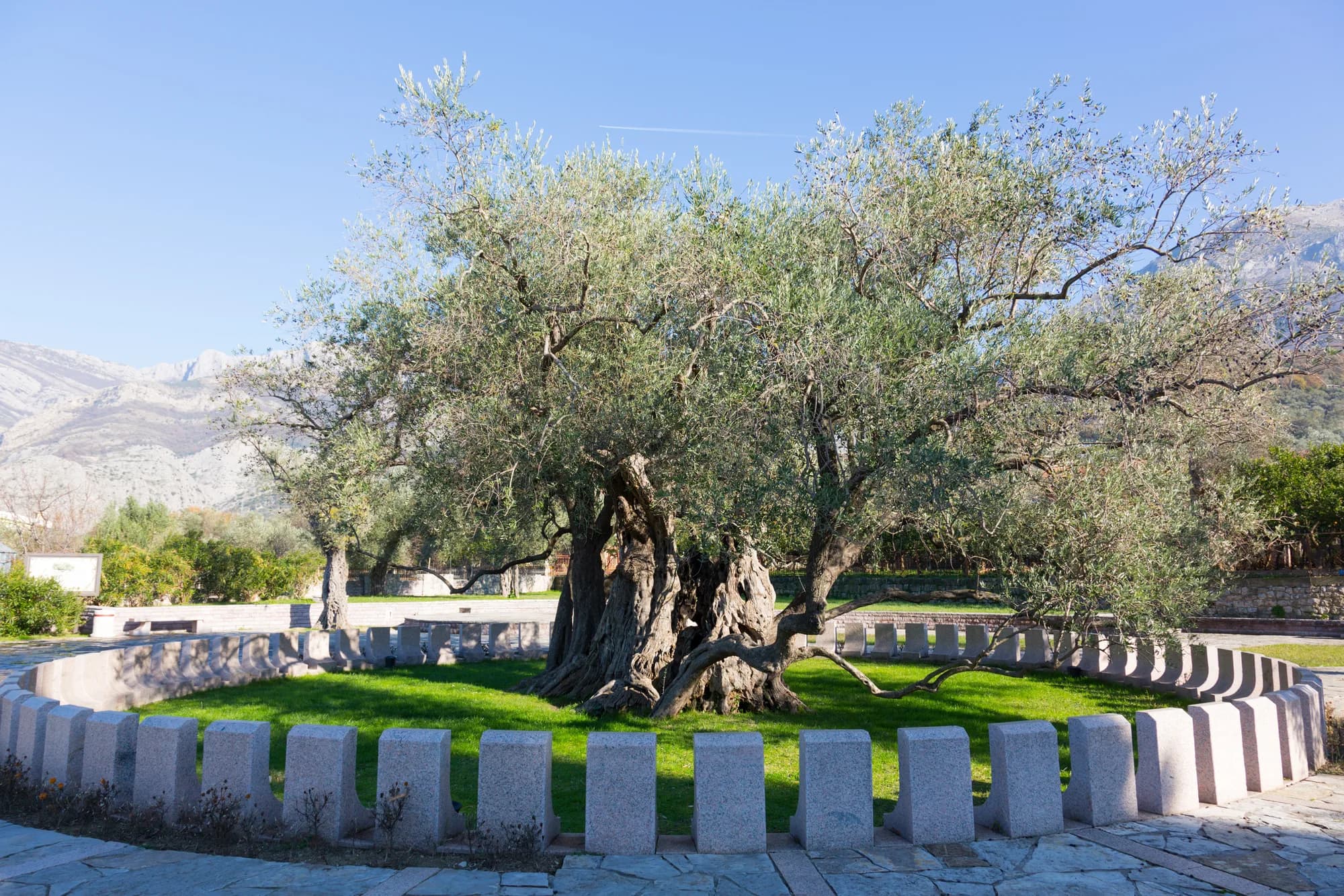
Everything in central Bar is close, and there are free public car parks within a couple of hundred metres of the gate. King Nikola’s Palace and its park are a five-minute walk, Topolica beach a few minutes more, the ferry port for Bari and Ancona about eleven minutes on foot; the bus and railway stations, side by side to the south-east, are some 1.7 kilometres — twenty-three to twenty-six minutes’ walk, or a short taxi. The early-Christian Trikonhos, a triconch church of the fifth to ninth centuries, is 700 metres away; the Catholic co-cathedral of St Peter 800 metres. Stari Bar and the Stara Maslina at Mirovica are three and a half to four kilometres off and need transport. Allow forty minutes for the cathedral itself: the plaza and the grove, then the dome, the narthex and the apse in that order, then out again to see Rumija behind the domes. The wider town is in our Bar guide.
A free original
The photograph at the top of this page is offered as a RAW file under a Creative Commons Attribution licence: the camera’s own DNG, ungraded, with a full-size JPEG beside it for anyone who does not develop RAW files. Use it, adapt it, print it — with a credit to Montenegro.com and, online, a link back to this page.
- Download the DNG — 3072 × 3072, DJI Osmo Pocket 3, about 19 MB
- Download the full-size JPEG — 3072 × 3072, about 2 MB
Licensed CC BY 4.0. Original photograph by Montenegro.com, 20 September 2026.
Frequently asked questions
Is the cathedral of St Jovan Vladimir medieval?
No. The cornerstone was laid in 2002, construction ran from 2006 to 2016 and the church was consecrated on 25 September 2016. Its dedication and its Serbian-Byzantine style look back to the Middle Ages; the building is ten years old.
Is it the largest church in Montenegro?
The parish says so, by a few square metres over the Resurrection cathedral in Podgorica; the Belgrade press at the consecration ranked it second. It is 54 by 36.8 metres, 44.5 metres to the cross, and holds about 1,200 people. It is the largest Orthodox church on the Adriatic coast on any count.
What is painted in the dome?
The Ascension of Christ, at a height of 40 metres, chosen in place of the Pantocrator that usually fills an Orthodox dome. Below it are the Mother of God with the apostles and the four evangelists; the narthex dome holds Pentecost; the apse the Mother of God “Wider than the Heavens”.
Are the saint’s relics in Bar?
Particles are: sealed in the altar at the consecration, and one displayed for veneration. The main relics have been near Elbasan in Albania since 1381, with periods in Tirana; the head is reported at Zograf on Mount Athos and a forearm at Ohrid.
When can I visit, and does it cost anything?
No visitor hours or fee are published. The church is open around its services — liturgy at 09:00 on Sundays and feasts and 08:00 on other days, vespers at 18:00 (20:00 in summer) — and worship takes priority over sightseeing.
What is the cross carried up Rumija?
A silver-plated yew cross, 45 by 38 centimetres, believed to be the one Jovan Vladimir held when he was killed, kept by the Andrović family of Velji Mikulići and carried to the summit of Rumija every Trinity Sunday. A replica of it stands on the cathedral’s dome.