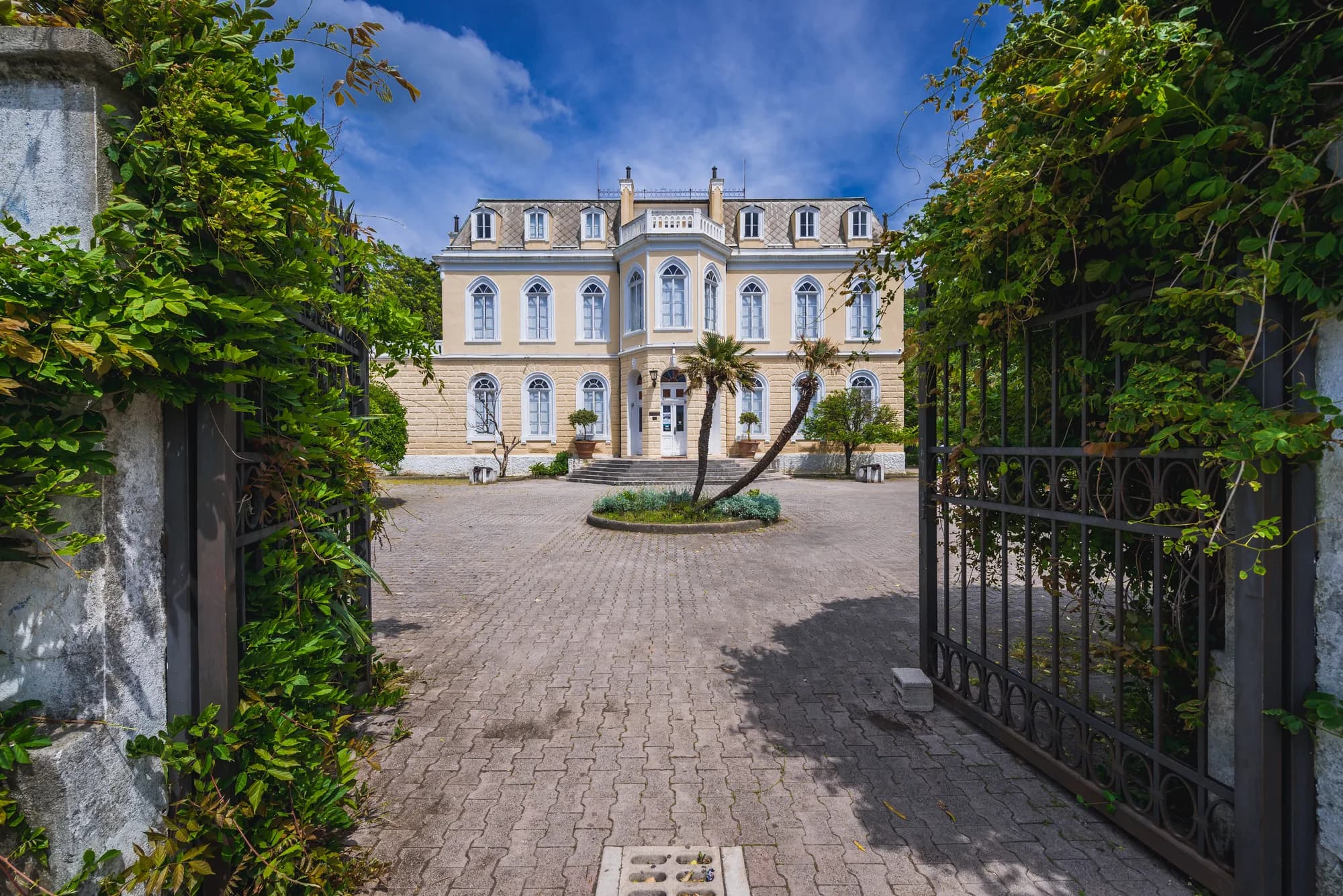
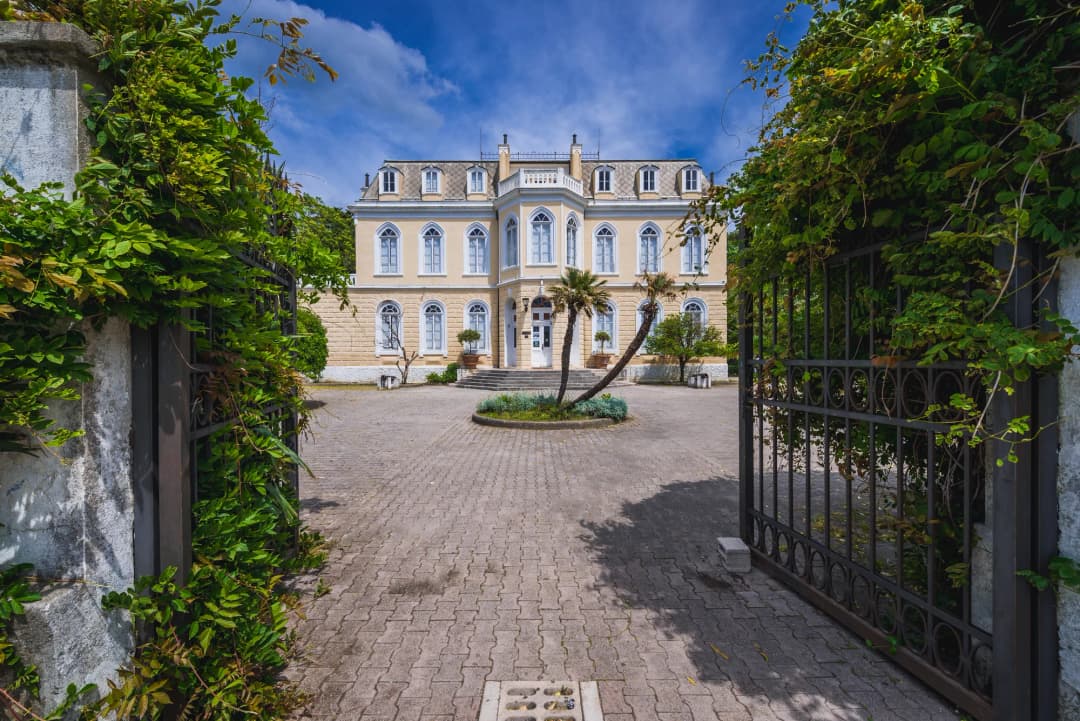
King Nikola’s Palace on Bar’s Topolica waterfront reopened on 20 July 2026 after a major restoration. The building again houses Bar’s Homeland Museum, but the familiar “royal wedding gift” story needs correction: the institution that runs the museum says Prince Petar Karađorđević built the residence for his own use after marrying Princess Zorka, and Nikola later bought it. The result is more interesting than the legend—a private seaside villa that became a royal summer residence, then a museum for the whole history of Bar.
| Phase | What happened |
|---|---|
| 1883 | Petar marries Princess Zorka |
| By 1885 | Petar builds for his own use |
| Later | Nikola buys the property |
| Royal phase | Summer residence at Topolica |
| Note | The museum's account replaces the simplified "Nikola built a wedding gift" narrative |
Source: kulturnicentarbar.me, gov.me
The corrected origin story
The Bar Cultural Centre, which operates the museum, says Petar Karađorđević built the original residence for his own needs. Petar had married Nikola’s eldest daughter, Zorka, in 1883 and lived in Montenegro. Nikola subsequently bought the property. That institutional account is more specific than tourism pages that call the palace a gift “dedicated” to the couple, and it is the version used here.
Even the date needs a small qualification. The government’s Cultural Heritage Administration and the Cultural Centre say the palace first appears in the newspaper Glas Crnogorca in 1885, so 1885 is conventionally treated as its year of origin. The official 2022 park study says the exact time of construction is not known. “Built in 1885” is therefore useful shorthand, not a surviving completion certificate.
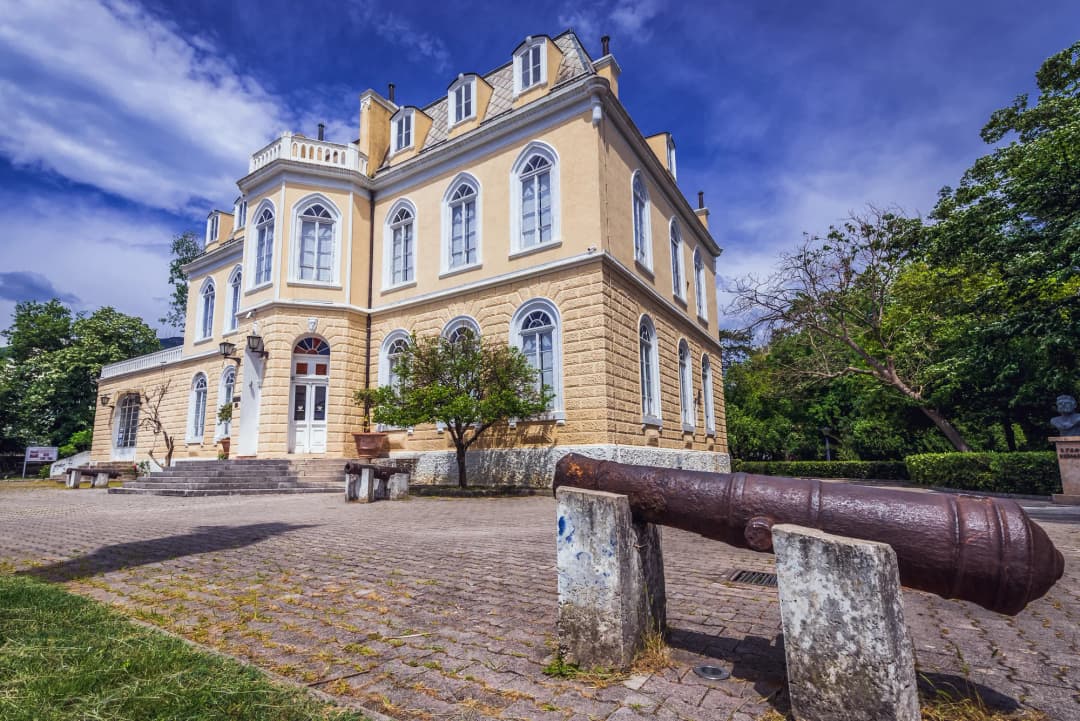
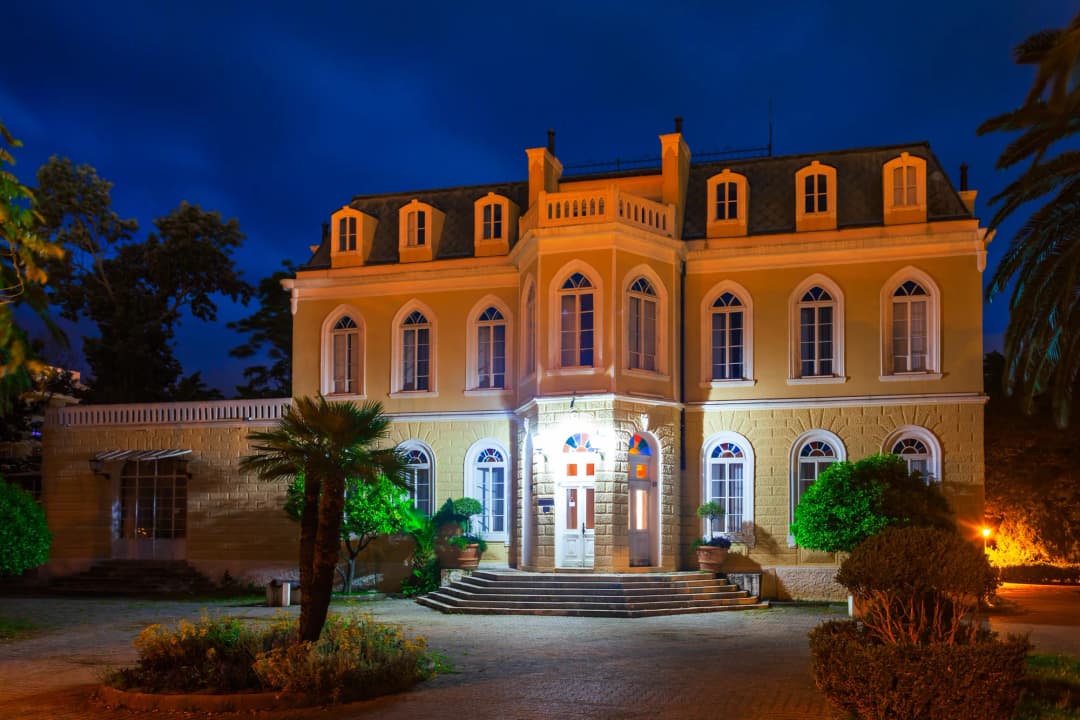
The design is associated with court architect Josip Slade. The Cultural Centre describes the Large Palace as an eclectic late-nineteenth-century residence drawing on neo-Renaissance and neoclassical historical styles. It faces the sea and dominates a compound that grew beyond one house: the Small Palace, court chapel, guard towers, winter garden and park. A ballroom was added along the west facade in 1910.
How to read the palace complex
The name “King Nikola’s Palace” usually points to the Large Palace, but a useful visit reads the ensemble. The central building carries the residential and museum story. The Small Palace and chapel explain the family compound. The winter garden—also called Knjaževa bašta in municipal planning documents—adds a delicate glass-and-metal Secession-era structure. The park connects everything to Bar’s shoreline.
This layered composition has parallels elsewhere on the coast. Tivat’s Buća Palace and Great Park also asks visitors to separate a historic residence from the landscape and later public uses around it. Herceg Novi’s Njegoš School and Ivo Andrić House provide another lesson: a restored cultural building is an interpreted site, not a perfectly frozen domestic interior.
| Element | Documented role | What to verify now |
|---|---|---|
| Large Palace | Principal residence; Homeland Museum since 1960 | Daily museum hours, temporary admission policy and event changes |
| Ballroom | Added to west facade in 1910; exhibition and performance use | Whether an event limits ordinary museum circulation |
| Small Palace + chapel | Supporting parts of the royal compound | Whether interiors are included in the public route |
| Winter garden | Glass-and-metal Secession structure within the protected ensemble | Status of the separate reconstruction phase |
| Palace park | Protected horticultural landscape of about 1.3 hectares | Open paths, work zones and temporary closures |
The museum is about Bar, not only royalty
The Homeland Museum was founded in 1959 and moved into the Large Palace in 1960. Those dates are often collapsed into one. Its scope is broader than royal furniture. The Cultural Heritage Administration lists archaeological material from municipal sites, divided into prehistoric, ancient and medieval collections; historical collections of weapons, decorations, archives and photographs; art, graphics, icons and applied art; and ethnological material connected with clothing, household life, work and custom.
The Cultural Heritage Administration’s collection summary shows that the permanent display follows Bar’s material and cultural history through multiple periods, including Ottoman rule, Nikola’s era and the first half of the twentieth century. A visitor expecting only a royal-house reconstruction may miss the point: the palace is both an exhibit and a container for the municipality’s memory. For a contrasting form of coastal heritage still tied to daily work, compare Bar’s museum display with the fishing structures in our Port Milena kalimera guide.
What the 2023–2026 restoration changed
Bar announced the first comprehensive reconstruction since the work that followed the 1979 earthquake in late 2023. The municipality notes smaller maintenance interventions in the 1990s and in 2006–2007, plus roof conservation beginning in 2022. The initial nine-month forecast did not hold: conservation discoveries, revised project work and interior presentation extended the closure until July 2026. The municipality’s official reopening account records the finished main-building scope.
A March 2025 decision by the Cultural Heritage Administration approved the conservation project for the interior museum display and required conservation supervision and formal acceptance of completed measures. When the palace reopened, the municipality reported structural repair, conservation-restoration work and full interior museum equipment. The standout discovery was original wall painting beneath later layers on the upper floors. It was restored and presented as part of the cultural property rather than covered again.
| Date | Milestone |
|---|---|
| 2022 | Roof conservation |
| Nov 2023 | Complex closes |
| Mar 2025 | Interior project approved |
| 20 Jul 2026 | Museum reopens |
| Outcome | €2.31m reported municipal investment · original wall painting restored |
Source: bar.me, wapi.gov.me, vijesti.me
One site, two protection stories
The palace complex and the park are protected for related but distinct reasons. Bar’s public-consultation record says the palace ensemble was protected as a cultural monument in 1957 and is now treated as cultural heritage of national significance. The park received nature protection as a horticultural object in 1968. The official 2022 park review study measured it at about 1.3 hectares and documented its mature trees, Mediterranean setting and combined ecological, aesthetic and cultural value.
This is stronger than the inherited tale that generations of Bar sailors simply filled the garden with seeds from every port. Maritime exchange is central to Bar’s history, and nearby stories such as the captain in our Ivo Visin and Prčanj guide show how far Adriatic seafarers travelled. But the reviewed palace sources do not establish that charming collective origin story, so it is not repeated as fact.
A November 2025 municipal draft programme proposed 2026 procurement for park landscaping and reconstruction of the winter garden as phases separate from the main palace works. It gave project estimates of €191,962.48 for the winter garden and €1,668,912.25 for the park. These are draft estimates, not final spending, and the document does not prove adoption, procurement launch, active work or current access restrictions. Its narrower evidentiary value is that the municipality proposed treating these as separate phases.
| Layer | Protection | Covers |
|---|---|---|
| Cultural | 1957 protection | Buildings · interiors; historic ensemble |
| Natural | 1968 park protection | Trees · horticulture; urban habitat |
| Shared visitor duty | Follow routes · respect any barriers | Do not climb exhibits or damage plants |
| Note | Opening does not establish any later landscape-phase status |
Source: bar.me
Practical visit planning after reopening
The Museums of Montenegro directory currently lists summer visitor hours of 09:00–21:00 and says admission is temporarily free. Treat both as a dated snapshot, not a permanent promise. “Temporary” has no guaranteed end date, and museum hours can change for seasons, holidays, conservation work or events. Before a special trip, contact Bar Cultural Centre at +382 30 312 431 or [email protected] and ask specifically about the Homeland Museum at Topolica.
The palace stands beside the level seafront promenade in modern Bar. Approaching the exterior is straightforward, but the entrance in the licensed images has steps and no current official accessibility audit was found. Ask the museum about a step-free route, lift availability, accessible toilets, seating and companion arrangements rather than assuming the restoration solved every access need.
Allow roughly an hour only as a planning estimate, then adjust for the exhibitions and any programme in the ballroom or courtyard. Check whether the Small Palace, chapel, winter garden and full park are included that day. Do not cross barriers around trees, structures or conservation areas. If you want a longer coastal walk, Herceg Novi’s Pet Danica promenade history offers a useful comparison between a waterfront name, public memory and the modern life around it.
FAQ
Is King Nikola’s Palace open in 2026?
Yes. A dated report confirms that the restored palace opened to the public on 20 July 2026. Because events or site conditions can affect circulation, confirm the exact museum and park access for your date.
Was it built as Nikola’s wedding gift to Zorka?
The Bar Cultural Centre gives a different sequence: Petar Karađorđević built it for his own use after marrying Zorka, and Nikola later bought it. This guide follows the museum operator’s account.
Why is 1885 used if the date is uncertain?
The palace first appears in Glas Crnogorca in 1885, so heritage institutions treat that as its year of origin. The official park study says the exact construction time is not known.
Is admission free?
A current museum directory says entry is temporarily free. That is deliberately not converted into a permanent “free museum” claim. Reconfirm with Bar Cultural Centre.
What is new after restoration?
The municipality reports structural and conservation work, upgraded museum interiors and restored original wall painting discovered on the upper floors. The display still covers Bar’s wider archaeology, history, art and ethnology.
Methodology and sources
The Bar Cultural Centre controls the building history and museum scope; the municipality controls the reopening and project account; dated reporting fixes the opening to 20 July 2026; the Cultural Heritage Administration controls conservation approval; and Bar’s official park study plus its November 2025 draft works proposal distinguish cultural protection, nature protection and potential future phases. The draft is not evidence that those phases were adopted or launched. Visitor hours and free admission come from a current museum directory and are expressly date-qualified. Broader royal and preservation journeys can continue through a carefully planned Montenegro grand tour, but this palace is best understood slowly: first as Petar and Zorka’s residence, then Nikola’s summer court, and now Bar’s public museum.