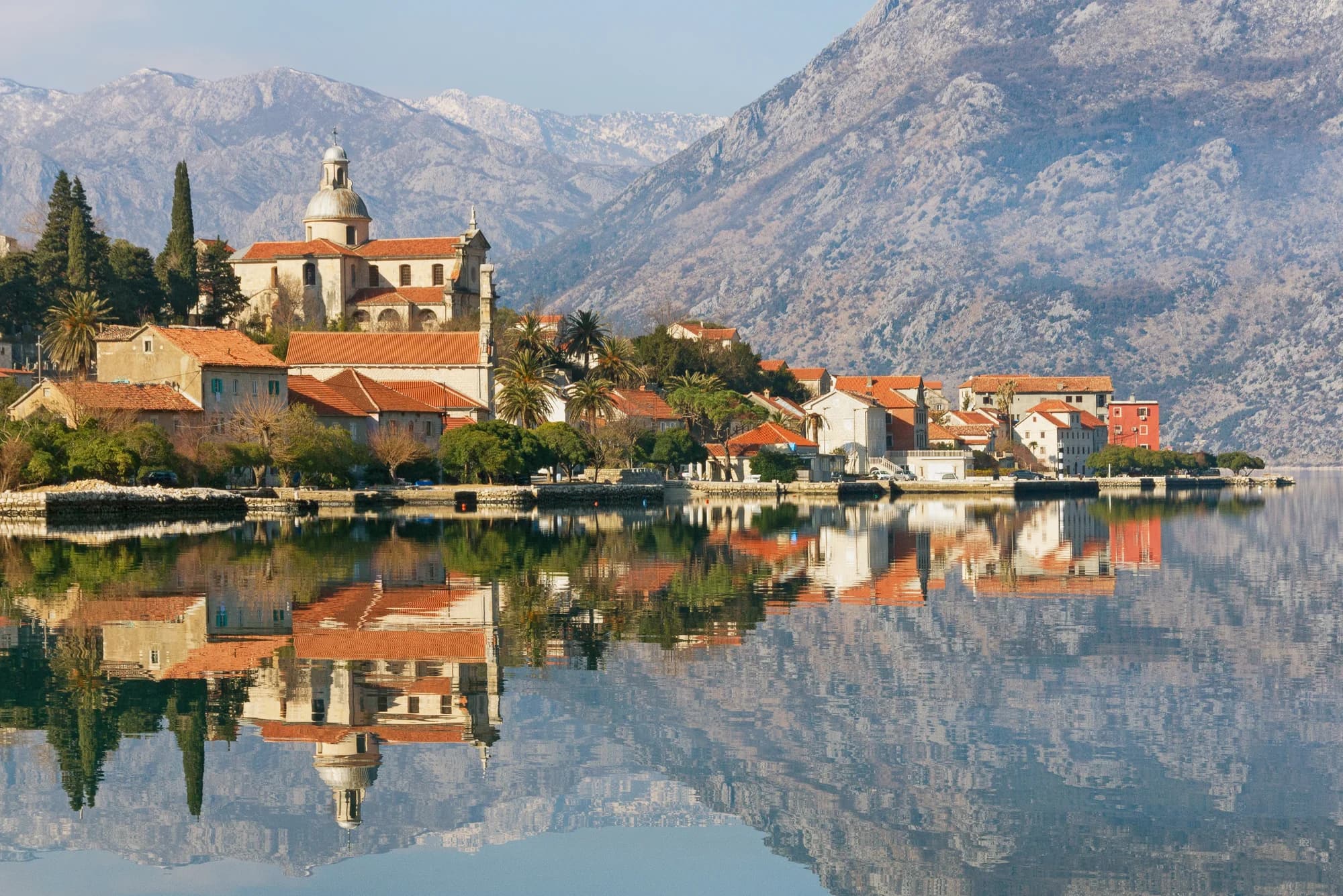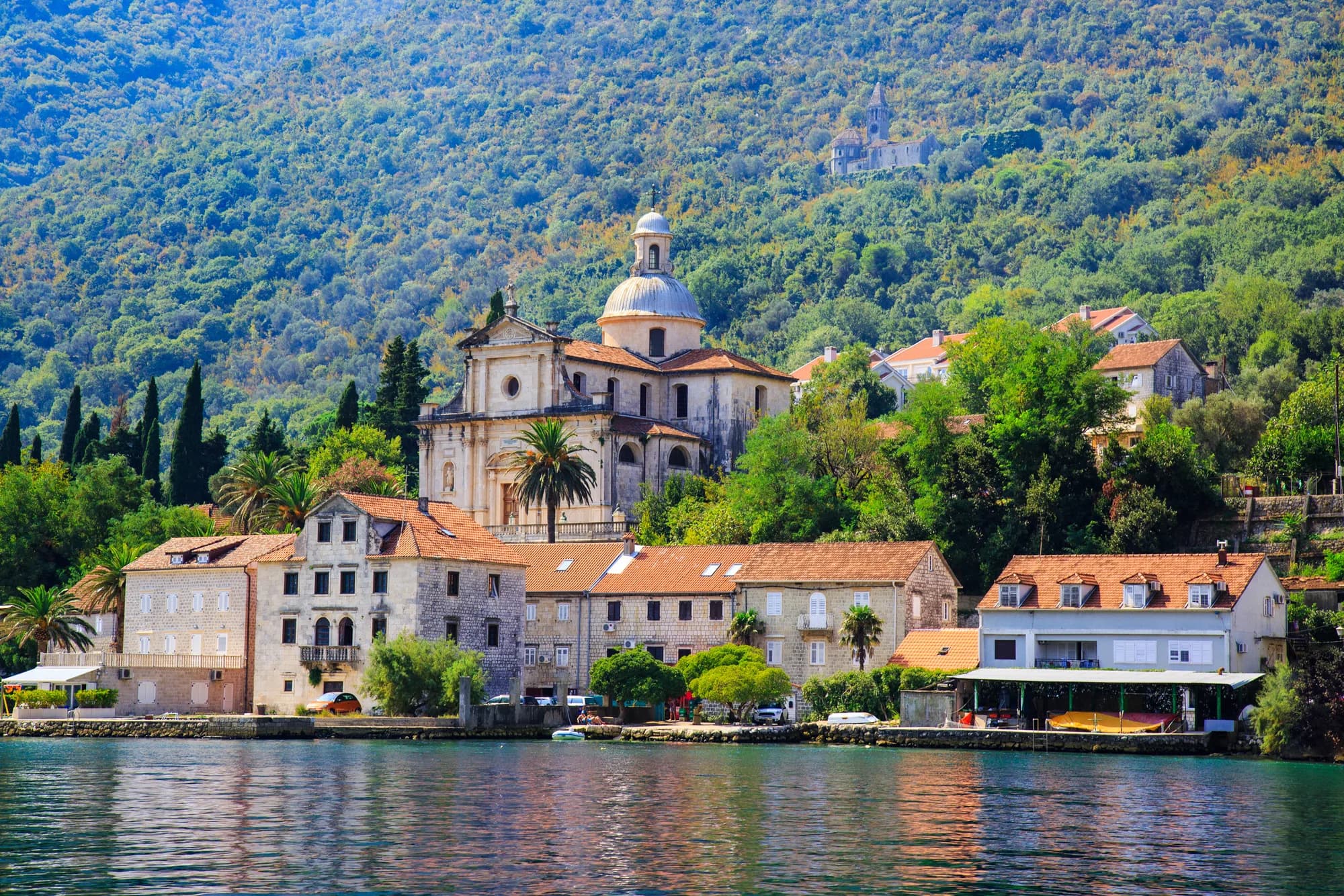
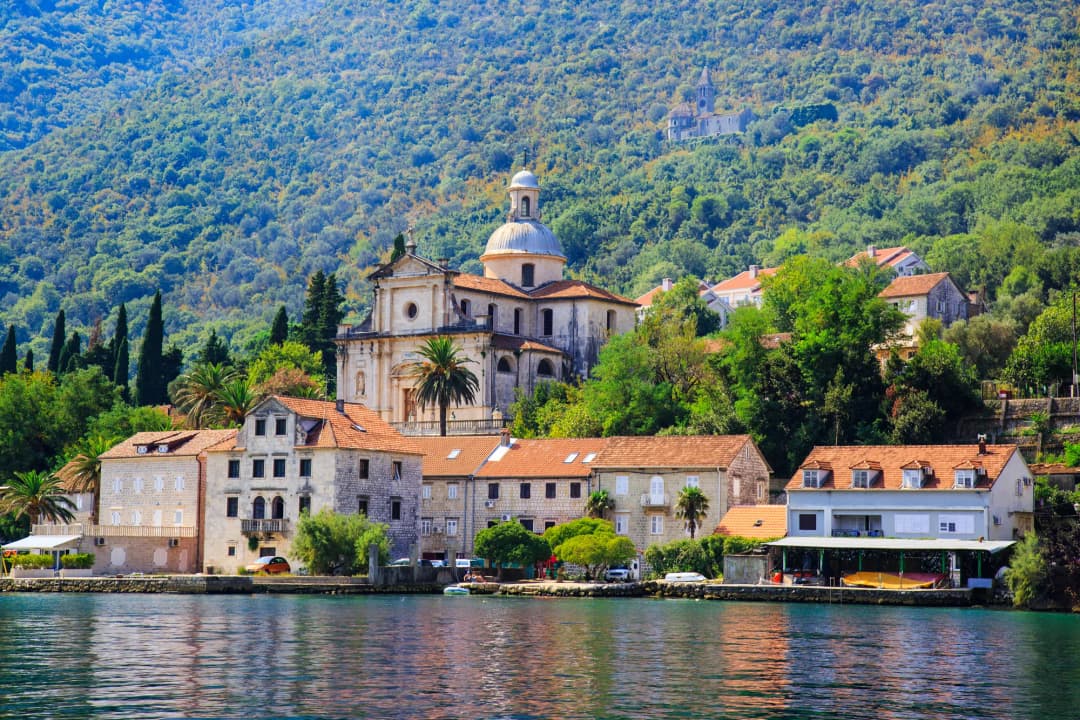
Prčanj’s great waterfront church tells two connected stories: how a small maritime community converted shipping wealth into architecture, and how that same seafaring culture produced Captain Ivo Visin’s seven-year voyage around the world. The durable name is the parish Church of the Nativity of the Blessed Virgin Mary, also known locally as Bogorodičin hram. Although its plan is basilican, the sources reviewed for this guide do not establish a canonical “minor basilica” title.
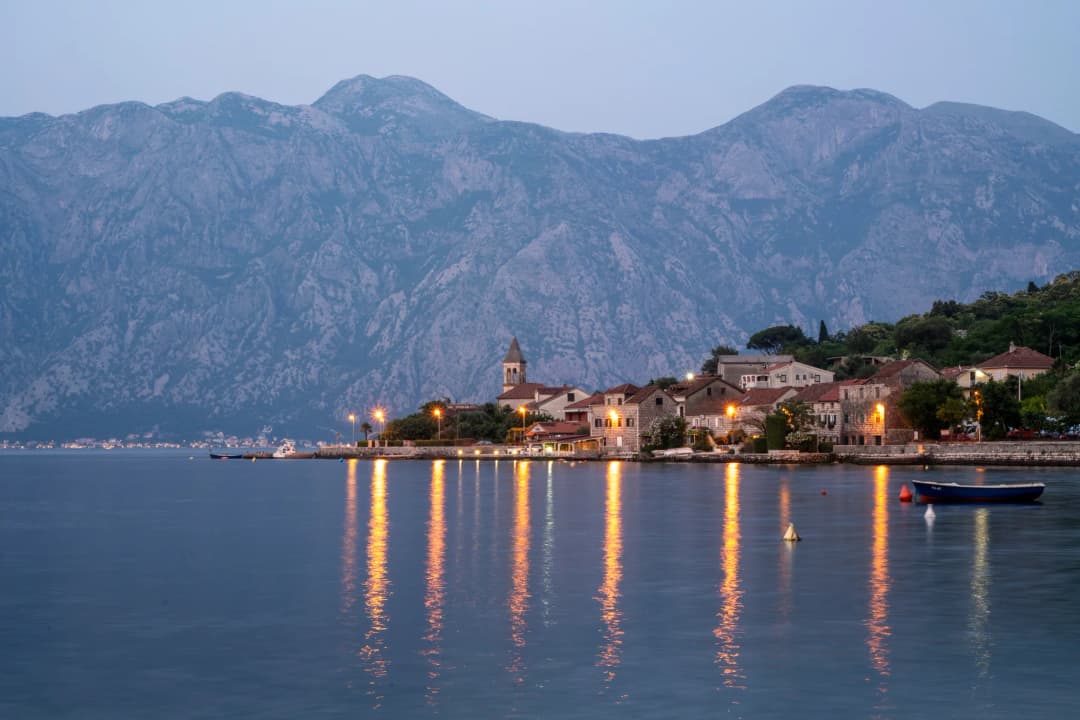
This distinction matters because the building is not a conventional ticketed attraction. It is an active Catholic church, a protected collection and, in 2026, a conservation site. A careful visit begins outside, treats interior access as conditional, and reads the staircase, church and waterfront as parts of one maritime landscape.
| Question | Evidence-based answer | What to recheck |
|---|---|---|
| What is the site? | Parish Church of the Nativity of the Blessed Virgin Mary; architecturally a three-aisled domed basilica. | Do not infer a canonical basilica title. |
| When was it built? | Church construction began in 1789 and concluded in 1909; solemn consecration followed in 1913. | The access staircase has its own 1908–1913 chronology. |
| Can I enter? | No reliable public timetable was found. April 2026 reporting described active restoration. | Ask the Diocese or parish before a special trip. |
| What connects Visin? | His Merito Navali flag, knight’s cross, portrait and a Splendido image are recorded in the church collection. | Display access can change during works and worship. |
| Can I park? | A 2015 municipal plan recorded no organized public parking in Prčanj at that time. | That is not a live 2026 inventory; use only legal spaces. |
Church, temple or basilica?
The Montenegrin Academy of Sciences and Arts (CANU) uses two complementary descriptions. Ecclesiastically, this is the parish church dedicated to the Nativity of the Blessed Virgin Mary. Architecturally, it is a monumental three-aisled basilica with a dome and large apse. In other words, “basilica” describes the spatial form in this evidence; it should not be promoted into an unverified church honorific.
The local name Bogorodičin hram means the Temple of the Mother of God. English-language signs and guides may translate the dedication as Church of the Birth of Our Lady, Church of the Nativity of Mary or Church of the Nativity of the Blessed Virgin Mary. They point to the same waterfront building, not three different sites.
| Description | Name / form |
|---|---|
| Parish dedication | Nativity of the Blessed Virgin Mary |
| Local name | Bogorodičin hram |
| Architectural form | three aisles + dome = basilica plan |
| Caveat | No reviewed source establishes a canonical minor-basilica title |
Source: leks.canu.ac.me
Why the new church moved toward the shore
CANU traces the dedication back to an older church recorded in 1399 as Sctae Mariae de Perzana, higher on Mount Vrmac. That building was expanded in 1672 and consecrated in 1705. As Prčanj’s population, shipbuilding and maritime trade shifted toward the water, the steep approach to the old church became increasingly impractical. Residents sought Venetian permission for a new shore-side building in 1656 but received it only in 1789.
The present church therefore represents more than stylistic ambition. Its site records a settlement moving from the slope to the maritime edge. UNESCO’s account of the Natural and Culturo-Historical Region of Kotor explains why that relationship matters: the value of the inner bay lies in the integration of settlements, palaces, religious ensembles, roads, cultivated slopes and shoreline structures. Prčanj’s church makes that sea-to-settlement axis unusually legible.
For the wider urban story, pair this article with our complete Prčanj guide. It situates the church among captains’ houses and the waterfront rather than treating it as an isolated monument.
A 120-year construction record
Construction began in 1789 using the design of Venetian architect Bernardino Maccaruzzi. CANU records successive master builders, completion of the dome around 1885 and Milan Karlovac’s supervision of the final 1905–1909 phase. The academy says Maccaruzzi’s plan was substantially realized despite changes during the long build.
An April 2026 HRT report adds a documented interruption from 1807 to 1867. It also relays the parish’s account that shipowners directed half of their profits toward construction and transported Korčula stone without charge. That funding tradition is meaningful, but it should be read as a reported community practice—not as proof that every owner, voyage or construction phase followed an identical formula.
| Date | Stage |
|---|---|
| 1789 | work begins |
| 1807–1867 | reported pause |
| c.1885 | dome complete |
| 1909 | church complete |
| 1912–1913 | stairs built; church consecrated |
| Note | “120 years” refers to the church build: 1789–1909 |
Source: leks.canu.ac.me, glashrvatske.hrt.hr, morepress.unizd.hr
The staircase is a separate work of architecture
The ceremonial stair is often folded into the church’s 120-year story, but an original research article in Ars Adriatica reconstructs a more precise sequence. Maccaruzzi’s staircase drawing did not survive. The built design was by architect Milan Karlovac; its balustrade was carved in the workshop of Ivan Fabris on Vrnik near Korčula, and Josef Večernik carried out the construction in 1912–1913.
This authorship changes how to look. The staircase is not simply leftover access infrastructure. It mediates between boat-level arrival, the waterfront road, the raised terrace and Maccaruzzi’s older church composition. Its turns and landings stage the approach, while the Korčula-stone balustrade binds a twentieth-century intervention to the church’s Adriatic material network.
| Role | Who | Detail |
|---|---|---|
| Design | Milan Karlovac | built scheme |
| Stonework | Ivan Fabris workshop | Vrnik / Korčula |
| Construction | Josef Večernik | 1912–1913 |
| Note | Maccaruzzi designed the church | his staircase drawing is not preserved |
Source: morepress.unizd.hr
What the church collection represents
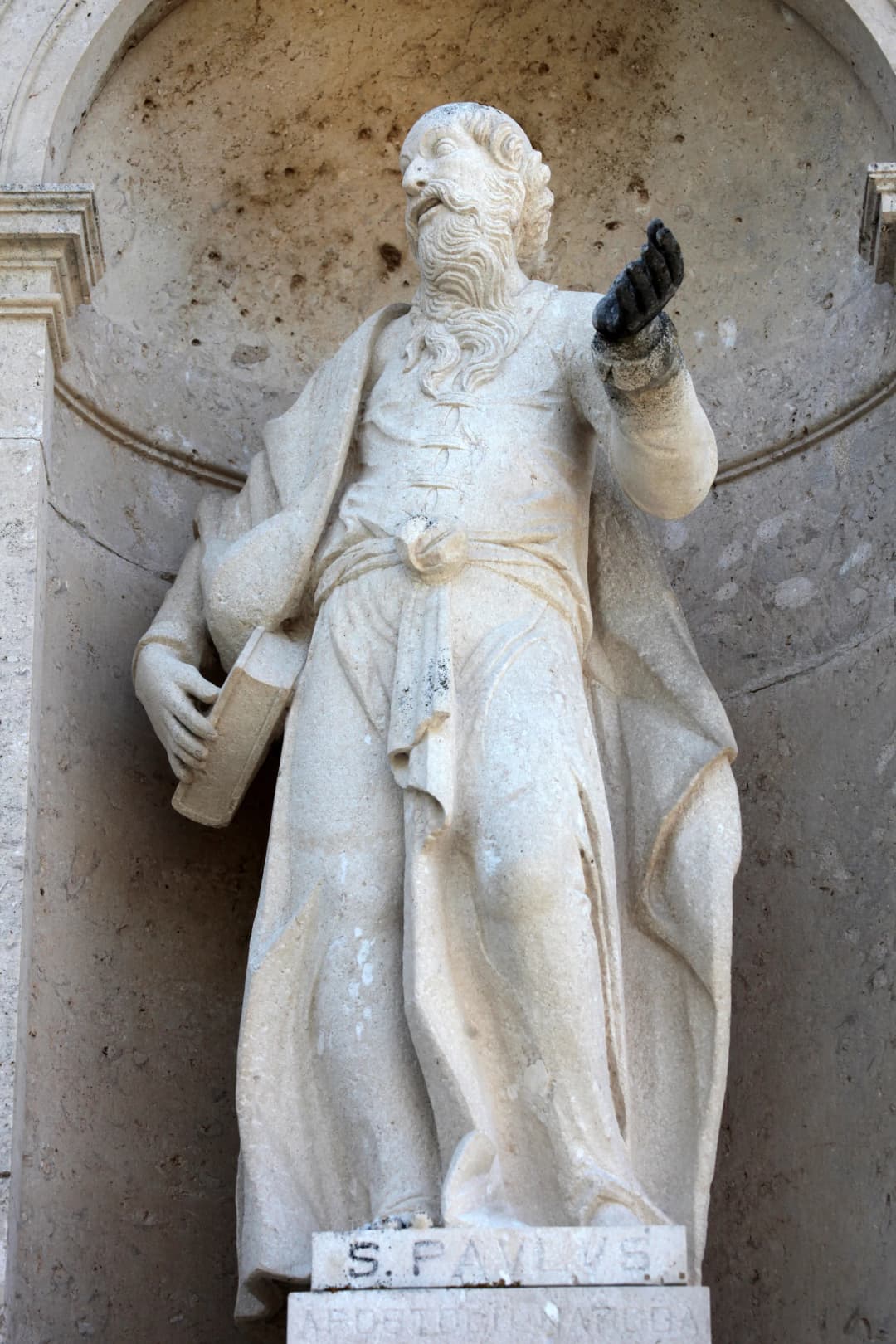
CANU’s art entry presents the church as a layered repository rather than a single-period interior. The main altar, made in Venice in 1742, came from the older church. The collection includes Marian icons, altars, paintings, sculpture, reliquaries, votive gifts, liturgical textiles, books and archival material. Works and attributions range from Tripo Kokolja, Andrea Brustolon, Antonio Balestra and Giovanni Battista Piazzetta to twentieth-century artists including Ivan Meštrović, Milo Milunović and Petar Lubarda.
That breadth is evidence of collecting, transfer, patronage and reinterpretation over centuries; it is not a promise that every named work hangs in an ordinary visitor route. During services or conservation, areas may be closed and objects may be moved. Approach the interior as a sacred space first: dress respectfully, remain quiet, do not use flash, and ask before photographing.
Ivo Visin and the working voyage of Splendido
Ivo Visin was born in Prčanj in 1806, studied navigation locally and in Trieste, and ordered the two-masted brig Splendido from Andrija Zanon’s Rijeka shipyard. CANU and the Croatian Technical Encyclopedia agree on the main departure record: Visin, officer Friedrich/Federiko Belavita and nine other crew members left Antwerp on 11 February 1852 under the Austrian flag.
The voyage was not a modern record attempt with a fixed tourist itinerary. It was a long commercial navigation assembled through successive legs. The documented route went west around Cape Horn, into the Pacific and Asian trading waters, then across the Indian Ocean, around the Cape of Good Hope and back into the Atlantic. The CANU biography gives 2,757 days and more than 100,000 nautical miles; LZMK records 101,297 nautical miles.
| Stage | Point | Date |
|---|---|---|
| 1 | Antwerp | 11 Feb 1852 |
| 2 | Cape Horn | |
| 3 | Pacific Americas | |
| 4 | Asian waters | |
| 5 | Cape of Good Hope | |
| 6 | Trieste | Aug 1859 |
| Note | Schematic sequence—not a navigational chart |
Source: leks.canu.ac.me, tehnika.lzmk.hr
What can be stated confidently
- Ship: a two-masted brig about 30 metres long and 311 tonnes in the referenced records.
- People: Visin, Belavita and nine additional crew at departure.
- Direction: west from Europe around Cape Horn, across the Pacific and Indian oceans, then around southern Africa.
- Finish: Trieste in August 1859, after more than 100,000 nautical miles.
- Recognition: Emperor Franz Joseph I awarded the white Merito Navali flag and a knight’s cross in 1860.
What needs qualification
Authoritative references do not agree on every detail. CANU gives 10 August 1859 for arrival in Trieste; the two LZMK encyclopedias give 30 August. They also use different global rankings—“fifth” or “sixth”—and national formulations. Because counting depends on whether one means an individual, commander, owner, merchant voyage, ship or national flag, this guide does not repeat a universal numerical rank. It preserves the better-supported formulation: Montenegrin and regional institutions identify Visin as the first South Slavic captain associated with such a circumnavigation, and the voyage was the first by a merchant ship under the Austrian flag in the cited record.
| Status | Claim |
|---|---|
| Shared across sources | ✓ Antwerp departure: 11 Feb 1852 |
| Shared across sources | ✓ circumnavigation completed in 1859 |
| Shared across sources | ✓ more than 100,000 nautical miles |
| Shared across sources | ✓ 1860 imperial recognition |
| Do not flatten | ? arrival: 10 or 30 August |
| Do not flatten | ? fifth or sixth individual |
| Do not flatten | ? national label and counting rule |
| Do not flatten | ? “first” without a defined category |
Source: leks.canu.ac.me, tehnika.lzmk.hr, enciklopedija.hr
Why Visin’s flag belongs in the church story
The Merito Navali flag is not decorative evidence pasted onto an unrelated landmark. CANU records the flag, knight’s cross, Visin portrait and a representation of Splendido in the church collection. The Croatian Technical Encyclopedia says the flag and invitation charter are held there. That placement joins a seafarer’s state recognition to a parish archive created by the same shipowning community.
The record also extends into Kotor. CANU’s Maritime Museum entry records an entrance-hall relief of Visin and Splendido and says the museum has awarded a Merito Navali prize since 2004. This provides a separate institutional interpretation if the church treasury is unavailable, but it does not prove that every Visin object is currently displayed. Confirm the current exhibition before traveling for one item. Our focused Ivo Visin voyage reconstruction goes deeper into the route and evidence.
2026 conservation status
Conservation is not a footnote to a visitor guide. Montenegro’s official 2025 cultural-property decision allocated €15,000 to the Bishop’s Ordinariate for a phase of conservation measures at the church. That proves a funding decision, not completed work. On 10 April 2026, HRT reported that a first phase covering the roof, dome, windows and stained glass was under way. The parish priest described targets for the coming months, but forecasts are not completion certificates.
The honest planning rule is therefore simple: expect change. Scaffolding, closed doors, relocated objects or liturgical restrictions can coexist with an impressive exterior visit. Contact the Diocese of Kotor using the current contact published in the bishops’ conference directory if interior access is central to your plan. Ask specifically about the date, service schedule, restoration restrictions, treasury access and photography rather than asking only whether the church is “open.”
| Step | Action | Detail |
|---|---|---|
| Exterior enough? | view facade + stairs | without entry promise |
| If no | Contact first | date + service; works + treasury |
| On site | Adapt on arrival | worship comes first; obey site barriers |
| Note | A restoration forecast is not a current access notice |
Source: gov.me, glashrvatske.hrt.hr, kbk.rs
Getting there without creating a parking problem
Prčanj lies on the narrow Kotor–Muo–Prčanj–Stoliv shore road. In June 2026, the Municipality reported repairs across 1,310 square metres of damaged sections. That is useful maintenance evidence, but it does not mean the road is wide, uncongested or supplied with visitor parking.
The municipality’s 2015 detailed urban plan stated that Prčanj had no organized public parking at that time. Because that document is a planning baseline rather than a live inventory, it cannot prove today’s exact supply. It does justify a cautious strategy: do not stop on the carriageway, block gates or use private waterfront space. If your accommodation cannot confirm legal parking, arrive by taxi, arrange a drop-off, or use verified current public transport information. For the broader approach to the bay, see our Dubrovnik–Kotor transport guide.
The monumental stairs are themselves a barrier. No reviewed source confirms a public step-free route into the church or treasury. Travelers who cannot manage stairs should contact the parish in advance and ask about a current accessible entrance rather than relying on map imagery.
A compact Prčanj heritage route
- Begin on the waterfront. Look back from the road or legal public space to understand the church’s raised, sea-facing composition.
- Read the staircase. Notice its landings and balustrade as a 1912–1913 work, not an anonymous appendage to the 1789 design.
- Use the terrace only if open and safe. Respect barriers and services; conservation takes priority over a photograph.
- Continue through Prčanj. Captains’ houses and shore structures explain the community that funded and filled the church.
- Cross-reference nearby maritime towns. Our guides to Dobrota’s captains’ waterfront, Perast on foot and Perast’s wider history show three different expressions of Boka’s sea-linked patronage.
FAQ
Is the Prčanj church officially a basilica?
The reviewed CANU source describes a three-aisled domed basilica in architectural terms and identifies the site as a parish church. This guide does not claim a canonical minor-basilica designation.
Is the church open every day?
No reliable 2026 daily visitor timetable was found. Restoration was reported in progress on 10 April 2026. Contact the Diocese or parish for the exact date and treat worship, conservation and security restrictions as controlling.
Can I see Ivo Visin’s Merito Navali flag?
The flag is recorded in the church collection, but collection ownership is not a guarantee of display or visitor access. Ask specifically about the treasury. CANU separately records Visin and Splendido in the Maritime Museum’s interpretive relief cycle, not as a substitute promise that the flag is there.
Was Visin the fifth or sixth person to sail around the world?
Reference works disagree, and the count changes with definitions. It is safer to state the documented voyage, Austrian-flag context and regional institutional designation than to repeat one universal rank.
How long did the church take to build?
The present church’s construction spans 1789–1909: 120 years. The monumental staircase followed in 1912–1913, when the church was also solemnly consecrated.
Is there accessible or easy parking?
No current inventory was found. A 2015 plan recorded no organized public parking then, and the shore road remains a sensitive shared corridor. Confirm legal parking or arrange a drop-off; never block the road or private access.