Dobrota is a distinguished waterfront town next to Kotor, lined with grand maritime captains' palaces, offering easy bay swimming and a perfect base for exploring the inner Bay of Kotor.
8,000residents
2offshore islets
Jun–Septhe busy months
Updated Originally published 18 min readby Pavle Obradović
Dobrota — Comprehensive Travel Guide
Overview
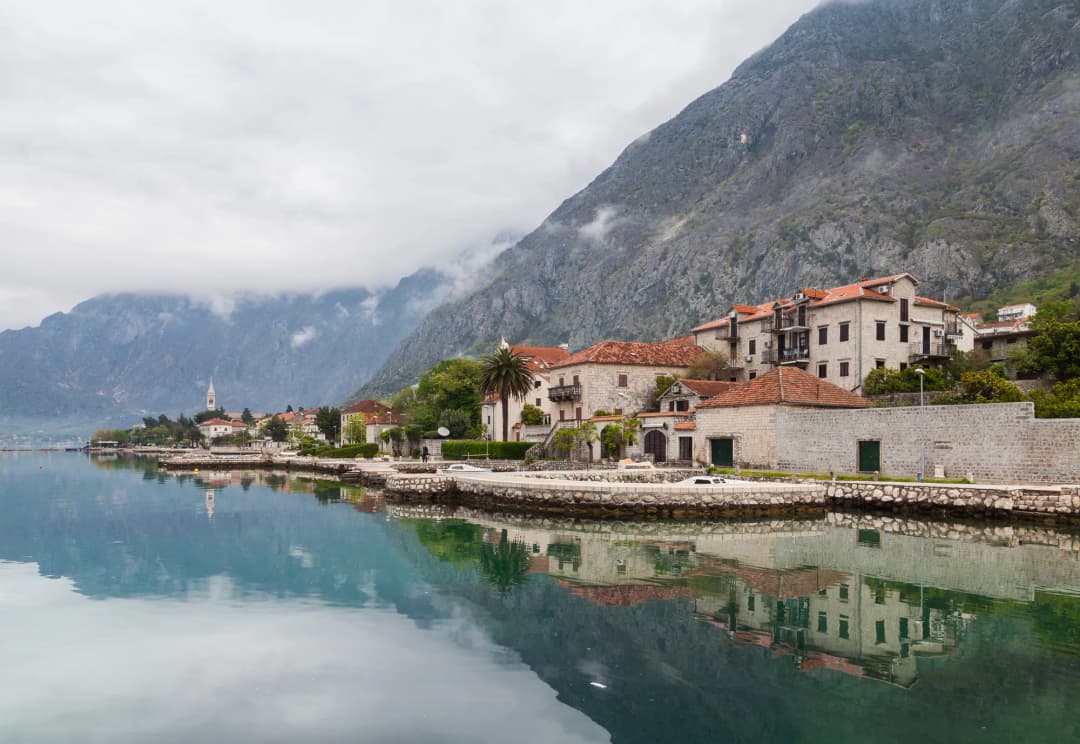
Dobrota is a long, elegant waterfront town stretching for nearly 5 km along the eastern shore of the inner Bay of Kotor, immediately north of Kotor's Old Town. With a population of around 8,000, it is the largest settlement covered in this guide, but it maintains the character of a residential community rather than a tourist destination. Dobrota's fame rests on its extraordinary maritime heritage — from the 17th to the 19th century, this was home to one of the most powerful merchant fleets on the Adriatic, and the grand stone palaces of its sea captains still line the waterfront in an almost unbroken procession of baroque splendour.
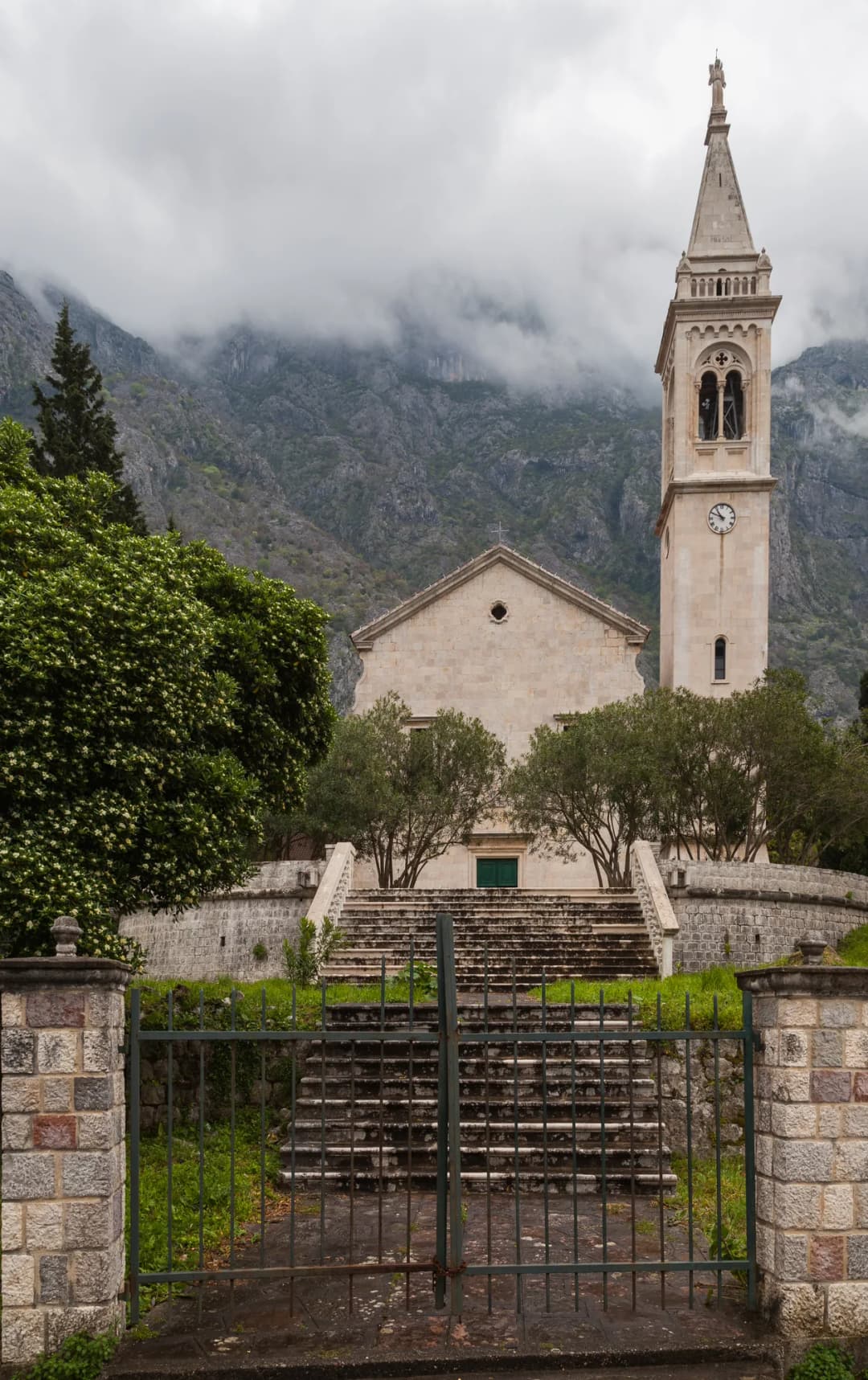
The town produced a remarkable number of wealthy seafarers, shipowners, and merchants whose ambitions stretched across the Mediterranean and beyond. The Tripkovic, Ivanovic, and Dabinovic families were among the most prominent, and their palaces — massive stone edifices with ornate balconies, carved doorways, and private chapels — rival those of much larger Adriatic cities. Dobrota's Church of St. Eustace (Crkva Svetog Eustahija), the main parish church, contains an important collection of religious art, silver ecclesiastical objects, and maritime votive offerings that speak to the deep intertwining of faith and seafaring in the Boka Kotorska tradition.
Today, Dobrota is essentially a seamless extension of Kotor, connected by a continuous waterfront promenade. Many visitors staying in the Kotor area are actually based in Dobrota, benefiting from its quieter atmosphere, easier parking, direct waterfront access for swimming, and more spacious accommodation — all while being a short and pleasant walk from the old town's restaurants, shops, and historic attractions.
Dobrota begins where Kotor's Old Town ends, stretching north along the bay road toward Prcanj and eventually Perast. From Tivat Airport, the drive takes about 10–15 minutes via the road around the bay. From Podgorica Airport, allow approximately 90 minutes via the highway and the Sozina tunnel. From Dubrovnik Airport, the journey takes about two hours including the border crossing.
Buses between Kotor and the other bay settlements stop throughout Dobrota along the main road, with frequent service during summer months. The town is linear, following the waterfront road for about 5 km. Walking from the southern end (nearest Kotor) to the northern end takes about 45 minutes along the waterfront promenade. A continuous path connects Dobrota to Kotor's Old Town — a flat, easy walk of about 10 minutes from the nearest point. Bicycles are useful for covering longer distances within Dobrota and can be rented from shops in Kotor.
Top Things to See & Do
1. Walk the Avenue of Captain's Palaces
Dobrota's waterfront is essentially an open-air museum of 17th–19th century maritime architecture. The captain's palaces are grand stone buildings, many with three or four stories, carved stone balconies, elaborate doorways with family coats of arms, and interior courtyards with gardens. Take your time walking the waterfront and admiring these remarkable buildings, each one a testament to the wealth generated by Boka's golden age of sail. Notable palaces include the Palazzo Tripkovic, with its imposing facade and carved stone balcony, and the Palazzo Dabinovic, which retains much of its original decorative stonework. Some palaces have been converted to boutique accommodation or small galleries, offering a glimpse of the interiors.
2. Visit the Church of St. Eustace
The Church of St. Eustace (Sveti Eustahije) is Dobrota's principal church and a repository of the town's maritime heritage. Inside, you will find valuable paintings, religious icons in elaborate silver frames, ship models offered as votive gifts by returning sailors, and a treasury of silver ecclesiastical objects that reflects the exceptional wealth of the local maritime community. The church also holds a collection of documents and artefacts related to Dobrota's seafaring families, including navigation charts, ship logs, and personal correspondence. Check locally for visiting hours, which vary by season.
3. Swim Along the Waterfront
Dobrota has numerous spots for swimming along its 5 km waterfront. Stone steps, concrete platforms, and small pebble coves provide access to the deep, clean waters of the inner bay. The water is calm and sheltered, making Dobrota's swimming spots some of the safest in the bay — suitable for swimmers of all abilities. Several spots have been fitted with ladders and handrails for easy entry and exit. The best swimming areas are in the middle and northern sections of Dobrota, where the waterfront is less busy and the platforms are wider.
4. Climb Kotor's Fortress Walls
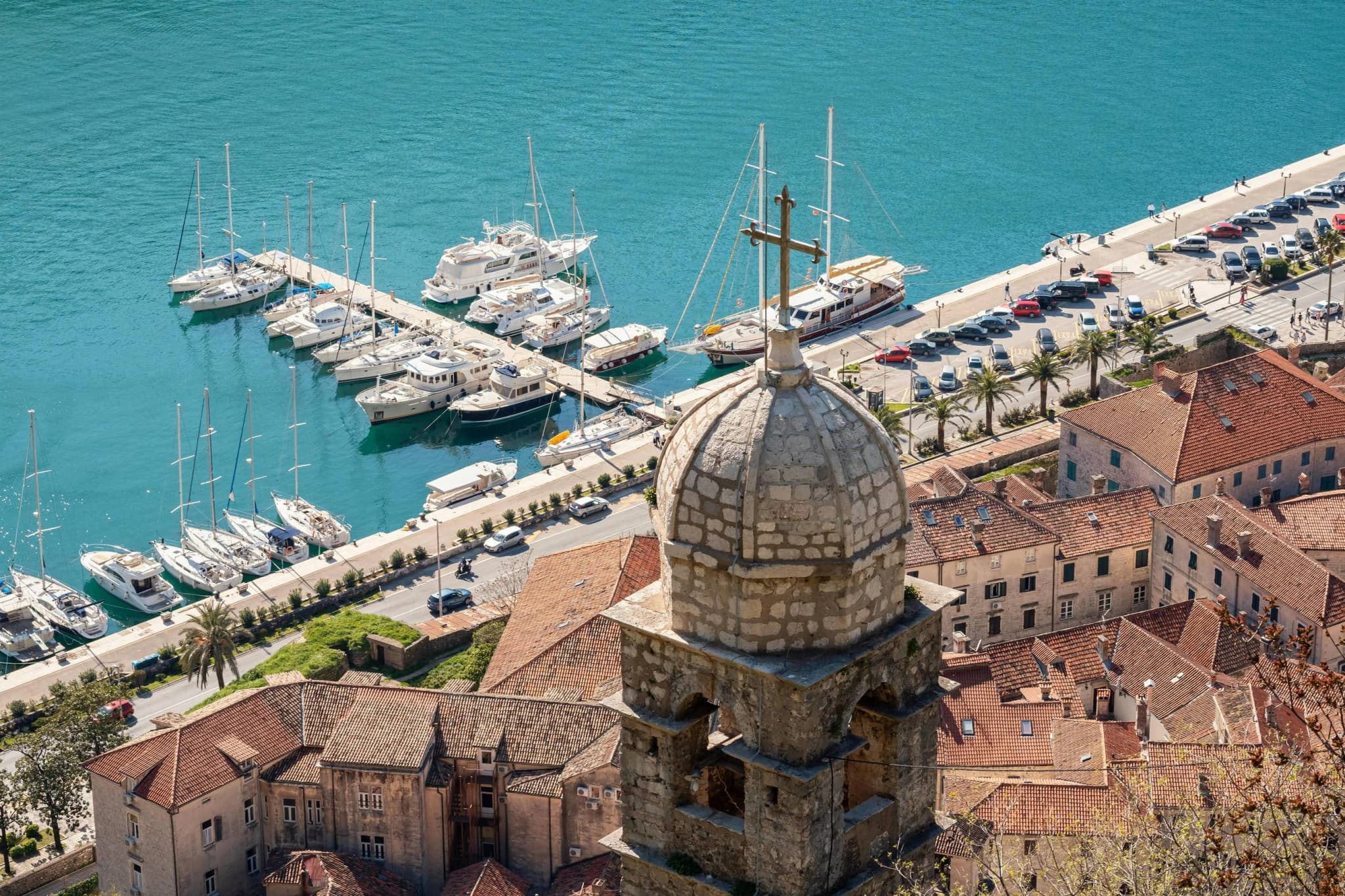
From Dobrota, it is a short walk to the entrance of Kotor's famous fortress walls, which zigzag up the mountainside behind the old town to the Castle of San Giovanni at approximately 260 metres elevation. The climb (about 1,350 steps) takes 60–90 minutes and rewards hikers with one of the most spectacular views in the Mediterranean — the entire Bay of Kotor spread out below with Dobrota's waterfront clearly visible as a ribbon of stone palaces along the eastern shore. The late afternoon light is best for photography, though early morning offers cooler temperatures and smaller crowds. An entrance fee of a few euros applies during summer.
5. Explore Kotor's Maritime Museum
The Maritime Museum in Kotor's Old Town tells the comprehensive story of the Boka Kotorska's seafaring heritage, including Dobrota's central role. Ship models, navigation instruments, portraits of famous captains, maritime flags, weapons, and documents spanning several centuries make this one of the most important maritime museums on the Adriatic. It provides essential context for understanding the grand palaces you see along Dobrota's waterfront and brings the human stories behind those stone facades vividly to life. Allow at least an hour for a proper visit.
6. Explore Kotor Old Town
Kotor's UNESCO World Heritage-listed Old Town is just a 10-minute walk from the nearest point of Dobrota and is one of the best-preserved medieval towns on the Mediterranean. Within the fortified walls, you will find the Cathedral of St. Tryphon (dating from 1166), numerous churches and palaces, atmospheric squares, and a maze of narrow streets lined with shops, restaurants, and galleries. The old town is compact enough to explore thoroughly in a few hours, though you may find yourself drawn back repeatedly over the course of your stay. Time your visit for early morning or late afternoon to avoid the midday cruise ship crowds.
7. Day Trip to Perast and the Island Churches
Perast, one of the jewels of the Bay of Kotor, is just 12 km north of Dobrota along the coastal road. This tiny town of baroque palaces and church towers faces two small islands — Our Lady of the Rocks (an artificial island with a church built by local sailors over centuries) and St. George Island (a natural island with a Benedictine abbey). Boat trips to Our Lady of the Rocks depart from the Perast waterfront every few minutes and cost just a few euros. The combination of Dobrota's palaces and Perast's islands makes for one of the finest one-day maritime heritage experiences on the Adriatic.
Where to Eat
Galion, located at the southern end of Dobrota near the old town, is one of Kotor's most respected restaurants. Set on a waterfront terrace with views of the old town walls reflected in the bay, it serves refined seafood and Montenegrin cuisine. The black risotto, seafood platter, and grilled fish are excellent. Expect to pay 25–35 euros per person for a full meal with wine. Reservations are recommended in summer, especially for terrace tables.
Along Dobrota's waterfront, several smaller restaurants and konoba serve excellent local food at more moderate prices. Look for places displaying the daily catch — fresh sea bass (brancin), sea bream (orada), and squid (lignje) grilled simply over charcoal are hard to beat. The local specialty riblja corba (fish soup) makes an excellent starter, rich with the flavours of the Adriatic.
The proximity to Kotor also means dozens of additional restaurants are within easy walking distance, ranging from upscale dining in converted palazzo courtyards to casual pizzerias and traditional Balkan grill houses. For a memorable splurge, book a table at one of the restaurants inside Kotor's Old Town walls for a meal surrounded by medieval architecture.
Best Time to Visit
Dobrota is a genuine year-round destination. Summer (June–September) is best for swimming and waterfront dining, with sea temperatures reaching 24–26°C. The shoulder seasons of May and October offer comfortable weather for walking and sightseeing with significantly fewer crowds. Kotor's cruise ship season (May–October) brings large numbers of day visitors to the old town, but Dobrota's residential waterfront remains relatively peaceful throughout. Winter visits offer atmospheric bay views with snow-capped mountains reflected in still water, empty streets, and the chance to experience Kotor's old town without crowds — plus hotel and apartment prices drop by 50% or more from peak summer rates. The annual Boka Navy parade in February is a spectacular event that draws visitors from across the region.
Where to Stay
Dobrota has properties on montenegro.com offering waterfront accommodation with easy access to Kotor. Staying in Dobrota is one of the smartest choices for a Bay of Kotor holiday — you get the tranquility of a residential town, direct bay access for swimming, morning views of mist rising off the water with the mountains beyond, and a 10-minute walk to one of the most beautiful old towns in the Mediterranean. Properties range from modern apartments in renovated stone buildings to rooms in former captain's palaces, many with balconies or terraces directly overlooking the bay. The value proposition is excellent: accommodation in Dobrota typically costs less than equivalent properties in the old town while offering a more peaceful and authentic experience.
Practical Tips
Dobrota is the best base for visiting Kotor without dealing with the old town's notorious parking difficulties — walk in on the waterfront path and avoid the traffic entirely.
The early morning, before cruise ship passengers arrive (usually before 9 AM), is the best time to visit Kotor's old town — you will have the streets nearly to yourself.
Many of the captain's palaces are private residences, so admire them from the outside and respect the occupants' privacy. A few have been converted to boutique accommodation or galleries that welcome visitors.
The road through Dobrota is the main bay thoroughfare and can be busy with traffic — exercise caution when walking along the road, especially with children. The waterfront promenade, where it exists, is much safer.
Dobrota's central position in the inner bay makes it an ideal base for day trips: Perast and its islands (15 minutes), Risan's Roman mosaics (20 minutes), Lovcen National Park (45 minutes via the serpentine road), and across the bay to Tivat via the Lepetane–Kamenari ferry (15 minutes).
Look for the Boka Navy memorial events in February, when the centuries-old maritime brotherhood parades in traditional dress — one of the most distinctive cultural events on the Adriatic.
Bring a reusable water bottle — the fountains in Kotor's old town dispense drinkable mountain water, and you can fill up for the walk back to Dobrota.
For the best photographs of Dobrota's waterfront palaces, visit in the late afternoon when the western sun illuminates the facades with warm golden light.
What makes Dobrota a captains’ waterfront?
Kotor municipality identifies the Tripković, Ivanović, Radimir-Dabinović and
Milošević palaces, plus Radimir family houses, as part of Dobrota’s built
heritage. The useful observation is spatial: prominent residences face the
water because the bay was a working route, while family compounds, churches
and cultivated slopes formed a connected settlement behind them.
Do not translate “palace” into public museum. A name on a heritage list
establishes cultural value, not opening hours. View façades, portals,
balconies and waterfront relationships from a lawful public position; do not
enter gates, steps, gardens, pontoons or courtyards without clear permission.
The separate
Dobrota practical guide
is better for choosing a base, while this article concentrates on how to read
the heritage.
How to read Dobrota's maritime heritage chain
Step
Link in the chain
How to read it
1
bay route
Read the connections, not isolated façades
2
landing
Read the connections, not isolated façades
3
family house
Read the connections, not isolated façades
4
church
Read the connections, not isolated façades
5
terraces
The public waterfront reveals the system even when interiors are closed.
Source: kotor.me, whc.unesco.org
Ivo Visin belongs to Prčanj’s maritime story
The
Montenegrin Academy’s lexicon
records Visin as born in Prčanj in 1806 and deceased there in 1868. It
documents his voyage aboard Splendido from 1852 to 1859. His
achievement belongs to the wider maritime history of the Bay of Kotor, while
his home identity remains Prčanj.
Dobrota’s named maritime families and waterfront estates tell the settlement’s
own story. Across the bay, Prčanj provides the local setting for Visin’s life.
For his full biography and nearby landmarks, use the
Ivo Visin and Prčanj guide;
the broader
Prčanj maritime village guide
helps plan a separate visit.
One bay story, two distinct places
Place
Who
What
Dobrota
Tripković · Ivanović
palace families
Dobrota
Radimir-Dabinović · Milošević
palace families
Prčanj
Ivo Visin
Splendido · 1852–1859
Prčanj
Ivo Visin
home and voyage
Both
One bay
two distinct maritime settings
Source: leks.canu.ac.me, kotor.me
St Matthew and St Eustace: historic churches
Kotor municipality dates St Matthew’s Church to the 17th century. It says St
Eustace was mentioned in the 14th century and that the church’s present
appearance belongs to the 18th. These dates trace the waterfront’s long
religious history. Opening hours and access to artworks or treasuries require
direct confirmation with the relevant church authority.
Plan first for exterior appreciation. If a door is open, check whether entry
is welcome, cover shoulders and knees, silence phones, avoid flash, and give
any service complete priority. Ask a church authority or qualified local guide
about treasury or collection access before building the day around it. Never
follow another visitor through a private-looking entrance.
Dobrota lace is protected—and still being taught
Montenegro’s Cultural Heritage Administration lists the skill of making
Dobrota lace as a nationally protected intangible cultural asset. This is a
national designation.
Museums of Kotor
describes the craft as a local form of reticella and documents workshops led
by a recognised custodian. Europa Nostra’s 2026 Excellence Day booklet reports
that the Pacijenca project trained more than 50 women over three years,
showing how teaching and practice continue the tradition.
Dobrota lace safeguarding chain: a living skill needs more than display
Stage
What it means
Protect
national intangible cultural asset
Teach
custodian-led museum workshops
Transmit
50+ women trained over three years
Caveat
A documented project is not a promise of a drop-in class today.
Source: gov.me, muzejikotor.me, europanostra.org
Why UNESCO status does not mean “unchanged”
Dobrota belongs within the Natural and Culturo-Historical Region of Kotor.
UNESCO defines the property’s value through open and fortified settlements,
palaces and religious ensembles integrated with the cultivated terraced
landscape. A 2012 ICOMOS evaluation explicitly names Dobrota among the
settlements in the nomination and management-plan boundary history.
What the sources say
Protection is not a glass case. UNESCO warns that urbanisation, roads and new
coastal building can gradually transform the property. A 2025 UNESCO/ICOMOS
report specifically identifies remaining terraces and forest above parts of
Dobrota as attributes of the cultural landscape while discussing development
pressure. Visitors help by using public paths, respecting private property,
choosing lawful parking and not treating old stonework as a seat, climbing
wall or drone stage.
For regional context, read the
Bay of Kotor landscape guide. Perast
offers a denser baroque ensemble in a small town, while the
Perast guide explains
its different public-visit pattern. Dobrota’s strength is the inhabited linear
shore.
Kotor Old Town is the southern orientation point; Dobrota continues north
along the bay.
Practical Dobrota heritage walk
Start on the Kotor side and choose a turnaround before walking. A short
version focuses on the transition from the old town edge into southern Dobrota
and St Matthew. A longer version continues toward St Eustace and returns by
confirmed bus, taxi or the same route. The settlement is elongated, so “walk
Dobrota” is not one fixed distance.
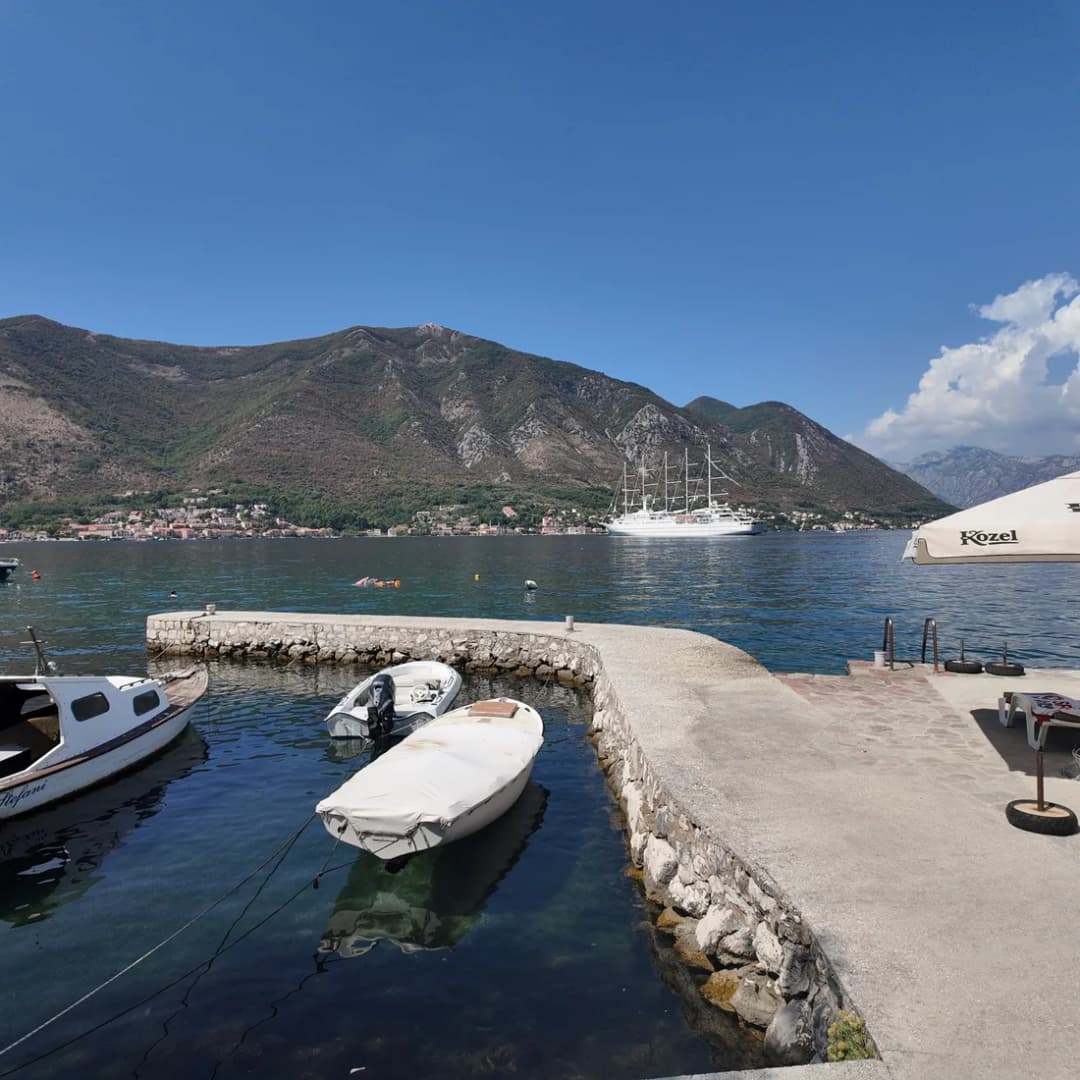
Short piers such as this one interrupt the shoreline path at intervals and make convenient pauses along the route.
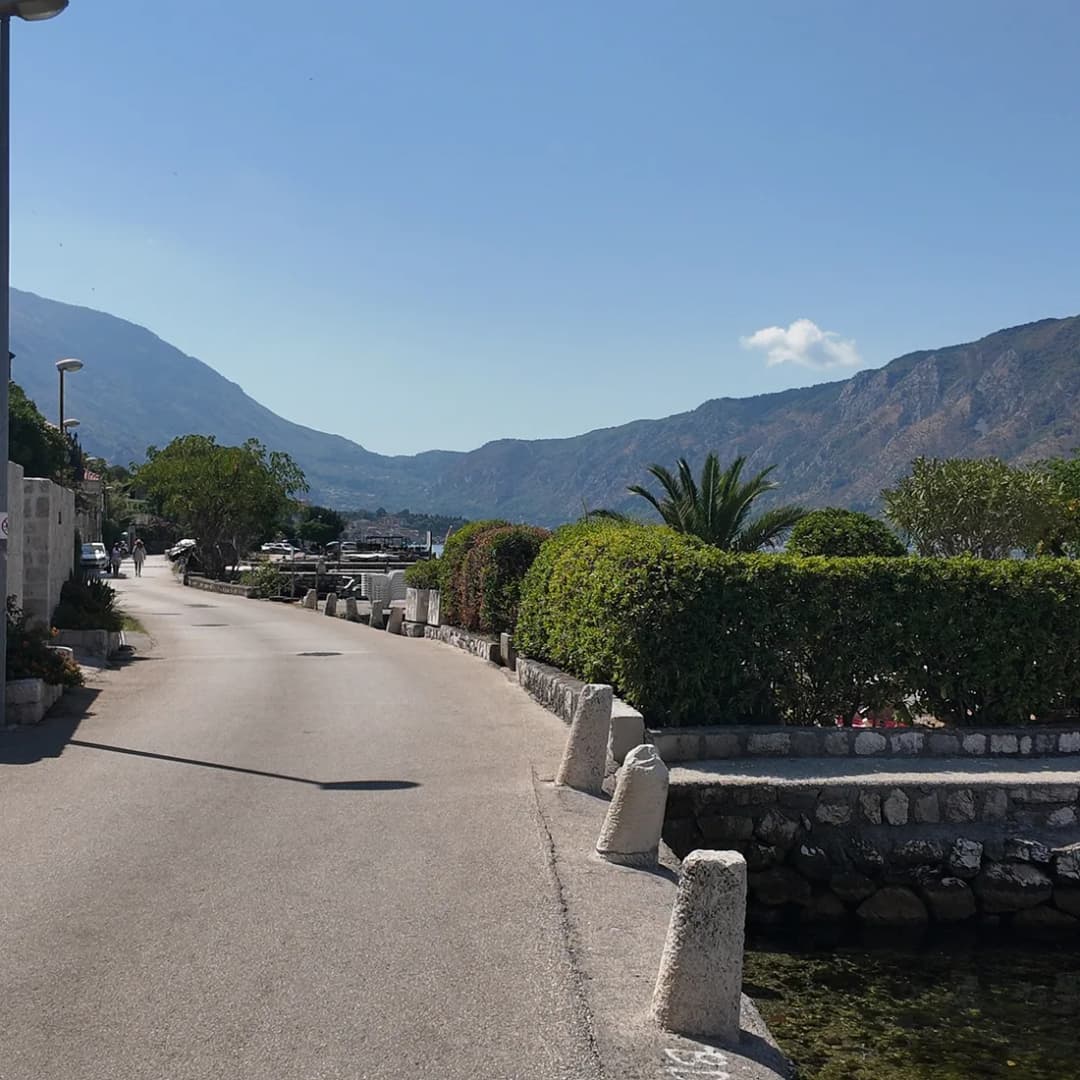
The shoreline experience varies between promenades, small roads, crossings,
curbs and narrow sections. In March 2026, Kotor municipality reported adding
lighting systems at Dobrota pedestrian crossings. This remains a real traffic
corridor, not a continuous pedestrian museum. People using wheelchairs or
prams should inspect the chosen segment, surface, curb cuts and return before
committing.
Dobrota walking decision sequence: plan the return before the linear walk
Step
Action
1
choose stop
2
inspect access
3
confirm return
4
walk north
Note
Shared roads and crossings remain; visibility upgrades do not remove traffic.
Source: kotor.me
How to get there and return
Southern Dobrota continues directly from Kotor’s urban edge, but the useful
walking time depends on your start and chosen landmark. Kotor municipality’s
public-transport portal links Blue Line schedules; its newest visible item is
dated September 2025 and several documents are older. Confirm the stop,
direction, fare method and last practical return locally on the travel day.
The
Montenegro transport guide
covers the main transport choices around the country.
Driving can create more friction than it removes. Do not count on a heritage
building having visitor parking, block a gate or occupy a waterfront access.
If staying in or near Kotor, a short walk plus a confirmed return often makes
the heritage easier to see. Heat, rain and darkness can change that decision.
Check current swimming-water results
Montenegro’s Environmental Protection Agency reported that the Dobrota 04
bathing-water location received a poor seasonal
classification for 2024. That classification does not describe every access
point or establish the 2026 status. Check posted results and local
restrictions for the exact public bathing location; avoid swimming after
pollution warnings or when water, weather, entry and exit conditions are
unclear.
Dobrota bathing-water checks: water clarity is not a laboratory result
Item
Detail
2024 result
Dobrota 04 — poor seasonal class
Scope
one named location, one season
2026 decision
check posted result, obey restrictions
Reminder
Check the latest posted result for your exact swimming place.
Source: epa.org.me
A working research waterfront
Dobrota is also a working research waterfront. The University of Montenegro
identifies its Institute of Marine Biology at Dobrota and lists centres and
laboratories working on Adriatic biodiversity, benthos and marine protection,
marine chemistry, fisheries, plankton, water quality and mariculture.
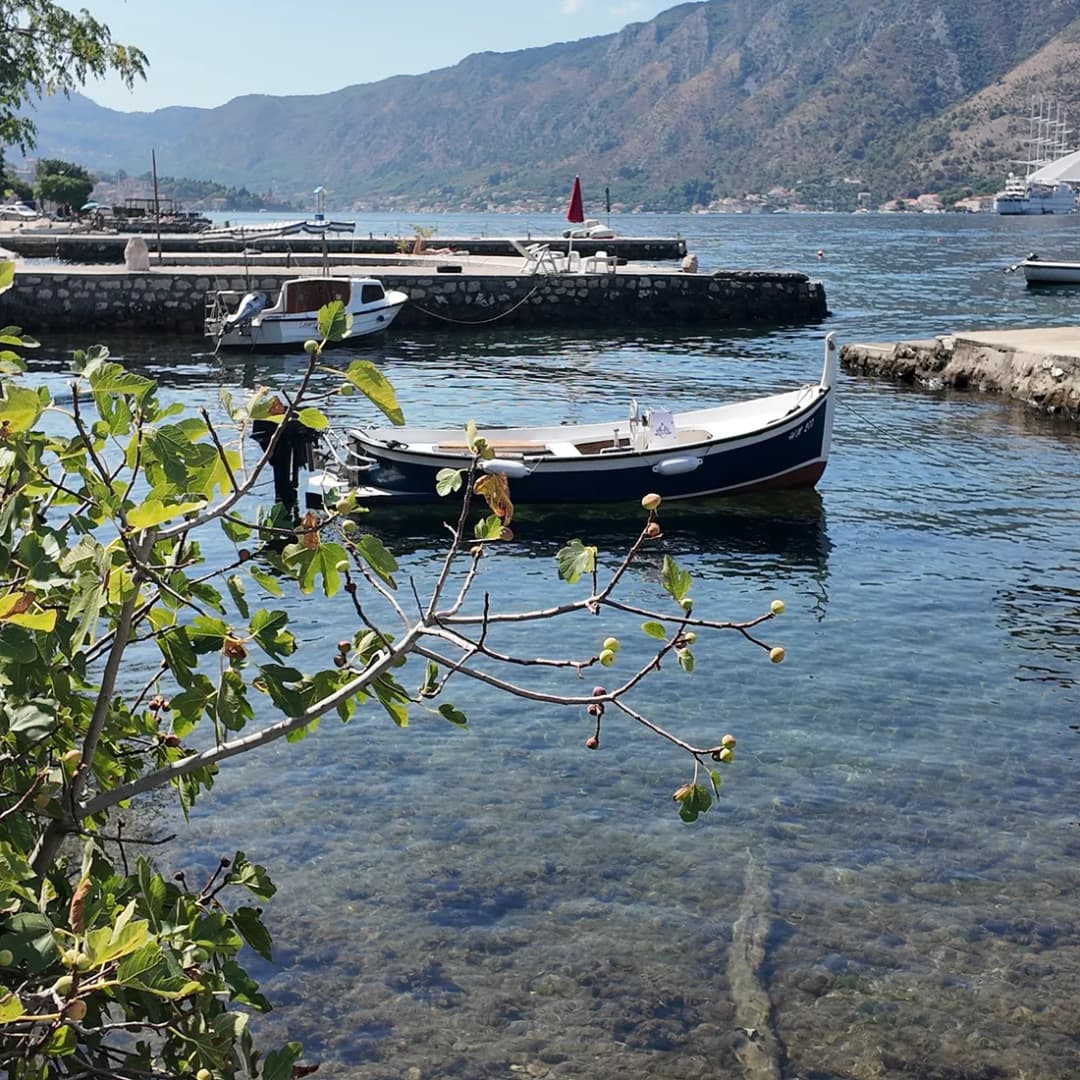
Working boats keep their berths year-round here, so the jetties are in use well outside the summer season.
It does not make the institute a drop-in aquarium or public laboratory. Attend
only a published public programme or confirmed visit. The contrast is
valuable: the same waterfront shaped by merchant shipping now hosts research
into the ecological system on which contemporary Bay life depends.
History & Heritage
Dobrota's maritime golden age spans roughly two centuries, from the mid-17th century to the mid-19th century, during which the settlement produced an astonishing concentration of wealth, culture, and naval expertise. The Dobrota Maritime Brotherhood (Bratovstina), established in the 17th century, was a sophisticated organisation that managed collective shipping investments, provided mutual aid to members' families, and maintained rigorous standards of seamanship and conduct. This institution was central to Dobrota's success and served as a model for similar organisations elsewhere in the bay.
At the peak of its prosperity, Dobrota's merchant fleet numbered dozens of oceangoing vessels, and the town's captains were known and respected in ports across the Mediterranean, the Black Sea, and the Atlantic. The 12 baroque palaces that line the waterfront are the most visible legacy of this wealth. These were not merely residential buildings but statements of prestige and cultural ambition. Many contained private libraries, art collections, and chapels with paintings commissioned from Italian and Venetian masters. The palaces' architectural style reflects the strong Venetian influence on the bay's culture, with distinctly Adriatic adaptations suited to the local climate and building materials.
Under Venetian rule (1420–1797), Dobrota's captains served the Republic's navy and commercial fleet, gaining experience and wealth in the process. The town's loyalty to Venice was rewarded with trading privileges and a degree of self-governance. When the Austro-Hungarian Empire assumed control of the bay in 1797, Dobrota's captains adapted once more, serving in the imperial navy while continuing their merchant activities. The famous Boka Navy — a ceremonial naval formation that still parades annually in Kotor — includes representatives from Dobrota's leading families, maintaining a tradition that stretches back centuries.
The Church of St. Eustace is the spiritual heart of Dobrota and a repository of its maritime heritage. The church's treasury contains an exceptional collection of silver and gold ecclesiastical objects, many donated by returning captains as thanksgiving offerings for safe voyages. Ship models hanging from the ceiling serve as votive offerings, a common practice in maritime churches across the Mediterranean. The collection of religious paintings includes works attributed to notable Adriatic and Venetian artists, making the church an important artistic as well as spiritual destination.
Dobrota also holds the distinction of being the longest continuous settlement in the Boka Kotorska — its 5 km of waterfront development represents an unbroken chain of habitation and architecture spanning several centuries, creating what amounts to an open-air museum of Adriatic maritime civilisation.
Quick answers
When is the best time to visit Dobrota?+
Dobrota is a genuine year-round destination. Summer (June–September) is best for swimming and waterfront dining, with sea temperatures reaching 24–26°C. The shoulder seasons of May and October offer comfortable weather for walking and sightseeing with significantly fewer crowds.
Dobrota begins where Kotor's Old Town ends, stretching north along the bay road toward Prcanj and eventually Perast . From Tivat Airport , the drive takes about 10–15 minutes via the road around the bay.
Galion , located at the southern end of Dobrota near the old town, is one of Kotor's most respected restaurants. Set on a waterfront terrace with views of the old town walls reflected in the bay, it serves refined seafood and Montenegrin cuisine.
Dobrota has properties on montenegro.com offering waterfront accommodation with easy access to Kotor. Staying in Dobrota is one of the smartest choices for a Bay of Kotor holiday — you get the tranquility of a residential town, direct bay access for swimming, morning views of mist rising off the water with the mountains beyond, and a 10-minute walk to one of the most beautiful old towns in the Mediterranean.
Pavle Obradović is from Herceg Novi. He was Manager of Montenegro.com, then Director of the Herceg Novi Tourism Organization, and is now Coordinator for Investment and Development Projects at the Municipality of Herceg Novi. He holds a BSc in International Hospitality and Service Management from the Rochester Institute of Technology (RIT).
···
Updated · Originally published
Montenegro Travel Newsletter
Get weekly stories, guides, and insider tips about Montenegro delivered to your inbox.