Perast, Montenegro: The Baroque Pearl of the Bay of Kotor
Perast, a car-free Baroque town on the Bay of Kotor that never held more than 1,643 people: the boat to Our Lady of the Rocks, palaces, swim spots and stays.
12th centuryfirst recorded
2offshore islets
Jul–Augthe busy months
Updated Originally published 57 min readby Pavle Obradović
Overview
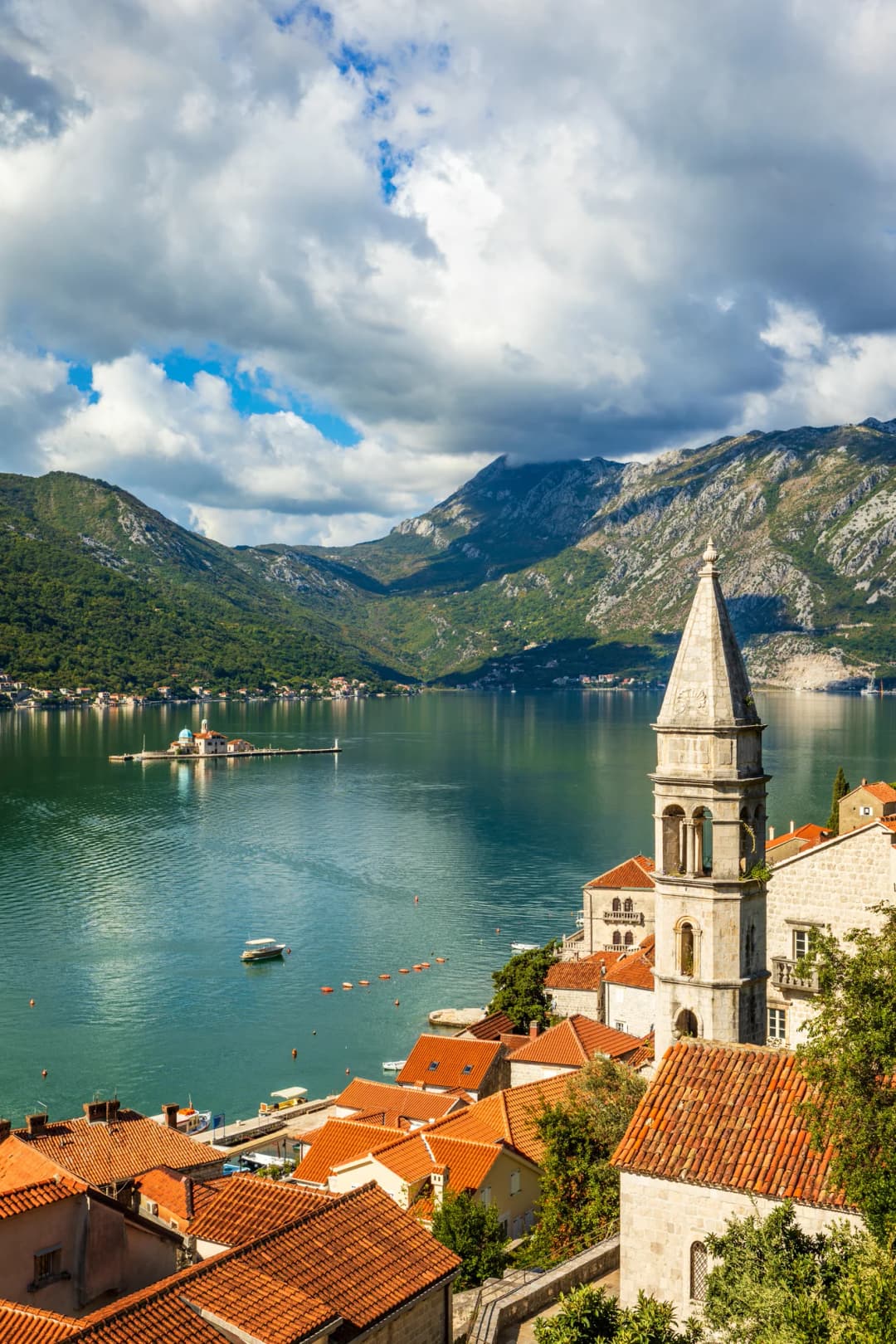
Perast is a small historic town in the Kotor Municipality of Montenegro, renowned for its well-preserved Baroque architecture, rich maritime heritage, and its role as a former Venetian naval centre. Located on the northeastern shore of the Bay of Kotor, beneath the hill of St Ilija (873 m), it is far smaller than its reputation: 237 people lived here at the 2023 census, against 444 in 1991, and at its eighteenth-century height it held about 1,643. Seventeen Catholic churches in the parish, sixteen Baroque palaces and a car-free waterfront a kilometre long belong to that vanished Perast, not to this one.
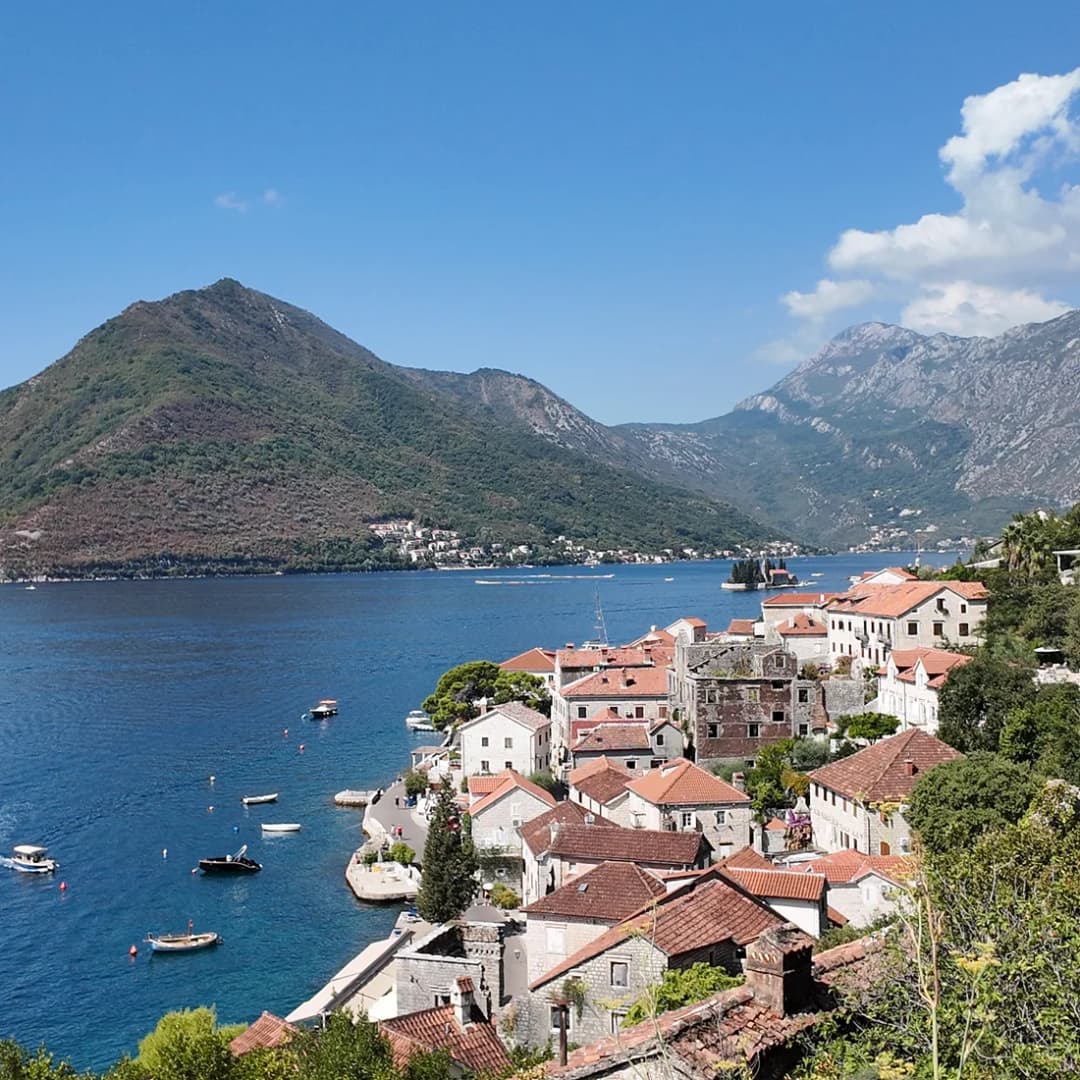
The rooftop line follows the shore, so almost every house in town faces the water.
Situated on a cape that separates the Bay of Risano from that of Kotor, Perast overlooks the Verige strait, the narrowest part of the Bay of Kotor, just a few kilometres northwest of Kotor. The town is part of the Natural and Culturo-Historical Region of Kotor UNESCO World Heritage Site, inscribed in 1979.
Perast is small enough to cross on foot and layered enough to punish a rushed checklist. The best first visit has three anchors: the Perast Museum for evidence, the waterfront for townscape, and—only if weather, operator and access align—a licensed boat to Our Lady of the Rocks. Its palaces, church towers and two offshore islands are not all interchangeable public attractions: one island has a church you can walk into, the other is a private monastery and closed to visitors.
This guide combines that practical plan with the town’s full history. The planning sections use the museum’s current tariff, the bus operator’s own stamped price list, municipal transport documents, maritime-safety guidance and UNESCO conservation material. Where a price exists but nobody publishes it — the island boat, the island church, the bell tower, the car parks — this guide says who reported the figure and when, rather than asserting it.
Perast first-visit priorities: build from certainty outward
Priority
What it covers
ANCHOR
Perast Museum · published hours and ticket
WALK
waterfront · lanes · exterior architecture
CONDITIONAL
licensed island boat · weather · safe boarding
Source: muzejikotor.me, montenegro.travel
Day trips
How far a day reaches
8 min
15 min
22 min
Perast essentials at a glance
Decisions to resolve before a Perast visit
Decision
Evidence
Action
Perast Museum ticket
€8 adult, €5 child under 12 or group of ten, €4 student or Montenegrin pensioner
Allow 30 to 45 minutes inside
Summer museum hours
15 Apr–15 Oct, Tue–Sun 08:00–20:00
Avoid assuming Monday entry
Winter museum hours
15 Oct–15 Apr, Tue–Sun 10:00–16:00
January listed closed
Island visit
Boat required for Our Lady of the Rocks
Use licensed operator; verify landing and return
St George
Distinct island and religious site
Treat as a view unless landing is authorised
Bus from Kotor
€1.50 from the bus station or the Riva on route K1
Odd hours only on Sundays and holidays
Driving
Seasonal coastal-road restrictions published
Follow current signs and marked parking
Parking
No published tariff; reported at €8 a day ticket, €15 for 24 hours, cash only
Reported free roughly November to April
The official Muzeji Kotor fees and hours page showed an €8 individual ticket when it was read again on 11 September 2026. The same page listed €5 for children under 12 and for groups of ten or more, €4 for Montenegrin secondary-school pupils, for students on production of an index book, for Montenegrin pensioners and for journalists with a press card, and €15 for a professional guiding service. A €12 ticket combines Perast Museum with the Roman Mosaics at Risan and a €15 ticket covers all five Muzeji Kotor sites — Perast, the Risan mosaics, the Solidarity Gallery, the Kotor historical museum in St Michael's church, and St Paul's church. Admission is free for anyone from the municipality of Kotor, for primary-school pupils at schools in Montenegro, for visitors with a disability, for accredited guides and for ICOM cardholders, one visitor to a card. The residency conditions matter: a foreign pensioner pays the full €8.
The same page listed Tuesday–Sunday opening from 08:00 to 20:00 between 15 April and 15 October, and from 10:00 to 16:00 between 15 October and 15 April. Mondays, all of January, Orthodox Easter, 1 May and 13–14 November are closure dates — eleven months of Mondays and a whole month in winter, which is more closed time than most visitors expect. Because the two published ranges share both boundary dates, confirm 15 April or 15 October directly. Group and school visits require booking.
Perast’s value lies in the relationship among stone buildings, waterfront, islands and steep mountain frame.
Perast Museum (Bujović Palace)
Begin here rather than with the legends. Perast Museum fills Bujović Palace on the waterfront, and its rooms hold what the churches, the shipyards and the captains’ houses left behind: ship models, navigation aids, charts, weapons, portraits, coats of arms, furniture and the ordinary objects of a household. It is the one building in town that turns the words “captains” and “Venetian period” into things you can stand in front of. Muzeji Kotor, which runs it, gives the founding date as 28 February 1937, when the municipal council voted it into existence.
The Collection: The museum's Montenegrin page puts the holdings at over 3,000 objects spanning the fifteenth to the twentieth century; its English page still says about 2,000. They run to easel painting, heraldry, flags, edged weapons and firearms, uniforms and costume, ship models, navigation instruments and ship's gear, diplomas, seals, cartography, medals, coins and banknotes, jewellery, icons, furniture and musical instruments, alongside the Visković family holdings, the municipal and school archives and a library. Not all of it is on display at once. Three things on the ground floor repay finding: Coronelli's great atlas of 1690, the sixteenth-century Perast sword that recalls the victory over the Ottomans in 1654, and the mother-of-pearl-inlaid džeferdar of Mehmed-aga Rizvanagić, taken as war booty in the seventeenth century. The War Room holds the original flags and trophies and a Venetian bronze falconet of the seventeenth century still on its original carriage, which the museum calls a world rarity; on its wall hang the portraits of Marko Martinović and Matija Zmajević. Navigational instruments include compasses, sextants, octants and chronometers that represented the cutting edge of technology in their day, and are how Perast's captains found their way across the Adriatic and beyond. The art collection includes Baroque paintings from the town's churches, and the ethnographic section covers daily life in earlier centuries.
The Building: The palace was built in 1694 for Vicko Bujović, a Perast seafarer and merchant who was elected town captain several times and fought the Ottomans in the Morean War. Muzeji Kotor names no architect. The Hrvatski biografski leksikon credits the Venetian builder Giovanni Battista Fonta, dates the work to 1693–94 and records his name cut in Latin on the outer wall, Ioan Bap[tista] Fonta; the Hrvatska enciklopedija gives the same man as Giovanni Fonte and the year 1693. The museum, founded in 1937, moved in about twenty years later, after a reconstruction its own English page dates to 1957 and its Montenegrin page to 1948. Earthquake damage later forced closure, and remediation preceded reopening in 1998.
Visiting: Plan 30 to 45 minutes. The palace itself — grand staircase, carved stone balconies, views across the bay — is arguably as interesting as the exhibits. Entrance fees are modest; see the €8 individual ticket and seasonal hours above, and ask staff which floors are available, whether photography is allowed and what accessibility support exists. The tariff grants free admission to visitors with a disability, but no published source gives a step-free route, a lift specification or an accessible-toilet plan, so ask at the desk before you commit to the stairs.
Perast maritime-history sequence: five dates, five different claims
Year
Claim
1420
Venetian era
1570
fort cited
1698
navigation class
1937
museum founded
1998
museum reopened
Takeaway
History is a sequence of institutions and change—not one timeless "Baroque age."
Source: muzejikotor.me
For a fuller palace-by-palace and church-by-church account, continue to the comprehensive Perast history guide.
Our Lady of the Rocks Island
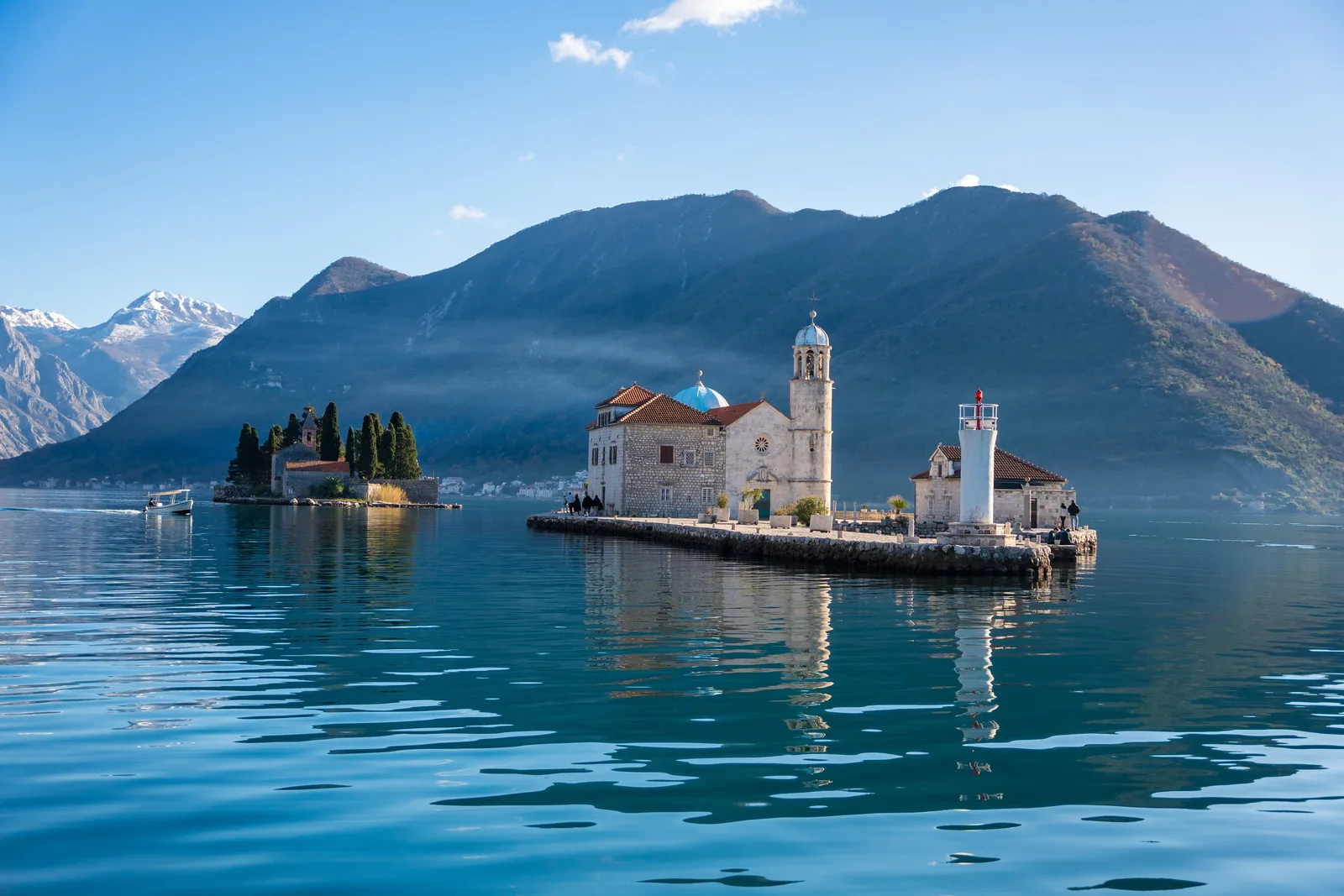
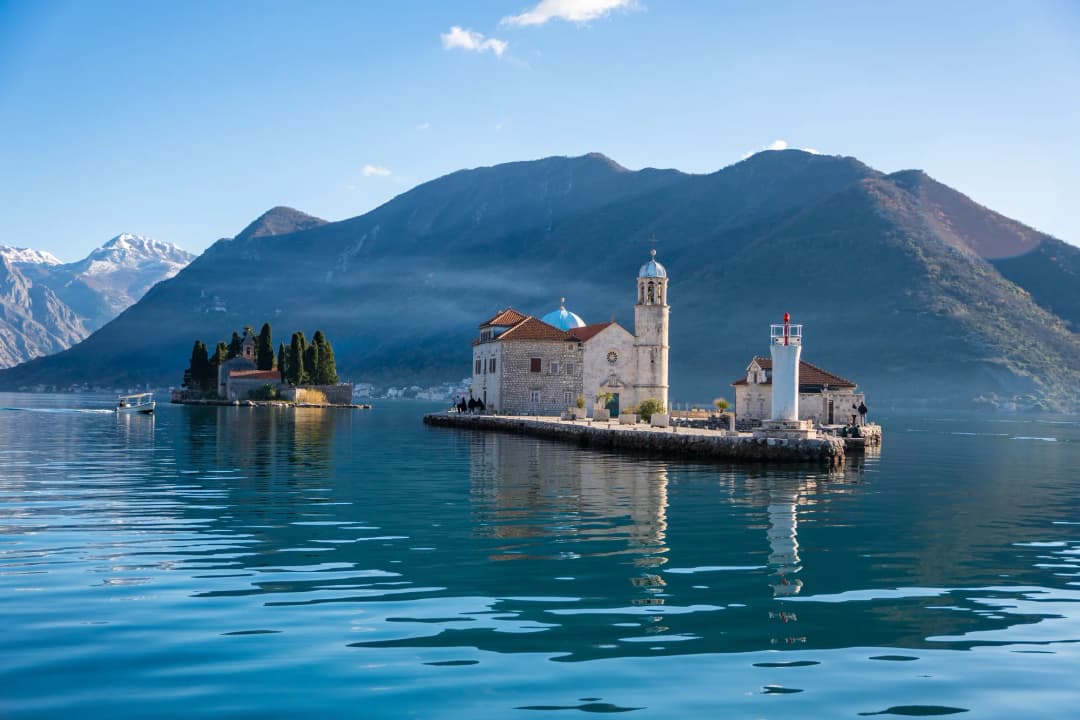
A little over half a kilometre offshore from Perast, a small island rises from the bay topped by a domed church with a distinctive blue cupola. This is Our Lady of the Rocks (Montenegrin: Госпа од Шкрпјела) — Gospa od Škrpjela — one of the two islets off the coast of Perast and, on most reckonings, the only man-made island in the Adriatic; the Italian account is more careful and calls it one of very few. It was built on a rock, the Škrpjel, over centuries, and the Adriatic Pilot gives its area as 3,030 m². Montenegro's national tourism organisation describes it simply as a man-made island holding a Catholic church and museum.
Legend and creation
The origin story is one of the most beloved legends on the Montenegrin coast, and the sources that carry it say so in those words: prema predaji, according to tradition. On the night of 22 July 1452, two fisherman brothers of the old Perast family Martešić — Mortešić in the earliest telling — found an icon of the Virgin and Child on a reef off the island of St George. One of the two then fell suddenly and mortally ill, and recovered. In gratitude they swore to build an island above the rock where the icon was found, and a church on it.
But the rocky outcrop was barely above the waterline. They needed to create an island first. What followed was an extraordinary multigenerational project of faith. To turn the reef into an island, ships that had already served their time were sunk near it, having previously loaded them with stones. A decree was issued requiring all ships that called at Perast to drop one stone near the reef, and each time a Perast sailor returned from a successful voyage, he would drop a stone onto the submerged reef. Over time the reef became a plateau. The larger church — the one standing now — went up on it in 1630, by some accounts 1632, while Ottoman raiders were plundering Perast and the islet, in 1624 and again in 1654. The 1667 earthquake damaged it; the dome was added in 1722, the building reached its present form in 1725, and it was consecrated in 1736.
Inside the church: 68 canvases
The interior is the reason to land. Ceiling and walls carry a cycle of canvases by Tripo Kokolja (1661–1713), born in Perast, trained in Venice under the patronage of Archbishop Andrija Zmajević, and in Muzeji Kotor's words the most significant Baroque painter of Boka Kotorska. The museum counts 68 canvases and records that they took him a full ten years, the work beginning in 1684; a Croatian art-historical account counts the cycle at 64, across a ceiling divided into 45 fields. Either way it is the single largest body of Baroque painting in the bay, and Muzeji Kotor calls the ensemble — not any one picture in it — Kokolja's greatest achievement. The Death of the Virgin is the one most people stop in front of.
The small museum alongside holds the church's most affecting object: an embroidered panel worked by Jacinta Kunić-Mijović while she waited for her beloved to come back from sea. Tradition holds that she spent some twenty-five years on it, weaving her own hair into the figures' hair as her own turned from dark to grey, and that she had nearly lost her sight by the time she finished it in 1828. Around it, filling the free wall surface, hang some two thousand silver and copper votive plaques left by sailors in thanks for safe passage.
Nobody publishes an admission price for the island church and museum. It is not one of the five sites on the Muzeji Kotor tariff, and the sanctuary has no working website: gospaodskrpjela.com does not resolve at all, and gospa-od-skrpjela.me now redirects to a squatted domain. The figures in circulation are €1 (Montenegro Pulse), €2–3 (Adriatic Ways) and €3 (Along Dusty Roads). Carry small notes and ask at the door; it is a church with a collection attached, not a ticketed museum.
Boat trips from the waterfront
The only way onto Our Lady of the Rocks is by boat, and small boats wait along the Perast waterfront throughout the day, roughly 9am to 5pm. The shared shuttle is reported at €5 per person return by Wikivoyage, by Adventurous Kate (updated May 2026) and by Along Dusty Roads; a private water taxi for one party is about €10. No operator, harbour office or municipality publishes a tariff, so treat €5 as the going rate rather than the price. The crossing itself takes about five minutes, most people spend 30 to 45 minutes on the island, and the boat comes back for you. No advance booking is normally needed in season — walk down to the quay. A fuller Bay of Kotor cruise booked out of Kotor starts around €20 on the booking aggregators and runs to €70 for a private boat; again, nothing is published.
Treat the crossing as conditional rather than guaranteed. National tourism and museum sources establish the island's cultural importance, but neither provides a dependable public boat fare, operating timetable, admission price, photography policy or daily landing guarantee. Choose a licensed passenger operator and ask four questions before paying: Is the island accepting visitors now? What exactly is included? When is the confirmed return? What happens if wind or another condition interrupts landing? Do not accept “any time” as a substitute for a return plan. Preserve enough buffer to reach your bus, driver or accommodation.
Boarding deserves more attention than the short crossing. On 14 June 2026 Montenegro's Maritime Safety Administration took a call at 7.44 in the morning: a passenger getting off a boat at Our Lady of the Rocks had fallen into the sea and cut her leg badly enough to need a tourniquet. The rescue vessel SAR-5 lifted her off the island and handed her to the ambulance service in Kotor harbour, a little over forty minutes from the call. The administration's own comment on the case is that a significant share of injuries at sea happen exactly then, boarding or leaving a vessel. Wait for crew instruction, keep both hands available, use the provided handhold, avoid jumping and tell the operator in advance if steps, balance or transfers are difficult. The administration gives 129 for reporting an accident, injury or person missing from view at sea.
Perast island access certainty: island names do not equal identical access
Island
Access notes
OUR LADY OF THE ROCKS
church and museum documented; licensed boat required; confirm landing and return; ask access and photo rules
ST GEORGE
distinct religious island; no assumed public landing; view unless authorised
Source: montenegro.travel, gov.me, muzejikotor.me
Every year on 22 July, locals celebrate the Fašinada, continuing the centuries-old tradition of expanding their man-made creation. It belongs to living community heritage, not a generic boat excursion — see the culture section below, and the dedicated Fašinada evidence guide, which explains the 22 July ritual, participation boundaries and what visitors should not stage for themselves.
St George Island (Sveti Đorđe)
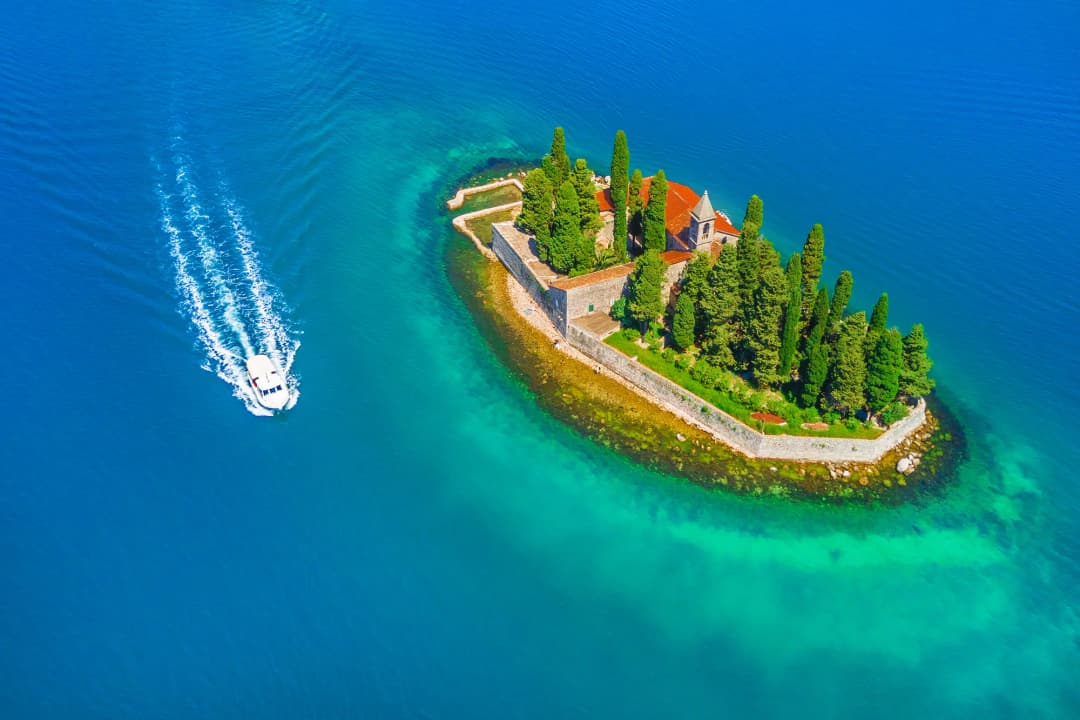
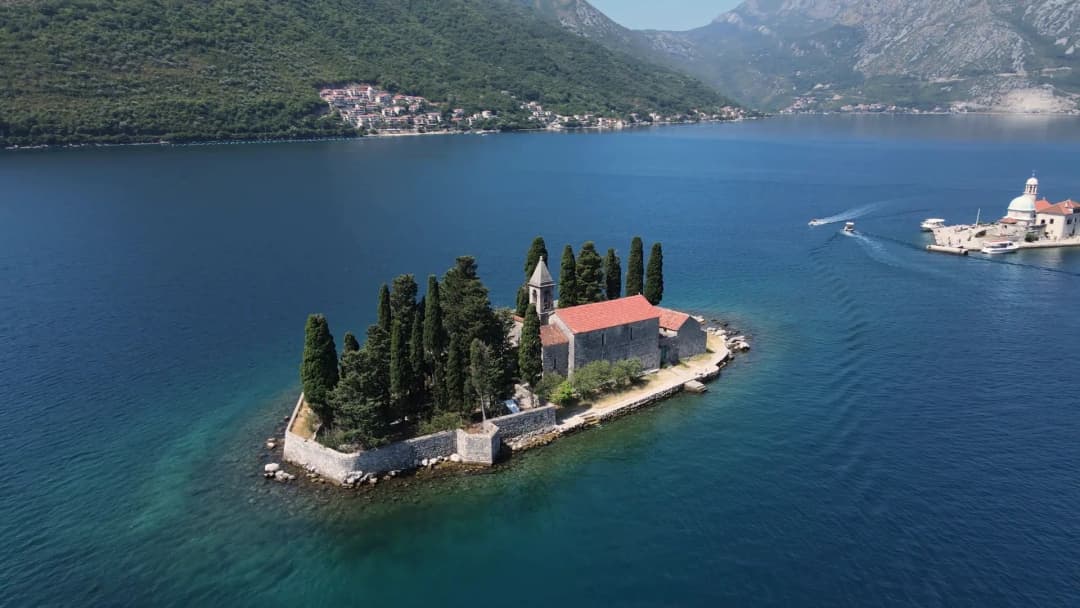
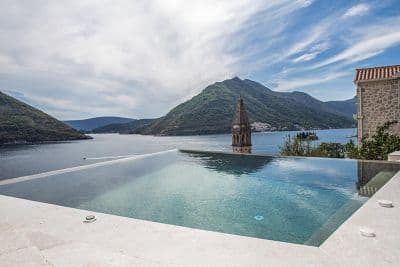
The second island off Perast's shore is a striking contrast to its man-made neighbour. St George Island — Sveti Djordje — is a natural formation, thickly covered with dark cypresses that give it a brooding, almost Gothic atmosphere. The island carries the Benedictine monastery of St George, founded in the 12th century — the Italian account dates the abbey to 1166 — and it also contains the old graveyard for nobility from Perast and the entire Bay of Kotor, in use until 1866. For centuries Perast's ship captains and its wealthy families were buried there, each tombstone carrying its own emblem. The island is often linked to Böcklin's Isle of the Dead, and often called that in guidebooks — but the painting's usual candidates are Pontikonisi off Corfu, Strombolicchio and Ponza, and the Perast attribution is an association rather than a fact.
Its medieval church did not survive the 1667 earthquake; it was brought down and a plainer one built in its place. Local accounts add a raid by the corsair Karadoz in 1751, which appears in no reference work — the raids the record does carry are the Ottoman plunderings of 1624 and 1654. In mid-October 1813, during the Siege of Cattaro, the French held the island and fired from it on the approaching squadron; a British and Sicilian force bombarded it at six in the morning and took it with the ships' boats the following day.
The island is closed to visitors. It is repeatedly described as leased to the Diocese of Subotica for some fifty years, a claim that appears in no church or heritage source, so take the lease as hearsay and the closure as the operative fact: the monastery grounds are private, the island shuttle does not land there, and nothing on the quay can grant you permission. Treat it as a religious and funerary landscape to be seen from the shore or from the water. Boat trips to Our Lady of the Rocks pass close enough for excellent photographs, and the island is at its most beautiful from a slight distance, its reflection shimmering in the bay.
Walking Perast: waterfront, palaces and churches
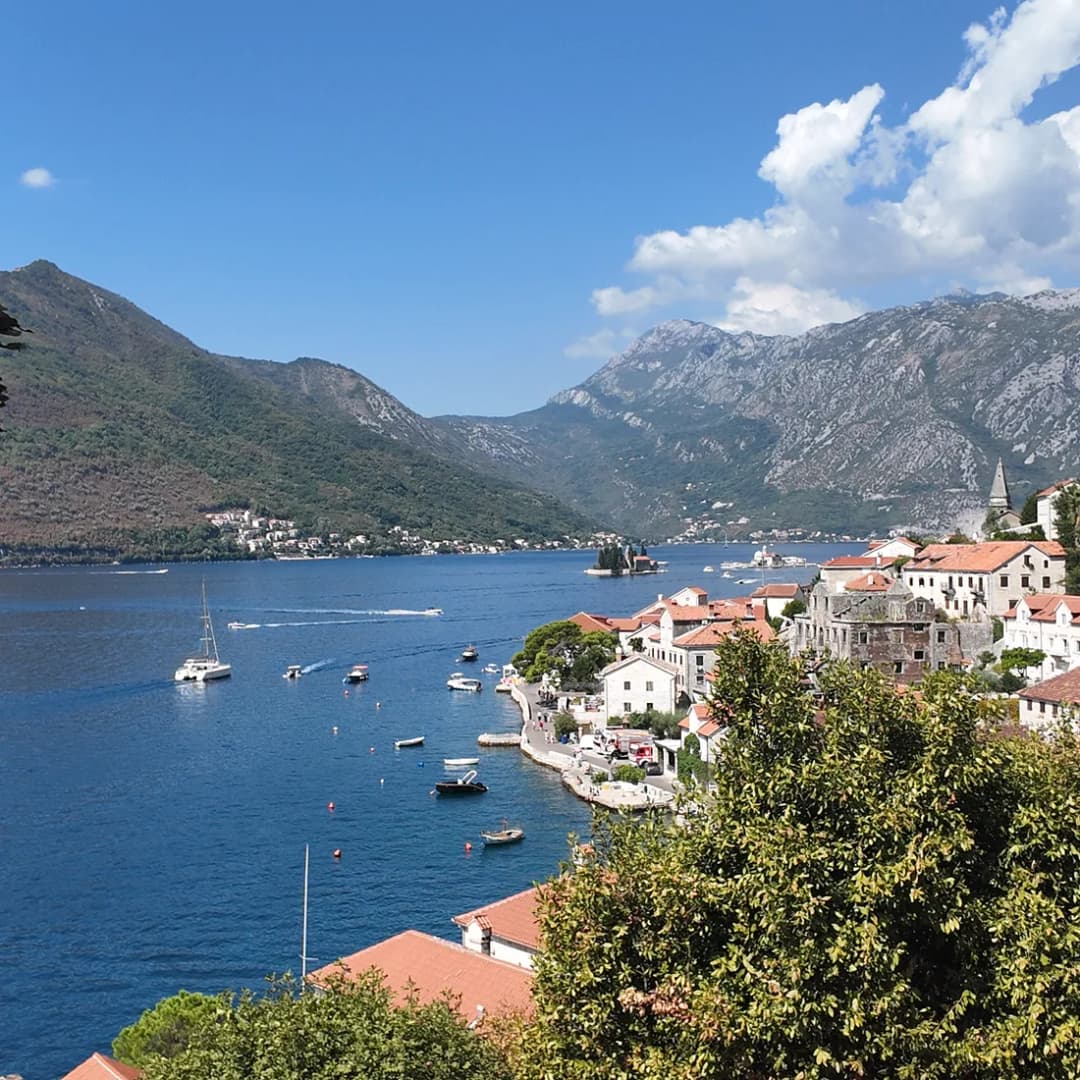
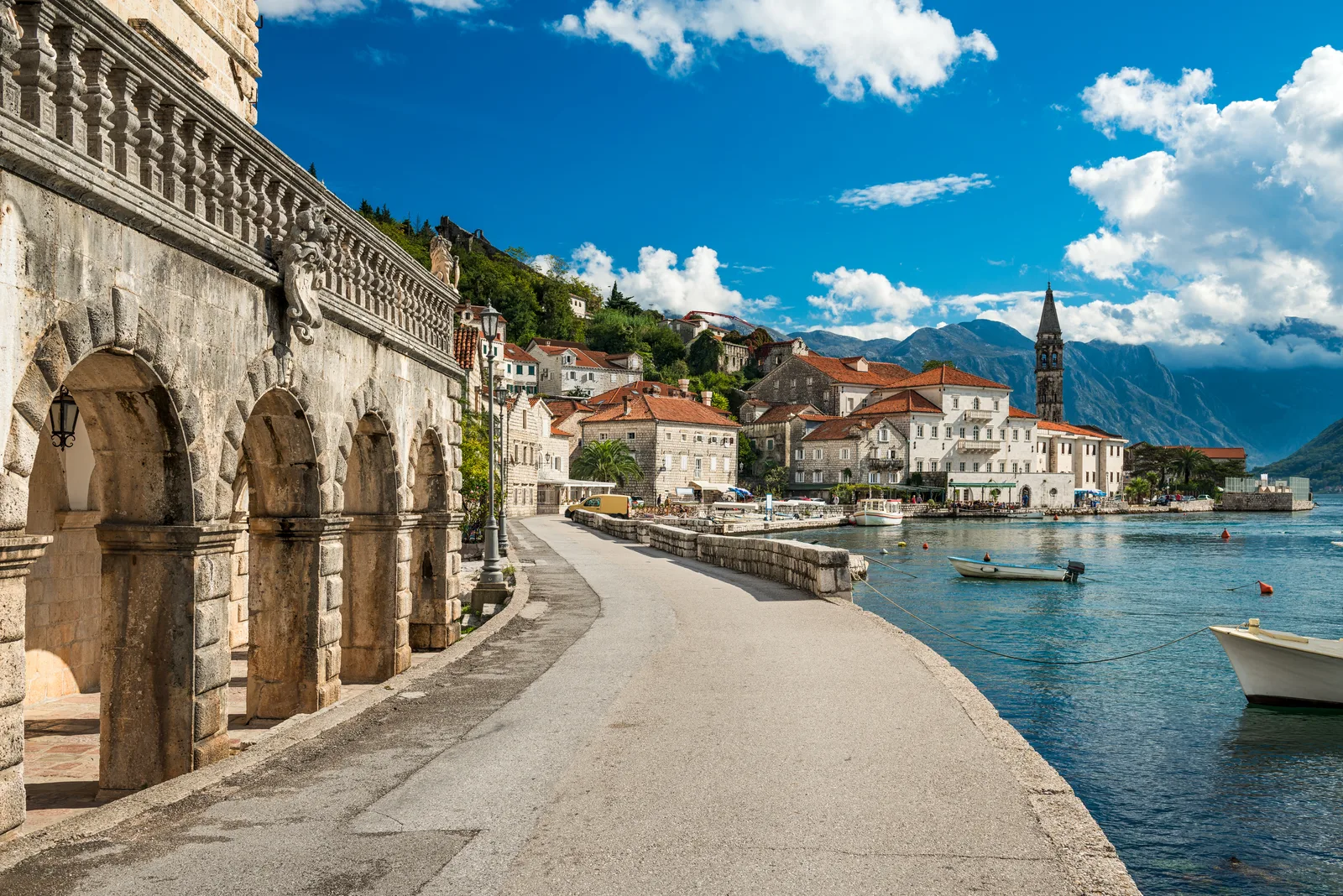
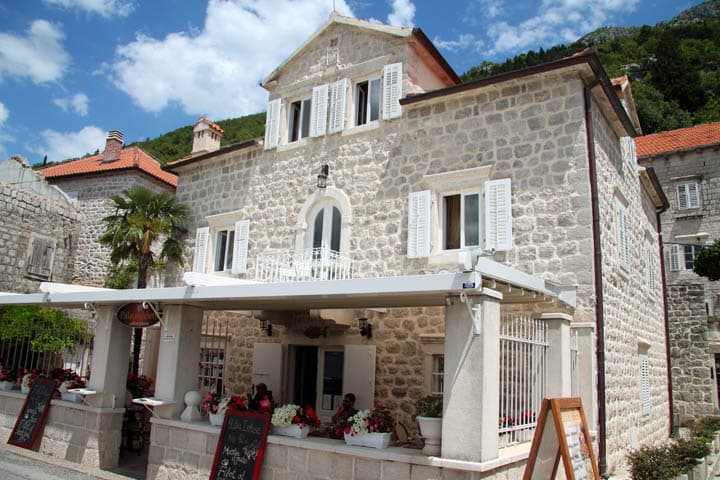
Perast is essentially a single waterfront promenade, perhaps a kilometre long, with a handful of narrow alleys climbing the hillside behind it. The town centre is car-free, and at Perast's scale, your feet are all you need. The promenade runs along the water, passing palace after palace, each one a reminder of a different captain's fortune made at sea. Many have been restored as hotels or restaurants, their ground-floor arches now sheltering café tables.
UNESCO does not value Perast as a row of isolated postcard façades. Its statement of Outstanding Universal Value describes Kotor and Perast as authentically preserved small cities whose planning and architecture are integrated with the bay landscape. The protected whole includes settlements, shoreline, paths, roads, cultivated slopes and the steep rocky frame. That is why the most revealing walk looks both inland and across the water: start by reading street levels and stairways, then compare palace façades, defensive openings, church towers and small waterfront structures.
Baroque palaces
The standing count is 16 palaces, 19 on a wider reckoning, most of them Baroque and most belonging to the twelve kazade, the town's family brotherhoods; and 17 Catholic churches in the Perast parish, the two island churches included, plus an Orthodox church and a cemetery chapel. That sits against the 20 palaces and 19 churches the history section says were built in the 18th century alone, because built and surviving are different numbers. They line Perast's one-kilometre shore, built by shipping families in the 17th and 18th centuries, and almost all of them stand on the single road by the water — courtyards, high ceilings and Venetian detailing, one after another.
The most prominent building is Bujović Palace, the imposing 1694 Baroque structure that now houses the Perast Museum. A named palace on a map is not necessarily a museum, and Visković Palace is the case in point. In March 2026 the municipality finished €84,597 of work on it — new doors, windows and shutters to close the façade openings, and restored railings and handrails — for no purpose grander than keeping the weather out and stopping the decay. That is evidence of preservation, not an invitation to go in.
St Nicholas church and bell tower
The Church of Saint Nicholas dominates the central square, and this is where Captain Viscovich buried the Venetian flag. It is two churches in one. The standing parish church took its present form in 1616, in Korčula stone, with a Renaissance façade. A far larger replacement was begun alongside it and abandoned: only its great apse was ever raised, and the builders joined the unfinished stump to the old church rather than pull either down. The reason usually given is not war but orientation — the old church faces east to west, towards the sea, where the new one would have run north to south.
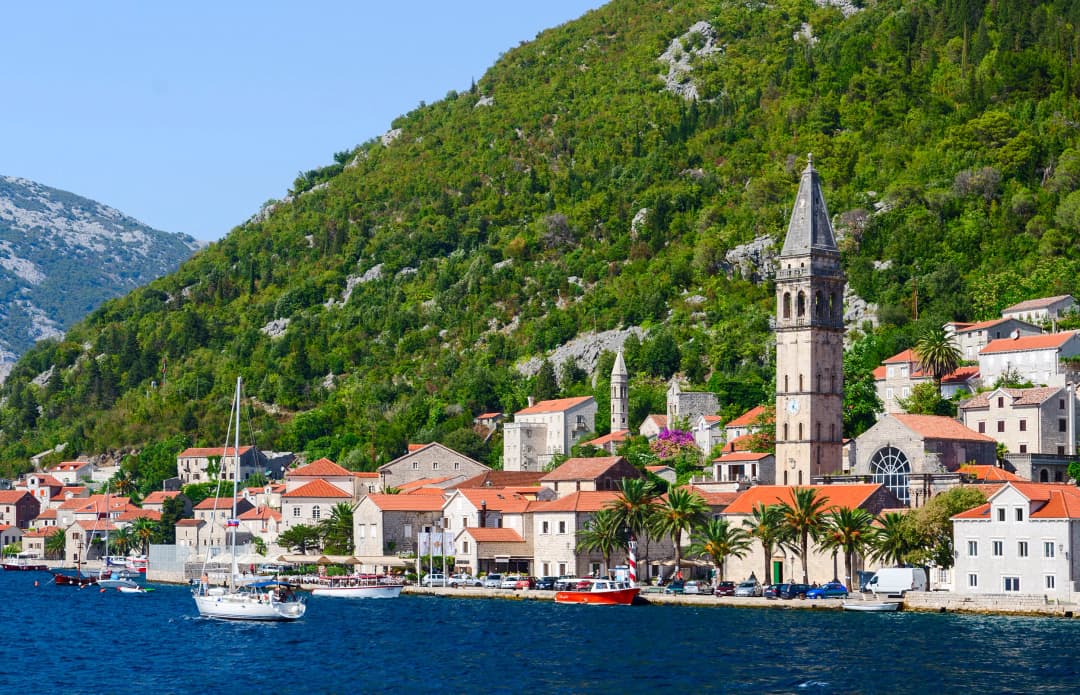
The Bell Tower: the campanile of 1691, also of Korčula stone, is the Baroque piece here. It was designed by the Venetian architect Giuseppe Beati and built by Ivan Krstitelj Škarpa of Stari Grad on Hvar, and it stands 55 metres to the tip of its pyramid — the next of the bay's great campaniles, St Eustace at Dobrota, is 35.5 metres. Of its three bells the great one was a gift of Archbishop Andrija Zmajević in 1713, the middle one dates from 1797, and the small one was cast in Split in 1926.
Climbing the tower: a narrow winding stair, with places where you duck and places where you wait for someone coming down. Entry is reported at €1 per person, cash only, by Montenegro Pulse, by Along Dusty Roads and by Adventurous Kate in May 2026; Adriatic Ways says €2. There is no published tariff, and Along Dusty Roads puts the usual opening at around 10am. The climb buys the finest 360-degree view in the bay, when it is open — religious services, maintenance and local events all close it, and the church interior with it. Dress appropriately, silence phones and ask before photographing an interior, a worshipper or a private ceremony.
The Church of Our Lady of the Rosary, smaller and easier to overlook, stands just behind the shore road beside the Zmajević palace — it was the Zmajević family mausoleum, and Kokolja painted it too — and is worth ducking inside if the doors are open.
The lanes behind the waterfront
Behind the waterfront, narrow stone lanes climb steeply uphill between old walls draped with bougainvillea. Some lead to partially ruined palaces, others to tiny gardens. The pleasure is in the wandering itself, the crumbling stone, the unexpected views back down to the bay. Keep doorways, church thresholds and private terraces clear as you go.
UNESCO's 2025 decision asked Montenegro for context-specific conservation and restoration guidelines for historic buildings in Perast, for sustainable tourism management written for a World Heritage property, and — its sharpest line — for a halt to any further approvals of new construction inside the property and its buffer zone until the planning rules are harmonised. It also wants cumulative impact assessments rather than one project judged at a time. Visitors participate at a small scale: do not sit on carved stone, climb walls, fly drones around homes and churches or enter construction areas for a photograph.
Perast access ladder: a name on a map is not an invitation
Access level
Applies to
PUBLIC ROUTE
waterfront and evident lanes
MANAGED ENTRY
museum and open church
EXPLICIT PERMISSION
private, works, landing
Rule
No permission or managed route? Omit the stop.
Source: whc.unesco.org, kotor.me
Photography
Perast is one of the most photogenic small towns in Montenegro, offering countless photo opportunities — but timing makes the difference between a good shot and an exceptional one.
Height is what separates the islands in a frame; from the waterfront they overlap into a single shape.
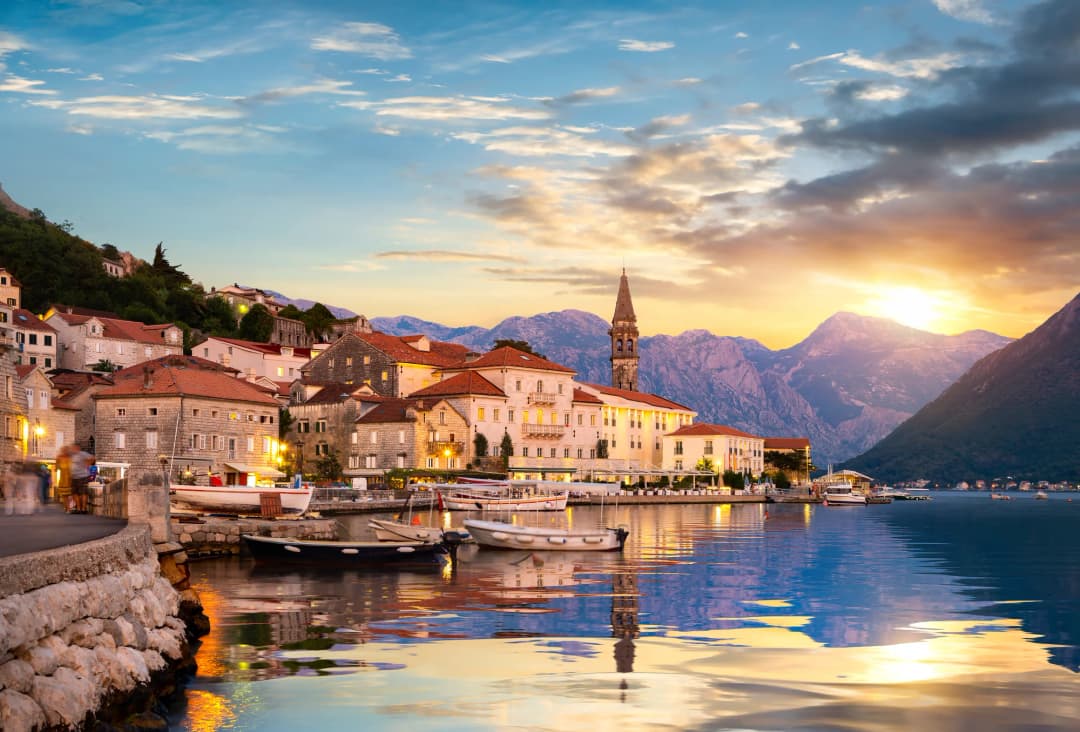
Morning light is ideal for Our Lady of the Rocks — the sun casts soft, warm light across the bay and illuminates the church façade. By midday the light is harsh; by late afternoon the island falls into shadow. Sunset is when the waterfront shines, the low sun turning the stone palaces honey-coloured and the bay deepening to indigo. For sunset photography, visit Perast and Our Lady of the Rocks on a sunset tour—the views as the sun descends behind the mountain are spectacular.
For the classic elevated panorama, drive or walk along the main road above town. Several pull-off spots let you shoot down towards the waterfront with both islands beyond, and height is what separates them: from the promenade the two overlap into a single shape. The boat ride to Our Lady of the Rocks is the other good position, for the view back at the bell tower standing over the palace roofs with the mountain behind.
The single best tip: arrive before 9am in summer. You will have the waterfront nearly to yourself, the light will be soft, and the bay calm enough to produce perfect reflections. Early morning or late afternoon are the best times of day for lighting generally.
Culture and Events
Fašinada (22 July)
The Fašinada is held on 22 July, at sunset, and it is the least generic thing that happens in this town all year. Perast counts it back to 1452 and says it has never been missed — not for war, not for the 1667 or 1979 earthquakes, not for the pandemic. In 2013 it was entered on Montenegro's register of intangible cultural heritage.
What it commemorates: the tradition of 22 July 1452, when the Martešić brothers are said to have found an icon of the Virgin on a crag and begun the making of the island. The annual ceremony involves the local community gathering to deposit stones around the island of Our Lady of the Rocks, thereby helping to preserve the island’s structure.
The Ceremony: The Fašinada ceremony commences with locals forming a convoy of boats at sunset, filled with stones and adorned with greenery. Led by a boat carrying the pastor and notable citizens of Perast, this flotilla sails towards Our Lady of the Rocks, culminating in the stones’ deposition to reinforce the island. The name is Italian, and the derivation with a dictionary behind it is fascina, a bundle of bound brushwood, and fascinata, the bank-reinforcing work built out of such bundles — which is exactly what the convoy is doing to the reef. A popular alternative traces it to fascia, a tie or band, for the line of boats roped one behind another.
This tradition sees participation exclusively from men who perform this task to the accompaniment of traditional folk songs.
Shooting the Rooster (15 May)
15 May is the feast of Gospa Peraška, Our Lady of Perast, and the day the town shoots at a rooster that stands for the enemy. The feast is kept in honour of the victory of 1654, when Perast held off a far larger Ottoman force. It turns into a big festival and celebration, including a Kolo Chain Dance performance by the Boka Navy and lots of wine in the local taverns.
Klapa nights and the Boka Navy
Usually in mid-to-late September, the International Klapa Festival takes place in Perast, hosting local and regional a cappella groups singing the unaccompanied harmony that grew up in Adriatic taverns. It is the one festival here that asks nothing of a visitor except to stand still and listen.
The Boka Navy is the confraternity behind most of the rest of the calendar: UNESCO's own element file describes it as a traditional non-governmental maritime organisation founded at Kotor in 809, its origin linked to the arrival of the relics of St Tryphon, the city's patron. Membership is open to men, women and children of all ages. UNESCO inscribed the cultural heritage of the Boka Navy Kotor on its Representative List of the Intangible Cultural Heritage of Humanity in 2021 — Montenegro’s only entry on that list. Perast keeps every Fešta it can, and the lanes fill with music when it does.
On the water: tours, kayaks and swimming
Perast has no beach in the sense the rest of the coast means it. What it has is water — enclosed, flat and deep straight off the stones — and three ways of getting into it.
Longer boat tours. Beyond the island shuttle, several boat tours depart from the town, offering trips to Our Lady of the Rocks, St George Island, and further into the Bay of Kotor, with many tours including stops for swimming and sightseeing. Longer tours take in the Blue Cave with swimming opportunities and a visit to a submarine tunnel.
Kayaking and paddleboarding. You can rent a kayak or SUP, with several locations around the waterfront offering hourly rentals for €10/hour. The bay is usually still and always sheltered, and the view back at Perast from a hundred metres out — bell tower, palace roofs, mountain behind — is the one most photographs are trying for.
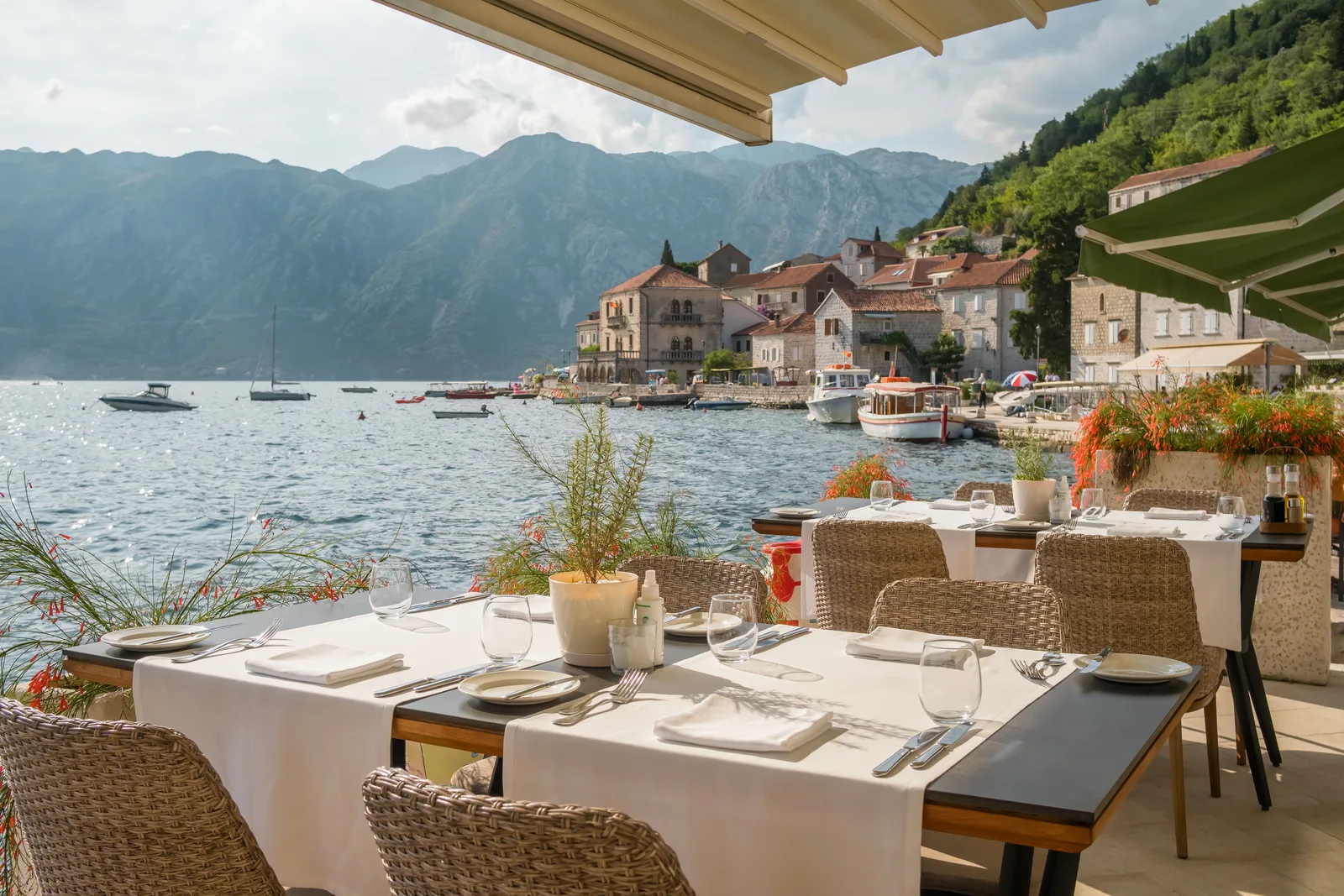
Swimming. There is no sand. What there is instead is several stone piers and marked swimming spots along the waterfront, with deep clear water straight off the edge. Pirate Beach Bar at the north end of town is Perast’s main beach, with drinks and music throughout summer.
Where to eat in Perast
Most restaurants feature a menu of seafood, pasta, and pizza, showcasing Italy’s influence on Perast. Reservations for more popular restaurants are recommended for sunset, especially on weekends during high season.
Trattoria Rosmarino: above the waterfront, looking down the bay; fish, seafood, seasonal vegetables, and Perast cake for pudding.
Conte Hotel Restaurant: Located in the heart of UNESCO-protected Perast, offering a combination of tradition and gastronomic experience with fresh local ingredients like Albanian red shrimps, Mali Ston oysters, and Kvarner shrimps.
Fish Restaurant Djardin: close to St Nicholas, and the tables look straight out at both islets.
Riva Restaurant (Heritage Grand Perast): on the water, Mediterranean and Montenegrin, and the one most likely to need booking at sunset.
Where to stay in Perast
Perast has nine published listings on this site — four apartments and five hotels, which in a town of 237 residents is close to the whole commercial stock. Six are below. Every line is drawn from the owner’s own description of the place; no nightly rate is quoted here, because the rate lives on the property page where it is kept current.
Almost every bed in Perast is in a converted palace or a stone house on the shore, so the real choice is between a room with a bay window and a room without one. One thing is worth knowing before you book: Casa del Mare – Mediterraneo, frequently listed as a Perast hotel, is not one. It stands at Kamenari in the Herceg Novi municipality, half an hour round the bay.
If you stay overnight, accommodation staff can help verify the day’s access and transport, but they do not replace official visitor registration rules. The tourist tax and registration guide explains what visitors and hosts need to check.
Getting to Perast
From Kotor
Perast is a short hop from Kotor. Routed with OSRM on OpenStreetMap data on 11 September 2026 it is 13.8 km and 22 minutes along the bay road; published accounts give 12 km and 15 to 20 minutes outside season, and 14 km and 20 to 30 minutes. Allow up to 45 minutes in July and August traffic, and note that the bus operator’s own kilometre column puts the Kotor bus station 14.5 km away. A boat is the alternative.
The public bus is the cheapest way in, and for once there is a real document behind it. Kotor municipality’s public-transport page hosts the operator’s stamped timetable and price list for route K1, Novo Naselje Škaljari – Kostanjica, which runs the northern shore and stops at Perast. Everyone calls it the blue line; Blue Line is the company, and the route is labelled the red line on its own timetable. Perast is stop 11, 15.6 km from the Škaljari terminus and 14.5 km from the Kotor bus station.
The published fare from the Kotor bus station or the Riva to Perast is €1.50, and Perast to Risan is €1; a monthly pass for unlimited journeys is €45. Departures leave the Novo Naselje Škaljari terminus at a quarter past every hour from 05:15 to 22:15, the 06:00 being the single exception, and reach the Kotor bus station 1.1 km later; a 23:15 is added between 1 June and 31 August. On Sundays and public holidays the pattern changes rather than thinning: departures from the Kotor end run at odd hours only, and the returns from Kostanjica and Risan at even hours. Allow 25 to 35 minutes for the ride depending on traffic. The stop is on the main road above town; walk downhill to the waterfront.
The route file on that page is dated 8 July 2024 and both documents are scans, so they are not searchable — open the PDF rather than copying a blog timetable, confirm your departure serves the Perast stop, identify which side of the main road handles each direction, and save the return options offline. Traffic can erase a tight connection.
From Tivat Airport and Dubrovnik
From Tivat Airport the road round the bay through Kotor is the quick way: OSRM routes it at 20.4 km and 31 minutes on a clear day, so allow 45 in July. The Kamenari–Lepetane car ferry across the Verige narrows is the scenic way and not the fast one, because it lands you on the wrong side of the strait — 12.1 km of driving to reach Lepetane, then 15.0 km back east along the northern shore from Kamenari to Perast, which OSRM puts at 37 minutes of driving before the crossing and any queue. From Dubrovnik airport, allow about two hours including the border crossing. Perast is also accessible via organised day trips from Dubrovnik, Croatia, typically combining visits to multiple Bay of Kotor destinations.
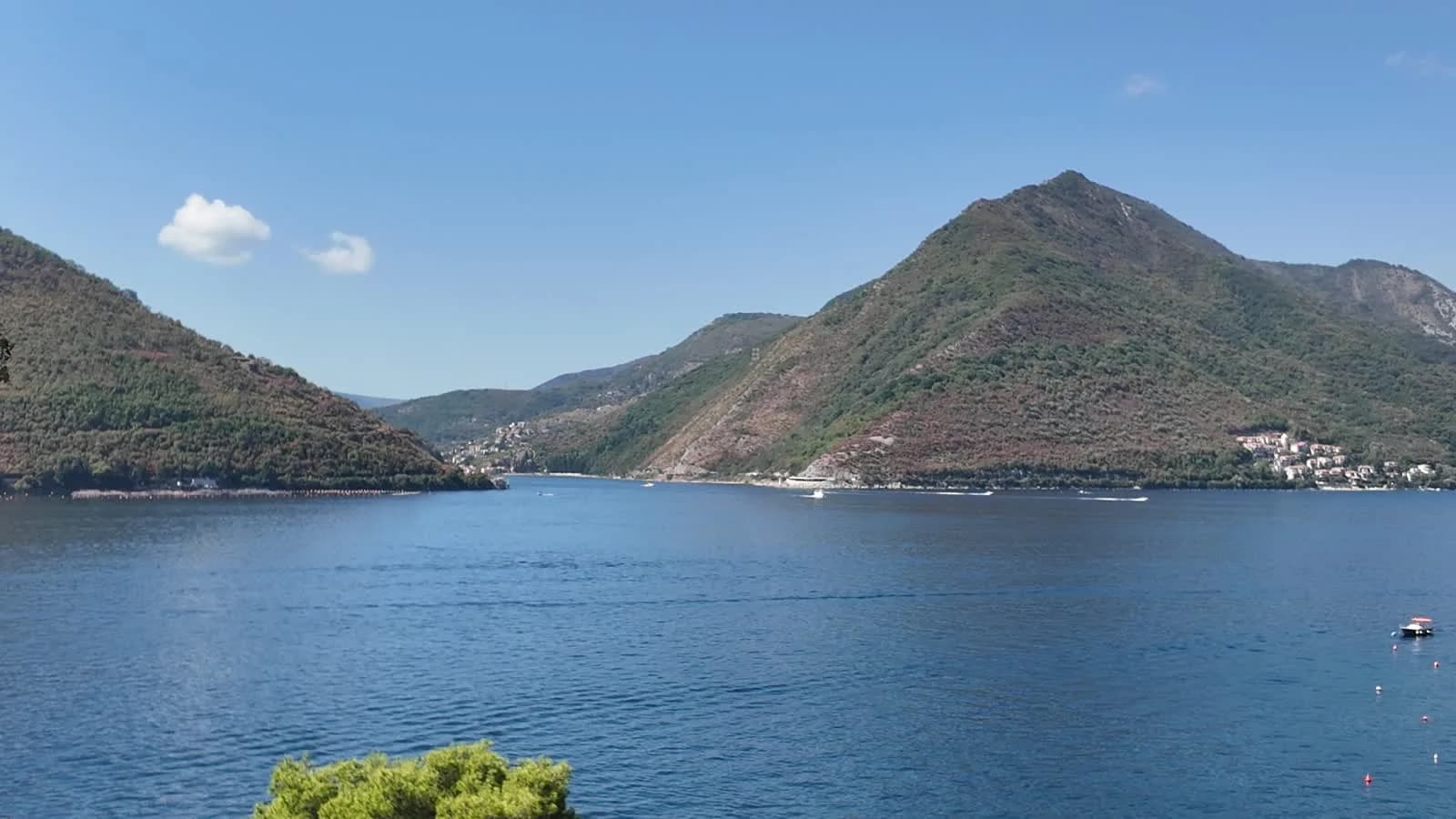
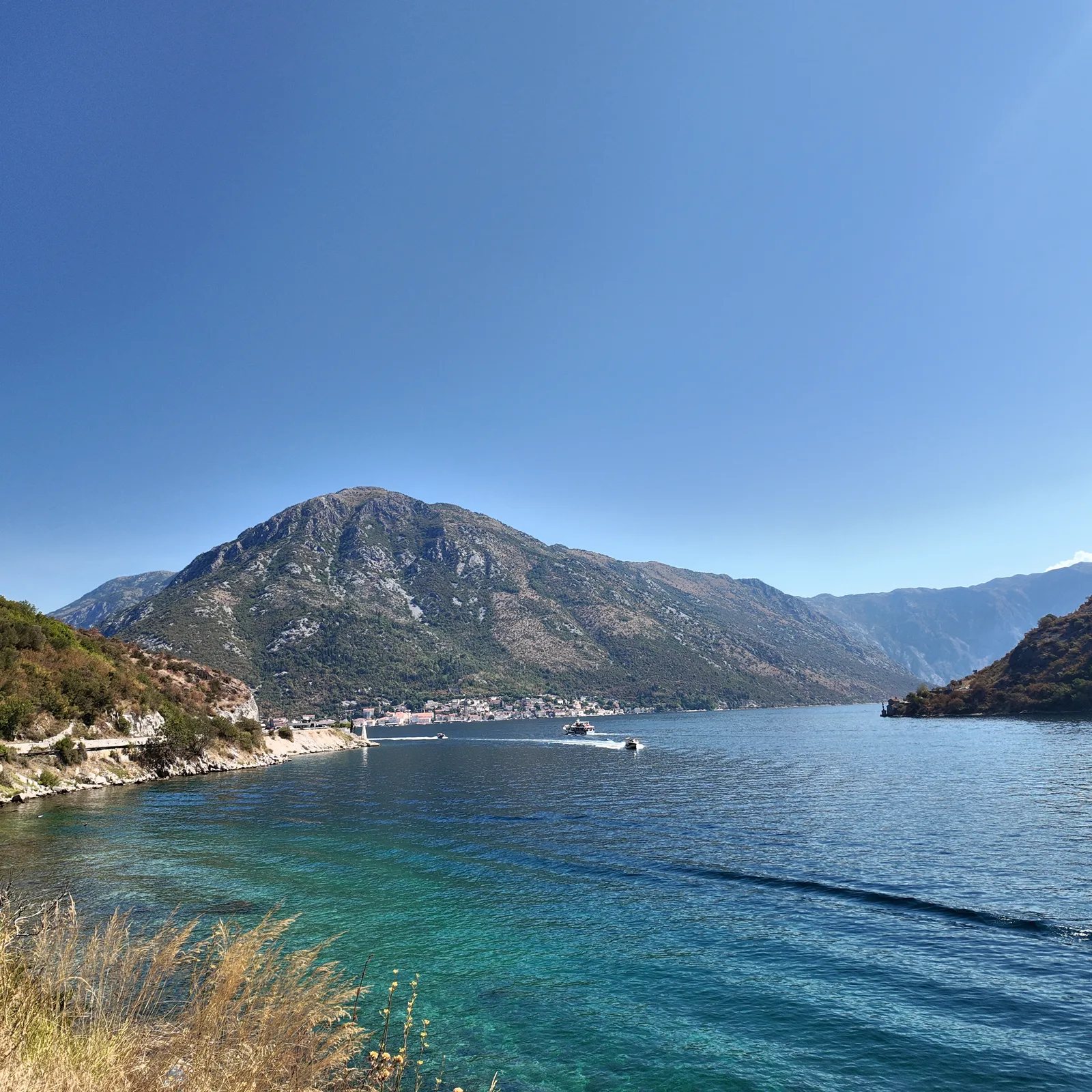
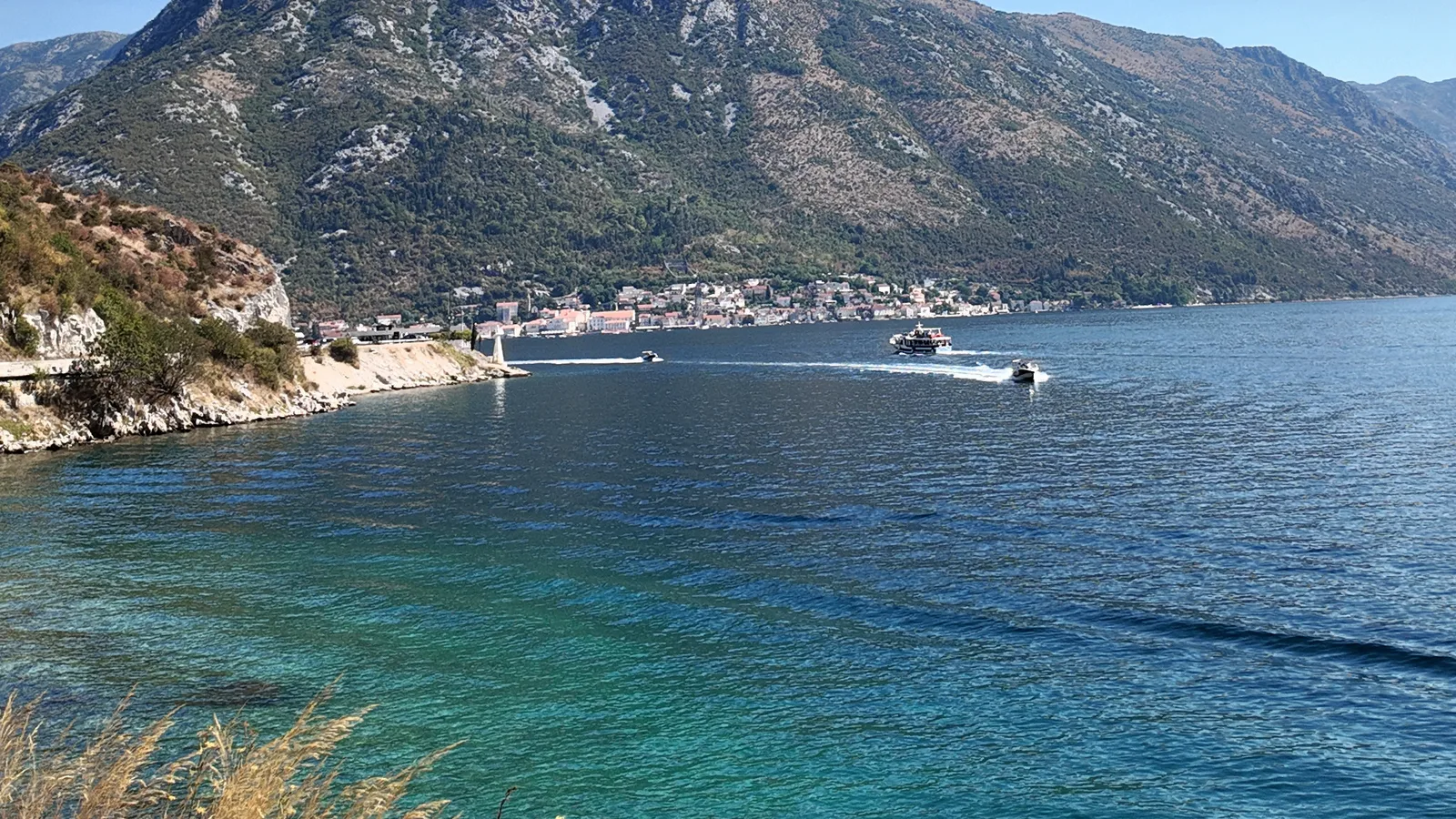
The Verige strait from the shore road at the narrows: boats thread the channel, and Perast is the pale line of buildings across the water at the foot of the mountainside.A closer look from the same spot: the bell tower of St Nicholas rises over the waterfront, a tour boat heads across the strait, and the white light on the near point marks the narrows.
Original photography by the montenegro.com team, August 2026.
Driving, the car-free centre and parking
Perast's waterfront is closed to traffic for the season rather than for ever, and the rule is written down. Article 11 of the Municipality of Kotor's traffic decision bans vehicles from the coastal road through Perast from 15 May to 30 September, between 08:00 and 01:00, exempting electric and unpowered vehicles, people with residence in Perast, disabled drivers, suppliers to the shops and restaurants, fire engines, ambulances and anyone holding a permit from the municipality. Article 12 keeps coaches off the lower road through the town at any time of year, with school buses and scheduled service buses excepted — which is why one bus still comes through. The whole coastal road in Perast is also a 30 km/h zone. In practice you park at one end and walk in with your luggage.
That decision is not new and local arrangements change, so the barrier, the signs and the staff in front of you are what count. Do not argue from an undated map. Parking is the single biggest practical challenge here, and it is extremely limited.
Use marked parking only, and be sceptical of anything that is not. In July 2025 Kotor's inspectorate removed illegal car parks in Perast outright — pitches set up with no registration and no documentation — and earlier the same month the municipality had put metal and plastic bollards along pavements and surfaces in Perast, Risan and Dobrota that had been used for improper parking. Someone waving you into a space here is not necessarily entitled to charge you for it. Never stop in the main carriageway for luggage or a photograph, and do not block a bus stop, doorway or turning area.
The two car parks, and who runs them:
Parking 1, the south lot: arriving from Kotor it is on your left, and it is the larger of the two. There are no hourly rates for a short stay.
Parking 2, the north lot: at the Risan end, same rates and conditions, and a little closer to the museum, the square, St Nicholas and the quay the island boats leave from. Easier to get out of towards Risan.
Neither is a municipal car park. Both stand on state coastal land administered by JP Morsko dobro and are let by public tender to private operators — the agency's own director described the winning bidder as taking on "the two parking areas at both ends of Perast" and said clear rules there had been a basic complaint from visitors for years. That is why there is no tariff to look up: the charge is the same at both and nobody official publishes it. Along Dusty Roads and Adriatic Ways independently give €8 for a day ticket — generally read as eight hours rather than a calendar day — and €15 for 24 hours, cash only, with no pre-booking. Along Dusty Roads adds €12 and €30 for a van, and both say the barriers are open and parking free from about November to April. Some boat operators include parking with a ticket. Treat all of those as observations with a date on them, not as prices you can hold anyone to.
Both lots fill quickly in summer. Overflow street parking exists along the main road above, but it means a longer walk down and a longer walk back up. Arriving before 9am is the only reliable strategy in peak season.
Hotel parking: ask before you arrive. Hotel Per Astra has its own car park for fifteen cars; Hotel Conte tells guests to ask reception about parking nearby. Neither is a given, and neither is signposted from the road.
Alternative Parking: If you find car parking in Perast too expensive, you might consider leaving your car in neighbouring Risan, which is 3.7 km up the shore on the bus operator's own kilometre column. There are several unpaid parking spaces in the centre of town and along the coastal road. From Risan, you can take a bus or taxi, or simply walk.
A water taxi from Kotor eliminates the parking problem entirely and is arguably the most enjoyable way to arrive — approaching Perast from the water, as its original inhabitants did, with the full panorama revealing itself as you draw near.
Perast transport decision flow: plan the exit before arrival
Mode
Step 1
Step 2
Step 3
BUS
newest municipal file
stop and direction
return saved offline
CAR
current barrier/signs
marked legal space
no roadside improvising
BOTH
KEEP A RETURN BUFFER
Source: kotor.me
Getting Around and How Long to Stay
The town of Perast is small. Measured across its building footprints it runs about 940 metres end to end — a walk of a quarter of an hour at a stroll — and the waterfront promenade is effectively the whole town.
About 4 to 5 hours should be plenty for a leisurely visit, including the boat trip to Our Lady of the Rocks island.
Money: You will need cash in small denominations. Restaurants usually take cards, but the shuttle boat to Our Lady of the Rocks, the collection on the island and the bell tower are cash in practice, and none of them publishes a price to check against.
What Perast costs in 2026
Two things in Perast have a published price. The museum tariff is on the Muzeji Kotor site, and the bus fare is on a stamped price list the Municipality of Kotor hosts for the operator. Everything else in this town is unpublished — there is no tariff anywhere for the boat to the island, for the island church, for the bell tower or for the two car parks. On the car parks the absence is not merely a failure to find one: Article 35 of the municipality's own traffic decision is the article that designates where vehicles may park, it names Škaljari, Novo Naselje, Njegoševa, Maceo, Tabačina, the Dobrota shore road and the Riva at Risan, and Perast is not in the list; the lots are leased coastal land and their operators publish nothing. Those rows carry what independent guides reported and say who reported it; where nothing at all is published the cell is a dash. Figures read on 11 September 2026.
Perast prices, September 2026
What
2026
Who publishes it
Perast Museum, adult
€8
Muzeji Kotor
Perast Museum, child under 12, or a group of ten or more
€5
Muzeji Kotor
Perast Museum, student with an index book, journalist with a press card, Montenegrin secondary-school pupil or pensioner
€4
Muzeji Kotor
Perast Museum, anyone from the municipality of Kotor, primary-school pupil at a Montenegrin school, visitor with a disability, accredited guide, ICOM card
free
Muzeji Kotor
Perast Museum, professional guiding service
€15
Muzeji Kotor
Perast Museum with the Roman Mosaics at Risan
€12
Muzeji Kotor
All five Muzeji Kotor sites
€15
Muzeji Kotor
Shared boat to Our Lady of the Rocks, return
€5
nobody — reported by three independent guides
Private water taxi to the island, return
about €10
nobody — Adventurous Kate, May 2026
Church and museum on the island
—
nobody — reported at €1, €2–3 and €3
St Nicholas bell tower climb, cash only
€1
nobody — €1 in three guides, €2 in a fourth
Parking 1 or Parking 2, day ticket (about eight hours)
€8
nobody — two guides agree
Parking, 24 hours
€15
nobody — two guides agree
Parking, van
€12 day, €30 for 24 hours
nobody — Along Dusty Roads
Parking, roughly November to April
free
nobody — two guides agree
Bus K1, Kotor bus station or the Riva to Perast
€1.50
Blue Line price list, Municipality of Kotor
Bus K1, Perast to Risan
€1
Blue Line price list
Bus K1, monthly pass, unlimited journeys
€45
Blue Line price list
Bay of Kotor cruise booked out of Kotor
from €20
nobody — aggregator listings, 2026
Kayak or paddleboard hire
€10 an hour
nobody — rental stands on the waterfront
Watching the Fašinada from the waterfront, 22 July
free
—
A museum-and-waterfront day therefore costs €8 plus €1.50 on the bus each way. Adding the island and the tower costs €5 for the boat and €1 for the climb, plus whatever the church on the island asks at the door. The expensive decision here is the car: €8 to park is what two adults pay to reach Perast by bus both ways and climb the bell tower.
Best time to visit Perast
Late spring and early autumn — roughly May, June and September — are the sweet spot: warm, swimmable and noticeably less crowded than the July–August peak, when the bay is hottest and cruise-ship day-trippers are most numerous. Summer (June-September) provides the best weather for swimming and outdoor activities, though it’s also the busiest time. April and October are cooler and quieter but still pleasant for sightseeing. Deep winter closes things rather than discounting them: the museum shuts for the whole of January, and the car-park barriers stand open, with parking free, from roughly November to April.
Whenever you come, visiting earlier or later in the day helps you experience Perast and the islands at their calmest, away from the midday tour crowds, and gives the best lighting for photography. For broader trip timing and crowd trade-offs, see why to visit Montenegro now.
A half-day and full-day plan
Half-day: verify the museum opening, begin at Bujović Palace, then walk the lower public route slowly. Use the square and shore to compare town, islands and mountain frame. If a licensed boat departure and return fit comfortably, add Our Lady of the Rocks; otherwise keep the island as a view and retain a calm day.
Full day: use the same core at a slower pace, add the island only after confirming safe access, and include unstructured time along the waterfront. The Bay of Kotor guide helps place Perast within the inner bay, while Kotor versus Dubrovnik helps travellers making a wider Adriatic choice.
Do not use the extra hours to search for Spila cave or climb towards Holy Cross fort from an old description. No current source gives a signed, maintained public route or a safe way in to either. If hiking is central to the trip, choose a documented route from the Montenegro hiking guide and verify conditions locally.
Practical accessibility and comfort checks
Perast’s lower route appears simple but contains uneven stone, thresholds, stairs, narrow passages and exposed sun. Before a mobility-dependent visit, ask the museum about entrance steps, lift availability, floor access, seating and toilets. Ask a boat operator about boarding height at both ends, handrails, vessel stability and whether mobility equipment can be carried safely. “Short crossing” is not an accessibility specification.
Bring water and sun protection, avoid peak heat, and keep footwear secure enough for wet boarding surfaces. Families should keep children beside them at the quay rather than at the edge. In poor weather, a museum-and-waterfront day is the successful fallback—not a failed island trip.
Day trips from Perast
Perast sits at the midpoint of the inner bay, which makes it a better base than its size suggests: nothing in Boka is more than an hour away, and the two ends of the bay are opposites. Many visitors do it the other way round, basing themselves in Kotor and treating Perast as a half-day escape.
Every time and distance below was routed with OSRM on OpenStreetMap data on 11 September 2026, from the Perast waterfront. OSRM is conservative on Montenegrin roads, so these are slower than locals quote — and in July and August the bay road adds to them rather than subtracting.
Risan (8 minutes, 4 km) — the oldest settlement in the bay, and the reason to go is a Roman town villa whose floor mosaics date from the 2nd century AD and cover 790 m². The finest panel holds Hypnos, the god of sleep, a half-naked youth reclining with his legs crossed and folded wings behind his shoulders; Muzeji Kotor notes he is the only human figure in the whole complex, every other room being geometry and foliage. It is a Muzeji Kotor site: €6 alone, or €12 on the combined ticket with Perast Museum.
Dobrota (15 minutes, 10 km) — captains’ houses strung for kilometres along the shore towards Kotor, with two churches full of the same maritime money that built Perast, and almost nobody looking at them.
Kotor (22 minutes, 14 km) — the walled town, the fortress stair up the mountainside and the bay’s only real crowd. Completely different energy from Perast; the two are the argument for staying in the bay rather than on the coast.
Tivat (36 minutes, 24 km) — Porto Montenegro’s superyacht marina and the airport, reached round the bay through Kotor rather than across the Verige narrows.
Herceg Novi (47 minutes, 30 km) — the mouth of the bay: stepped streets, the Forte Mare and the Kanli Kula above them, and open sea instead of still water.
Budva (51 minutes, 36 km) — over the hill to the open coast, a walled old town on its own peninsula and the sand the bay does not have.
Lovćen and the Njegoš mausoleum (60 minutes, 45 km) — up the Kotor serpentine and its twenty-five hairpins onto the mountain that gives the old Montenegro its name. Not a drive to start late.
Cetinje (89 minutes, 63 km) — the old royal capital on the far side of Lovćen, with its monastery, its museums and the embassies of a country that had fifty thousand people.
Three more are close enough to fold into any of the above without a separate trip: Morinj at the head of the bay, for its springs, old stone mills and waterfront restaurants; Stoliv across the water, where Upper Stoliv is one of Montenegro’s most atmospheric abandoned villages; and Prčanj between Perast and Kotor, with an enormous never-completed cathedral that is a monument to ambition outpacing resources.
Why Visit Perast
Perast is 237 residents, 17 parish churches and 16 palaces on one kilometre of shore, and what it offers is disproportion — a town that spent two centuries at the centre of Adriatic seafaring and then stopped, intact. The specifics:
A man-made island of 3,030 m², one of very few in the Adriatic — Our Lady of the Rocks, built on sunk ships and dropped stones since 1452
One of the best-preserved Baroque townscapes on the Adriatic coast, inscribed by UNESCO in 1979 and named in its criterion (iv)
A real part in European naval history: seven gonfaloniers dead around the Venetian standard at Lepanto in 1571, and the town that taught navigation to Peter the Great's boyars in 1697–98
A living custom, not a re-enactment — the Fašinada, rowed out every 22 July since 1452 by the town's own reckoning, and on Montenegro's intangible heritage register since 2013
A 55-metre bell tower of 1691, the great campanile of the bay, with the best 360-degree view in it for €1
A car-free centre 22 minutes from Kotor by road and €1.50 by bus, and quiet by six in the evening when the tour boats have gone
What none of that conveys is the scale. Perast is one street. You can stand at one end of it and see the other, and everything in the list above is inside that kilometre or half a kilometre offshore from it — which is why it rewards a slow half-day and punishes a coach stop.
Frequently asked questions
How much is Perast Museum?
€8 for an adult on the Muzeji Kotor tariff, read on 11 September 2026. Children under 12 and groups of ten or more pay €5; students with an index book and journalists with a press card pay €4, as do secondary-school pupils and pensioners from Montenegro; anyone from the municipality of Kotor, primary-school pupils at Montenegrin schools, visitors with a disability, accredited guides and ICOM cardholders go free. A visiting pensioner from abroad pays the full €8. A guided tour is €15. A €12 ticket adds the Roman Mosaics at Risan and a €15 ticket covers all five Muzeji Kotor sites, which is worth it only if you are actually going to Risan.
What days is Perast Museum closed?
Every Monday, the whole of January, Orthodox Easter, 1 May and 13–14 November. Otherwise it opens Tuesday to Sunday, 08:00 to 20:00 from 15 April to 15 October and 10:00 to 16:00 from 15 October to 15 April. Because the two published ranges share both boundary dates, 15 April and 15 October are worth confirming directly. Allow 30 to 45 minutes inside.
How many of the two islets can you land on?
One. Our Lady of the Rocks has the church and the museum and is reached by a shuttle boat from the waterfront, about €5 per person return and roughly five minutes each way. St George is closed: the monastery grounds are private and the island shuttle does not land there. It is often said to be leased to the Diocese of Subotica, a claim no church or heritage source carries, but the closure itself is not in doubt. Treat it as a view from the water unless the site authority and a licensed operator both confirm otherwise on the day.
How much is the boat to Our Lady of the Rocks?
€5 per person return is the figure three independent guides give — Wikivoyage, Adventurous Kate in May 2026 and Along Dusty Roads — and a private water taxi for one party is about €10. No operator, harbour office or municipality publishes a tariff, so that is the going rate rather than the price. Compare licensed operators on the quay, and confirm what is included, whether the island is accepting visitors, the return time and what happens if wind stops the landing, before you pay.
Can I drive along the Perast waterfront?
Not in season. Article 11 of the Municipality of Kotor's traffic decision bans motor vehicles from the coastal road through Perast from 15 May to 30 September between 08:00 and 01:00, exempting residents, disabled drivers, suppliers, emergency vehicles, electric and unpowered vehicles and permit holders; the whole road is a 30 km/h zone, and coaches are barred from it year-round. In 2025 the municipality installed bollards on surfaces that had been used for illegal parking. Use one of the two car parks at either end — around €8 for a day ticket — and walk. Current signs, barriers and staff instructions control, whatever an older document says.
Can I hike to the fort or Spila cave?
Not on this guide’s advice. The Holy Cross fortification above the town dates from 1570 and the cave is named in old descriptions, but no current source establishes a signed, maintained public route, a condition report or a safe entry for either. Perast is a walking town at sea level, not a trailhead. If hiking matters to the trip, take a documented route from the Montenegro hiking guide and check conditions locally first.
Is Perast itself a UNESCO World Heritage Site?
Not on its own. Perast is part of the Natural and Culturo-Historical Region of Kotor, inscribed in 1979 under criteria (i) to (iv), 14,600 hectares of property inside a 36,491-hectare buffer zone. UNESCO’s own justification names the town: criterion (iv) reads that “Kotor and Perast are highly characteristic and authentically preserved small cities enhanced by architecture of great quality”. The property sat on the List of World Heritage in Danger from 1979 until 2003, after the earthquake.
History
Ancient Origins
Perast's name is traditionally derived from the Pirusti, an Illyrian people, and the Hrvatska enciklopedija says plainly that the Illyrian Pirusti founded the town and gave it their name. The tribe itself sits inland in the written record. In 167 BC — the year Rome settled Illyria, two years after the Third Macedonian War ended at Pydna — Livy lists the Pirustae of the Dassaretii among five peoples declared free and exempt from tribute, quod incolumi Gentio ad Romanos defecissent: because they had gone over to Rome while King Gentius was still undefeated. It was payment for changing sides, not a standing honour, and the Boka names in that same sentence are Rhizon and Olcinium, Risan and Ulcinj, not Perast. The account that Queen Teuta planted a branch of the Pirusti a few kilometres east of Risan is given in the sources as legend, and her reign ended around 227 BC, sixty years before Livy's grant.
Medieval Period
The first documented mentions of Perast refer to 1336, when it was a small fishing village with a shipyard and several commercial and fishing boats in the harbour. The oldest kept document about the construction of sailing ships in Perast dates from this period, though shipbuilding in Boka likely began even earlier.
Venetian Glory (15th-18th Century)
Perast came under Venice with Kotor in 1420, and Perast Museum identifies 1420–1797 as the town's Venetian period of economic, social and cultural prominence. Its position sharpened once the Ottomans took the coast from Herceg Novi to Risan — Herceg Novi fell before 14 December 1481 — and Perast found itself on a frontier. It had free trade with the Republic of Venice and was granted forgiveness from Venetian authorities in the ruthless fight against pirates on the Adriatic. Controlling the strait where Perast was located was of paramount importance to both the Venetians and Ottomans, who vied for supremacy in the area for over four hundred years.
Because of this strategic importance, the city grew and was enriched: in the 18th century alone, 20 palaces were built in Baroque style, along with 17 Catholic and two Orthodox churches. The town acquired its present urban plan and architectural appearance during the prosperous years of the 17th and 18th centuries, and today represents one of the most beautiful examples of Baroque architecture on the Adriatic coast. Notably, the museum describes a town without continuous defence walls, relying instead on family towers and the Holy Cross fortification above it, built in 1570.
Battle of Lepanto (1571)
Men from Perast fought at Lepanto, and what the town remembers is not navigation but the standard: guarding the Venetian Republic's war banner of the Holy Cross, seven of Perast's gonfaloniers were killed. The engagement of 7 October 1571 saw a fleet of the Holy League — a coalition of Catholic states promoted by Pope Pius V and led by the navies of the Republic of Venice and the Spanish Empire — inflict a major defeat on the Ottoman fleet in the Gulf of Patras. The right to carry that banner is the honour Perast kept afterwards.
Maritime School and Russian Navy Connection
In 1697–98 the Venetian Senate put seventeen Russian boyars, sent west by Peter the Great, into the hands of Captain Marko Martinović, who taught them navigation aboard his own ship. Muzeji Kotor credits Martinović with founding the first maritime school in the Balkans here in 1698; the Hrvatska enciklopedija dates the first maritime school on the Adriatic to sixteenth-century Perast and describes Martinović as assigned to teach rather than as its founder. They agree on the teaching, and on what came of it — the town trained officers for other people's navies, Matija Zmajević among them, born in Perast in 1680 and made an admiral of the Russian fleet in 1727.
Economic Peak
In the late 18th century, Perast reached its economic zenith with four busy shipyards and a fleet of over 100 ships, making it one of the wealthiest ports on the Adriatic. The town that owned that fleet was never large — a Croatian historical account puts it at 1,643 people in the middle of the eighteenth century, fewer than a single modern cruise call lands in the bay in a morning — and it had no continuous defensive wall. Family towers and the Holy Cross fortification on the slope above the roofs did that work instead. Everything a visitor photographs on the waterfront today was paid for in this century and the one before it, by captains whose money came from carrying other people’s cargo.
From Venice to Austria (1797–1918)
On 23 August 1797 the captain of Perast, Giuseppe — Josip — Viscovich, buried the flag of St Mark beneath the altar of St Nicholas rather than surrender it, and gave the address remembered as the Discorso de Perasto. The Republic of Venice had fallen that year, and the Treaty of Campo Formio put the Bay of Kotor under Habsburg rule. What followed was a century of changed flags rather than changed fortunes: the Treaty of Pressburg of 1805 and the Treaties of Tilsit of 1807 brought French rule, the Congress of Vienna returned the bay to Austria, and in 1815 it was annexed to the Austrian Empire and folded into the province of Dalmatia, where it stayed until 1918. Perast kept its captains and lost the empire they had sailed for. Nothing of consequence was built on the waterfront after this point, which is why the town reads as one century rather than five.
Yugoslavia, the earthquake and UNESCO (1918–2003)
The Serbian army entered the bay on 7 November 1918 and within a month Perast was in the Kingdom of Serbs, Croats and Slovenes; in 1941 it was absorbed into the Italian province of Cattaro, which lasted until Italy capitulated in September 1943, and after a German occupation it came out into Yugoslavia in 1944. The decisive date of the century, though, is 15 April 1979, when a magnitude 6.9 earthquake off the coast killed 101 people in Montenegro and damaged almost every monument in the bay. Bujović Palace was among them: the museum closed and did not reopen until 1998, on the 300th anniversary of the maritime school. At its third session, in Cairo and Luxor on 22–26 October 1979, the World Heritage Committee inscribed the Natural and Culturo-Historical Region of Kotor on the World Heritage List and, in the same paragraph of the same decision, on the List of World Heritage in Danger — at Yugoslavia's own request. It stayed on the danger list for twenty-four years and came off it in 2003.
Independence and the visitor town (2006)
Montenegro voted to leave the state union with Serbia on 21 May 2006 — 55.5 per cent for, a fraction over the 55 per cent the rules demanded — and parliament declared independence on 3 June. Perast entered the new country as a town of a few hundred people with a UNESCO listing and two islands offshore, and the two decades since have made it a place that is visited far more than it is lived in. The census counted 269 residents in 2011 and 237 in 2023, against 444 in 1991. The Fašinada was entered on Montenegro’s register of intangible cultural heritage in 2013, and in 2021 UNESCO inscribed the cultural heritage of the Boka Navy Kotor — the confraternity whose kolo is danced here on feast days — on its Representative List. Perast now has more restored palaces than households.
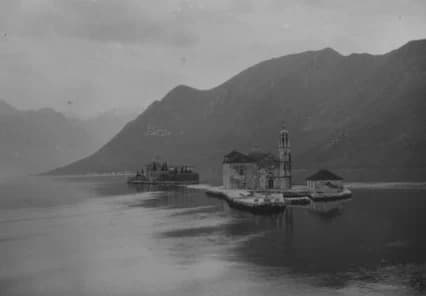
A century and a quarter apart: the islets on a glass slide from around 1900, photographed from the Perast shore (left), and from the air in 2026 (right). The chapel, the bell tower and St George's cypresses stand exactly where they stood.
Written by
Pavle Obradović
Pavle Obradović is from Herceg Novi. He was Manager of Montenegro.com, then Director of the Herceg Novi Tourism Organization, and is now Coordinator for Investment and Development Projects at the Municipality of Herceg Novi. He holds a BSc in International Hospitality and Service Management from the Rochester Institute of Technology (RIT).
···
Updated · Originally published
Montenegro Travel Newsletter
Get weekly stories, guides, and insider tips about Montenegro delivered to your inbox.