In June 1624, Ivan Mazarović was about 96 years old, and he had already survived one of the largest naval battles of his age.
He had commanded Perast's standard-bearers at Lepanto in 1571, when a Christian fleet of oared galleys broke an Ottoman armada in the Gulf of Patras. He had helped Venice take a fortress the following year. Then he had come home to a bright strip of coast beneath the mountains of the Bay of Kotor, where merchants sent ships toward Venice, Albania and southern Italy and where men knew how to fight at sea.8
None of that kept him from becoming a captive. The surviving biographical record is spare. During the 1624 attack on Perast, it says, he was seized “in deep old age.” He was ransomed the next year and eventually died at 105. It does not tell us what he saw as the attackers approached, where he was taken or what it cost to bring him home.8
The story most often told about the place where he was taken begins with iron.
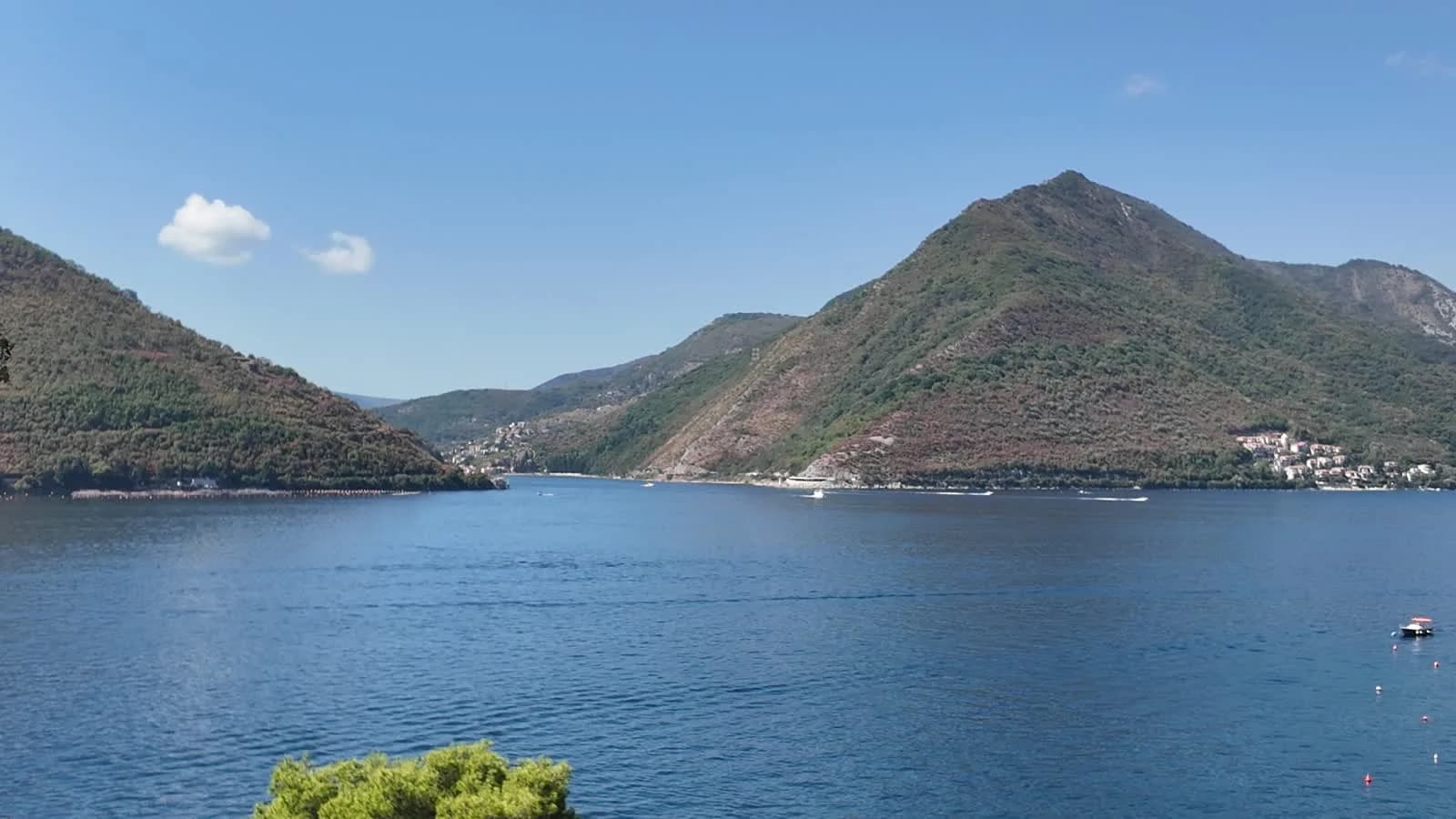
Verige, the narrow strait before Perast, is commonly translated as “the Chains.” Stand today at the ferry ramp at Kamenari and the explanation offers itself: the two shores lean toward each other until the far bank is close enough to read a car's number plate, and the great outer bay simply disappears behind rock. Local tradition stretches a barrier from shore to shore across this throat to stop hostile ships. Guides repeat it. Postcards printed it a century ago. It is an irresistible image: a mountain gate locked at water level.
THE NAME IN PRINT

For four hundred years the chain has explained the raid in a single sentence. Either the gate was locked or it was not.
This story is about what that sentence hides. Because whatever guarded the narrows in June 1624, it did not save Ivan Mazarović, and it did not save the several hundred people who were carried out of the bay with him.

THE RAID IN NUMBERS
- 340 m
- the narrowest crossing at Verige; published measurements vary
- 16–36 min
- for oared craft to row from the narrows to the Perast waterfront
- 13
- raiding vessels in reported accounts
- 400–450
- people carried away for sale or ransom in surviving accounts
- 1625
- the year Ivan Mazarović, aged about 96 when taken, was ransomed
THREE CORRECTIONS
The bay is a drowned river-valley system. Glaciers shaped nearby mountains, not the flooded basin itself.
A barrier is technically plausible. No reviewed record or surviving mechanism establishes one operating here in 1624.
The likely attackers were small oared fighting craft. Their prey was the working traffic of cargo, messages and people.
The land made a gate
The Bay of Kotor looks on a map like a series of inkblots joined by short necks. It is often called a fjord, but geological and bathymetric studies describe a ria: a river-cut valley flooded as sea level rose, divided into basins by turns and constrictions.101112 Glaciers shaped the surrounding mountains; they did not excavate the modern bay. The distinction matters because this is not one open bowl of water.
Verige is the decisive pinch. Published descriptions place the narrowest crossing at roughly a third of a kilometer; a local measurement gives 340 meters, and the constricted reach runs a little over two kilometers before the inner basin opens.1330 To a vessel entering from the outer bay, the route beyond folds behind rock. To the communities inside, the strait was both shield and trap: every friendly cargo had to pass through it, and so did every enemy.
GEOGRAPHY AS DEFENSE
That geometry gives the chain story its power. In a narrow channel, even an imperfect obstruction could force oared vessels to slow, bunch together or send men forward to cut a way through. A floating boom need not be a colossal iron cable suspended above the water. Comparative research on Adriatic harbor barriers describes chains carried by logs, boats or other floats. Venice's records even mention a chain and vessels placed before Kotor in 1572.2
THE BAY ON PAPER

So where does the legend come from? The trail is shorter than the legend implies. The name itself has two rival explanations in local tradition: chains once stretched across the water, or a Verigo family that held land on the shore and gave its name to the place.30 The 1572 record proves a chain was used in the bay, but before Kotor, not at Verige. The scholars who have studied the strait's fortifications have found no secure description of an operating mechanism here: no confirmed capstan, anchorage, storage recess or account of who closed it.3 The earliest dated evidence gathered for this story of the name in public circulation is a hand-colored postcard from 1913, printed nearly three centuries after the raid. Between the 1572 chain at Kotor and the 1913 postcard, the record assembled so far is silent on iron at Verige. The barrier therefore appears as a dashed possibility rather than a documented fact.
THE EVIDENCE TEST
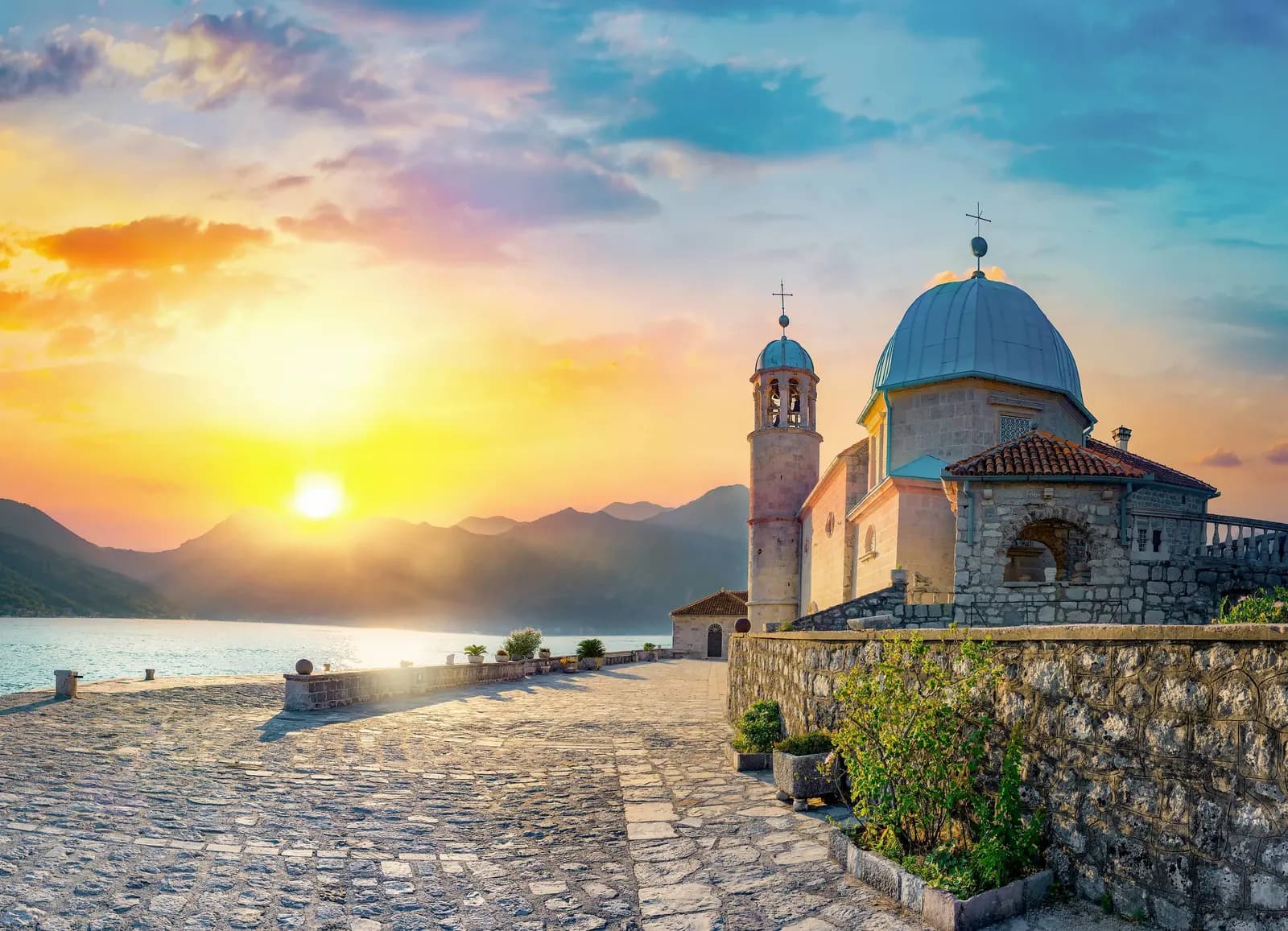
Documented: the fortified position at Gospa od Anđela, St. George Island, the towers of Perast and the Castle of the Holy Cross formed defensive depth along the approach to Kotor.
Technically plausible: a floating chain or timber-supported boom could obstruct a channel hundreds of meters wide.
Unresolved: whether such a barrier operated across Verige in 1624, how it was raised or closed, and what happened to it during the raid.
VERIGE · DEFENSE IN DEPTH
The documented positions and the tasks a barrier would have required.
Scenario A · No operational barrier. Warning and resistance carry the full burden.
Scenario B · A barrier exists but ordinary traffic leaves it open when the fleet arrives.
Scenario C · An obstruction buys time but an endpoint, shore party or gap defeats it.
- 1Detect
Lookouts identify danger before surprise becomes momentum.
- 2Signal
The warning moves toward island, town and upper fortress.
- 3Delay
A boom, if present, slows oared craft. It cannot fight by itself.
- 4Resist in depth
Successive positions concentrate defenders and create fallbacks.
EXAMPLE SKETCHES
A barrier, if there was one, would have been only the first decision in a longer chain. Someone had to see danger early enough. Someone had to distinguish a raiding fleet from ordinary traffic. A signal had to move from the strait toward the island outpost and the town. Men had to leave work, collect weapons, load powder, crew boats and occupy walls. An obstruction had to be closed before attackers reached it. The defenders needed enough force at each point to turn delay into resistance.
Stone survives. Readiness does not.
A town made of ships
Perast's vulnerability came from the same thing that made it prosper. It was not merely a settlement beside the sea. It was a settlement distributed across the sea.
Historian Michele Santoro's study of the Bay of Kotor's maritime community describes early Perast trade in grain from Albania and Apulia. Around 1600, the town reportedly possessed about 50 commercial vessels.4 Their hulls carried food, messages, passengers, money and local ambition. Their crews carried expertise into Venetian service and across the Mediterranean. Mazarović's own career, from the standard at Lepanto to a Venetian fortress siege, was one thread in that fabric.
WATERFRONT MEMORY


Two kinds of vessel explain the town's exposure. The broad trabaccolo hauled ordinary goods along the coast, slow and full. The small postal fregata carried mail, state dispatches, merchants, jewelry and cash between Kotor, Venice and Constantinople; the word did not yet mean the large naval frigate of a later era.1415 A postal boat combined an armored van, a mail truck and a diplomatic pouch in one wooden hull. Maritime predation was targeted extraction: take the vessel, strip the merchandise, seize the letters, kill or enslave the crew, hold the passengers for ransom.
VESSEL DOSSIER
Surviving comparative ranges reveal the tactical mismatch: narrow oared attackers against broad, cargo-optimized prey. Exact specifications for the vessels present in 1624 do not survive.
- Waters
- Mediterranean family
- Size
- 20–28 m × 2.5–3.5 m
- Crew
- 40–68 rowers + fighters
- Drive
- 10–17 oars/side + lateen sail
- Armament
- 1 bow cannon + swivel guns
- Engine
- None · human and wind power
- Modern scale
- 66–92 ft yacht length; far narrower
- Waters
- Boka / Adriatic
- Size
- 10–12 m × 4.5–5 m
- Crew
- 4–6
- Capacity
- 10–30 t
- Drive
- 2 lateen-rigged masts
- Engine
- None · wind power
- Modern scale
- 33–39 ft cruising yacht; much broader
- Waters
- Adriatic
- Size
- 14–20 m × 3.5–5 m
- Crew
- Usually 4–5
- Capacity
- 40–140 t
- Drive
- 2 masts; broad working sail plan
- Engine
- None in the sail era
- Modern scale
- 46–66 ft heavy motor-sailer length
- Waters
- Adriatic
- Size
- 11–28 m; up to 6 m beam
- Crew
- 3–6
- Capacity
- 15–100 t
- Drive
- Up to 4 oars + 2–3 masts
- Engine
- None · wind with auxiliary oars
- Modern scale
- 36–92 ft working yacht/coaster
Santoro found Perast-linked dispatch boats repeatedly attacked by Uskoks, the Christian raiders who operated from the Habsburg frontier. In 1583, Zuanne Speranza testified that his vessel had been plundered. In 1597, another postal boat was richly looted near Ragusa. Later Dubrovnik records show the same prey economy from the opposite direction: a captured Spanish trabaccolo recovered near Gruž in 1712; a felucca carrying Ragusan and French merchants robbed and sunk in 1713; grain traffic attacked in 1715.5 The danger was not attached to one flag, faith or coastline. It followed portable value.
Perast's sailors were also capable of becoming the danger. Santoro records them killing a corsair commander and sinking his fusta in 1603. That same year, they seized and sank another corsair vessel. In 1621, they towed a captured fusta home and destroyed it ceremonially. In 1622, they captured another and sank it near Budva.4 A man of Mazarović's age had lived through all of it.
In modern language, “pirate” sounds like a stable identity. In the early modern Mediterranean it could be an accusation, a legal category or a diplomatic weapon. A sailor might be treated as a lawful privateer by one authority and a pirate by another. Violence at sea overlapped with state service, commerce, retaliation and local feud. Ottoman officials sometimes pursued raiders whose attacks threatened diplomacy; Venetian subjects conducted coercive expeditions of their own.6
None of that diminishes what happened to civilians in 1624. It changes the shape of the story. The sack was not a bolt from an empty horizon. It came after years of seizures, reprisals and humiliations in a crowded imperial borderland, and the men who led it had biographies of their own.
A CROWDED BORDERLAND
- 1583Perast-linked dispatch craft plundered
- 1597Another postal vessel looted near Ragusa
- 1603Perast crews sink corsair craft
- 1621Captured fusta destroyed at Perast
- 1622Another fusta taken and sunk
- 1624Perast sacked; hundreds carried away
The predators' machine
The fleet that sailed toward the Adriatic in the spring of 1624 was built for speed and proximity, and it was commanded by a man who had once been Christian, Italian and a subject of Genoa.
Santoro calls its 13 vessels galeotte: small galleys or galliots, not the towering state galleys of historical spectacle. His account places the expedition under the dey of Algiers and Osta Murat, a Genoese renegade associated with Tunis. Later in the narrative he uses fuste for the craft that attacked Perast.4 A recently presented archival lead describes 13 galleys and perhaps 2,000 fighters.7 The variation preserves the language and uncertainty of the surviving accounts.
THE PREDATORS’ ADVANTAGE
- 13
- hulls could divide into landing, screening and reserve groups
- OARS
- supplied acceleration and control without a favorable wind
- LOW
- freeboard and shallow access aided boarding and landings
The commander is better known in North Africa than in the bay he raided. Usta Murad, as Tunisian history remembers him, was born around 1570 at Levanto on the Ligurian coast, the son of one Francesco Di Rio. How he reached Tunis is not recorded: the chroniclers could not say whether he was captured and sold or crossed over of his own accord. He converted, took the name Murad, and by 1600 had become something like a personal secretary to the ruling dey. In 1615 he was given command of the galleys of Bizerte, a post he held for 22 years, with six galleys and a swarm of smaller craft that worked the coasts of Christian Europe. In 1637 he became dey of Tunis himself. He built the fortified corsair harbor at Porto Farina, and his descendants ruled Tunis as the Muradid dynasty long after his death in 1640.31
That is the man who stood behind the sack of Perast: not a nameless barbarian but a Ligurian who had changed sides, and who was, by the standards of his adopted state, a senior naval officer conducting a lawful campaign. The people of Perast had every reason to call him a pirate. His own government would have called him an admiral.
PERIOD SHIP ICONOGRAPHY
These prints bracket the vessel family in time. They show why an oared galley could maneuver without wind; neither image depicts the 1624 attack or identifies its individual craft.


The family resemblance among his vessels matters more than the label. A galeotta or fusta was long, low and driven by oars as well as sail. It did not need a favorable wind to accelerate. It could maneuver in confined water, land armed men and swarm a slower trader. Its low freeboard helped fighters board another vessel or step into shallows. Its human engine, banks of rowers, made surprise possible on a still day. Mazarović knew exactly what such craft could do. He had spent a day at Lepanto among hundreds of them.
A full Venetian galley might carry hundreds of people. The raiders approaching Perast were probably using smaller fighting craft, but a flotilla multiplied their force. Thirteen hulls meant simultaneous landing or boarding parties and several chances to exploit confusion. One recently reported estimate of roughly 2,000 attackers would make the expedition larger than the population then attributed to Perast.7 Both figures remain estimates.
This was the central asymmetry. The raiding force arrived concentrated. Perast's strength was dispersed. Its best sailors were valuable precisely because they were often elsewhere, aboard trading vessels, carrying dispatches or serving Venice. Sources describe only a small group of soldiers defending the town when the attack came.4 The security system depended on mariners. The maritime economy removed them. Whatever fighting experience remained in town that June included a man of 96.
The short clock
How long did Perast have? The exact path of the 1624 attackers through the bay is not known, and no cited account records a barrier being cut, lowered or bypassed. But the geometry of the bay and the known performance of oared craft allow the clock to be set within limits.
From the open sea at the mouth of the bay to the narrows at Verige is roughly 14 kilometers of water, measured on modern charts along the route a vessel must take through the outer basin.13 The naval historian John Guilmartin, who reconstructed the performance of sixteenth-century galleys, gives them a sustained speed under oars of three to four knots and a burst of about seven.32 At a working pace, a flotilla could cover the outer bay in about two hours, much of it screened from Perast by the headlands that make the inner basin feel enclosed. A lookout at the narrows might see the raiders only as they turned into the constricted reach.
From the narrows to the Perast waterfront is about 3.3 kilometers. At three knots that is 36 minutes. At four knots, 27. At a seven-knot sprint, which rowers could hold only briefly, 16 minutes.
THE SHORT CLOCK
- 01recognize 13 hulls as an enemy
- 02send the signal to St. George and the town
- 03leave workshops, find weapons, load powder
- 04close a barrier, if one existed
- 05reach a tower and hold it
Distances measured along the navigable route on published charts and rounded. Speeds after Guilmartin: three to four knots sustained under oars, about seven in a short burst. Times are illustrative bounds, not a record of the 1624 approach.
That is the whole budget. Inside it, someone at Gospa od Anđela had to recognize 13 low hulls as an enemy and not a convoy. A signal had to travel to St. George and the town. Men had to leave workshops and boats, find weapons, load powder and reach a tower. If a barrier existed, it had to be closed by people who had to be found, and who had to agree on whose order to obey. A defensive work is not a spell. It is a set of tasks performed under pressure, and the pressure here was measured in minutes.
Within that budget, the surviving facts permit three bounded scenarios. In the first, there was no operational chain: the raiders passed the choke point and outran the warning. In the second, a barrier existed but was open, because a port cannot remain sealed against the traffic on which it lives, and closing a floating boom needed detection, authority, labor and time that surprise denied. In the third, an obstruction delayed the fleet but did not stop it: attackers landed a cutting party, seized one end, or passed through a navigable gap. Comparative studies of harbor chains show that control of the anchoring point could matter more than the strength of the chain itself.2
ATTACK SEQUENCE
- 01CONCENTRATE
Arrive with the force already assembled. Surprise converts distance into an advantage.
- 02PENETRATE
Pass Verige before warning, authority and labor can close any obstruction—if one existed.
- 03DIVIDE
Use separate hulls for screening, landing and reserve roles while defenders remain dispersed.
- 04EXTRACT
Leave before reinforcements turn a fast raid into a sustained fight.
These are operational possibilities, not claims about what occurred. Their value is that they return agency to the people on both sides.
Behind the narrows lay depth. At Gospa od Anđela, the fortified enclosure beside Verige could watch the approach and shelter a small force. Beyond it, St. George Island formed another point in the water. Perast's waterfront towers gave households local refuges and firing positions. Above the town, the Castle of the Holy Cross offered a final anchor.3 Each layer could detect, signal, delay or resist. None could supply the men who were at sea.
The raiders reached Perast. The small defending force was overwhelmed. Accounts vary, but the result is consistent: the town was plundered and hundreds of people were carried away. Santoro gives roughly 400 captives. A 2024 conference abstract describing a newly surfaced examination gives about 450 and places Perast's population near 600.47 Even as estimates, they reveal the scale. Captivity was not incidental to the raid. It was one of its principal products.
WHAT “CAPTIVE” MEANT
Here, a captive was a person seized from the town and carried away by sea, not a soldier detained after battle. Newly studied local records identify women, children and older residents among those taken; many able-bodied men were away on trading voyages. Raiders could sell them into slavery, put them to forced labor or exploit their relatives' willingness to pay ransom. These paths could overlap: someone sold in one port might later be located and redeemed through brokers.17
CLAIM COLLATION
| Measure | Reported | Source context | Confidence |
|---|---|---|---|
| Fleet | 13 vessels | Scholarship and a new archival lead | Multiple reports |
| Attackers | ≈2,000 | Conference report of archival evidence | Preliminary |
| Captives | ≈400–450 | Accounts give different estimates | Reported range |
| Population | ≈600 | Reported contemporary denominator | Approximate |
| Loss | ≈100,000 ducats | Reported 1626 examination | Attributed estimate |
Ivan Mazarović was among them.
The long clock
For the attackers, the voyage away turned people into inventory. For the families left in Perast, it began a second campaign. The record of that campaign survives, barely, in a courtroom ledger.
TWO TIMESCALES
In the Historical Archives of Kotor, in the court-notarial records for 1625, the year after the sack, the names of captive Perast families begin to appear. The pages are damaged and faded. The clerks wrote in a form of Venetian specific to Perast, different from the dialect used down the bay in Kotor, and they used abbreviations that follow no standard.7 Two archivists there, Tina Ugrinić and Marija Knežević, have spent the past two years reading them alongside the municipal archive held at the Perast Museum and the records of the Perast parish. In February 2026 they presented what they had found to a conference on the Venetian maritime state in Venice, and it was judged one of the most compelling papers in the room.1
What the ledger records is not the battle. It is what people did after it. Relatives appear before a notary to raise money. Intermediaries are named. Captives are traced through Greek islands, where they were offered for sale, and on toward Carthage, Tunis and Algiers.1 Some entries end with a return. Some do not end at all.
THE LONG CLOCK
The paper trail moves by intermediary: a priest, merchant, official, relative, creditor or other broker who knew whom to ask and how to transfer value across political and religious frontiers.117 News traveled irregularly. A rumor of survival might take months. A ransom demand could arrive after a family had already divided property or assumed a captive was dead. The sea gate had failed in hours. The effort to reverse that failure could consume years.
Ransom was both mercy and market. A captive's price might depend on age, health, occupation, social standing and the buyer's belief about a family's resources. A skilled mariner could be valuable as labor and as a hostage. A prosperous household might secure credit; a poor one might sell land, pledge future income or fail entirely.17
The newly reported 1626 examination gives the raid a headline figure. According to the scholar who presented it, the document survives in the Šime Ljubić papers at the State Archives in Zadar and records testimony about a raid by 13 vessels, the seizure of roughly 450 people and losses from houses and churches estimated near 100,000 ducats.7 The number means little on its own. Consider the scale of the institution that would eventually be asked for help: the Venetian Arsenal, the largest industrial complex in Europe, cost the Republic about 150,000 ducats a year in the seventeenth century and employed some 3,000 master craftsmen.33 The claimed loss of one small town in one day was two-thirds of the annual cost of the state shipyard. Those figures are not yet a settled accounting. Their promise lies in the questions behind them: Who testified? What counted as a loss? Which figures were witnessed, and which were estimates designed to move officials? A petition emphasizes need. A diplomatic dispatch emphasizes threat. A legal examination organizes memory into questions.
READING THE RECORD
Reports threat
May magnify dangerPerforms need
May stress hardshipAnswers questions
Shapes memory to procedureFormalizes obligation
Records transaction, not experienceOne Perast biography shows what a single ransom could cost. Captain Petar Lukin Bujović traded along the Adriatic coast in 1624 and 1625. Some time afterward he fell into corsair captivity, and in 1627 he was ransomed with money raised by selling a ship. Venice later exempted him from customs on grain imported from Albania.16 He was not taken in the sack, but his ledger is the raid's ledger in miniature: a captive's freedom bought with a hull, and a commercial privilege granted to rebuild the livelihood the hull had represented. Multiply that by several hundred households and the cost of the raid stops being a number in a deposition. Perast lost labor from ships and workshops. It lost future voyages. Property used for ransom could not finance cargo. A missing parent altered inheritance. A missing sailor shifted risk to every partner in a voyage.
Mazarović's short biography supplies one completed transaction. Captured in 1624, he was successfully ransomed in 1625.8 His age made him extraordinary. The fact that he came home made him fortunate. The Kotor ledgers hold the families who searched for years, and the names whose lines end without a return.1
The town that held
Thirty years later, Perast was attacked again, and this time it won. The comparison is the closest thing the record offers to an experiment.
On 15 May 1654, an Ottoman force from the sanjak of Herzegovina came down on the town under Mehmed Rizvanbegović, the expelled commander of Risan. Traditional accounts put the attackers in the thousands and add small oared craft from Ottoman Herceg Novi and Ulcinj. The scale is disputed: the casualty figures range from a few dozen killed to several hundred, and historians of the Cretan War treat the size of the assault with caution.2034 What is not disputed is the outcome. The attack was repelled, and Rizvanbegović was killed in it.
Look at what had changed. In 1624 the alarm, if it came at all, came at the narrows with minutes to spare. In 1654 it came days ahead: an Orthodox priest, Radul of Riđani, and the Stijepović brothers of Risan warned Perast that an attack was being prepared.34 In 1624 the town's defenses were a partial system. By 1654 the raid had been answered with three decades of building, and the inner bay's defenses formed a deeper field: the position at Verige, St. George, roughly ten towers in Perast and the Castle of the Holy Cross.9 In 1624 a small garrison stood alone. In 1654 Kotor sent a few dozen Venetian soldiers under Krsto Visković, and they were joined by hajduk fighters who had crossed from Herzegovina that spring.34
And one thing had not changed at all. In 1654, as in 1624, Perast's own armed vessels and their crews were away at sea when the enemy arrived.34 The town's mariners were absent both times. The difference was that in 1654 the people who remained knew the attack was coming, had walls that faced it, and had the hours needed to man them.
THE CONTROL CASE
| 1624 | 1654 | |
|---|---|---|
| Enemy | Thirteen oared raiders from Algiers and Tunis, arriving by water | Herzegovinian force under Mehmed Rizvanbegović, largely by land, with small craft from Herceg Novi and Ulcinj |
| Warning | Minutes at most; exact sequence unknown | Days: Radul of Riđani and the Stijepović brothers of Risan reported the preparations |
| Perast’s mariners | Away on trading and dispatch voyages | Away at sea with the town’s armed vessels |
| Defenders present | A small group of soldiers | A few dozen Venetian soldiers under Krsto Visković plus hajduk fighters |
| Fortifications | Partial; phase-by-phase state unresolved | Thirty years of building: towers, St. George, Holy Cross |
| Political setting | Peacetime raid in a tense maritime frontier | Open war: the Cretan War theater |
| Outcome | Town plundered; hundreds carried away | Attack repelled; the commander killed; casualty figures disputed |
Sources: Santoro; Lalošević; traditional accounts of 15 May 1654 as summarized in the source list; Madunić on the disputed scale. The 1654 victory belongs to a different kind of attack and should not be projected back onto 1624.
The victory fed a heroic civic tradition, and it belonged to a different defensive moment: wartime rather than a raid, an assault largely from the land rather than a fleet through the narrows. It should not be projected backward onto 1624. But it isolates the variable at the heart of every wall. Geography can narrow an enemy's options. Stone can protect defenders. A barrier can purchase time. In 1654 the purchase was made days in advance, and the town spent it well.
Fortifications accumulate. Architectural research indicates that defensive positions existed around Perast before 1624 and were expanded afterward.9 That distinction prevents a common visual mistake: drawing every surviving wall as if it had been present, complete and staffed on the day of the sack. A community builds in response to memories as much as plans.
The same is true of ships. A fusta is not inherently a pirate vessel any more than a tower is inherently an effective defense. Its meaning comes from crew, authority and purpose. Perast sailors who hunted corsairs understood small oared craft because they inhabited the same maritime system as Usta Murad, and the hajduks who helped hold the walls in 1654 were, in other seasons and other ports, raiders themselves. The contest was not between a modern state and chaos. It was among communities and empires that used overlapping technologies and disputed one another's legitimacy. The people taken from Perast paid for conflicts they did not necessarily choose.
What the chain hides
Today, the crossing at Verige takes about five minutes. The car ferry between Kamenari and Lepetane runs every fifteen or twenty minutes across the same 340 meters of water, and it still produces the optical trick on which the old defense depended: from the deck, the outer bay vanishes behind the headlands and the inner basin seems briefly enclosed.35
The chain legend turns that feeling into an object. It offers a clean cause and a clean failure.
The evidence offers something less tidy and more revealing. Security at Verige was ecological. It depended on the shape of the channel, the visibility from shore, the speed of vessels, the staffing of outposts, the movement of signals, the readiness of towers and the presence of armed boats and the mariners to crew them. It also depended on money: the commerce worth defending and the credit needed when defense failed. An iron barrier may once have belonged to that arrangement. No source cited here securely describes its mechanism or operation at Verige in 1624.
In 1633, nine years after the sack, Ivan Mazarović died at about 105. The old commander had survived Lepanto, the loss of his freedom and the journey home. His name occupies only a few lines in a later family history. Around it are the outlines of other lives: the relative who found him, the intermediary who negotiated, the creditor who advanced money. The mechanism that brought him home is missing from the published account: no sum, no payer, no broker, no instrument.
The last line of his biography is a return. In the ledgers at Kotor, some lines end without one.
THE RECORD IS STILL OPEN
Two questions remain open: whether any document before 1913 describes a chain at Verige, and what the 1625 Kotor ledgers and the 1626 Zadar examination record about individual households. We welcome documented corrections and additions from archives, libraries, private collections and family papers.
Send the editor a clear image or transcription, the archive or collection name, shelf mark if known, date, provenance and permission status. Every submission will be evaluated against the existing record before it is incorporated.