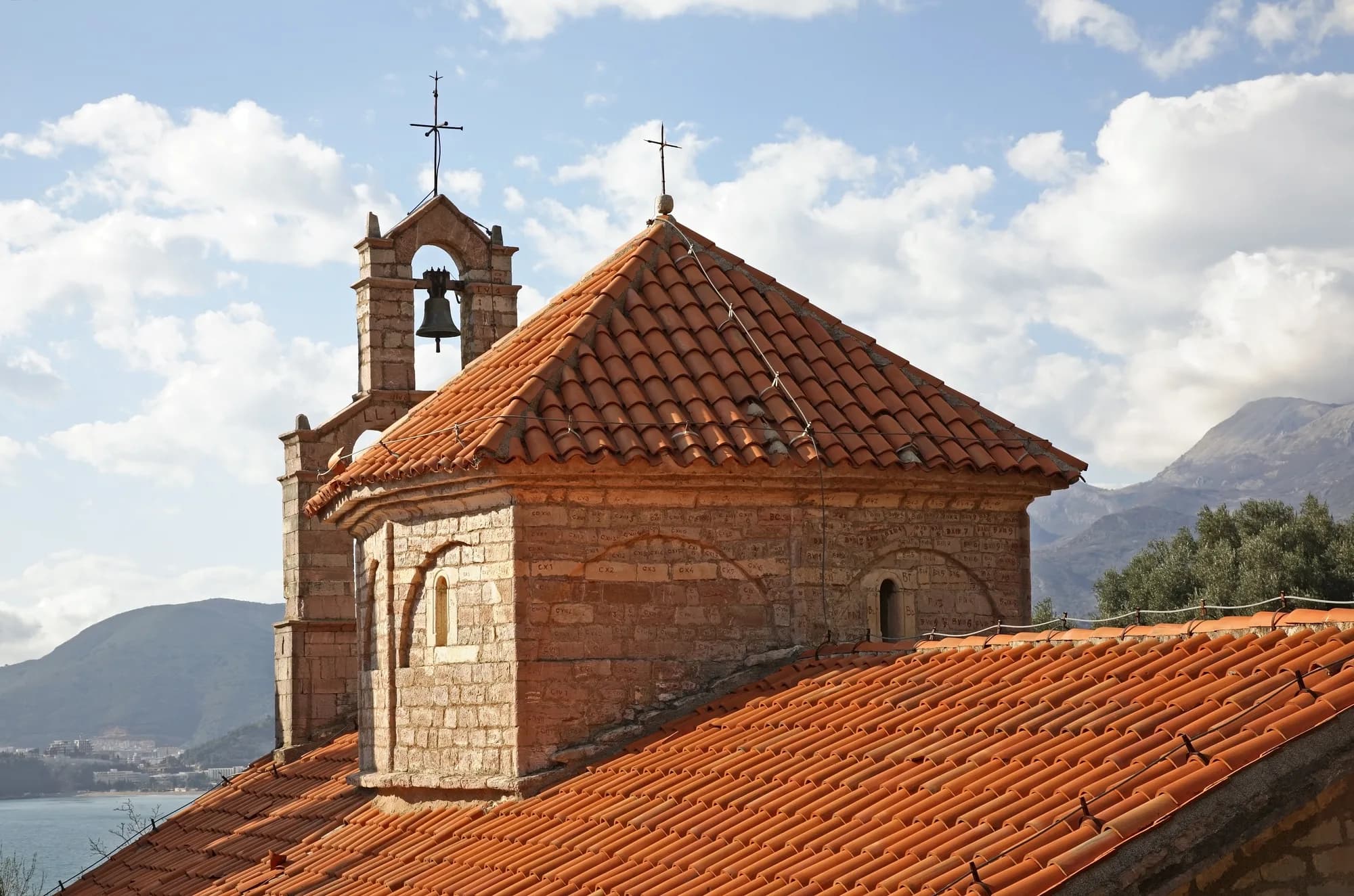
Praskvica Monastery stands on a stone terrace above Miločer and Sveti Stefan, but its history is not one clean founding date. A 1413 charter securely anchors the Church of Saint Nicholas. The smaller Holy Trinity church may be older, while the familiar date of 1050 belongs to local and monastic tradition rather than surviving archaeological proof. The same distinction matters for the peach-scented water and the one-armed Russian monk said to have built Jegor's path.
This guide keeps record and legend side by side without turning one into the other. It explains the two churches, the surviving wall painting, the 19th-century rebuilding, Praskvica's Paštrovići role and the walk to Čelobrdo. It also gives a cautious 2026 visit plan for an active Serbian Orthodox monastery whose worship and community life come before sightseeing.
| Question | Evidence-led answer | Important limit |
|---|---|---|
| Where is it? | On a rise above Miločer, opposite the Sveti Stefan coast, in Budva municipality | Do not confuse the monastery with the island or resort grounds below |
| How old is it? | Written references begin in the early 14th century; the reliable Saint Nicholas foundation is tied to 1413 | The often-repeated 1050 date is tradition |
| What survives? | Two churches, residential and service buildings, the former school called the kulica, walls, cemeteries and grounds | The present Saint Nicholas church is largely a 19th-century rebuilding |
| What is Jegor's path? | A surviving stone route from Praskvica toward Čelobrdo, associated by tradition with monk Jegor Stroganov | Only part of the original coast-to-hill route survives |
| Can you visit? | The monastery publishes direct phone and email contacts for current enquiries | No dependable official daily opening schedule is published; confirm access |
| Date | Evidence |
|---|---|
| 1050 | tradition |
| early 1300s | written mention |
| 1413 | Balša III charter |
| 1681 | Holy Trinity art |
| 1812 | destruction |
| 1847 | rebuilding |
| 1979 | earthquake |
| Reading rule | A remembered origin can carry meaning without becoming a proven construction date. |
Source: leks.canu.ac.me, mitropolija.com
What the evidence says about the founding
The Archaeological Lexicon of Montenegro, published by the Montenegrin Academy of Sciences and Arts (CANU), describes Praskvica as a medieval monastery and says it first appears in written sources in a charter of King Stefan Uroš II Milutin at the beginning of the 14th century. The monastery's own official account specifies a 1310 charter but says that document has not survived and is known through later Paštrovići records.
The firmer landmark is Balša III's charter of 1413. CANU says the ruler of Zeta built the Church of Saint Nicholas with “his nobles, the Paštrovići.” This is why 1413 is the responsible foundation date for the documented monastery even though the site may contain older religious memory.
The 1050 date is different. Budva's tourism organisation reports that locals consider the Holy Trinity church to date from that year. The official Metropolitanate account connects the monastery with the era of Vojislav but explicitly says there is no support in written documents. CANU's archaeological entry calls Holy Trinity possibly early medieval; it also says excavations in 1987 found no earlier architecture beneath it. None of this proves the tradition false. It does mean a guide should not present 1050 as an established building date.
Two churches, several building lives
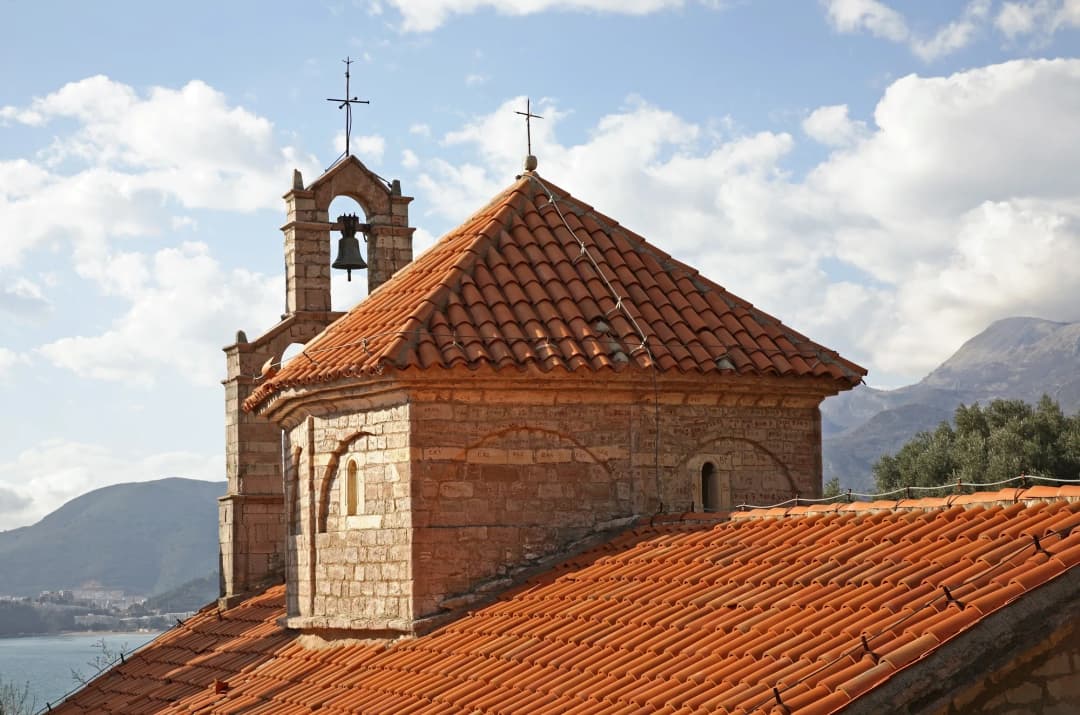
The complex is organised around two single-nave churches with semicircular eastern apses. Saint Nicholas is the lower, principal church. Holy Trinity stands higher, within a functioning cemetery. The remaining ensemble also includes monastic residences, service structures, old walls, two burial areas and the former folk-school building known as the kulica.
The Saint Nicholas church seen today is not simply Balša III's 1413 building. CANU says Napoleon's forces destroyed the older church in 1812 and that the present structure rose in the mid-19th century. Its art lexicon dates the Paštrovići rebuilding to 1847. Builders retained parts of the earlier north wall and north choir, and the outline of the 15th-century foundations is now marked in differently coloured floor slabs.
Those fragments matter. The original church had a cross-shaped plan associated with the Raška tradition. Surviving wall painting in the north choir and adjacent areas includes saints and holy warriors; CANU attributes it to an unidentified painter, probably in the 17th century. The present church has a rectangular single nave, semicircular apse, three-opening bell-cote and an octagonal dome.
| Element | Layers |
|---|---|
| Saint Nicholas | 1413 charter and foundations; 1847 rebuilding; older wall and painting fragments |
| Holy Trinity | possibly early medieval; 1681 painting by Radul + Dimitrije; cemetery on upper plateau |
| Shared monastic landscape | residences · former school · walls · service buildings · burial grounds |
| Note | Diagram shows relationships and historical layers; it is not a measured site plan. |
Source: leks.canu.ac.me
Holy Trinity and the 1681 painters
Holy Trinity is smaller and architecturally simpler: a rectangular nave, semicircular apse and single-opening bell-cote. Its porch was added later. The most securely dated feature is inside. CANU's art lexicon says painter Radul and his assistant Dimitrije executed the surviving work in the older eastern section in 1681.
This matters beyond Praskvica. An academic study in Balcanica identifies Dimitrije Daskal as Radul's most gifted student and dates their work at Holy Trinity to 1680. The one-year difference reflects how scholarship reads the painting campaign and inscriptions; the official and local heritage sources use 1681. The safe visitor summary is “1680–81, by Radul and Dimitrije,” not merely “old frescoes.”
A 2018 Ministry of Culture exhibition placed Praskvica's movable heritage in a wider Paštrovići network. It brought together icons from Praskvica, Reževići and Gradište made between the 18th and 20th centuries in local, Greek, Venetian and Russian workshops. Named artists included the Dimitrijević–Rafailović school, Nikola Aspioti, Aleksije Lazović and Marko Krstov Gregović. This is a useful corrective to treating the treasury as one-period art.
Praskvica and the Paštrovići
The monastery's official account calls it the spiritual and political centre of the Paštrovići. CANU identifies the kulica as a former folk school. These functions explain why the site mattered beyond worship: it held memory, education and material culture for coastal communities whose political world changed repeatedly.
Claims about “the first school on the Adriatic” or an unbroken institutional role are harder to prove and are unnecessary. The physical former-school building, archive tradition and surviving objects already establish a cultural function. A parliamentary heritage inventory lists Praskvica as a protected monument, while modern conservation evidence shows that protection is ongoing work rather than a guarantee of perfect condition.
For comparison, the nearby Reževići Monastery guide shows how another Paštrovići complex accumulated churches and art in different phases. Farther around the coast, Savina Monastery offers a different relationship between an active monastery, treasury and bay landscape.
| Role | What it means |
|---|---|
| Worship | living male monastery today |
| Community memory | Paštrovići political and spiritual centre |
| Education | the surviving former-school kulica |
| Heritage | architecture, wall painting, icons and archive |
| Note | The roles overlap; none makes every traditional detail a documented fact. |
Source: leks.canu.ac.me, mitropolija.com, gov.me, zakoni.skupstina.me
Jegor's path: material route, remembered biography
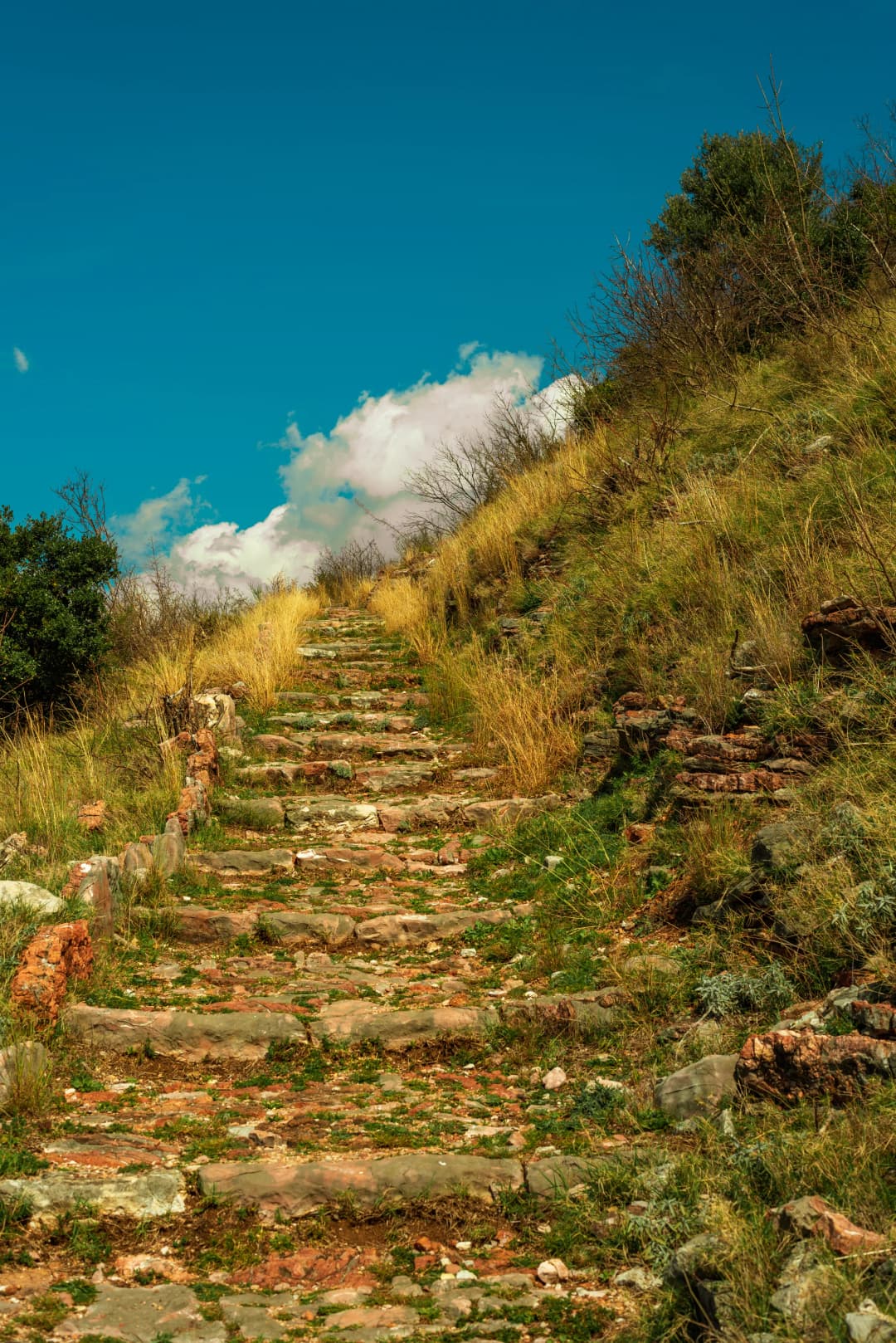
The path exists; the full biography attached to it is a transmitted story. Monastic and local accounts say Jegor Stroganov arrived from Russia near the end of the 18th century, had one arm, took a vow of silence and spent ten years laying a stone route from the coast toward Čelobrdo. Later versions add a duel, a lost daughter disguised as a monk and a deathbed recognition. Those dramatic details belong to literary and oral tradition, not a contemporary documentary dossier.
A 1971 stone plaque at Čelobrdo thanks Jegor and attributes the road to his ten years of work at the beginning of the 19th century. That is evidence of how the community commemorates him, not an eyewitness record. Budva's tourism organisation also treats Jegor's road as the area's best-known historical walking trail. The careful phrasing is therefore “traditionally attributed to Jegor,” while the stones, gradients and surviving line can be described directly.
What the surviving walk involves
A 2022 conservation proposal reported by Vijesti surveyed about 730 metres between Praskvica and Čelobrdo. It placed the monastery at roughly 93 metres above sea level and Čelobrdo at 250 metres: a rise of about 157 metres. The report counted 513 steps and described a route typically about 1.5 metres wide, broader on bends, with drainage channels and dry-stone boundaries.
That is the preserved upper section, not proof that every metre of the traditional coast-to-Čelobrdo road survives. The same report says the section through Miločer Park has been lost and the modern Adriatic highway cut the alignment. It also recorded collapsed and damaged portions requiring repair. Conditions can change after rain, vegetation growth or works, so treat the figures as route character—not a guarantee of an open, even trail.
Destruction, earthquake and conservation
The monastery's 1812 destruction was not its last rupture. CANU records major damage in the 15 April 1979 earthquake, followed by a multi-year restoration and protective archaeological work. Excavations in and around Saint Nicholas during the 1980s recovered a metal cross and 15th-century foundation remains. Work at Holy Trinity found six later burials but no earlier architecture.
Those findings change how the place should be viewed. Rebuilding did not erase the medieval church; it incorporated fragments and marked its footprint. Archaeology did not validate every origin story; it refined the limits of what can be claimed. Conservation of Jegor's path poses the same problem: repair must make the route safe enough to survive without turning irregular historical construction into a generic stairway.
Practical visit plan for 2026
Confirm before setting out. The official Metropolitanate directory lists Praskvica at 85315 Sveti Stefan, phone +382 33 468 075 or +382 68 655 059, and email [email protected]. It does not publish dependable daily visitor hours. Contact the monastery if church interiors, the treasury, a service, a group visit or mobility access is important. Never assume every building will be open.
Choose the approach. The monastery sits just inland of the Adriatic highway above Miločer. Use a current map and arrange the final access before departure; road works, gates and parking conditions can change. A base in the area is covered in our where-to-stay guide for Sveti Stefan. The Miločer guide explains the coastal landscape below without implying that resort paths provide monastery access.
Walk with margin. For Jegor's route, wear grippy closed shoes, carry water, avoid peak heat and do not start if stone is slippery or visibility poor. The surveyed climb is short but sustained, with uneven steps and no promise of a handrail. Turn back at damage, works, fire risk or a closed gate. Do not use a quoted half-hour as a deadline.
Respect an active monastery. Cover shoulders and knees, keep voices and phones quiet, give worshippers space and ask before photographing people, interiors, services or objects. Do not fly a drone or handle art and furnishings without explicit permission. A donation may be welcome, but no reviewed official source publishes a compulsory admission fee.
Pair places realistically. Praskvica combines naturally with the public viewpoints around the Sveti Stefan coast; use the current Sveti Stefan guide for access limits. For the royal-era landscape, continue with the history of King's and Queen's beaches at Miločer. Do not assume hotel, island or managed-beach access because the monastery is nearby.
Frequently asked questions
Was Praskvica Monastery founded in 1050?
That date is a respected local and monastic tradition, not a securely documented construction date. Written references begin in the early 14th century, and the reliable foundation landmark is Balša III's 1413 charter for Saint Nicholas.
Is the present Saint Nicholas church from 1413?
Not as a complete building. The medieval church was destroyed in 1812. The Paštrovići rebuilt it in 1847 while retaining parts of the earlier north wall and choir; archaeology later marked the older foundation outline in the floor.
Who painted the Holy Trinity church?
CANU attributes the 1681 painting in its older eastern section to zographer Radul and his assistant Dimitrije. Academic literature describes the campaign as 1680–81.
Did a one-armed monk build Jegor's path alone?
The route is traditionally attributed to Russian monk Jegor Stroganov and a 1971 community plaque commemorates ten years of work. The detailed biography—including the duel and disguised daughter—is transmitted story rather than a contemporary documentary record.
How difficult is Jegor's path?
A 2022 project described roughly 730 metres from the monastery to Čelobrdo, about 157 metres of ascent and 513 steps. Uneven stone, damage, heat, rain and vegetation can make a short route demanding. Check current conditions locally.
Is there an entrance fee or fixed opening time?
No reviewed official source publishes a compulsory fee or dependable daily schedule. Praskvica is an active monastery; contact it directly for current access, especially for interiors, groups, services or the treasury.
Can I photograph inside?
Ask first. Even if the grounds are accessible, worship, conservation and privacy can limit interior photography. Never photograph a service or person without permission.