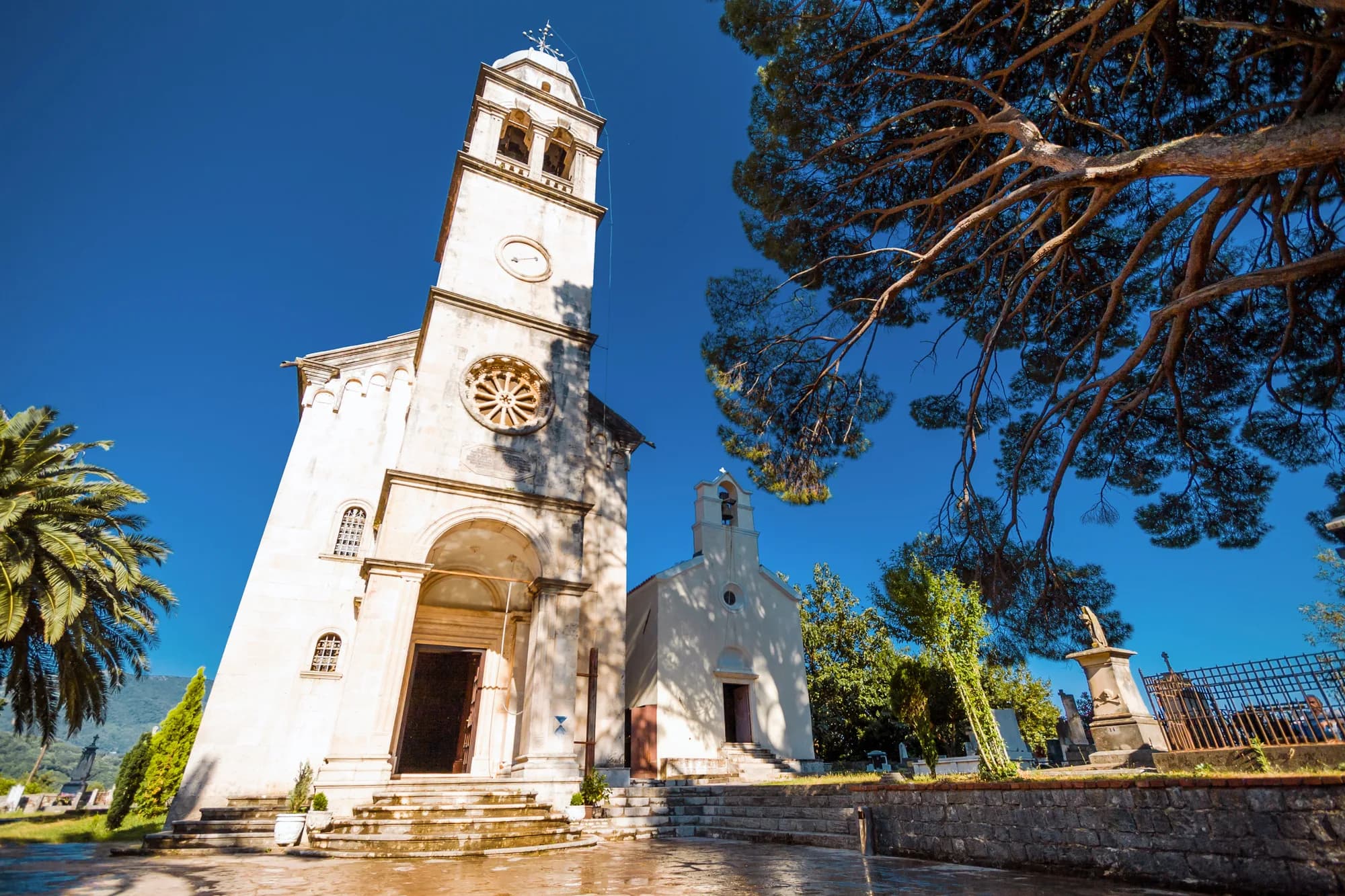
Savina Monastery is often introduced with a clean founding date—1030—and a straight line from Saint Sava to the present. The evidence is more interesting. Tradition, fresco inscriptions, archaeology, architecture and monastery records describe different layers. The complex visible above the Bay of Kotor is not one medieval survival but a sanctuary repeatedly built, emptied, renewed and expanded.
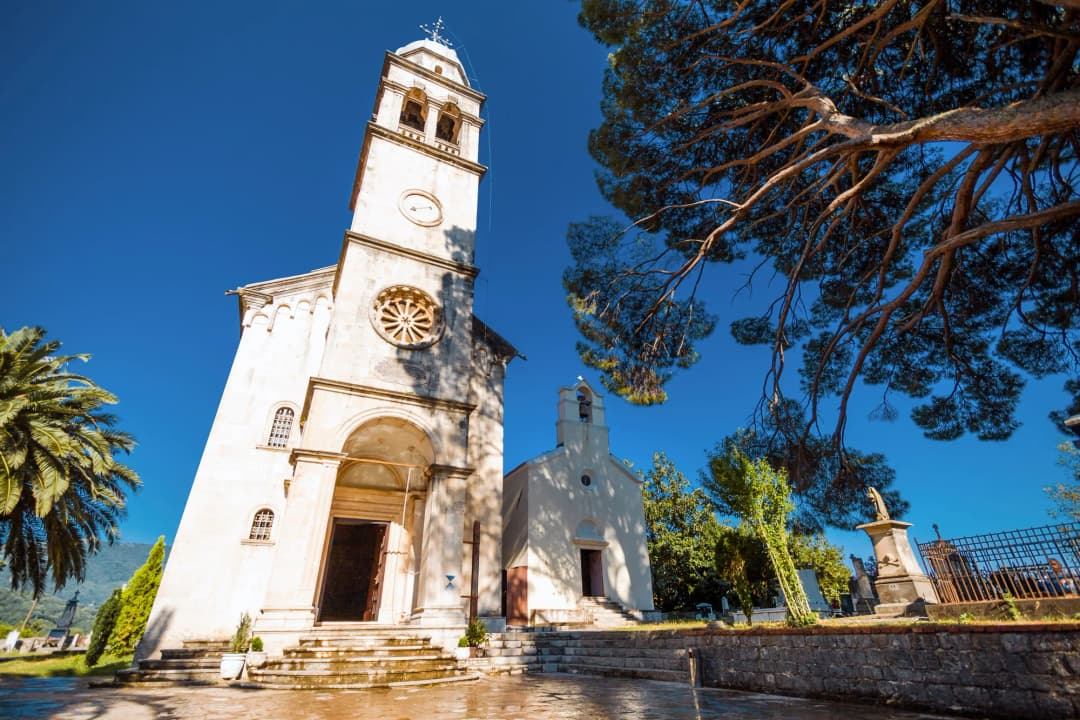
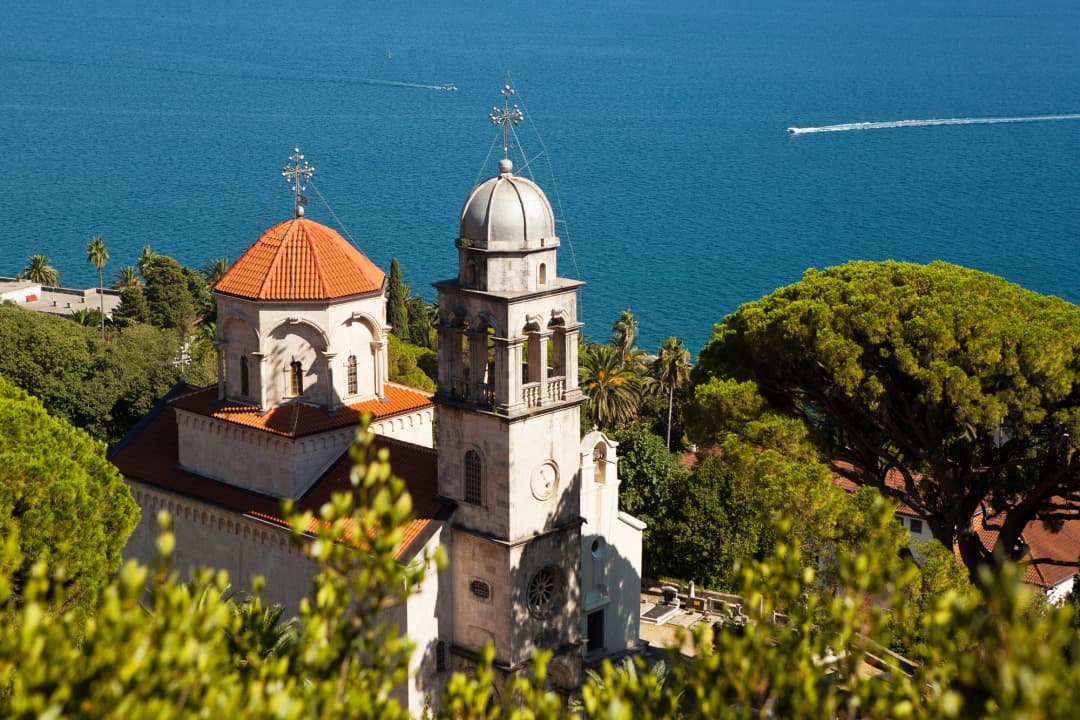
Three churches anchor the site: the Small and Great Churches of the Dormition within the main enclosure, and the Church of St Sava on the wooded hill above. Monks displaced from Tvrdoš in Herzegovina transformed an older sanctuary after arriving in the 1690s. The Great Church then expressed a distinctive 18th-century Adriatic Orthodox world through Korčula stonework, an Orthodox iconostasis, Venetian political permissions and networks stretching inland and toward Russia.
Savina at a glance
| Question | Best-supported answer | Limit |
|---|---|---|
| Founded in 1030? | 1030 is recorded tradition, repeated in an 1831 inscription | Surviving Small Church is more plausibly 15th century |
| How many churches? | Three: two Dormition churches and St Sava church | St Sava stands above the main enclosure |
| Tvrdoš connection | Displaced monks arrived in 1693 and led major renewal | Savina existed before their arrival |
| Great Church | Built 1777–99 by Nikola Foretić and collaborators | Archival study discusses building work through 1797 |
| Current opening | Official site says sunrise to sunset daily | Services and monastery needs can alter access |
| Treasury | Objects from Tvrdoš, Mileševa and Savina collections | Display and access must be confirmed on the day |
The 1030 date: tradition versus the surviving fabric
The monastery’s own history page is careful: it says the age and founder are not known with certainty. Tradition dates the Small Church of the Dormition to 1030. A fresco-inscription painted in 1831 repeats that date, but an inscription made eight centuries after an event is not contemporary proof.
The Montenegrin Academy’s art lexicon gives a more evidence-led reading. Stylistic and architectural analysis places the Small Church more plausibly in the 15th century. Its walls also preserve multiple painting phases; the municipality notes an older layer beneath frescoes dated 1565. The right conclusion is not that tradition is worthless, but that it answers a question about remembered sacred origin while archaeology answers a question about surviving material.
The Church of St Sava carries a similar distinction. Tradition connects its foundation with Saint Sava and originally with Sava the Sanctified. Archaeological work places the earliest layers in the late 12th or early 13th century, while much of the current single-nave church belongs to the 15th century. A porch was added in the 19th century. “Ancient” is accurate; “unchanged since Saint Sava” is not.
| Date | Evidence |
|---|---|
| 1030 | tradition |
| late 12th–13th | St Sava layers |
| 15th c. | major church fabric |
| 1565 | fresco phase |
| 1831 | 1030 inscription |
Source: en.manastirsavina.org, leks.canu.ac.me, hercegnovi.me
Tvrdoš in exile: renewal after 1693
Savina did not begin with refugees, but their arrival changed its scale and importance. During the Morean War, fighting reordered the borderlands between Ottoman and Venetian power. A scholarly survey records monks from Tvrdoš reaching Savina in 1693 after their Herzegovinian monastery was destroyed. They brought archives, books, icons and liturgical objects, then helped rebuild the coastal community.
This distinction repairs a common shortcut. “Founded by Tvrdoš monks in 1694” erases the earlier churches. “Unaffected medieval monastery” erases displacement and rebuilding. The best description is an older sanctuary renewed into a major Adriatic Orthodox centre by a displaced brotherhood and its inherited collections.
The monastery’s archive preserves more than devotional memory. The Historical Institute’s study of medieval charters shows why the collection matters to scholarship while also warning that copied or later-preserved documents require diplomatic analysis. A treasury label does not automatically prove an object’s original owner or uninterrupted chain of custody.
| Stage | What moved or changed |
|---|---|
| Tvrdoš | war + destruction |
| Transfer | monks • archives; books • objects |
| Savina | renewal; new centre |
Source: en.manastirsavina.org, hrcak.srce.hr, iib.ac.rs
The Great Church: an Adriatic Orthodox project
Venetian authorities approved a new, larger church in 1776 after earlier requests. Construction began in 1777 under Nikola Foretić, a master from Korčula. The monastery gives a 1777–1799 chronology, while an archival study describes construction from 1777 to 1797. The located sources do not fully resolve why their endpoints differ, so both remain attributed rather than compressed into one explanation.
Foretić’s building joins several architectural languages: Romanesque and Gothic references, a prominent bell tower, a dome and Orthodox liturgical organisation. That mixture is not evidence of confusion. It reflects skilled Adriatic stone building serving an Orthodox community under Venetian government. Donations gathered locally, inland and through Orthodox networks supported a project that took more than two decades.
The expense books matter because they replace heroic legend with labour, procurement and negotiation. The inherited claim that “8,454 workers” took part in eight years is unsafe: a historical ledger can count workdays, entries or repeat labourers, not necessarily 8,454 different people. The archival construction study supports the larger conclusion—sustained community effort—without turning accounting units into a headcount.
| System | Source |
|---|---|
| Permission | Venice, 1776 |
| Craft | Foretić + Korčula |
| Community | donations + labour |
| Iconostasis | Lazović workshop |
Source: manastirsavina.org, iib.ac.rs, hrcak.srce.hr
Iconostasis and the Virgin of Savina
The monastery attributes the Great Church iconostasis to priest-painter Simeon Lazović and his son, completed in 1797. Recent art history describes it as a mature achievement of Simeon’s workshop, combining movement, complex colour and Baroque details with the hierarchy of an Orthodox icon screen. Its importance lies precisely in adaptation rather than a simplistic “East versus West” contrast.
The revered Virgin of Savina icon has a more traceable history than many devotional claims. A study of the icon and monastery account book establishes that it was present by 1755, when a donor offered a gold-threaded cloth before it. A 1760 entry records a new lockable glass case. The surviving entries do not establish when its full silver covering was applied. The icon’s devotional status is real; the limits of its material chronology should also remain visible.
The treasury combines objects that came from Tvrdoš and partly Mileševa with Savina’s own holdings. The monastery highlights manuscripts and printed books dating as early as the 14th century. Attributions such as “the cross of Saint Sava” belong to the collection’s received identity, but personal ownership centuries earlier is not proved merely by the object’s name.
Savinska Dubrava: the landscape is part of the visit
The oak and Mediterranean woodland around Savina is not decorative background. The oak wood itself has been protected since 1966, confirmed as a nature reserve in 1968, and in 2015 the municipal assembly declared it a protected landscape of exceptional features, third category (Boka News). A municipal draft protection study mapped a 370,569-square-metre study area and recorded a mixture of private, state and monastery land. Because it is a draft study and its boundary answers a planning question, that figure should not be relabelled as “the monastery estate.”
The woods, cemetery, terraces and bay views explain why development and access require landscape care. Stay on established public paths, do not treat graves as picnic furniture, and avoid collecting plants. For coastal context, connect the walk to the Meljine guide or the evidence-led Meljine access update. The Pet Danica promenade history adds the story of the waterfront below.
Practical and respectful visit plan
The official monastery page currently says Savina is open every day from sunrise to sunset. It lists morning service at 06:00, evening service at 18:00, Saturday liturgy at 08:00 and Sunday and feast-day liturgy at 09:00, plus a Friday evening Akathist. These are published schedules, not guarantees that every interior or the treasury is continuously accessible. Recheck for feast days and special services.
- Choose whether you are visiting or worshipping. Visitors may quietly observe a service from an appropriate place, but should not circulate, narrate or photograph worship.
- Dress for an active Orthodox monastery. Cover shoulders and knees, remove hats where customary, silence phones and follow posted or spoken guidance.
- Ask before photography. Permission can differ between grounds, churches, icons, treasury objects and services. No online guide can grant it.
- Confirm treasury access. The official site describes the museum collection but publishes no continuous treasury timetable. Ask at the monastery rather than assuming it is closed or open.
- Plan the climb conservatively. Approaches from the waterfront involve gradients and steps. The article does not certify step-free access, parking availability or a fixed walking time.
| Step | What it covers |
|---|---|
| 1. Recheck | hours + services |
| 2. Enter quietly | dress + silence |
| 3. Ask | photos + treasury |
| 4. Protect | paths + graves + trees |
Source: en.manastirsavina.org, hercegnovi.travel, hercegnovi.me
For a broader Orthodox heritage comparison, the Reževići Monastery guide shows another three-church coastal complex with different documentary problems. Use the Herceg Novi area guide for accommodation logic, and the Literary Topla guide for a separate church-and-literature route.
Frequently asked questions
Was Savina Monastery founded in 1030?
That is the traditional date, repeated in an 1831 fresco-inscription. Current art-historical evidence places the surviving Small Church more plausibly in the 15th century. The monastery itself says the age and founder cannot be stated with certainty.
Did monks from Tvrdoš found Savina?
No. They arrived at an existing sanctuary in 1693 and drove its major renewal after Tvrdoš was destroyed. They also brought important archives and religious objects.
Why does the Great Church look partly Venetian?
It was built under Venetian government by Nikola Foretić of Korčula using Adriatic stonecraft, while serving Orthodox worship and housing an Orthodox iconostasis. The mixture reflects the Bay’s connected cultural world.
Can visitors enter during services?
The monastery publishes worship times and welcomes visitors, but services deserve priority. Enter quietly, remain in an appropriate area and avoid sightseeing movement or photography during worship.
Is the treasury always open?
No continuous public timetable was found on the official site. Ask on arrival and accept that access can depend on staffing, services and monastery needs.
Is entry free?
This guide does not freeze an unverified fee statement into 2026 copy. Check current signs or ask the monastery; donations and treasury arrangements may differ from general grounds access.