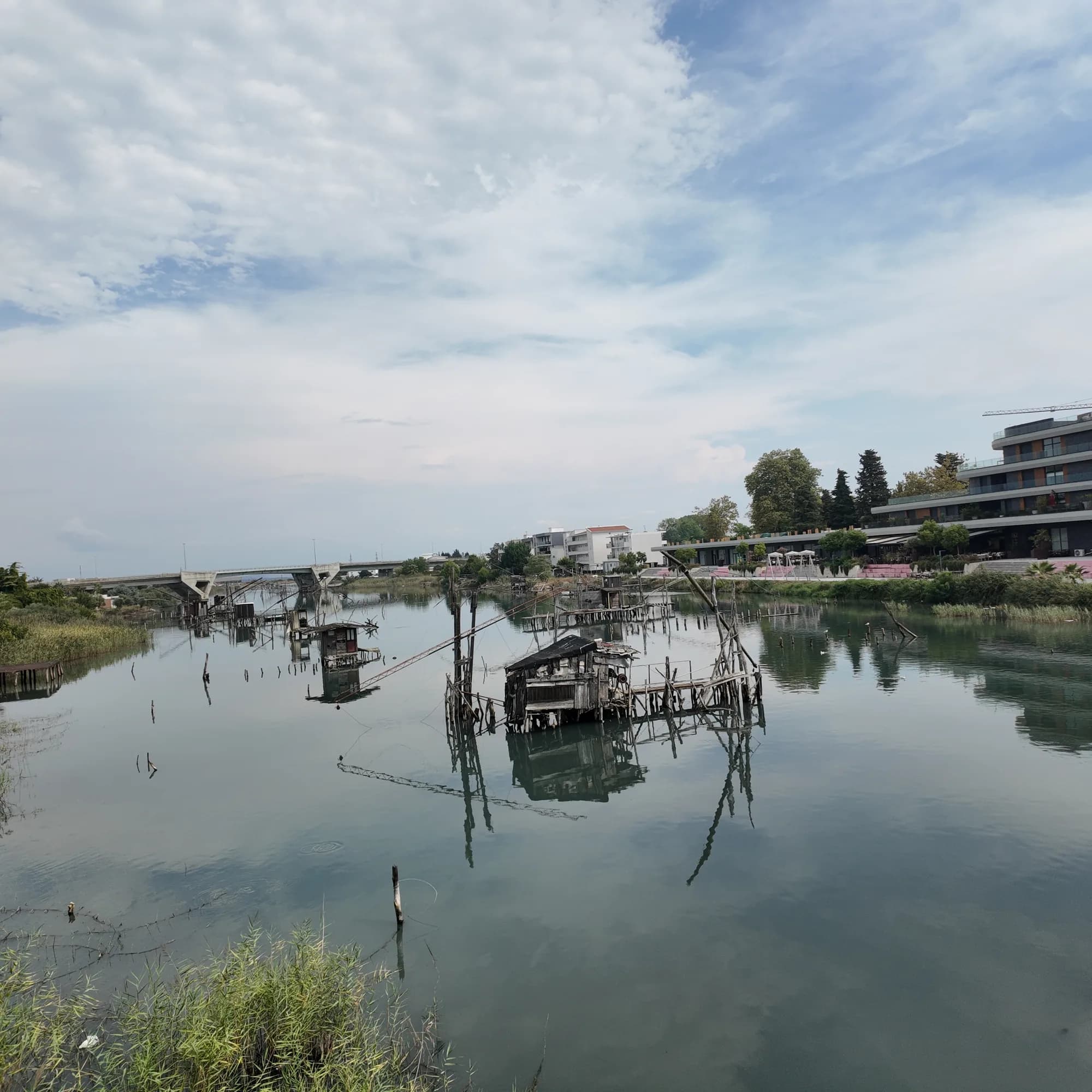
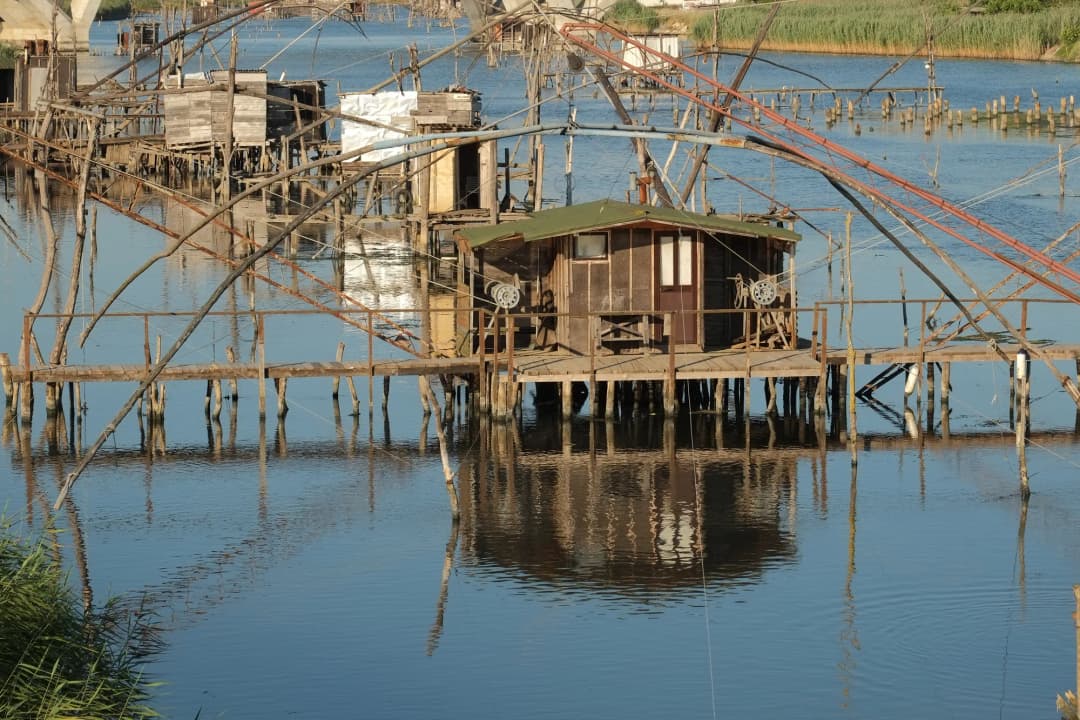
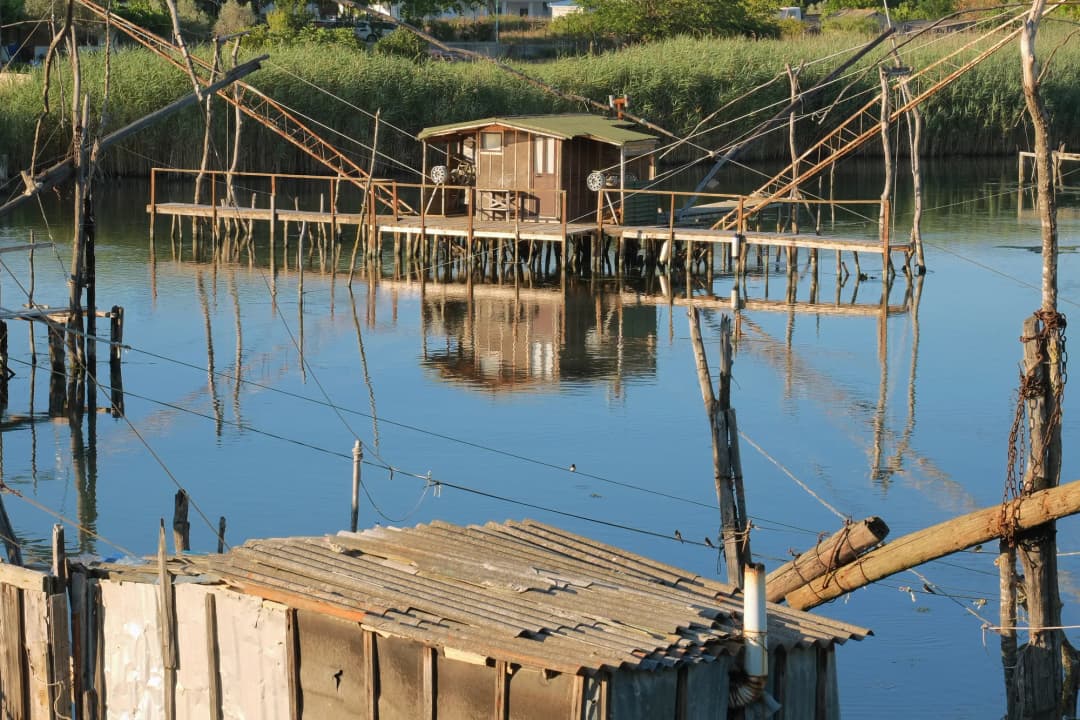
Port Milena’s kalimeras are protected because people know how to build and fish with them—not because every wooden hut is a public attraction. Along the canal east of Ulcinj, platforms on piles support long booms and square lift nets. Some structures appear maintained; others are weathered. A visitor can read the mechanism from public viewpoints, but cannot assume a net will operate, a platform is safe to enter or a catch is available to buy.
The honest story is more interesting than the inherited postcard version. An archival university study separates the 1885 drainage scheme from the 1896 flood that enlarged the channel and the April 1898 dedication of the new port as “Princess Milena.” National cultural authorities protected fishing with kalimeras as intangible heritage in 2017. Current environmental evidence records improvement at Port Milena since 2016, while still classifying the canal as a pollution hot spot requiring further attention.
| Established | Do not assume |
|---|---|
| Drainage planning involved engineer Varman in 1885 | The finished port and its name both date to 1885 |
| A flood enlarged the canal in 1896 | Its present form came from one construction event |
| The port received the Princess Milena name in 1898 | The name was a spontaneous fishing nickname |
| Fishing with kalimeras is protected intangible heritage | Every visible hut is itself a listed public monument |
| The canal improved from hot-spot A to B | The water is therefore suitable for contact or consumption |
| Wastewater and fishing-port projects are under way or proposed | Either project has already restored the canal |
A drainage canal became Port Milena
The canal’s origin was land and water management, not a purpose-built heritage display. The Ulcinj lowland contained marshy ground associated with Zoganj Lake. A 2024 University of Montenegro doctoral dissertation, drawing on archival files and earlier maritime history, says Russian engineer Varman became involved in the drainage project in 1885. The plan called for a canal longer than 4 km, with widths of 9 m and 7 m.
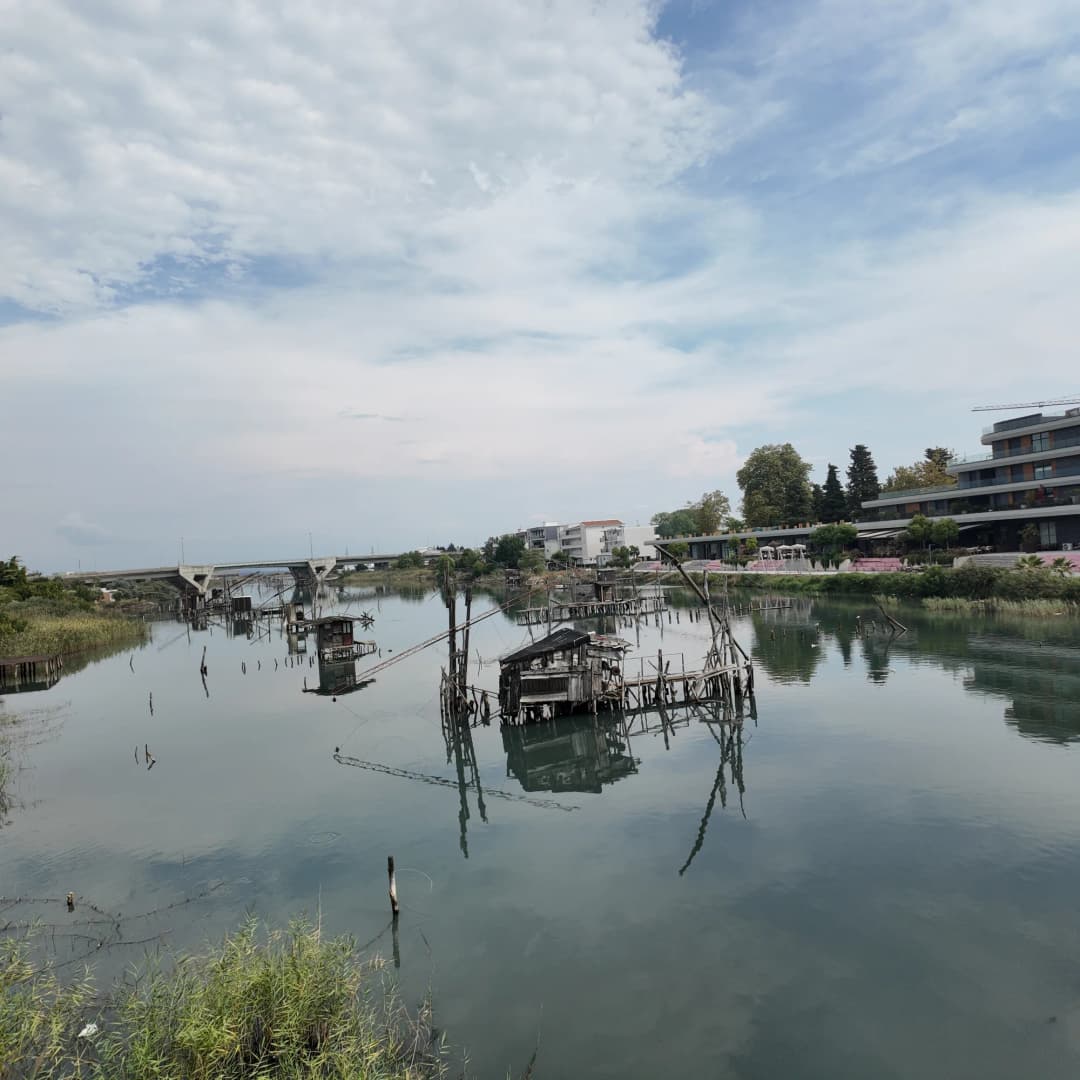
The same archival study does not collapse every later change into that date. It says work began around 1886; after a major 1896 flood breached the Bojana bank and passed through the lake and canal, the waterway was enlarged and Port Milena emerged as shelter for vessels. Austro-Hungarian naval surveyors mapped the Đerane port in 1897.
At the new port’s consecration in April 1898, the study says it received the name Knjaginja Milena—Princess Milena. That is earlier than Milena Petrović-Njegoš becoming queen in 1910. “Named for Queen Milena in 1885” compresses engineering, flood, port formation and naming into one inaccurate sentence. The better chronology preserves all four stages.
| Date | Event |
|---|---|
| 1885 | Varman joins drainage project |
| c.1886 | canal work begins |
| 1896 | flood enlarges waterway |
| 1898 | Princess Milena name |
| Note | Archive-led chronology · not one 1885 origin event |
Source: ucg.ac.me, gov.me
How a kalimera lift net works
A kalimera combines a fishing platform with a lift-net mechanism. Long booms project over the channel. Lines suspend a square net spread by crossed members. The fisher lowers the net horizontally into the water, waits for fish to pass above it, then raises the frame. A counterweight and winch or hauling system reduce the force needed to lift the wet net and catch.
The visible hut is useful working space, but the heritage lies in more than carpentry. It includes reading water and fish movement, placing and maintaining the structure, setting the net, timing the lift, handling the catch and transmitting those skills. A new decorative hut without practitioners would not, by itself, preserve fishing with kalimeras.
The word resembles Greek kaliméra, “good morning,” but resemblance is not etymology. The national heritage sources reviewed describe and protect the practice without giving a linguistic ruling. No archival linguistic source was found that settles the name’s origin, so this guide treats it as unresolved.
| Component | Role in system |
|---|---|
| PLATFORM / HUT | Base structure |
| BOOM | Extends over water |
| WINCH | Raises and lowers |
| SQUARE LIFT NET | Catches fish |
Source: gov.me, wapi.gov.me
| Step | Action |
|---|---|
| 1 | CHECK |
| 2 | LOWER |
| 3 | WAIT + READ |
| 4 | LIFT |
| 5 | SORT + RESET |
| Value | Technique + water knowledge + maintenance + transmission |
Source: gov.me, wapi.gov.me
What the 2017 heritage status means
What the sources say
The Cultural Heritage Administration’s current list includes “Ribarenje kalimerama”—fishing with kalimeras among Montenegro’s protected intangible cultural assets. The Ministry of Culture’s 2017 annual report records two elaborations and two decisions for new intangible assets that year: the skill of making layered cheese and fishing with kalimeras at Port Milena in Ulcinj.
“Intangible” matters. The protected subject is the living knowledge, expression and skill recognized by a community. The piles, hut, boom and net are material carriers of that practice, but a visitor should not describe every ruin, repair or restaurant imitation as individually listed. A 2025 environmental-planning document calls the nearby asset “material”; that conflicts with the Cultural Heritage Administration’s classification and its 2017 report, so this guide follows the specialist heritage authority.
The status is national, not UNESCO inscription. Montenegro’s heritage page explicitly distinguishes the country’s protected intangible assets from the one it identifies as placed on UNESCO’s world list, the Boka Navy. Calling the kalimeras “UNESCO-listed” would therefore be wrong.
| Layer | Elements |
|---|---|
| Practice (core) | KNOWLEDGE, SKILL, TRANSMISSION |
| Structures (carriers) | huts, booms, nets, platforms |
| Status | National intangible asset · not a blanket public-access designation |
Source: gov.me, wapi.gov.me
The environmental record: improvement is not restoration
Port Milena has a documented pollution legacy. Earlier Government remediation work identified wastewater, accumulated sediment and solid waste as connected problems and concluded that dredging alone would not be sustainable while major wastewater sources remained. That history is why the word “revival” needs evidence rather than optimism.
The 2026 Marine Environment Protection Strategy material adopted by the Government provides a useful, carefully bounded update. Its 2025 assessment moves Port Milena from priority hot spot A in the 2016 national action plan to hot spot B. The strategy attributes the improvement to some progress in sewer connection and waste management, and possibly to establishment of the Ulcinj Salina protected area. It still says all four B sites require further attention, stronger pollution-reduction work and continued monitoring. The Government’s 128th-session announcement records that the strategy was adopted on 28 May 2026.
That classification does not certify the canal for swimming, touching water, eating a specific catch or allowing children onto banks. This article makes none of those claims. Visitors should avoid contact, follow health and municipal notices and treat any food purchase through the ordinary licensed food chain rather than inferring safety from a net’s location.
| Stage | Category |
|---|---|
| NAP 2016 | A |
| ASSESSMENT 2025 | B |
| Meaning | B remains a hot spot requiring attention + monitoring |
Source: gov.me
Two projects, neither a finished canal cure
A visitor may see construction headlines and conclude the problem is solved. The project boundaries say otherwise. The Environmental Protection Agency’s January 2026 documentation for a fishing port at Rt Đeran reviews older plans for 40 fishing berths and up to 50 recreational berths. It also says local fishers and boat owners use Port Milena for shelter, while sand accumulation can restrict navigability at the mouth.
Update, September 2026. The state maritime authority, Morsko dobro, budgeted €485,000 for the Port Milena zone in 2026: a retaining wall along the road to Cape Đerane and a wooden pedestrian bridge over the canal linking Đerane to the start of Velika Plaža below the Otrant hotel, with the tender to follow once the municipality’s documentation is complete. In the same statement it said plainly that these works do not solve the canal’s core problem, the inflow of sewage. As of April 2026 the €5 million sewer for Donja Bratica, Bijela Gora, Totoši and Kodre had passed technical acceptance but awaited a building permit, the Đerane outfall was still not operating, and the consultant for the town’s treatment plant — GOPA, about €1 million from a €30 million KfW grant — had been signed only on 18 March. Ulcinj’s ecologist Dželal Hodžić warned that fresh water alone will not clear a sludge layer on the canal bed that is “certainly deeper than a metre”.
Most importantly, the 2026 port assessment states that wider Port Milena wastewater collection and treatment sit outside the fishing-port project’s scope. It recognizes the need for an urgent comprehensive solution and says the pollution problem predates the port project and is addressed through other plans and programmes. A new harbor proposal is not canal remediation.
A separate Ulcinj wastewater programme did break ground in October 2025. The Western Balkans Investment Framework reports a total estimated investment of €61.8 million, with construction of a treatment plant and water-network upgrades under way and expected completion in 2028. It is designed for a population equivalent of 60,000 and intended to end untreated effluent discharge into the Adriatic. That is meaningful progress, but a future completion target is not proof of present canal-water quality.
| Project | Scope | Status |
|---|---|---|
| FISHING PORT | Rt Đeran harbor; berths + shore facilities | Wider wastewater: outside project scope |
| WASTEWATER PROGRAMME | plant + network upgrades | launched October 2025; Target: completion 2028 |
| Caveat | Project milestone ≠ current water-quality certificate |
Source: epa.org.me, wbif.eu
Practical Port Milena visit
Approach Port Milena as a working waterside landscape. Use only clearly public roads, bridge approaches and signed public space. Stop where parking and pedestrian access are lawful and do not obstruct residents, fishers, cyclists or traffic. The absence of a ticket booth is not permission to enter a platform, yard, gangway or boat.
- Begin with a wide view: identify the pile-supported huts, long booms and net frames from public space.
- Check the foreground: broken boards, improvised rails, mud and traffic can make a visually close structure physically inappropriate.
- Use a long lens: photograph across the canal rather than stepping onto private or fragile structures.
- Ask before portraits or close work: a fisher at work is a person, not heritage scenery supplied for a camera.
- Do not request a demonstration: fishing depends on the practitioner, equipment, water and lawful activity—not a visitor schedule.
- Keep water contact out of the plan: the current strategy still classifies Port Milena as a hot spot.
Morning and evening can produce lower-angle light, but there is no guaranteed “best fishing hour” in the reviewed sources. Weather, season, tides, equipment and individual practice matter. Use light as a photography choice, not a promise that a net will rise.
| # | Rule |
|---|---|
| 1 | Clearly public viewpoint |
| 2 | Safe surface + no obstruction |
| 3 | Distance or permission |
| 4 | No platform entry or demonstration demand |
| 5 | No canal-water contact assumption |
Source: gov.me
Build a wider Ulcinj day without forcing a performance
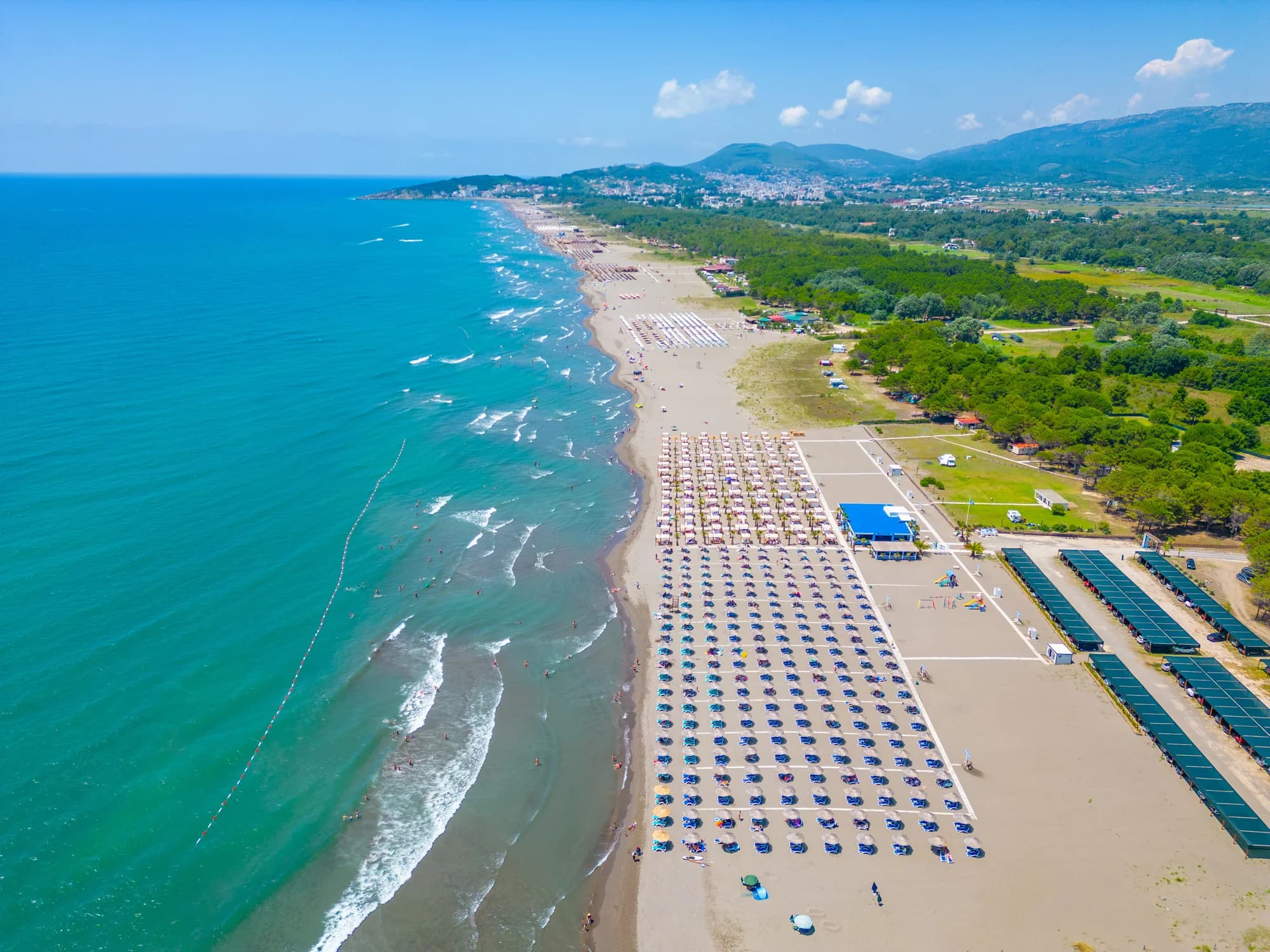
Port Milena forms the western threshold of Velika Plaža. The long beach has its own current access, bathing and wind decisions; do not transfer the canal’s heritage rules or water conditions to the signed beach, or vice versa.
Inland, the canal connects historically and hydrologically with the transformed Zoganj wetland and today’s Ulcinj Salina. The Salina is a protected landscape with its own entry and wildlife-viewing status. Check its current access rather than walking from a canal bank across apparently open ground.
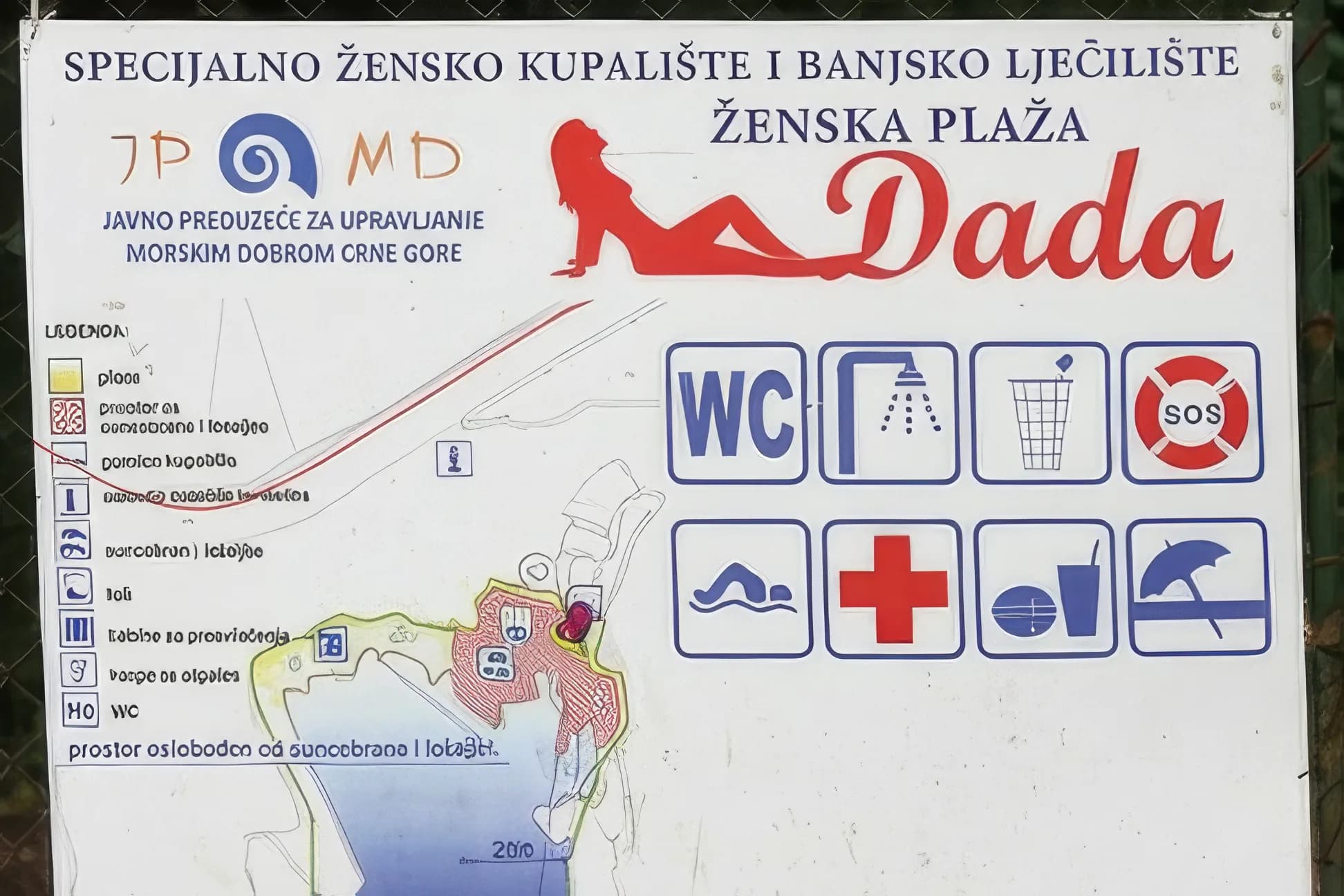
For a city sequence, continue to the old town and use the Slave Square and Cervantes evidence audit to separate documented history from legend. The Ženska Plaža guide applies the same care to health tradition, privacy and women-only access.
If choosing a base, compare the neighborhood logic in where to stay in Ulcinj. If continuing south, the Montenegro–Albania guide covers border planning. None of these additions depends on finding a working kalimera at a particular time.
| Place | Relationship |
|---|---|
| ULCINJ | Town anchor |
| PORT MILENA | kalimeras + canal |
| VELIKA PLAŽA | Connected coast |
| SALINA / WETLAND | Connected wetland |
| Note | Conceptual relationship · not a walking route or property map |
Source: gov.me, ulcinj.travel, epa.org.me
Frequently asked questions
What is a kalimera?
At Port Milena, it is a pile-supported fishing installation using long booms to lower and raise a square lift net. The protected heritage is fishing with kalimeras—the associated skill, knowledge and transmission—not merely the silhouette of a hut.
When was Port Milena built?
There is no honest single date. Varman joined a drainage project in 1885, canal work began around 1886, a major 1896 flood enlarged the waterway into vessel shelter, and the new Đerane port received the Princess Milena name in April 1898.
Are the kalimeras UNESCO-listed?
No. Fishing with kalimeras is protected on Montenegro’s national intangible-heritage register. The Cultural Heritage Administration separately identifies the Boka Navy as the Montenegrin intangible asset on UNESCO’s world list.
Does “kalimera” mean good morning in Greek?
The word resembles the Greek greeting, but resemblance alone does not establish an origin. The reviewed heritage authorities do not settle the etymology, so this guide treats it as unresolved.
Will I see a net operating?
Do not plan around that expectation. Operation depends on a practitioner, maintained equipment, water, lawful activity and timing. Observe what is happening without requesting a performance.
Can I walk onto a kalimera platform?
Not without explicit permission. Structures and approaches may be private, fragile or unsafe. Use clearly public viewpoints, respect barriers and avoid obstructing work or traffic.
Is Port Milena clean now?
The 2025 assessment improved its classification from hot spot A to B, but the 2026 strategy says B sites still need attention, pollution reduction and monitoring. That is progress, not a contact-water certificate.
Will the fishing-port project fix canal pollution?
The January 2026 assessment explicitly places wider Port Milena wastewater collection and treatment outside the fishing-port project’s scope. A separate wastewater programme started construction in 2025 and targets 2028 completion.
A responsible Port Milena visit leaves the machinery, people and uncertain water undisturbed. From public space, the long booms still reveal a complete cultural system: nineteenth-century water engineering, a living fishing skill, decades of environmental pressure and a future that remains under construction.