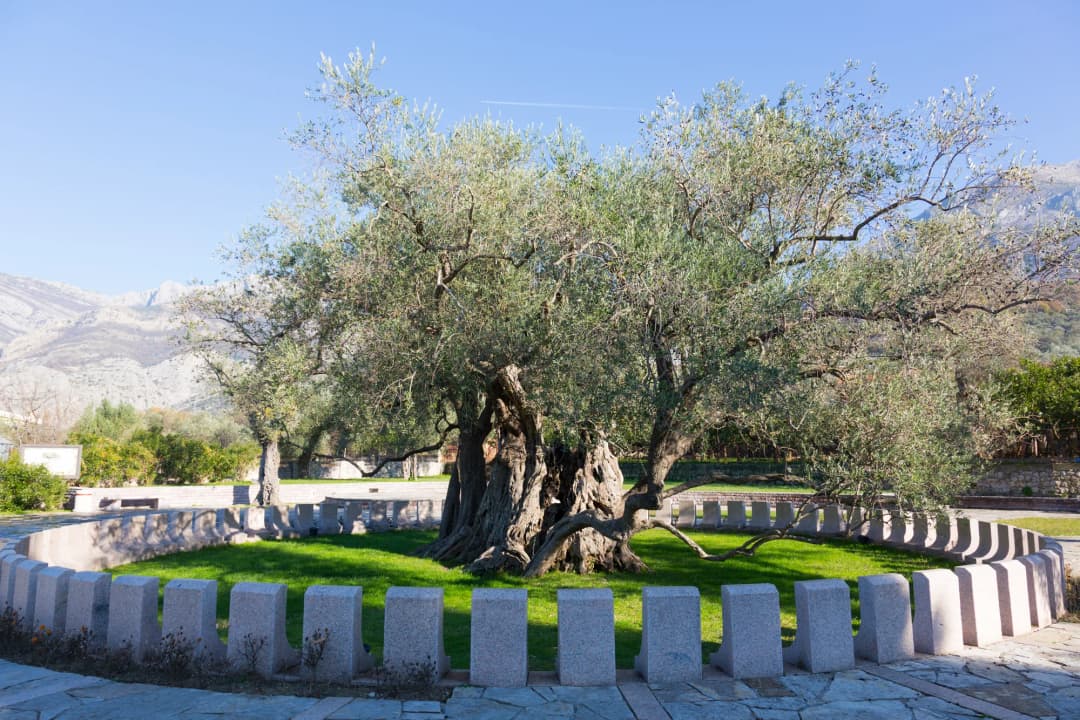
Stara Maslina is not valuable because a slogan calls it “the oldest tree in Europe.” It is valuable because Bar has measured, studied and protected a living olive whose official age estimate is 2,240 years. The distinction matters: an estimate is not a planting certificate, and “one of the Mediterranean’s oldest documented olive trees” is more honest than an unprovable continental record.
The tree stands at Mirovica, inland from modern Bar and close to Stari Bar. Its folded trunk, living crown, fruit and fire scar tell different kinds of history. This guide separates measurement from tradition, legal protection from tourism copy, and a current ticket price from visitor details that still require a phone call.
| Verified | What it does not prove |
|---|---|
| Official estimate: 2,240 years | Exact planting year or Europe-wide rank |
| Protected since 1957 | That every older source uses the same date |
| Trunk circumference: 7.8 m | The inherited “roughly 10 m” figure |
| Fruit studied from 2012–2016 | A guaranteed crop in 2026 |
| Peace story recorded locally | Proven etymology or documented feuds |
| Adult ticket listed at €2 | Permanent price or published opening hours |
How old is Stara Maslina?
The strongest public number comes from a Bar–Ulcinj project carried out in 2014 and 2015. Fifty selected old olive trees were assessed. The Municipality of Bar’s 2024–2028 management plan reports Stara Maslina as the oldest in that sample, with an identified age of 2,240 years. A Government summary of the project says two of the 50 sampled trees exceeded 2,000 years.
That result supports “about 2,240 years old.” It does not reveal a known planting date, so converting it into a precise third-century-BC origin adds false certainty. Ancient olive trunks are also difficult chronological objects: old wood can decay and the organism can continue through living tissue and new growth. The careful reading is an official age estimate produced by a defined project, not a literal birthday.
| Item | Value |
|---|---|
| Selected old trees | 50 |
| Assessment project | 2014–15 |
| Reported age estimate | 2,240 |
| Supported | About 2,240 years old |
| Not supported | Exact planting year or "Europe's oldest tree" |
Source: bar.me, gov.me
The tree in measurable terms
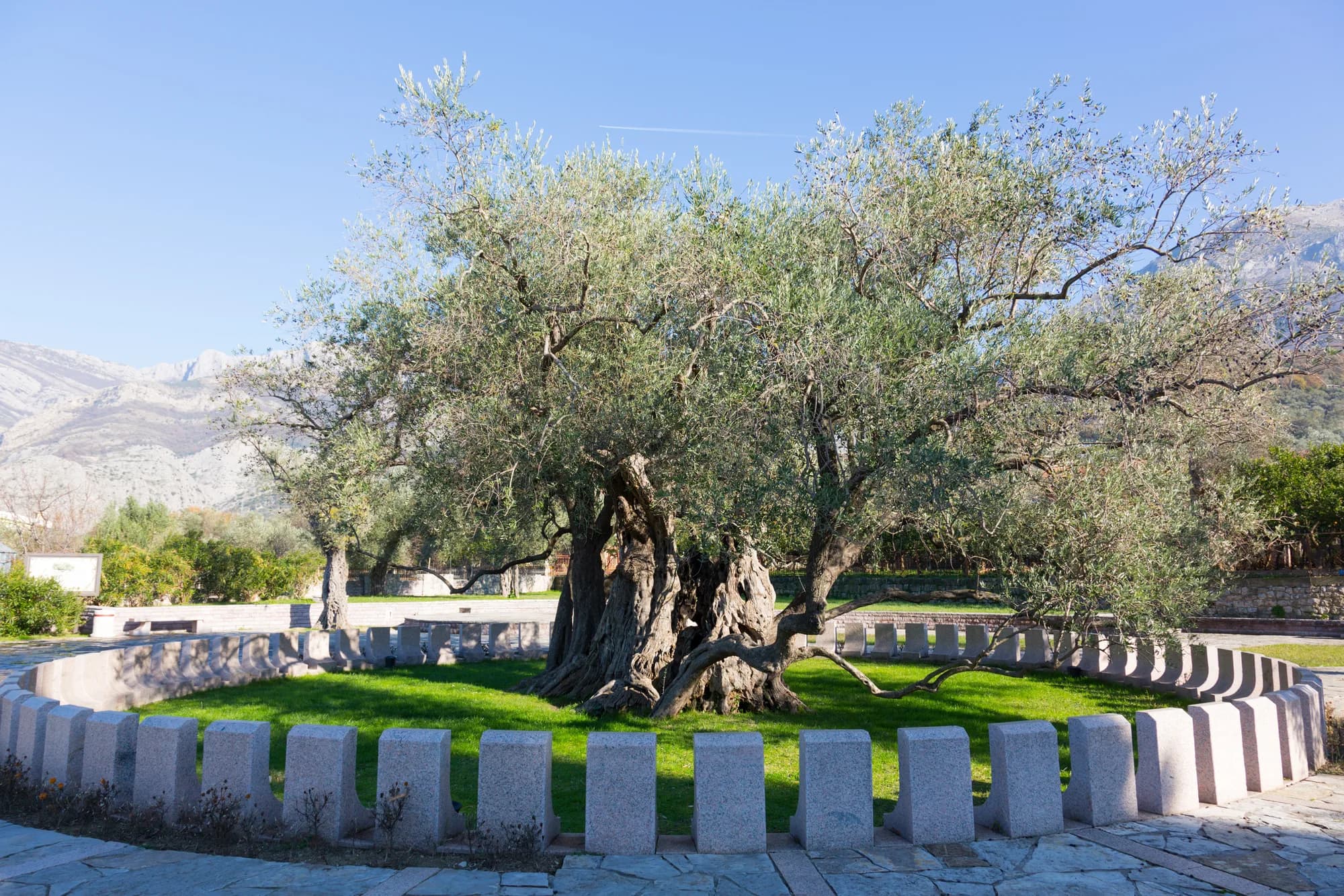
The management plan records a trunk circumference of 7.8 m and a diameter just under 2.5 m. The crown reaches 15 m across its widest section, and its ground projection covers 111 m². These measurements replace the inherited ten-metre circumference. The protected site is recorded at 47 m above sea level, around 42.080164° N, 19.129400° E.
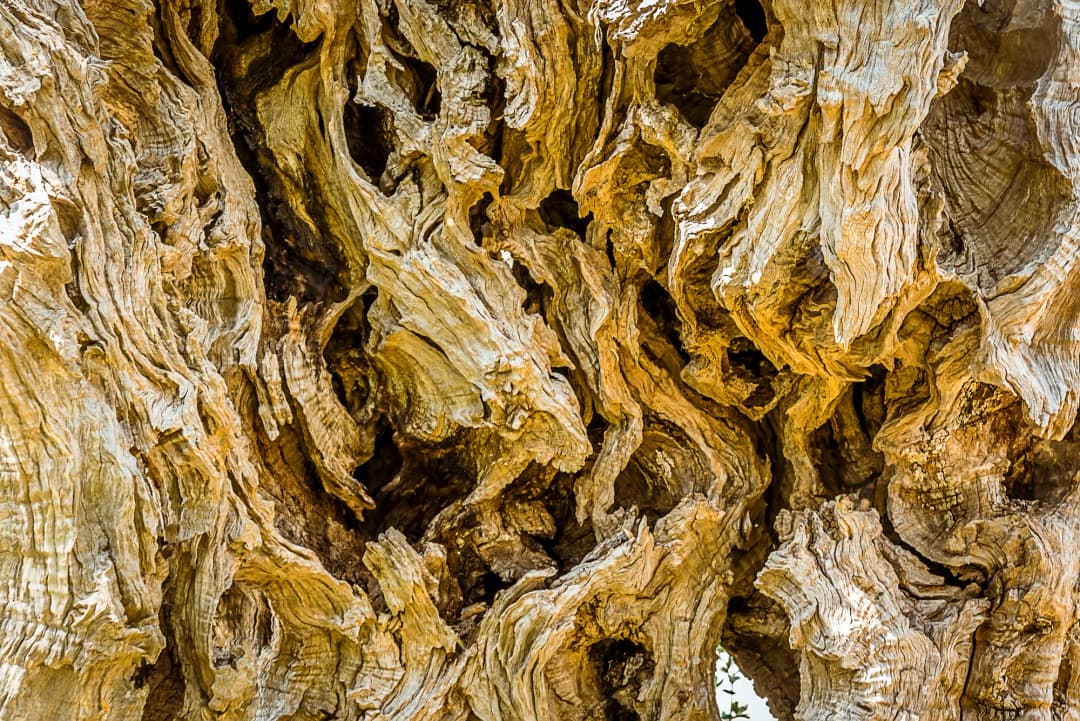
Close up, a number matters less than the structure it describes. The old wood is hollowed, folded and divided, with living branches rising above it. Do not climb, remove leaves or enter beyond visitor barriers. This is managed living tissue, not a dead architectural ruin.
| Measurement | Value |
|---|---|
| Circumference | 7.8 m |
| Diameter | <2.5 m |
| Widest crown span | 15 m |
| Crown projection / protected monument area | 111 m² |
Source: bar.me
Alive, fruiting and biologically distinctive
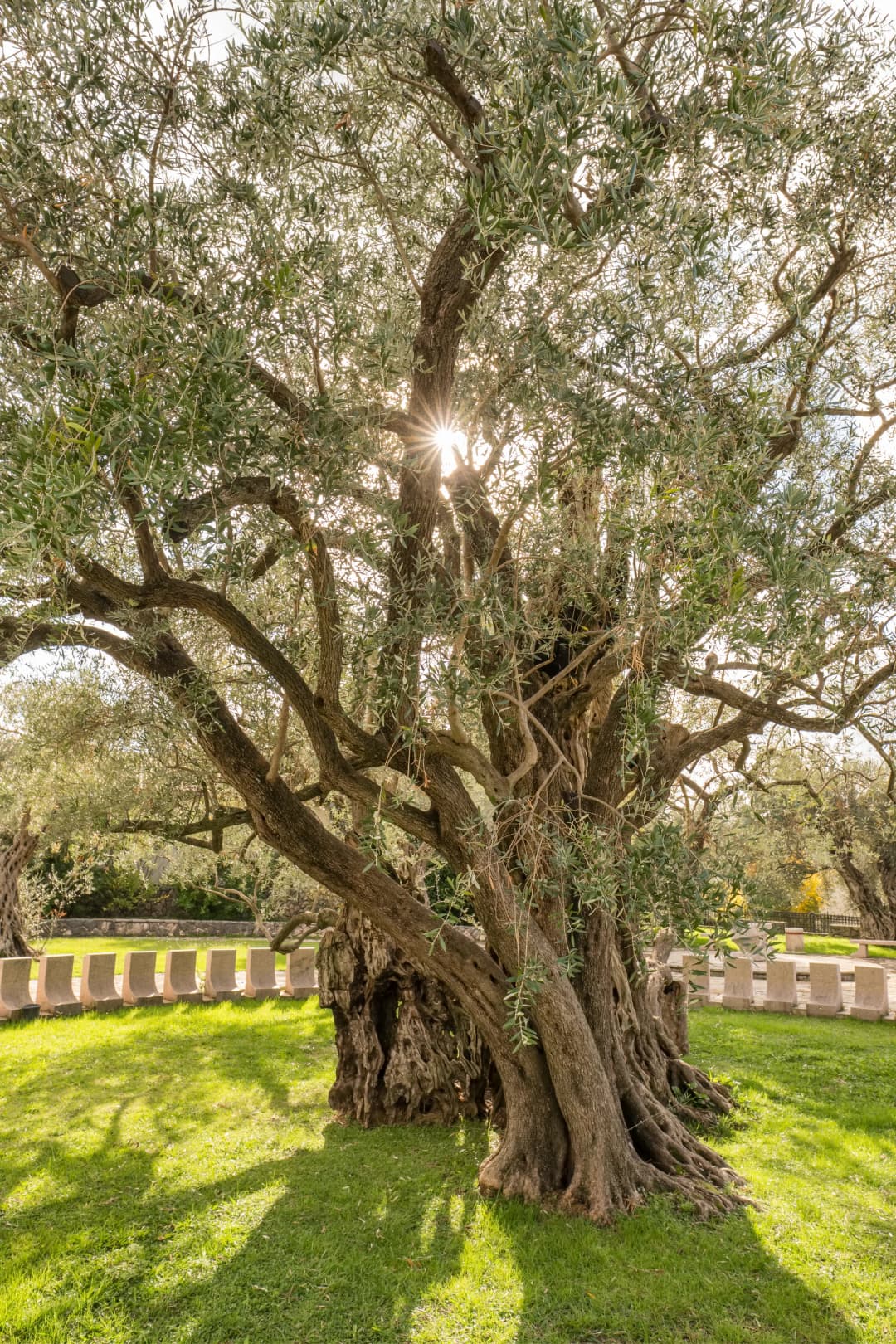
A peer-reviewed 2018 study by University of Montenegro researchers did more than repeat the age claim. It collected morphological observations over five years, from 2012 through 2016, and examined fruit and oil across multiple seasons. During that observation period the tree flowered, ripened and produced a regular medium-to-high yield reported at around 120 kg. That is sound evidence that the ancient organism was productive then; it is not a promise about this year’s harvest.
The study compared Stara Maslina with local Žutica olives. Three of eleven tested SSR genetic markers distinguished their DNA fragments. Its fruits were smaller and contained less oil than the comparison sample, while oil from both complied with the tested quality limits. The result complicates the easy label “just an old Žutica”: the authors called for broader comparison with other ancient trees and local varieties.
| Evidence | Finding |
|---|---|
| Five-year observation | 2012–2016 |
| Regular yield in study | about 120 kg |
| Distinguishing SSR markers | 3 of 11 |
| Caveat | Historical observations are not a 2026 crop forecast |
Source: scielo.br
Protection: 1957, with a 2020 designation
The current official management history says Stara Maslina was placed under protection in 1957 under the law then covering cultural-historical monuments and natural assets. Bar’s municipal assembly declared it a protected natural monument, category III, in December 2020. The state owns the protected ground, the Municipality of Bar holds the right of use, and the designated municipal secretariat is the site manager.
Why do some texts say 1963? The 2018 scientific paper uses that date for registration as a natural monument. The newer official management plan and the official manager’s visitor page both give 1957. This guide follows the current management record and flags the older inconsistency rather than hiding it.
| Year | What it marks |
|---|---|
| 1957 | Official first protection |
| 1963 | Older paper's wording |
| 2020 | Category III designation |
| Note | 1957 is the date used by today's manager and plan |
Source: bar.me, kucamaslina.me, scielo.br
Fire, water and the work of keeping an ancient tree alive
The blackened and lost wood should not be reduced to a colourful card-game tale. The management plan dates a serious fire to 1958. It reproduces a contemporary account in which flames returned after an initial response and 12,000 litres of water were used; firefighters reportedly suspected deliberate ignition, but that is not proof of a culprit. The damaged section survived partially attached until roughly one third of the trunk broke away in September 2004.
Fire is only one risk. The 2024–2028 plan lists groundwater, surface water, disease and pests too. Olives dislike waterlogged soil, and the plan records drainage work beginning after an environmental permit issued in January 2024. It also calls for monitoring and protection against threats including Xylella fastidiosa. A monument this old survives through active horticulture, hydrology and restraint—not simply because olives are immortal.
| Risk | Management measure |
|---|---|
| Groundwater | Deep drainage works |
| Surface water | Runoff collection |
| Fire | Prevention + response |
| Disease + pests | Monitoring + control |
| Principle | Protection means managing soil, water, people and biology |
Source: bar.me
The peace tree: tradition, not a court archive
Local tradition says people at odds reconciled beneath the canopy, and connects Mirovica with mir, peace. The Municipality of Bar and the scientific paper both record the story. It is meaningful cultural evidence: the tree has long functioned as a symbol and gathering place. It is not a list of documented settlements or conclusive linguistic proof.
The distinction makes the story stronger. Stara Maslina can be a peace tree because generations chose to narrate and use it that way, even when a particular meeting cannot be reconstructed. Cultural events still take place beneath the canopy, including a long-running children’s creativity festival. Respect the monument as both ecological organism and civic space.
For another case where archaeology and landscape must be read together, see the Roman mosaics beneath Petrovac’s olives. Bar’s tree is not proof of one specific Roman episode, but its estimated lifespan makes the surrounding ancient world a useful historical frame.
| Label | Basis |
|---|---|
| TRADITION | Reconciliation story |
| RECORD | Municipal + scholarly |
| PRACTICE | Gathering place today |
| Meaningful | Yes |
| A proven account of particular feuds | No |
Source: bar.me, scielo.br
Stara Maslina belongs to a wider olive landscape
The celebrity tree can obscure the groves around Bar. Municipal work in Džidžarin mapped 23 accessible old olives assessed at about 290–465 years, while noting that older, harder-to-reach specimens were not included on that visitor map. That is a more useful and traceable picture than repeating an unsupported regional total of “over 100,000 trees.”
Olive growing remains agriculture, not only heritage display. Government and municipal reports document harvest openings, producers, oil-quality awards and Maslinijada in Stari Bar. Do not build a trip around an assumed permanent November date: use a dated organizer announcement for the year you plan to attend. For a broader low-season itinerary, pair current events with our Montenegro off-season guide.
If deep time is your theme, compare the different evidence problem at the Risan Roman mosaics. If living coastal settlements matter more, Rose at the entrance to Boka offers another small place shaped by long maritime memory.
Practical visit to Stara Maslina in 2026
The official House of Olives visitor page lists admission at €2 for adults and €1 for children over eight. Children under eight and residents of Bar are listed as free. Those prices were checked on 30 August 2026 and can change.
No dependable opening hours were published on the official page reviewed for this update. Before a time-sensitive visit, contact the Stara Maslina ticket office on +382 67 137 931 or email [email protected]. Ask about that day’s hours, accessibility needs and any event affecting entry. Do not infer opening from an unsourced map listing.
| Need | Best current action |
|---|---|
| Location | Mirovica, inland from Bar; coordinates in the plan are about 42.080164, 19.129400 |
| Price | Check official manager page; adult €2 on 30 Aug 2026 |
| Hours | Call the ticket office; none verified on the official page |
| Mobility | Ask about step-free access and surfaces before travel |
| Photography | Stay behind barriers; do not climb or remove material |
| Festival | Use a dated organizer announcement for that year |
| Step | Check |
|---|---|
| 1 | Check current price |
| 2 | Call for hours |
| 3 | Confirm access needs |
| 4 | Respect barriers |
| 5 | Continue to wider Bar |
Source: kucamaslina.me
Build a responsible Bar itinerary
Give the tree enough time to circle slowly from the permitted visitor area, notice living and damaged wood, and read the panels. Then continue to Stari Bar rather than treating Mirovica as a drive-by photograph. If you are staying in registered accommodation, our tourist-tax and registration guide explains a separate practical obligation that should not be left until departure.
For a broader argument about why the country rewards slow travel, see why to visit Montenegro now. The best reason here is not a record-breaking superlative. It is the chance to encounter a protected organism whose biological life, civic meaning and vulnerabilities have all been documented.
Frequently asked questions
Is Stara Maslina really 2,240 years old?
That is the official estimate reported from a 2014–2015 project that assessed 50 selected old trees. Treat it as an approximate scientific result, not a known planting date.
Is it the oldest tree in Europe?
The reviewed sources do not prove that superlative. It is safer and still remarkable to call it one of the oldest documented olive trees in this part of the Mediterranean.
When was the tree protected?
The current municipal management plan and official manager say 1957. A 2018 scientific paper mentions 1963, but this guide follows the newer official protection history and discloses the conflict.
Does Stara Maslina still produce olives?
Yes in the bounded scientific sense: researchers observed flowering, ripening and regular yield during 2012–2016. That does not guarantee the size or availability of a crop in 2026.
Was the tree burned during a card game?
That colourful story is not established by the reviewed evidence. The official plan dates a serious fire to 1958 and records contemporary firefighter suspicion of arson, without proving who caused it.
How much does entry cost?
On 30 August 2026, the official manager listed adults at €2, children over eight at €1, and free entry for children under eight and Bar residents. Recheck before travel.
What are the opening hours?
No dependable schedule was found on the official visitor page. Call +382 67 137 931 or email [email protected] before a time-sensitive visit.
Stara Maslina needs no myth inflated into fact. A 2,240-year estimate, a 7.8 m living trunk, protection dating to 1957 and active conservation are already an extraordinary story—and a more durable one because each claim keeps its evidence label.