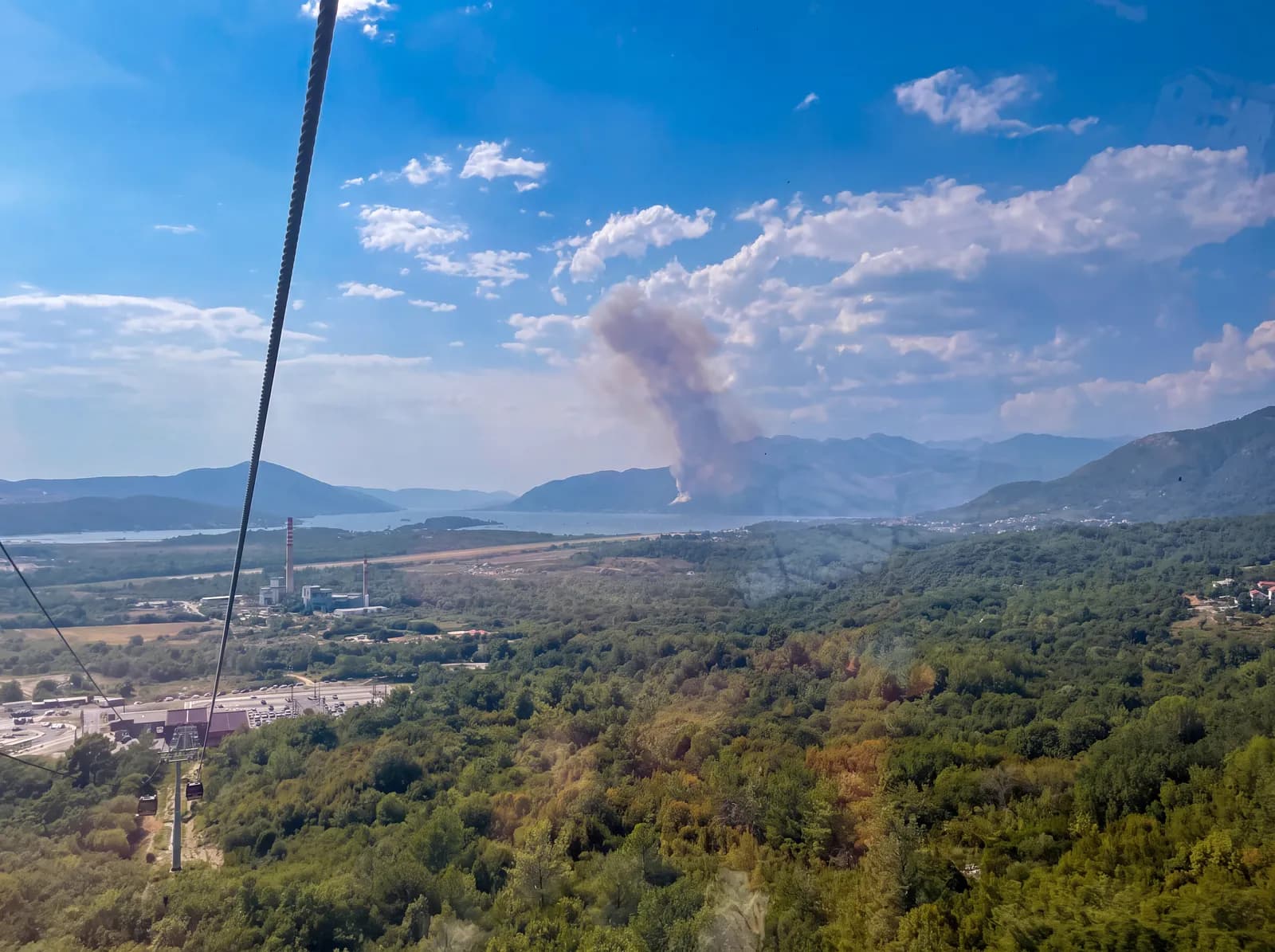
The Adriatic’s fires behave almost nothing like Malibu’s. Here is what that means for a trip — and how long it holds.
STATUS — 31 AUGUST 2026. Seventeen days on, the coastal emergency is over and the ledger has not moved: no house has been lost anywhere on the Montenegrin coast this season. The Herceg Novi fire is nevertheless still on the books — the Interior Ministry’s evening report of 26 August listed Đenovići and Bijelske Kruševice as active and under control, which is the ordinary late-August condition of burnt hinterland: ground smouldering in terrain nobody can drive into, watched rather than fought, with crews and aircraft on call if the wind turns. The reinforcement crews and soldiers left the coast in the third week of August, and Ulcinj’s water and power are back to normal. What pressure remains has moved inland, to Nikšić and Cetinje, where the last week of August was harder than anything the coast saw. The confirmed material damage from the whole coastal episode is still agricultural and electrical — one Briska Gora smallholding’s roughly 300 lemon trees, 100 pomegranates, an olive grove and its irrigation system, and about ten burned poles on the Gač line — and the EU’s Copernicus emergency service is still mapping the burnt area under activation EMSR922. Eight photographs from the Đenovići nights are published below. The analysis under them was written on 15 August, at the height of the fires; its numbers stand.
The fire above Bijela came down the hill on the second night, ran through the scrub to the edge of the village, and stopped at a wall.
It is the least dramatic sentence anyone wrote about the Montenegrin coast that week, and it is the whole story. Fifty houses were threatened above Herceg Novi. Fifty houses were still standing in the morning. The reason is not that Montenegro fought the fire better than California fought the Palisades. In most measurable respects it fought it with far less: no amphibious water bomber, a single Air Tractor, borrowed helicopters, volunteer brigades, and men from the village with garden hoses. The reason is that the fire arrived at a surface it could not ignite.
Every August someone photographs an orange line on a black ridge above Boka Kotorska and the same question follows within the hour. Is this the next Malibu? Should we cancel? The images are genuinely similar: two Mediterranean coastlines, two hillsides burning above the sea. The events behind them are not the same kind of event, and the difference is not luck or diligence. It is fuel, masonry, geography and ignition — four unglamorous variables that decide, before anyone dials 112, roughly how bad the night can get.
That should be reassuring, and in the short term it is. The uncomfortable part is that three of the four are moving in the wrong direction.
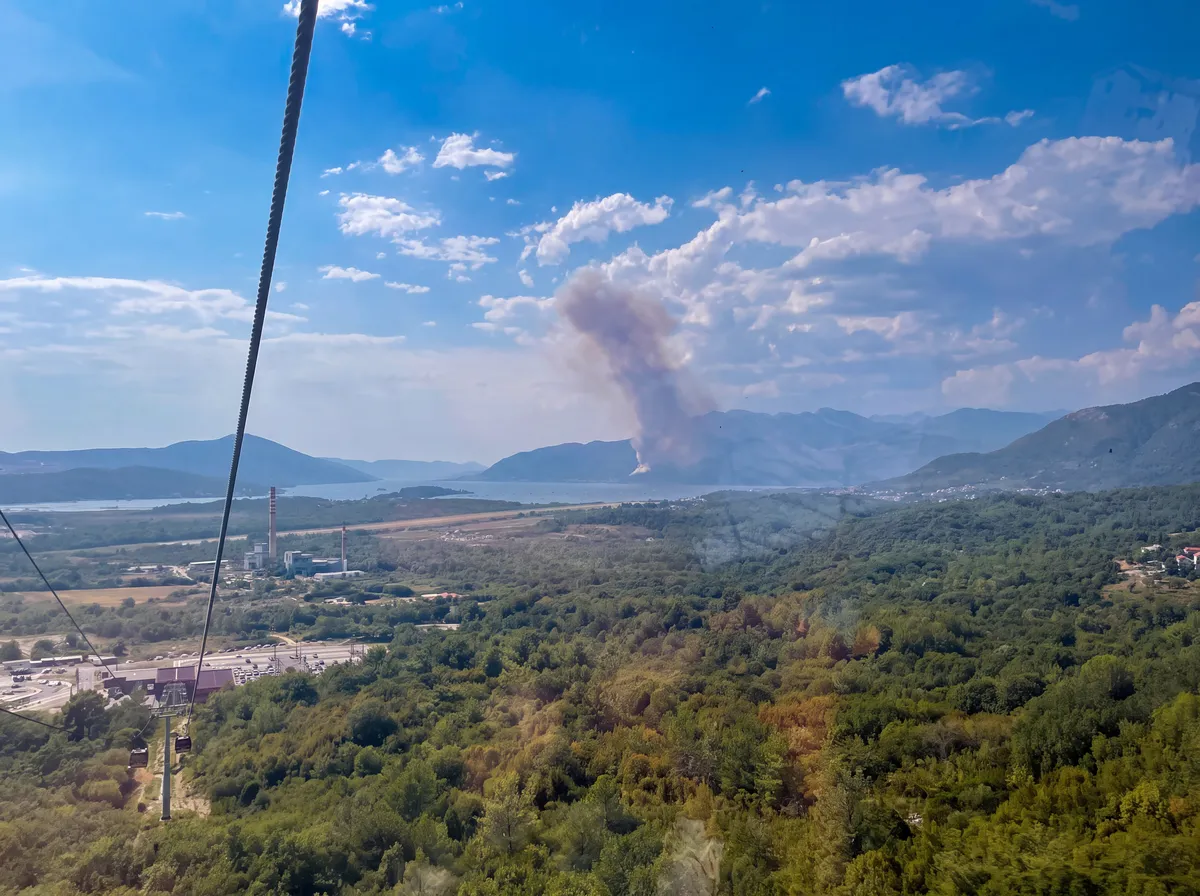
The nights above Đenovići
The eight photographs below were taken at Đenovići and Bijela between 14 and 19 August 2026 — from a gate, a car park, a pavement and a windscreen along the stretch of coast the fire front sat above for the better part of a week. They are montenegro.com originals, and they are what the fire actually looked like from the village.
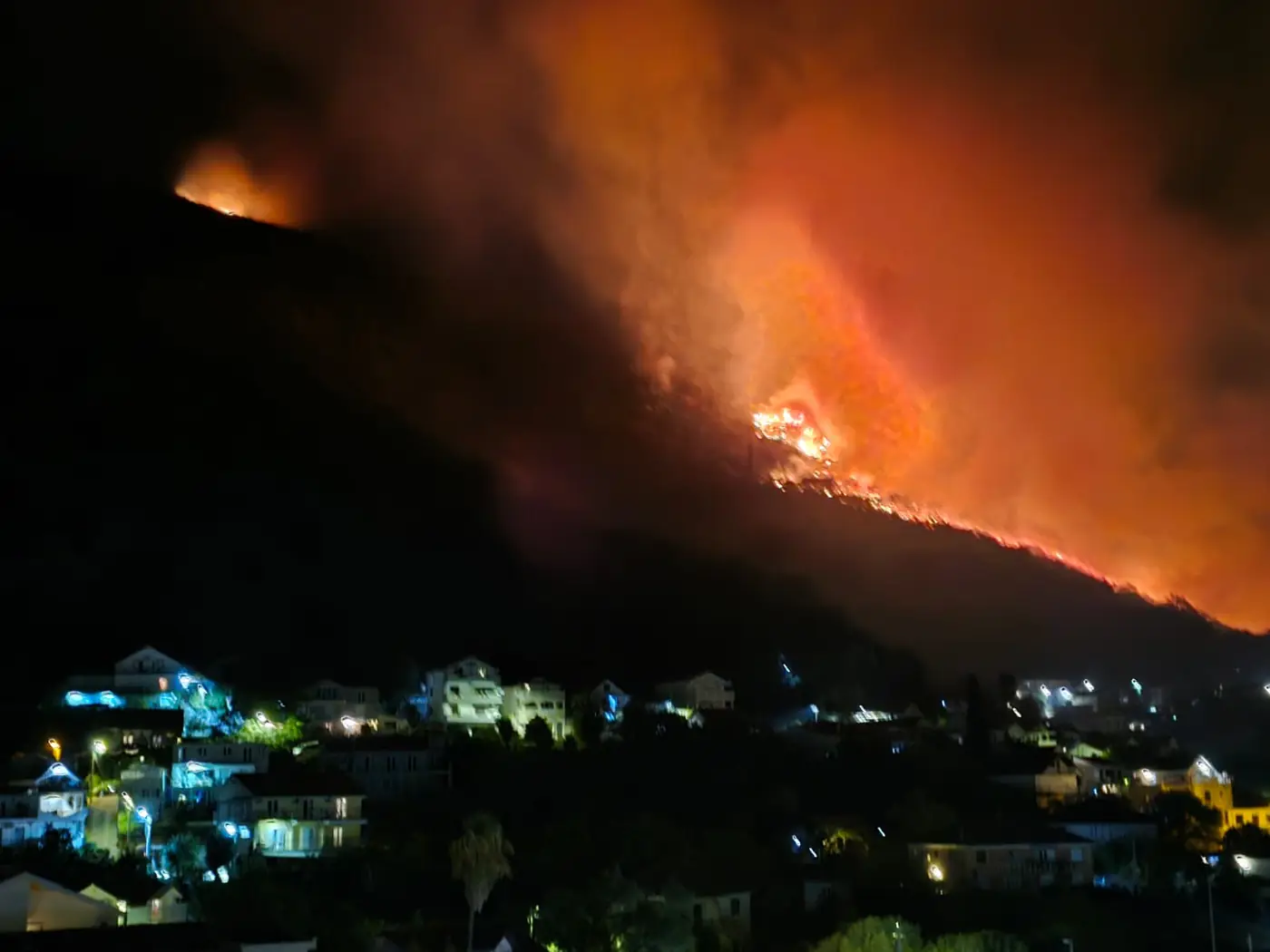
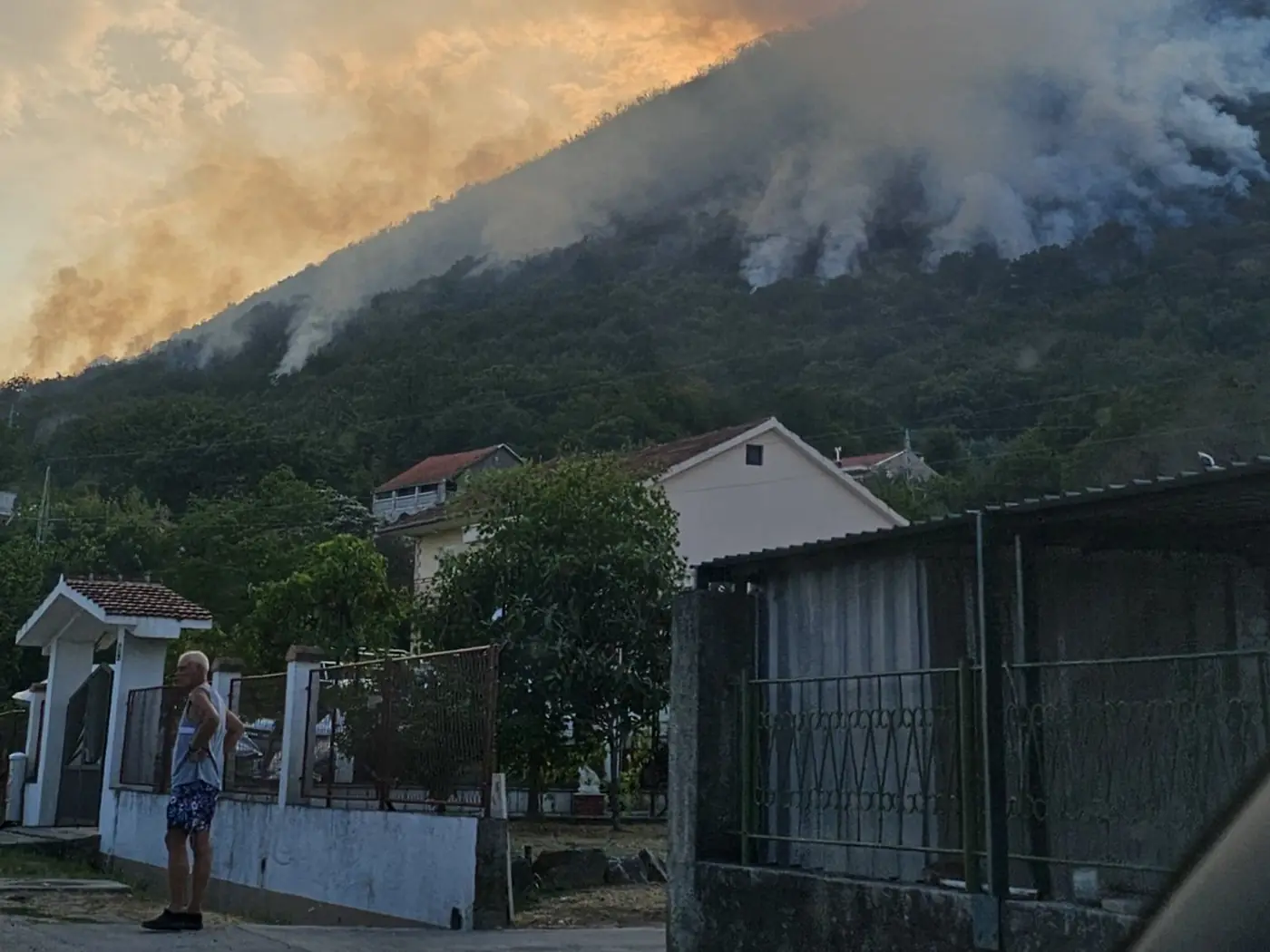
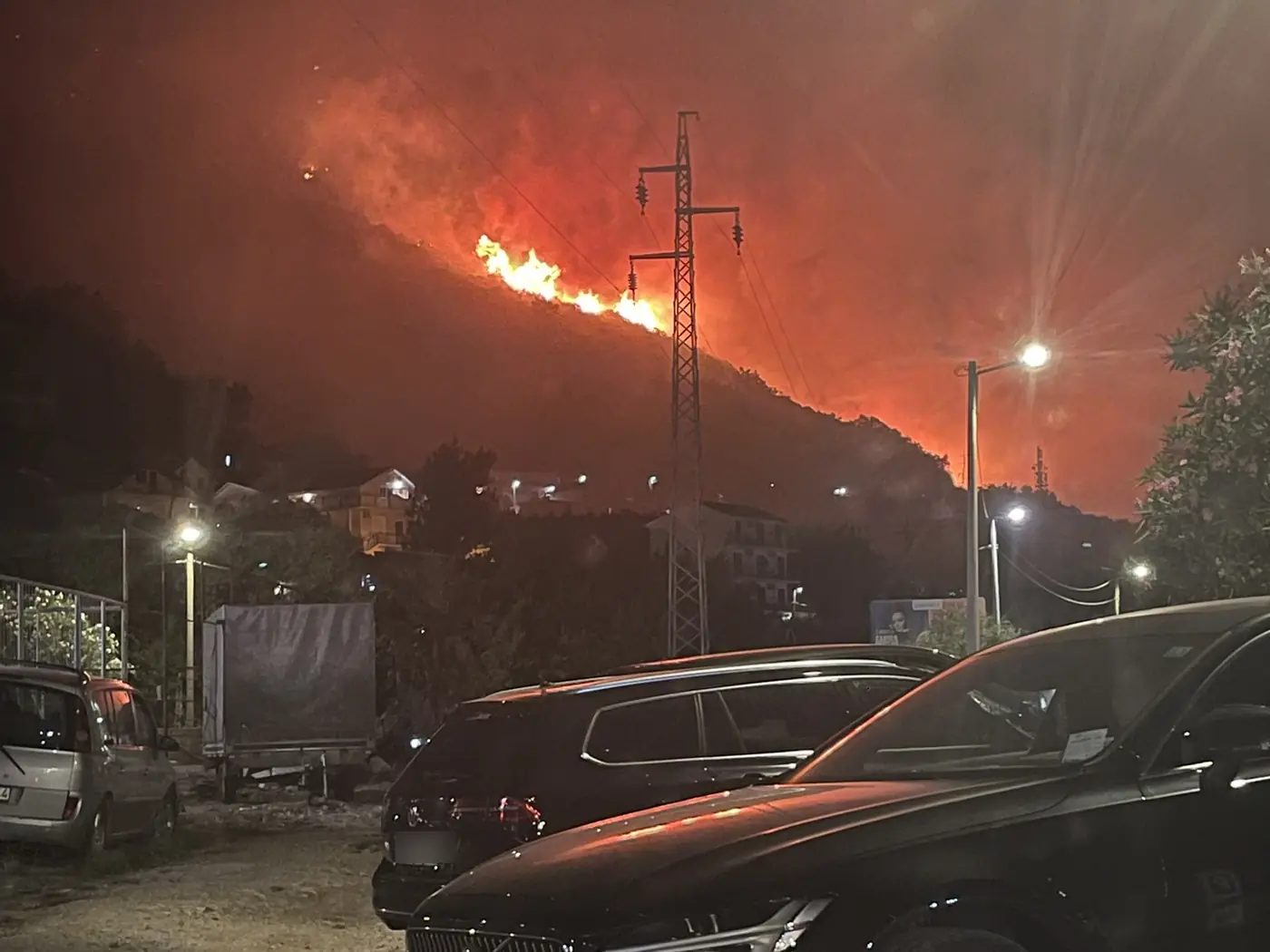
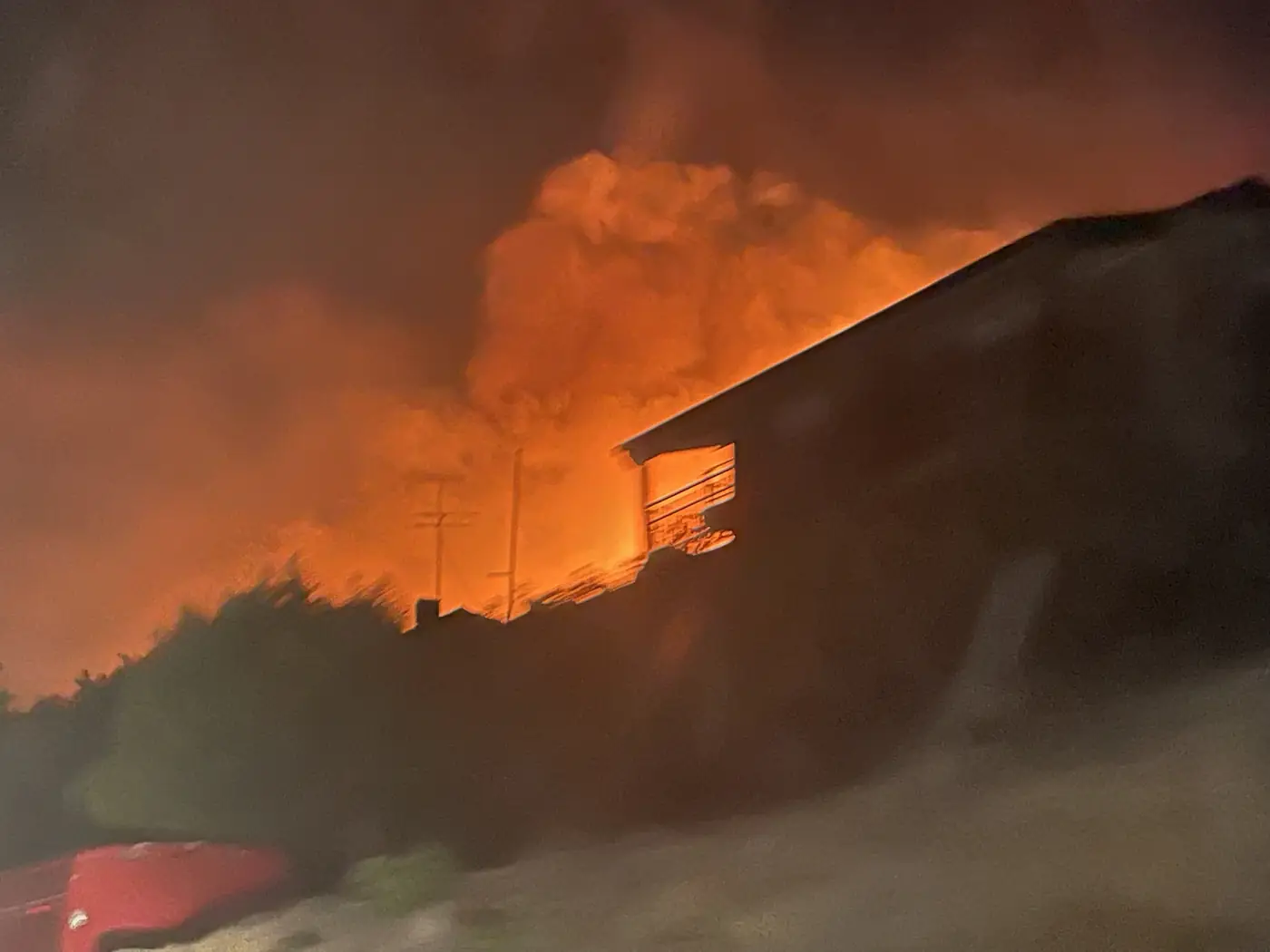
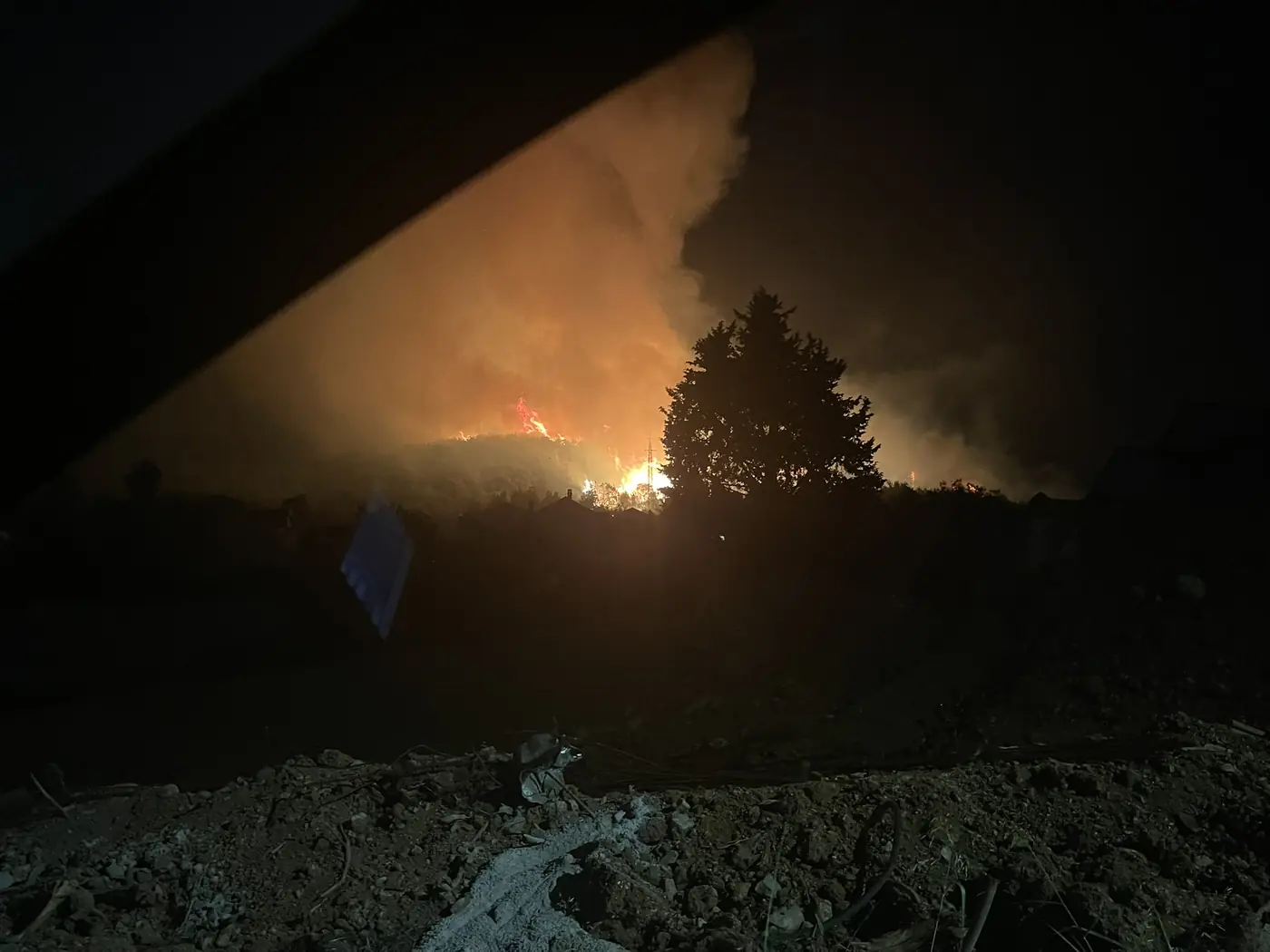
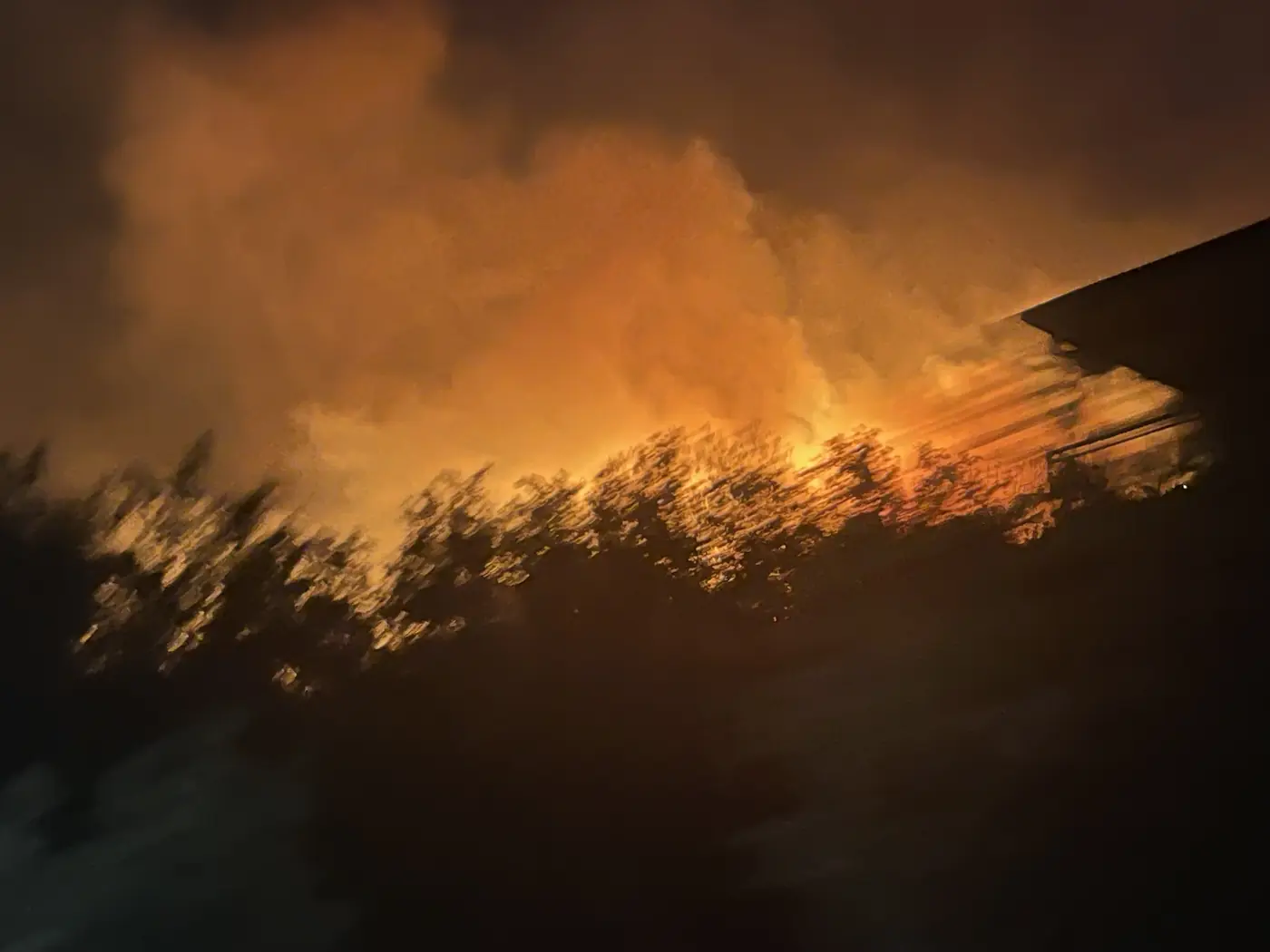
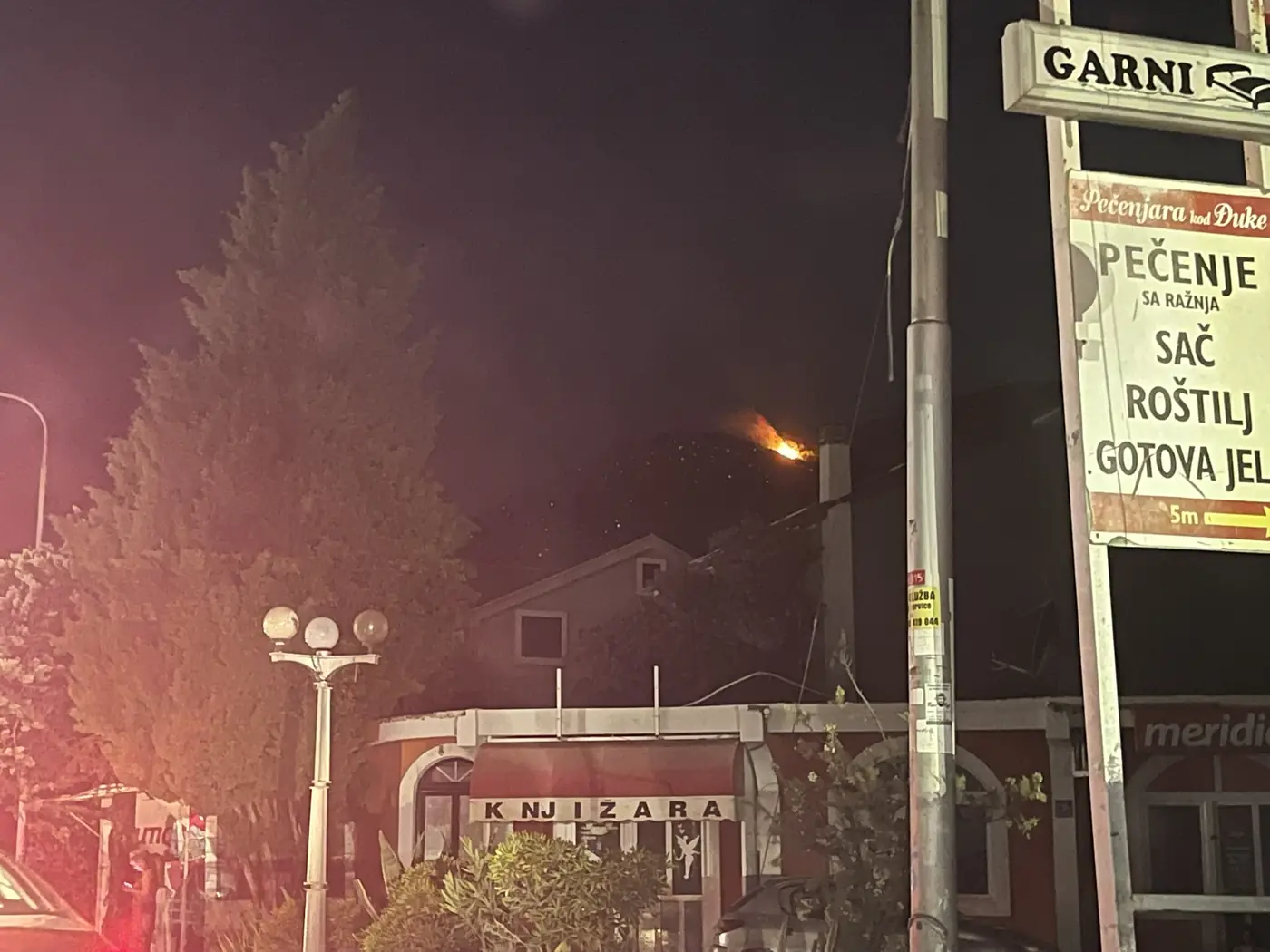
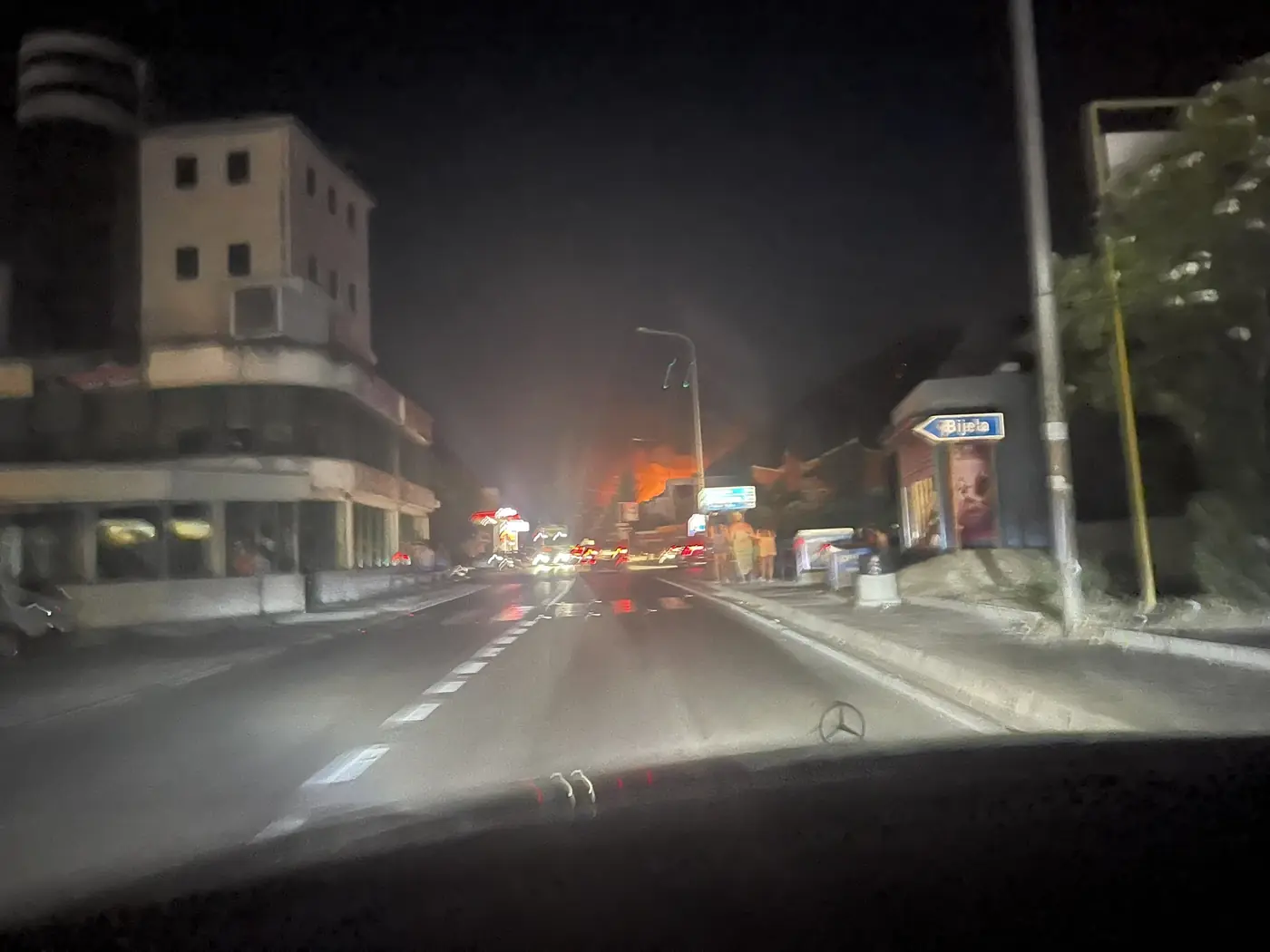
Photographed from below at night, this looks like the end of a village. It was not. The front ran the hinterland from Bijela to above Zelenika with Đenovići in the middle of it, and the line was held by the Herceg Novi protection and rescue service — seventeen vehicles and sixty-four people — with professional crews from Tivat and from Trebinje across the Bosnian border, volunteer brigades from Tivat, Perast and Bijela, the Luštica Bay works unit, an Air Tractor overhead, and an army helicopter that the ministry’s daily report credits with three sorties and thirty tonnes of water over Đenovići alone.
Below that line the week was ordinary. The bookshop stayed open. The Adriatic highway never stopped moving. The man in the daylight frame stood at his own gate, hands on his hips, and watched the hill above his roof burn.
Houses lost at Đenovići: none. Houses lost on the entire Herceg Novi fire: none. What burned was maquis, scrub and pine. That is exactly the result the four variables below predict — and it is why an orange ridge photographed on this coast is not the picture it appears to be.
What actually burned in California
In January 2025 the Palisades Fire ran through Pacific Palisades, Topanga and hillside Malibu. CAL FIRE’s damage assessment counted 6,837 structures destroyed and roughly a thousand damaged across 23,448 acres. Twelve people were killed. About 105,000 were evacuated. It stands as the third most destructive wildfire in California’s recorded history.
Montenegro’s fire seasons do not produce that, and the divergence begins at ignition rather than at the fire line.
The fuel has a ceiling
Southern California and the Montenegrin littoral belong to the same botanical family. Ecologists count five Mediterranean-climate shrublands worldwide — California’s chaparral, the Mediterranean Basin’s maquis and garrigue, Chilean matorral, South African fynbos, Australian kwongan — which evolved independently on five continents into almost exactly the same plant: hard-leaved, aromatic, evergreen scrub one to three metres tall, dependent on fire to regenerate.
The similarity ends at structure. What burns on the Montenegrin coast is what fire reports here call nisko rastinje — low scrub and dry grass running over stony ground broken by rock outcrop, dry-stone terraces, olive groves and old field boundaries. It moves fast, throws dramatic flame and produces enormous smoke. It is also a shallow fuel bed on fractured terrain, and it burns out behind itself.
Malibu’s canyons carry something else: deeper, older, continuous chaparral, decades of accumulated biomass funnelled by canyon topography directly into residential streets. That fuel bed can hold a front long enough and hot enough to do what Adriatic scrub fires almost never manage — convert into an urban conflagration that no longer needs vegetation at all, because by then the houses are the fuel.
The buildings refuse
This is the largest single difference and it deserves to be stated without qualification.
The Montenegrin coast is built of stone, brick, hollow block and reinforced concrete, roofed in tile, walled in masonry, with comparatively small openings. None of that is a fire strategy. It is simply how the eastern Adriatic has always built, for reasons of climate, available material and habit. The consequence is incidental and enormous: scrub fire reaching a Montenegrin village meets a wall it cannot light.
Californian residential stock is predominantly wood-framed. The state’s regulators have grown blunt about what that means — wood-framed homes were never designed to survive flying embers or direct flame, and California’s Wildland-Urban Interface code now layers fire-rated roofing, ember-resistant vents, boxed eaves and non-combustible siding over what remains a combustible core. Fire investigators consistently identify wind-driven embers, not the flame front, as the mechanism that takes houses: embers lodge in siding, decks and vents, smoulder, and light the structure from the outside in.
So the same vegetation fire produces two different disasters. In Malibu, house-to-house spread multiplied it. In Montenegro it stopped at the wall.
The nuance matters more each year. Newer construction on this coast increasingly brings timber pergolas, wooden decking, reed shading, PVC joinery, plastic furniture, gas bottles and unmaintained scrub to the terrace edge. Those are ember traps bolted onto a fireproof building. The traditional stock is resilient. A good deal of what has been added to it since 2005 is not.
The settlements face the sea
Malibu is a wildland-urban ribbon — dispersed homes strung up canyons, deep inside the vegetation, frequently with one road in and out. Fire arrives among the houses because the houses were built inside the fuel.
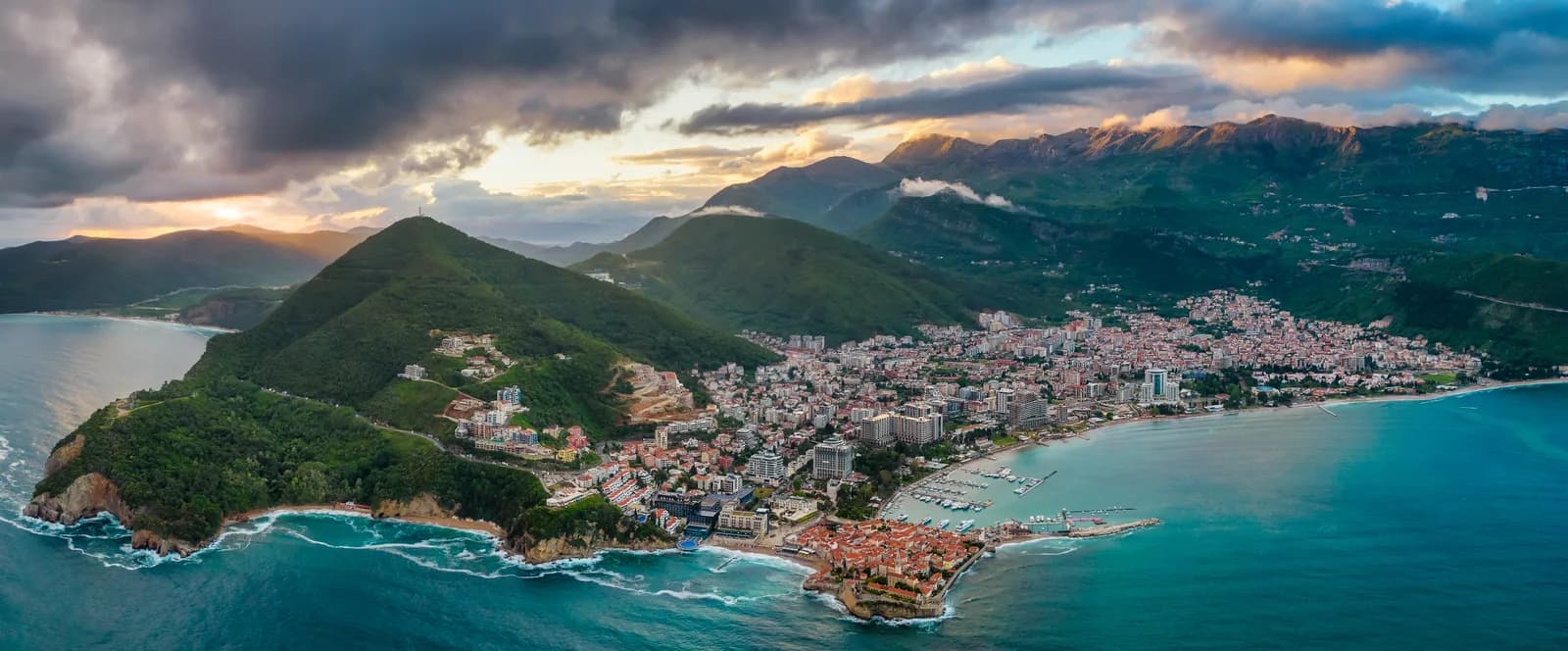
The Montenegrin pattern runs the other way. Settlements are compact and masonry, pressed against the shoreline and the coastal road, with Orjen, Lovćen and the Rumija massif rising steeply behind — the geography described in our guide to the Bay of Kotor. Fire on those slopes generally runs upslope and inland, away from the strip where visitors sleep. The Adriatic sits directly below as an unlimited tank, and aircraft can turn a load around in minutes — 282 tonnes of it in a single day in August 2026.
Exposure here is concentrated rather than distributed: scattered houses and vikendice in the hinterland, hillside settlements above the bay, olive terraces inland from Ulcinj, and infrastructure crossing wild ground.
The wind is a cousin, not a twin
Both coasts have a signature downslope wind and both are technically katabatic — dense air draining off high terrain, accelerating as it falls.
California’s Santa Ana arrives off the interior desert, hot and extraordinarily dry, relative humidity often in single figures. During the January 2025 event it blew sustained at 40 to 60 mph with gusts past 80. It desiccates the fuel and drives it in the same motion.
The Adriatic’s bura falls from the Dinaric wall onto the coast. It is violent — it is why Boka and the Croatian channels have their reputation — but it is fundamentally a cold wind, and it does not pre-dry the fuel bed the same way.
That is not the same as harmless. Research published in Natural Hazards and Earth System Sciences on the July 2017 Split fire, which broke into a populated coastal area, found bura flow over the coastal ridge undergoing gravity-wave breaking and drawing dry air down from aloft — sharply drying the surface and driving the fire downslope and upslope in stages. Bura is precisely what made the Herceg Novi fire so hard to hold in August 2026. The Adriatic has a serious fire wind. It does not have a desert fire wind.
And then there is us
Goran Janković, commander of the Protection and Rescue Service in Šavnik, said on 13 August that the human factor causes more than 95 percent of open-air fires in Montenegro.
His formulation, widely reproduced, attributes the remaining share to "negligence or other phenomena" during extreme heat and prolonged drought — which does not quite parse, since negligence is human activity and belongs inside the 95, not outside it. Read it the way the fire service plainly means it: almost every fire on this coast starts with a person, whether through carelessness or intent, and the natural share — lightning, essentially — is the rare exception. One of the 2025 Luštica fires was attributed to a strike. That is roughly how often it happens.
Burning garden and agricultural waste. Rubbish dumps. Discarded cigarettes. Unattended cooking fires. Sparks off machinery. Faults on power lines crossing dry ground — the Žager fire in August 2026 spread along a transmission line before it reached the houses and the church.
It is the most useful fact in this article, because unlike wind, fuel or masonry, it is the one variable a visitor holds directly.
THE LEDGER
Five numbers that govern the argument
6,837 — structures destroyed by the Palisades Fire, January 2025 CAL FIRE damage assessment
0 — houses lost above Herceg Novi in August 2026, of roughly 50 threatened Protection and rescue service, August 2026
282 tonnes / 137 sorties — water dropped in a single day over Bijela, Baošići, Vladimir and Zoganje Directorate for Protection and Rescue, August 2026
>95% — share of Montenegro’s open-air fires started by people Goran Janković, Protection and Rescue Service Šavnik, 13 August 2026
1,079,538 ha — burned across the EU in 2025, nearly double the 2006–2024 average European Commission Joint Research Centre / EFFIS, March 2026
The counterweights
A comfortable story would stop there. Four things argue against comfort.
The response system is thin. Montenegro operates no Canadair-class amphibious bomber. It flies an Air Tractor AT-802 and an Antonov AN-32P through the Interior Ministry’s Directorate for Protection and Rescue, supported by police and army helicopters, municipal brigades, volunteer fire societies and, routinely, residents with garden hoses. Several simultaneous fires stretch that immediately, and firefighters here say openly that crews work without rest and the country needs real aerial capacity. The gap is filled from outside: Montenegro participates in the EU Civil Protection Mechanism, and in August 2025 the Commission mobilised rescEU assets stationed in Czechia, Croatia and Italy, with Serbia, Hungary and Bosnia and Herzegovina offering aircraft bilaterally.
Adriatic urban-interface disasters are real. The 2017 Split fire is the regional counterexample and it is not distant history. While this piece was being written, a fire near Omiš on the Croatian coast reached houses, injured nineteen people and moved around 2,000 out of surrounding villages.
Montenegro has disrupted tourists before. In July 2017 fires crossed the Luštica peninsula, at least a hundred tourists were evacuated from homes and campsites, and the government activated the EU Civil Protection Mechanism after conceding it could not cope alone.
The trend runs one way. Rural depopulation across the Mediterranean since the 1950s removed the shepherds and smallholders who kept vegetation cropped and discontinuous; abandoned terraces grew into continuous fuel. Then add heat. The Joint Research Centre recorded 2025 as the EU’s most destructive season since records began in 2006 — 1,079,538 hectares, 7,783 fires across 25 member states, nearly double the 2006–2024 average, with seasons starting earlier and reaching further north.
Montenegro’s coastal fires remain structurally less catastrophic than California’s. They are also more frequent than they were, the fuel is more continuous than it was, and the terraces that used to break a fire’s run are filling in. The wall still holds. The margin behind it is thinner every decade.
What a fire here actually does to a holiday
Rarely flames. Almost always infrastructure, in this order.
Power and water. The dominant practical impact, and it recurs in nearly every serious fire, because the fire runs the corridor where medium-voltage lines cross wild ground. During the August 2026 fires the distribution operator switched off the 10 kV line at Gač, leaving Briska Gora, Zoganje and Ćetkovići dark. Bijela and Baošići lost electricity and water. All of Ulcinj lost water, because the pumps depend on the line the fire was burning beside, and the municipality asked residents to ration.
Roads. Sections of the Adriatic highway and inland routes close without notice while aircraft work overhead or crews hold a line at the verge. Expect detours, not entrapment.
Smoke. The most underrated risk, and the one that reaches people who never see a flame. It matters for asthma, COPD, cardiac conditions, small children and the elderly. Boka holds it, because of the geometry of the bay.
Beaches and sites. Localised and short. Cleared as precaution, not catastrophe — and with more than a hundred beaches along this coast, a closure usually means moving a few kilometres rather than losing the day.
None of this is the reason most trips go sideways in August. The things that actually catch visitors out in high season — a re-let apartment, a rental car that never existed, a taxi that stops at the border — have nothing to do with fire.
IF YOU ARE HERE DURING A FIRE
- 112 is the emergency number, from any phone.
- Keep bottled water in the apartment and the car, and devices charged. Power cuts mean no air conditioning, no lift and often no water pressure, sometimes for hours.
- Do not drive into smoke. If there is no alternative: slowly, windows up, vents closed, headlights on.
- Do not drive up hill roads to photograph a fire. Access roads are single-lane. One spectator’s car on a hairpin stops a tanker.
- Windows shut and air conditioning on recirculation when smoke settles into the bay.
- Treat a heavy smoke day the way you would treat an air-quality alert at home.
- Follow police and protection service instructions without debate. Preventive evacuation here means moving thirty people down a hill for a night.
- No open fire, anywhere, June to September. No beach bonfires, no burning garden waste at a rental, no cigarettes out of car windows, no disposable barbecues on dry ground. Montenegro prosecutes negligent fire-setting — and the person most likely to lose a house is a neighbour who lives here all year.
Should you cancel? Almost certainly not. The coastal towns, the beaches and the old towns are rarely touched directly; prepare for a lost afternoon, a detour and a few hours without water, and you have prepared correctly.
But read the smoke honestly rather than comfortably. What protects this coast is a wall someone’s grandfather built for reasons that had nothing to do with fire, on a hillside that used to be grazed and now is not, below a sea that can be reached in minutes by an aircraft the country does not own enough of.
That is a good margin. It is not a permanent one.
Common questions about wildfires in Montenegro
Should I cancel a trip to the Montenegrin coast because of fires?
In almost every case, no. Coastal towns, beaches and old towns are rarely affected directly — the exposure sits in hillside and hinterland settlements, not the shoreline strip. Plan instead for the things that do reach visitors: a few hours without power or water, a road detour, and one or two smoky afternoons.
Is the coast safe if fires are burning in the hills above it?
Generally yes, and the geography is the reason. Fire on those slopes runs upslope and inland, away from the coastal strip where visitors stay, while the sea below gives aircraft a refill point minutes away. Follow local instructions and stay off hill roads — the single most useful thing a visitor can do during a fire is not be on a mountain access road.
Will smoke ruin my holiday?
It can cost you a day or two rather than a trip. Boka Kotorska traps smoke because the bay is enclosed, so it can hang there after the fire itself is under control, and it usually clears on a wind shift. If anyone in your party has asthma, COPD or a cardiac condition, treat a heavy smoke day exactly as you would an air-quality alert at home.
What actually gets disrupted — is it the beaches?
Rarely the beaches, and almost never flames. It is infrastructure: power and water first, because fires run the corridors where medium-voltage lines cross dry ground, then road closures while aircraft work overhead. During the August 2026 fires all of Ulcinj lost water supply because the pumps depended on a line the fire was burning beside.
Are Montenegro’s wildfires getting worse?
Yes — in frequency and in season length, along with the rest of the Mediterranean. The EU’s 2025 season was the worst on record since monitoring began in 2006, with 1,079,538 hectares burned, close to double the 2006–2024 average. Rural depopulation is the quieter driver: abandoned terraces that were once grazed have grown into continuous fuel.
Why do Montenegro’s fires destroy so few houses compared with California’s?
Because of what the houses are made of. The coast is built in stone, brick, block and reinforced concrete with tile roofs, so a scrub fire arriving at a village wall generally meets a surface it cannot ignite. Californian housing stock is predominantly wood-framed, which is why wind-driven embers there can turn a vegetation fire into a house-to-house urban fire. Around fifty houses were threatened above Herceg Novi in August 2026 and none were lost.
What is the emergency number in Montenegro?
112, from any phone, including foreign mobiles. It covers fire, police and ambulance.
Can I help if there is a fire nearby?
Do not self-deploy to a fire line. The most useful contributions a visitor can make are not starting one — more than 95 percent of open-air fires here are human-caused — and keeping hill access roads clear so tankers can pass.
Related reading
- Is Montenegro Safe? A Practical Safety Guide — the wider risk picture, of which fire is one part
- Montenegro in High Season: 5 Things No Guidebook Tells You — what actually disrupts an August trip
- Bay of Kotor: Complete Guide — the geography that traps smoke in the bay
- Complete Guide to Herceg Novi and Herceg Novi — the municipality at the centre of the 2026 fires
- Ulcinj — the southern hinterland where the Vladimir, Gač and Briska Gora fires burned
- 25 Best Beaches in Montenegro — alternatives when one stretch of coast is closed
Reporting and sources: CAL FIRE damage assessments, January 2025 Palisades Fire; European Commission Joint Research Centre / EFFIS 2025 season report, March 2026; DG ECHO on the EU Civil Protection Mechanism and rescEU; Natural Hazards and Earth System Sciences on the 2017 Split fire; Montenegrin Ministry of Interior and Directorate for Protection and Rescue statements, August 2026; Portal Analitika, RTCG, Vijesti, CdM; CEDIS; US Embassy Podgorica; UN-SPIDER and ReliefWeb on the 2017 Montenegro fires; peer-reviewed literature on Mediterranean land abandonment and fuel continuity.