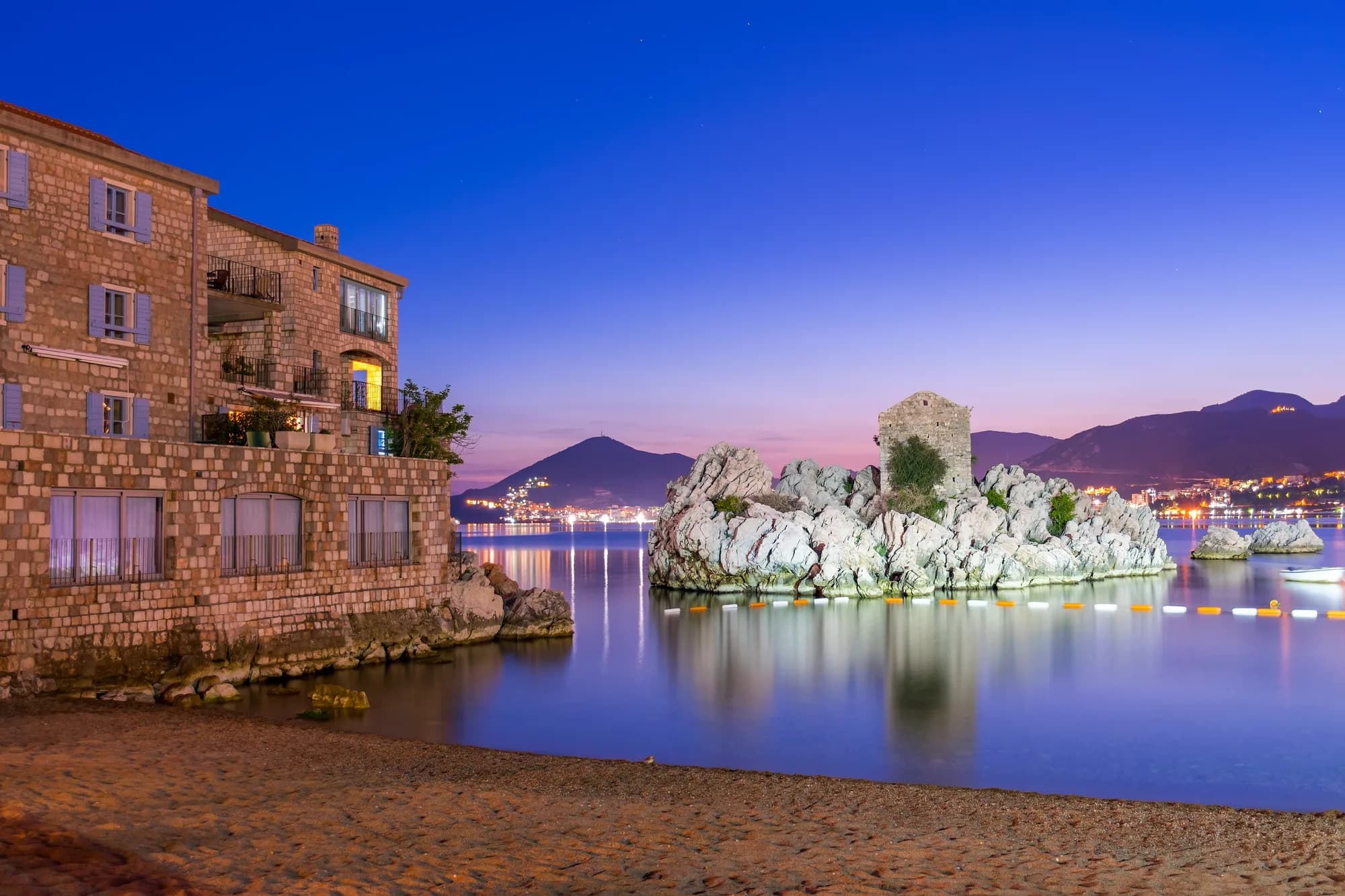
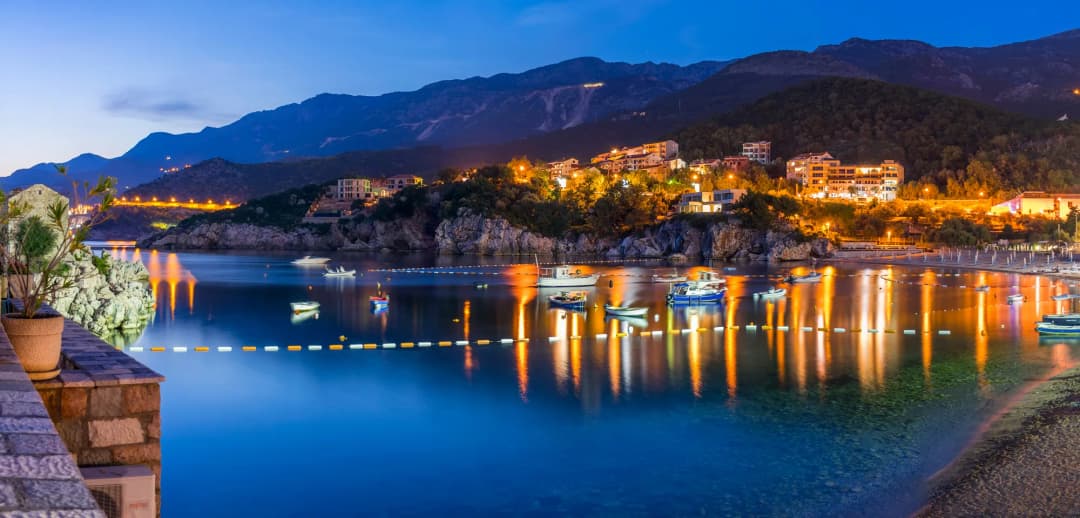
There is a moment, coming over the headland from Kamenovo, when Pržno assembles itself below you all at once: a tight crescent of red roofs and grey stone at the waterline, a short shingle beach, wooden boats at their moorings, and the small church above the bay. It looks like a stage set for an Adriatic fishing village, which is very nearly what it is — except that the boats still fish, the families are still the old families, and the fish on the terraces was in the sea that morning. On a riviera that traded almost everything for hotel beds, Pržno is the last complete tableau.
Paštrović stone
Pržno sits in the historic heartland of the Paštrovići, the clan community that held this coast for centuries, and its architecture is pure Paštrović coast: low stone cottages, some centuries old, built shoulder to shoulder against the sea wind, with the great monastery of Praskvica on the slope inland and Sveti Stefan around the next point. It was never a town — never even a large village — just a family anchorage that grew as much as its cove allowed and then, crucially, stopped.
After the Second World War, the village's stillness attracted an unlikely colony: painters and writers from across Yugoslavia, who came for the light and the quiet and kept coming. Artists such as Milo Milunović and Marko Čelebonović worked here, and the village acquired the nickname "the Saint-Tropez of Yugoslav painting" — Saint-Tropez strictly in the sense of painters at the waterline, not yachts. The comparison holds in one more way: both places owe their survival to being loved by people with an eye for what should not change.
Dinner over the water
Pržno's fame today rests on a single perfect arrangement: konoba terraces built directly over the sea. At Konoba More, set in a stone house said to be some five centuries old, the wooden terrace hangs above the water so that grilled fish arrives with the sound of the swell directly beneath your chair. A few doors along, Konoba Langust runs its own fishing boats and serves what they bring in — the langoustines of the name, whole fish by the kilo, black risotto — while Blanche adds a whiter-tablecloth take on the same waterfront. The geometry is the point: in Pržno the distance from net to grill to table is measured in metres, and the view from every table is the bay that supplied dinner.
The result, on a summer evening, is one of the great simple experiences of the Montenegrin coast — lights on the water, boats swinging at anchor, the murmur of a dozen languages along fifty metres of terrace. It is not undiscovered, and it is not cheap by local standards. It is merely right.
The resort above, the village below
Pržno's improbable preservation owes something to geography and something to its neighbours. The cove is small and hemmed by headlands, with nowhere for a promenade of hotels to sprawl. And the land that development might have taken was already spoken for: directly above the village stands the Maestral Resort & Casino, the riviera's big hotel and gaming house, and beyond the point stretches the wooded royal estate of Miločer, the former summer domain of the Yugoslav royal family, where building has always been out of the question. The Maestral absorbed the tour buses and the casino crowd on the hill; the parkland sealed the coast beyond; and the village between them was left at fishing-village scale — a few lanes, one beach, one church, no room and no need for more.
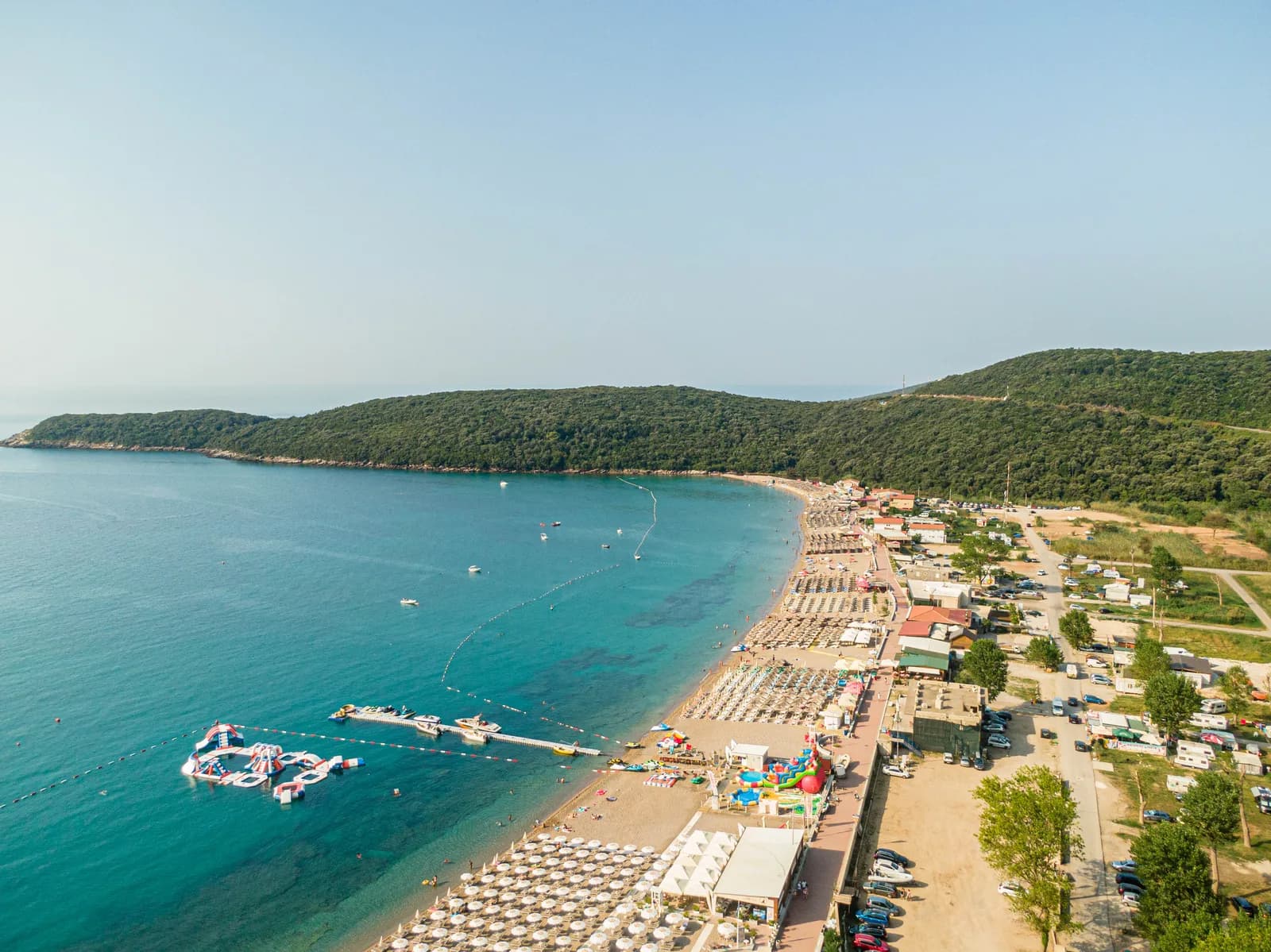
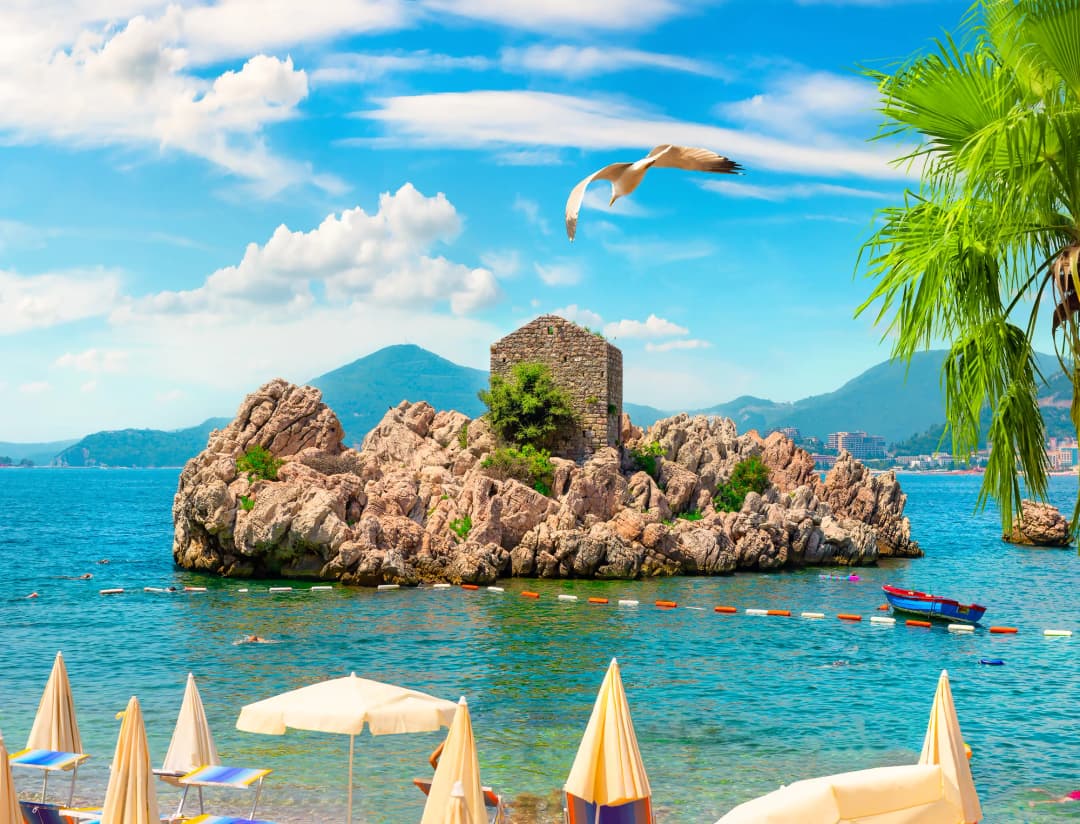
The beach itself is modest — a couple of hundred metres of coarse sand and fine shingle, with loungers in season and famously clear water — plus the small rocky coves under the pines toward Miločer for those who prefer swimming off the rocks. Behind the beach, the old olive terraces climb toward Praskvica monastery, reachable by a short steep path for anyone who wants to trade the smell of grilled fish for incense and eight hundred years of Paštrović history.
On the walk
For walkers, Pržno is the reward stage. The shoreline route from Budva arrives over the Kamenovo headland, drops through the village, and continues around the point into the pines of Miločer park toward Sveti Stefan — arguably the finest kilometre of the entire coast. The village anchors its own stage of the Seven Bays walk, and it is precisely the place to time for lunch or for the last golden hour, when the stone turns honey-coloured and the terraces fill.
Visiting. On foot, Pržno is reached along the coastal walk — from Kamenovo over the headland by the coast road, or from Sveti Stefan through Miločer park in about twenty minutes of level pine-shaded path. The village and beach are free to wander; loungers are paid in season and terrace tables at More, Langust and Blanche are best booked ahead in July and August, with whole fish priced by the kilo. Come at dusk if you come only once: the tableau — boats, stone, lamplight on water — is at its best exactly then.