Most visitors reach Petrovac for its pebble bay and pine-scented promenade, and walk straight past one of the most quietly remarkable ancient sites on the Montenegrin coast. Behind the town, in a terraced olive grove at a locality called Mirišta, lie the mosaic floors of a Roman estate that has been standing here, buried and half-forgotten, for the better part of two thousand years.
A find beneath the olive trees
The mosaics first came to light in 1902, when their existence in the ground at Mirišta was reported to the public. For a long time that was as far as knowledge went: a rumour of patterned floors under the roots of ancient olives, occasionally uncovered and then covered again. Systematic archaeology only arrived a century later. Between 2006 and 2011, campaigns led by researchers from the regional museum in Bar excavated the site across a series of seasons, working carefully through the cascading stone-walled terraces that the olive farmers had shaped over the estate.
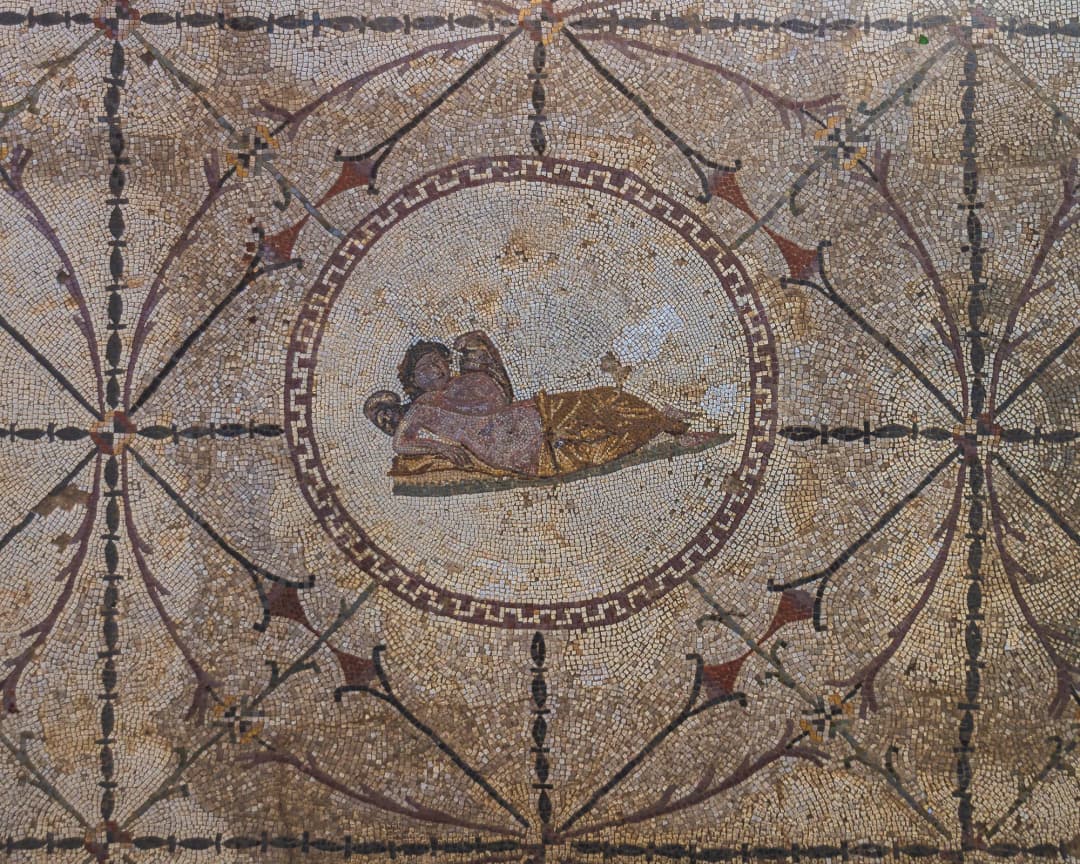
What they uncovered was not a single building but a place that changed over time. The complex began as a Roman villa near the shore in the early centuries of the empire, and over generations grew into a working agricultural estate, a villa rustica with facilities for processing olives — fitting, given that olives still grow directly over the ruins today. Coins of Constantine II, along with ceramic and glass fragments, place the busiest life of the villa in the third and fourth centuries.
Reading the floors
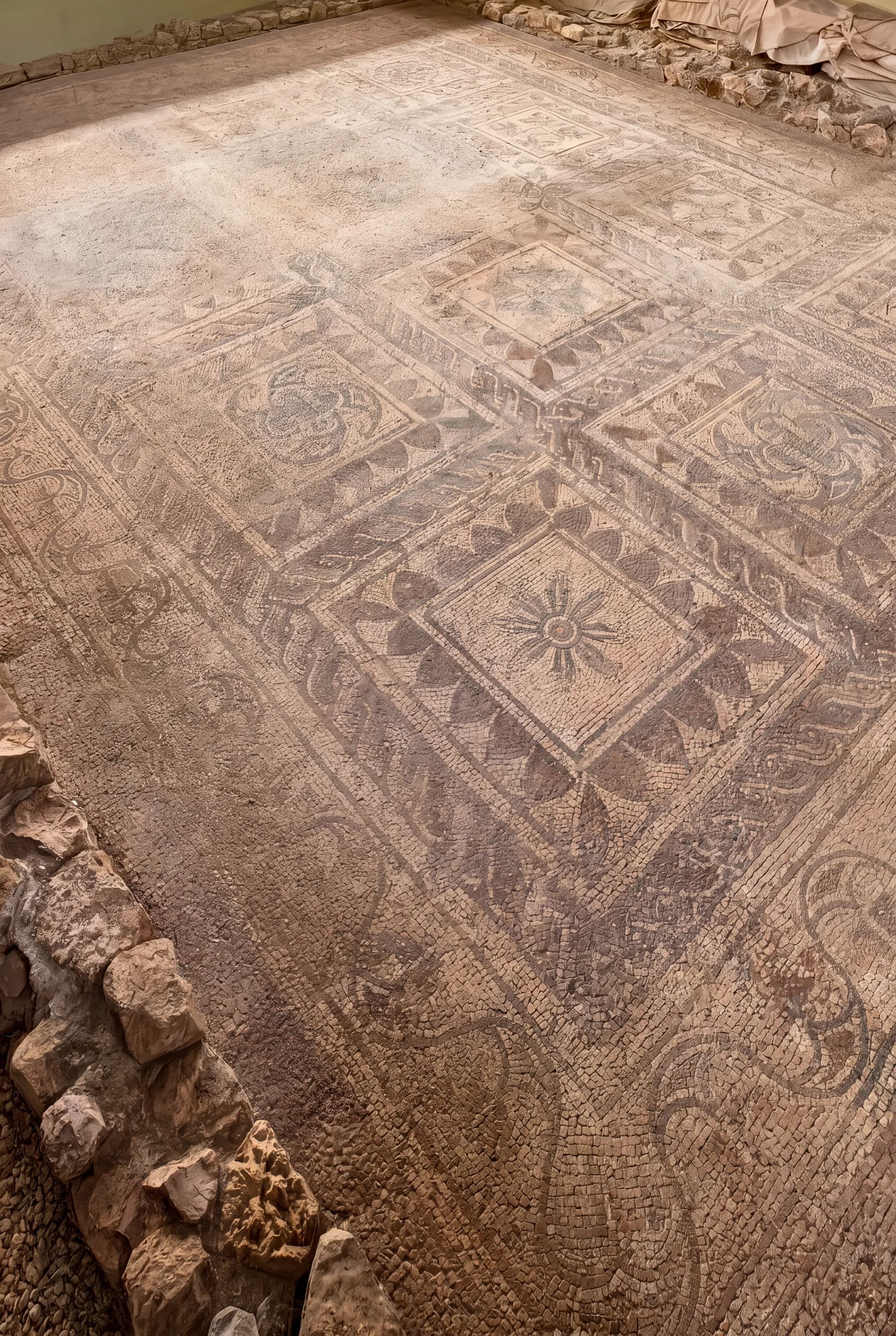
The mosaics themselves are the reason to come. They decorated the floors of the residential rooms in geometric compositions — cross-shaped rosettes, concentric circles, borders of interlocking pattern — the visual language of a well-off late-Roman household. One fragment carries a motif of a triple fish, a detail archaeologists read as an early Christian symbol, hinting that the estate's life reached into the age when Christianity was spreading along this coast.
The surviving display section is modest in size — roughly ten by fifteen metres of floor — and it is protected beneath a glass shelter that lets you look down onto the tesserae much as a visitor to the villa might once have looked at them, minus the couches and the sea breeze through open doors.
From seaside villa to working estate
What the excavations traced was an arc of change across several centuries. The building began, in the earlier imperial period, as the sort of comfortable maritime residence a Roman of means built for the pleasure of the coast — a house oriented to the sea, decorated with the patterned floors that signalled status. Over time its purpose shifted from leisure to production. Rooms and structures for the pressing and processing of olives were added, turning the pleasure villa into the working heart of an agricultural estate, its wealth now coming from oil rather than from the view. The presses are long gone, but the olives that still cover the terraces are, in their way, the estate carrying on. Alongside the coins and pottery, the diggers also recovered fragments of glass vessels — the everyday debris of a household that ate, drank and lived here through the third and fourth centuries, and whose ordinary objects now help date the floors above them.
Not the Risan mosaics
It is worth clearing up a common confusion. Montenegro's most famous Roman mosaics are at Risan, in the Bay of Kotor, celebrated above all for their depiction of Hypnos, the god of sleep — the only known mosaic image of him in the world. The Mirišta floors at Petrovac are a separate site entirely, further down the coast, with their own geometric and early-Christian character. If you have read about Risan and arrived in Petrovac expecting the sleeping god, this is a different, quieter story: a private estate rather than a showpiece, and one still embedded in a living olive grove.
Petrovac on the Roman road
The villa did not sit in isolation. Petrovac lay on the Roman coastal road that threaded along the eastern Adriatic, linking the settlements and harbours of the province, and an estate like this depended on that connection to ship its oil and produce. The town kept a Roman-tinged identity for a very long time afterwards: through the Venetian centuries and into the twentieth it was known as Kaštel Lastva, after the fortress on the rock, and only around the end of the First World War was it renamed Petrovac in honour of King Peter I. You can follow that older layer of the landscape on the Roman Road walk's Mirišta stage, which sets the mosaics in the line of the ancient route rather than treating them as an isolated curiosity.
Visiting
The mosaics sit a short walk inland from the Petrovac seafront, tucked among olive terraces and easy to combine with the town's fortress and promenade. Opening arrangements are seasonal and modest — this is a small local site rather than a major museum — so it is worth checking current hours with the town's tourist information or the Budva museums before you go, and treating the floors gently: they are fragile, in situ, and have already survived nearly two millennia under the trees.