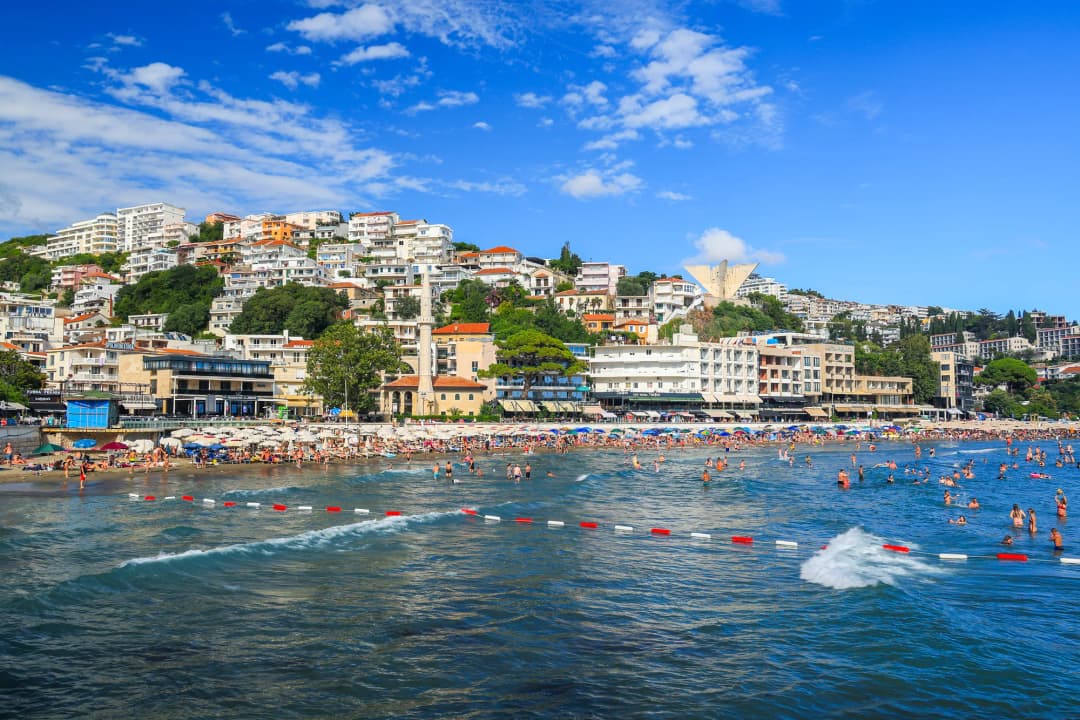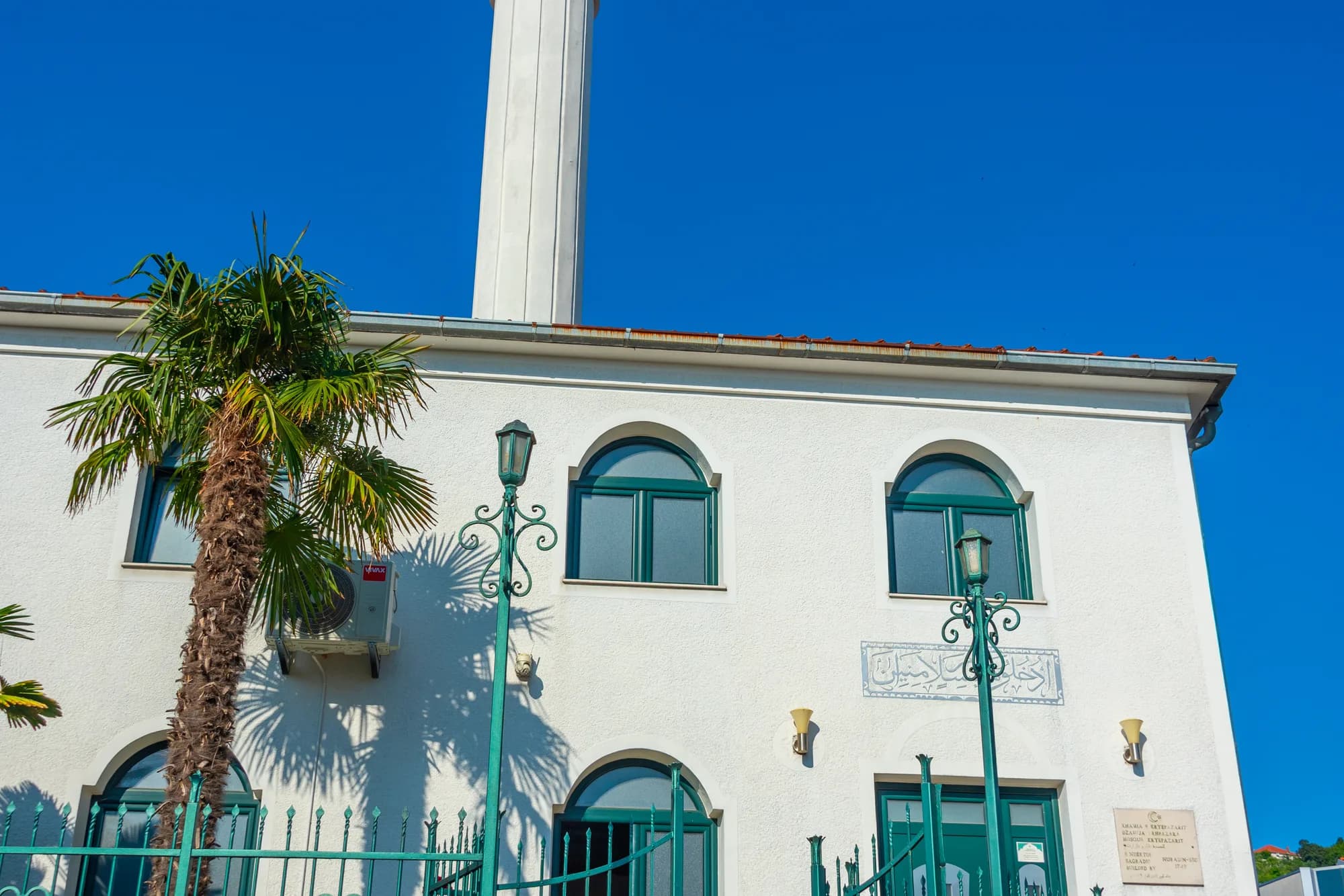
On the rocks between Ulcinj's Old Town and Mala plaža stands a small white mosque whose slender minaret looks out to sea — which is exactly the point. The Sailors' Mosque (Džamija pomoraca; in Albanian, Xhamia e Detarëve) is that rare building with two jobs: for centuries it served Ulcinj's seafarers as both a house of prayer and a lighthouse, a lamp in its minaret guiding the town's ships home across the dark Adriatic.
A mosque for a town that lived by the sea
Tradition dates the original building to the fourteenth century, making it — by that reckoning — one of the oldest Islamic sites on this coast, predating even the Ottoman conquest of the town in 1571. Whatever its precise origins, its logic is pure Ulcinj. This was a town of sailors, corsairs and traders whose fleets ranged the whole Mediterranean; a shoreline mosque where a departing crew could pray, and whose lit minaret would be the first thing they saw on return, fused the town's two great loyalties — faith and the sea — into a single silhouette.
Ibrahim Pasha's debt of gratitude
The building owes its most famous rebuilding to Ibrahim Pasha of Scutari (Shkodra), the powerful ruler of the region at the turn of the nineteenth century. Having survived the battle of Krusi against the Montenegrins in 1796, the pasha — so the tradition runs — rebuilt the mosque in gratitude, and dedicated it to the sailors of Ulcinj whose service had underpinned his family's power: hence, definitively, the Sailors' Mosque. Around it grew a small complex of learning and charity — accounts describe a religious school and shelter for travellers and the poor established here at the end of the eighteenth century — making the site a compact cultural centre for the maritime quarter.
1931: demolition
Then came the twentieth century, which was not kind. In 1931, under the Yugoslav kingdom, the military demolished the mosque. For eight decades the shoreline site stood empty — a missing tooth in Ulcinj's skyline, remembered by generations who had never seen it. Old photographs and the testimony of elders kept the building alive as an idea: the mosque that had once been the sailors' lighthouse. The loss was felt beyond the town's Muslim community — Ulcinj had lost not just a house of prayer but the oldest witness to its maritime golden age, the building that had watched its fleets leave and, more importantly, watched them come home.
2012: resurrection
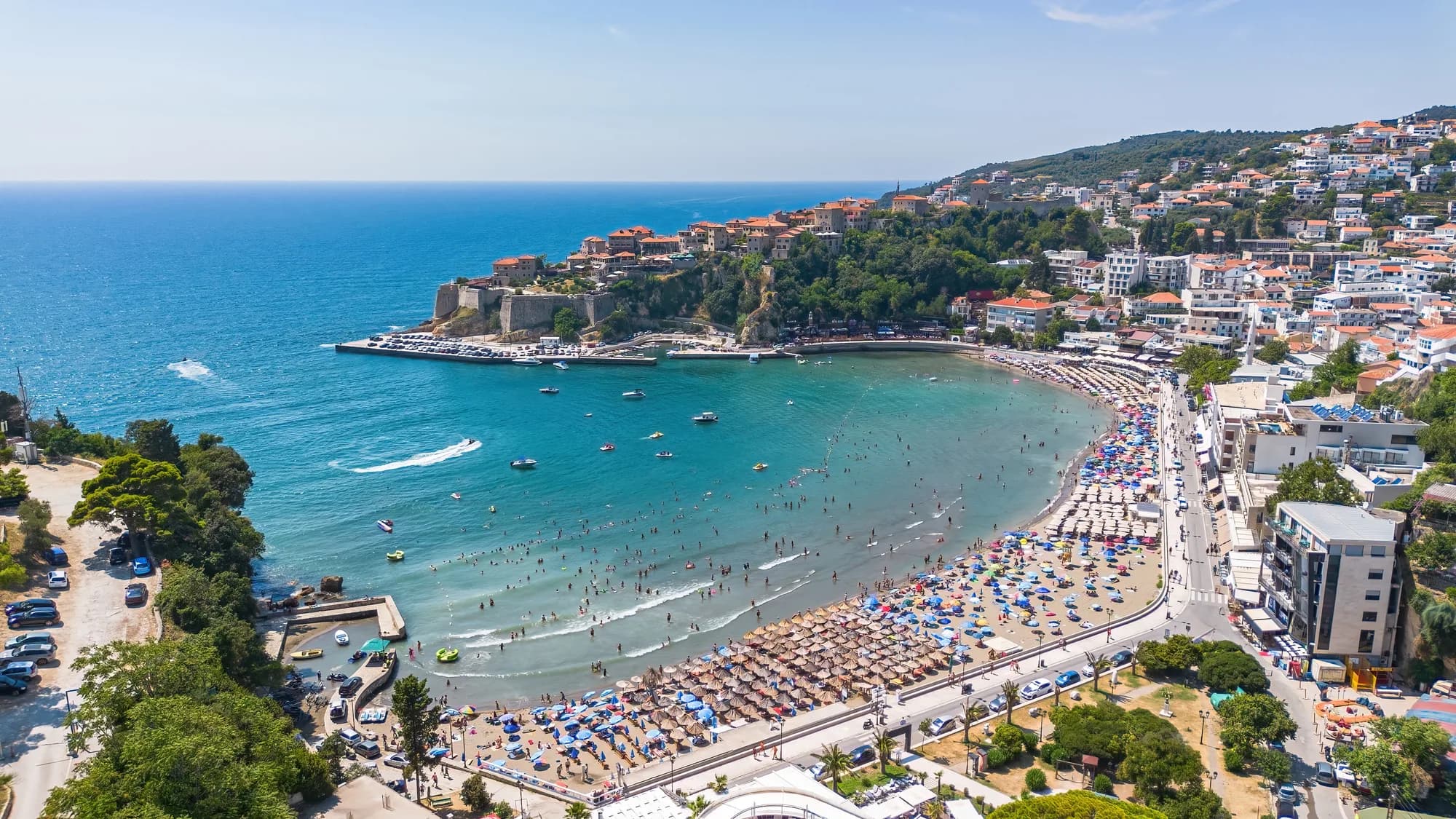
The idea finally won. Rebuilt with funding from private benefactors from Alanya in Turkey, together with the Islamic Community of Montenegro and the Municipality of Ulcinj, the Sailors' Mosque was inaugurated anew on 1 June 2012 — eighty-one years after its destruction. The reconstruction returned the essential form: modest prayer hall, white minaret, and the seaward orientation that made the original famous. Today it functions again as a working mosque and has instantly resumed its old role as a landmark, framing photographs of Mala plaža and the Old Town headland just as it did in the era of sail.
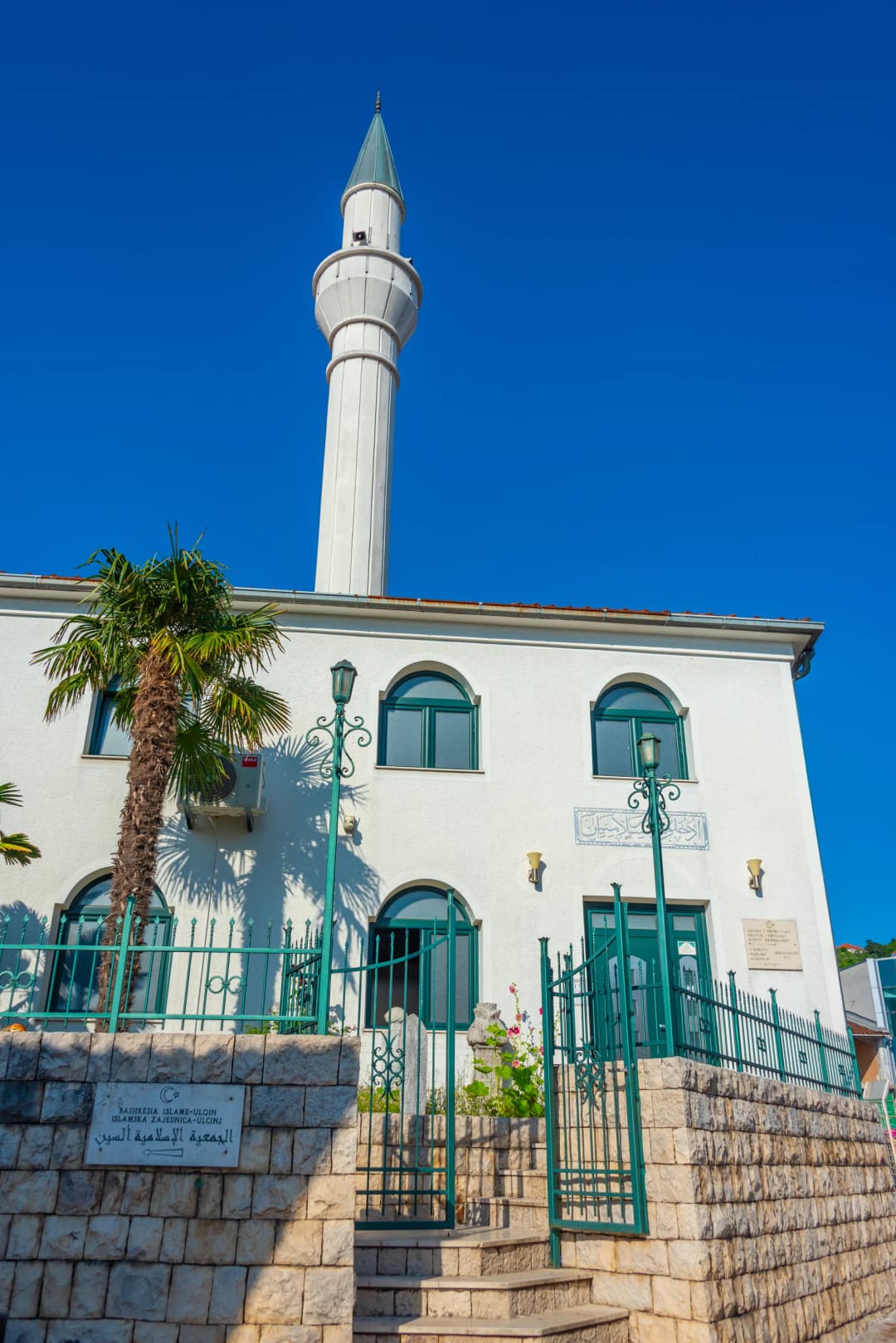
There is something quietly moving about the arc of this small building: raised by seafarers, rebuilt by a pasha's gratitude, erased by an army, and restored by donations across the sea. Few monuments anywhere compress the region's whole modern history — Ottoman grandeur, twentieth-century rupture, twenty-first-century revival — into such a small white package.
Visiting
The mosque stands right at the waterline below Ulcinj's Old Town, beside the path that links Mala plaža with the fortress walls, and it marks its own stage on the Pinjes Pines walk as the route comes down to the shore. It is an active place of worship: visitors are welcome outside prayer times, with the usual courtesies — shoes off at the door, modest dress, and quiet. The classic view is from the beach promenade at dusk, when the lit minaret stands against the darkening sea and, for a moment, the building is a lighthouse again — bring a camera, because this is one of the most photographed frames on the whole southern coast. Combine it with a climb into the Old Town above, where the town's other layered monuments — church-mosque, museum, ramparts — continue the same long story.