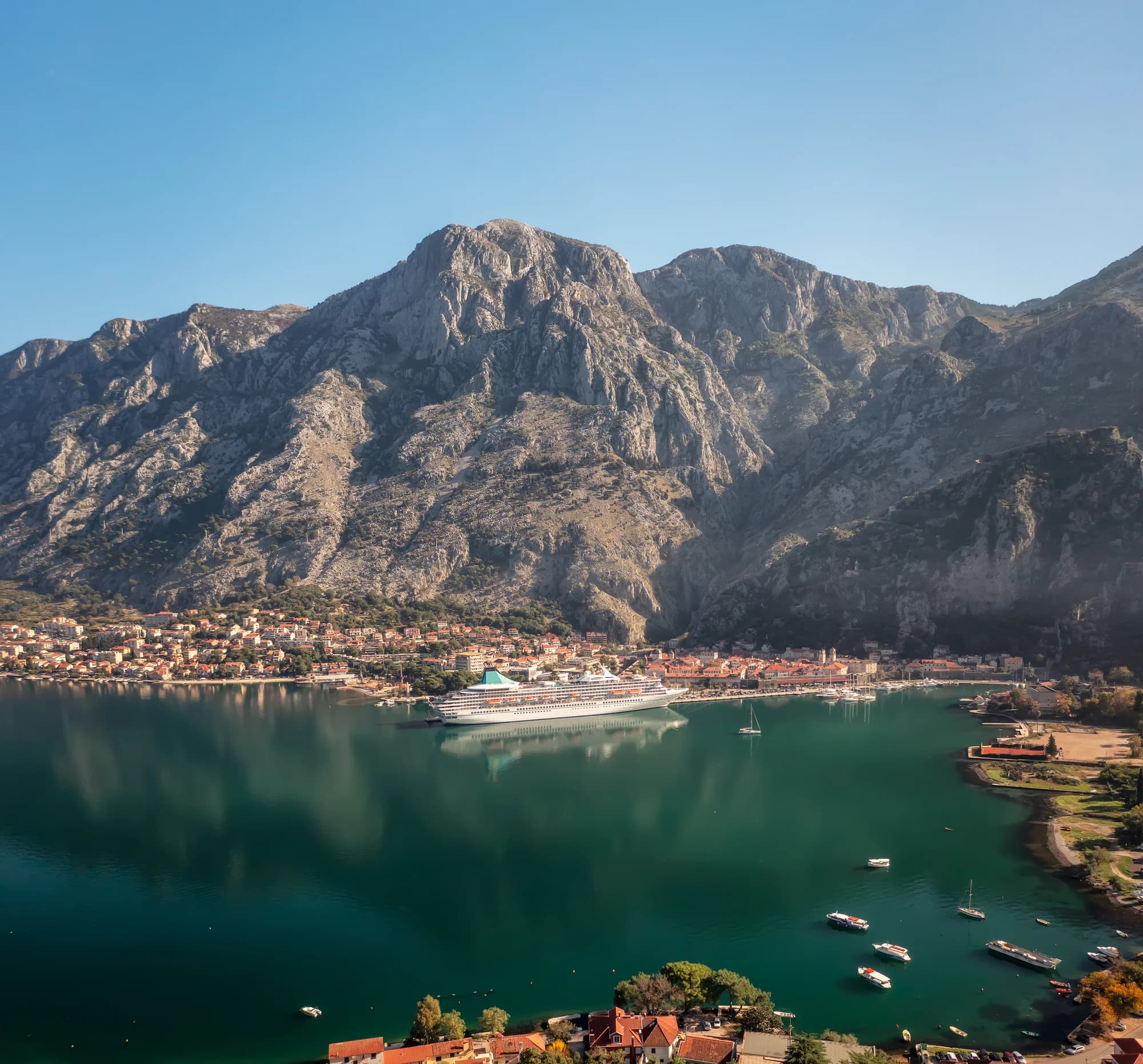
The “price of a coffee” is a memorable way to talk about Montenegro’s possible European Union membership. It is not, however, an accession date, an invoice or a shortcut through the remaining reforms. In June 2026 the European Commission presented a €3.2 billion financial package for the budget arrangements that would apply after accession. A senior Commission official, speaking anonymously in a media briefing, compared the annual per-person effect with a very cheap cup of coffee.
That comparison deserves two responses at once: enjoy the image, and read the footnotes. As of 31 August 2026, Montenegro remains an EU candidate. All 33 negotiating chapters are open and 18 are provisionally closed. The 2028 date is an attainable political target and budget scenario, not a ratified membership date. This guide first audits those claims, then turns the coffee metaphor into a practical eight-stop route without inventing café prices or promising access.
The short verdict: what is decided and what is not
| Statement | Evidence status | What it means | What it does not mean |
|---|---|---|---|
| Commission financial package | Adopted 30 June 2026 | A Chapter 33 proposal maps budget arrangements for possible accession | Membership has already happened |
| €3.2 billion | Official package figure | Expected financial allocations associated with the transition | A simple net bill already charged to EU residents |
| “Cup of coffee” | Anonymous briefing comparison reported by media | A way to communicate a roughly annual per-person scale | Text in the legal communication or a coffee-price study |
| 18 of 33 chapters | Official state of play on 14 July 2026 | More than half were provisionally closed | Those chapters or the whole negotiation are irrevocably final |
| 2028 membership | Target and budget scenario | A timetable political leaders are working toward | A treaty date guaranteed at the cutoff |
The Commission’s own question-and-answer page is unusually explicit: the package does not mean Montenegro will join in January 2028. Accession occurs only if the country meets the conditions and an accession treaty is ratified by all parties. The package also allows for a later entry into the next long-term EU budget. That conditional language is the most important fact in the story.
What the €3.2 billion package actually is
The Commission announcement of 30 June 2026 describes a transition from pre-accession assistance to participation in EU internal funds. It sits within Chapter 33, “Financial and budgetary provisions,” and is based on the Commission’s proposal for the next Multiannual Financial Framework. It is therefore part of a negotiation about how a future member would enter the EU budget system.
The €3.2 billion figure is not properly understood as cash handed over on day one. The package maps expected allocations, shifts existing pre-accession support and anticipates Montenegro contributing to the EU budget on the same basis as other members. The Commission also says relevant budget ceilings would be increased proportionally to avoid negative spillovers for existing member states, citizens and companies. Final amounts still depend on negotiations, the long-term budget and accession timing.
| Stage | What it covers | Conditions |
|---|---|---|
| Before accession | Pre-accession support and reform funding | Chapter 33 • Conditional package |
| €3.2bn expected allocations | Proposed transition package | Reforms • chapter agreement • EU long-term budget • accession timing • treaty ratification |
| After accession | EU internal funds plus budget contribution | Proposal can accommodate accession after 1 January 2028 |
Source: enlargement.ec.europa.eu, eur-lex.europa.eu
Where the “€1 coffee” line comes from
The legal communication does not call the package a coffee. The line was reported after a background briefing by a senior European Commission official who was not named. European Western Balkans reported the comparison as roughly one euro per EU citizen per year over the budget cycle. Eurostat’s April 2026 projection release used an estimated EU population of 451.8 million in 2025, which shows why per-person totals can look small when spread across the Union.
We are not recreating the anonymous official’s arithmetic because the public quote does not expose every assumption: whether the denominator is citizens, residents or taxpayers; how Montenegro’s future contribution is netted; which years are counted; and how transferred pre-accession funds are treated. The responsible conclusion is narrower. The coffee line communicates scale; the €3.2 billion package and its conditions are the auditable policy facts.
| Layer | Content | Status |
|---|---|---|
| 1. Official fact | €3.2bn package • Chapter 33 | Conditional • future transition |
| 2. Reported line | About €1 yearly per EU citizen | Anonymous official • coffee metaphor |
| 3. Not public | Exact formula • net contribution • denominator • final budget | Memorable comparison ≠ transparent fiscal calculation |
Source: europeanwesternbalkans.com, ec.europa.eu, eeas.europa.eu
How close is Montenegro to EU membership?
Montenegro opened accession negotiations in June 2012. On 14 July 2026, the EU and Montenegro provisionally closed the chapters on competition policy and customs union, taking the tally to 18 of 33. The Council’s live Montenegro page is the best short state-of-play source. It also explains that agreements on individual chapters are not final until there is an overall agreement.
Numbers alone do not decide membership. The Commission’s 2026 Rule of Law Report continues to assess Montenegro across the justice system, anti-corruption framework, media pluralism and freedom, and institutional checks and balances. Closing a technical chapter does not remove the need to demonstrate implementation. “Frontrunner” describes comparative progress; it is not a separate legal status.
After negotiations are completed, an accession treaty must still be prepared. Under the Council’s enlargement process, it requires European Parliament consent and unanimous Council approval before signature. Then every EU member state and Montenegro must ratify it under their constitutional rules. Only the treaty supplies the membership date.
What EU progress changes for a traveler today
Political momentum does not turn Montenegro into an EU or Schengen destination overnight. Visitors must follow Montenegro’s current entry rules, not the rights or assumptions that may apply inside the EU. This distinction became especially concrete in July 2026, when the government announced a visa-policy alignment affecting nationals of Belarus, China, Russia, Saudi Arabia and Türkiye from 1 November 2026.
Check the Government of Montenegro visa page for your nationality and travel date. Check flights, buses and rail separately; the National Tourism Organisation’s transport page links to the relevant operators. Candidate status does not guarantee a route, remove border control, create EU roaming rights or replace travel insurance.
Montenegro already uses the euro, but that fact should not be confused with EU or euro-area membership. For trip spending, use the actual menu and final card-terminal currency choice. Our Montenegro trip-cost guide is the appropriate place to compare budgets; the political coffee metaphor is not a price promise.
An eight-stop coffee route that does not depend on politics
The route below uses coffee as a pause between places, not as a claim about a specific café. No venue, drink style or price is endorsed. Look at the menu before ordering, ask about card payment and accessibility, and choose a table that does not obstruct residents or heritage access. Eight stops are options, not a checklist for one day.
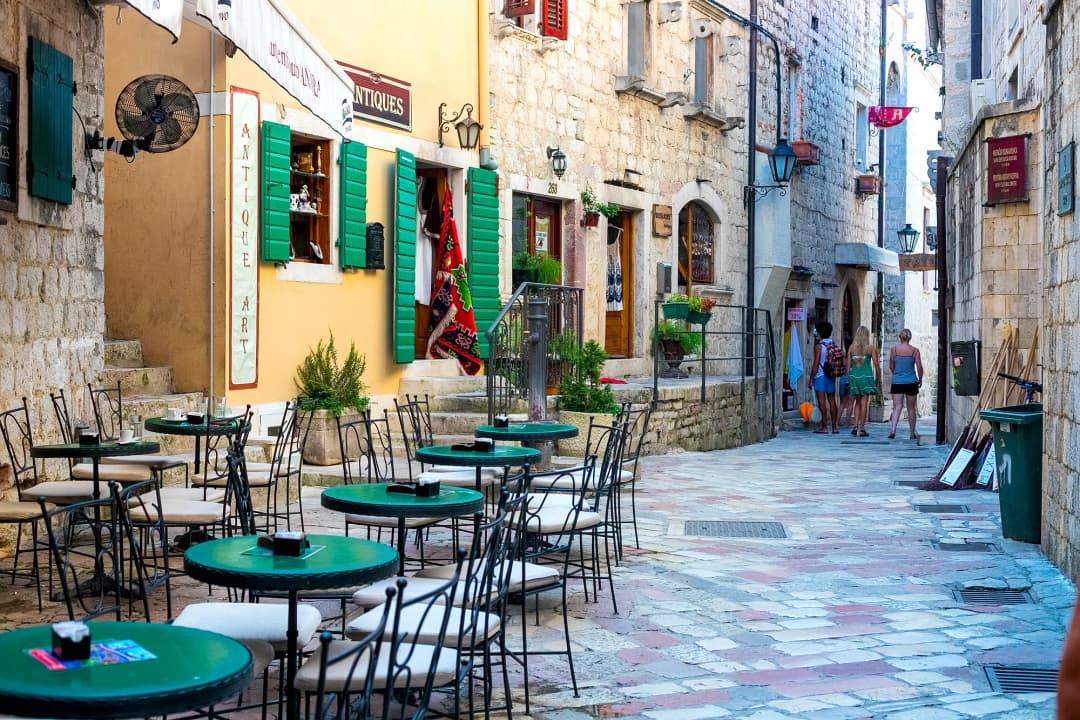
1. Kotor: read the whole World Heritage landscape
Kotor is the best place to begin because the EU story and the travel story share a lesson: read the complete framework. UNESCO’s property is not merely a photogenic old town; it covers 14,600 hectares of the best-preserved inner south-eastern bay and integrates settlements, architecture, cultivated slopes and water. Choose a square for a coffee, then walk without treating inhabited lanes as a set.
UNESCO also identifies development and urbanisation pressures, so responsible travel matters. Arrive outside the most compressed excursion window when possible, keep noise down, and support an operating local business without blocking doorways. Use our five-stop Montenegro guide to decide whether Kotor fits a wider route.
2. Perast: use the coffee as a timing buffer
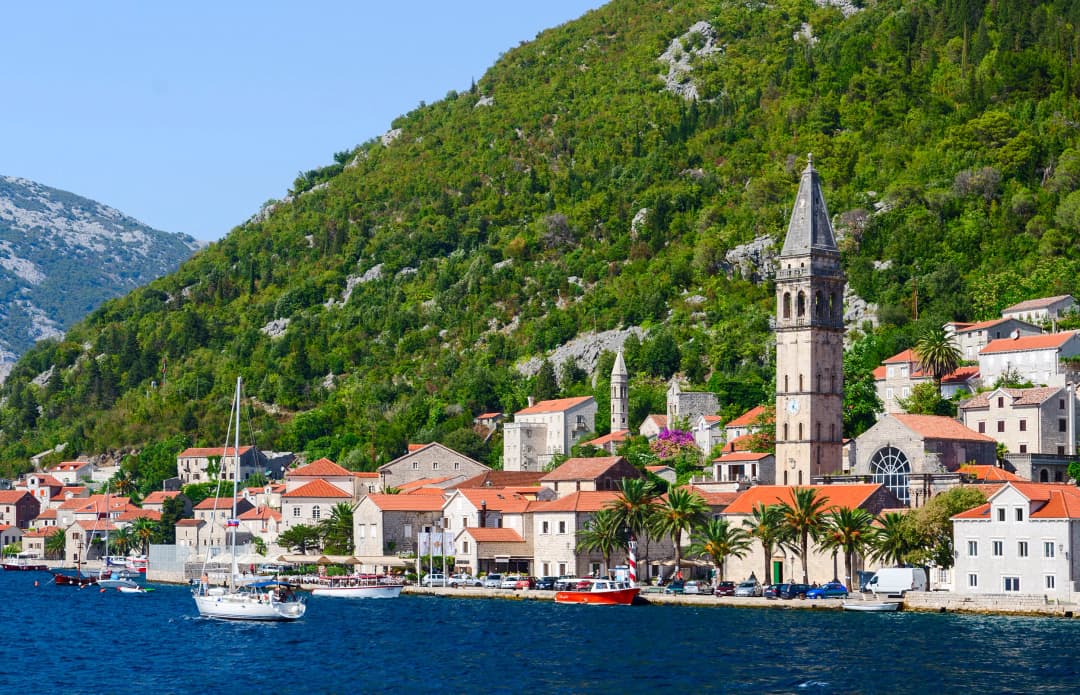
UNESCO names Kotor and Perast as characteristic, authentically preserved small cities within the property. Perast works best as a slow waterfront stop, but boat departures, church access and parking arrangements change. Confirm the activity first and use coffee as the buffer before or after it—not as a reason to miss a booked return.
3. Tivat: separate marina access from destination claims
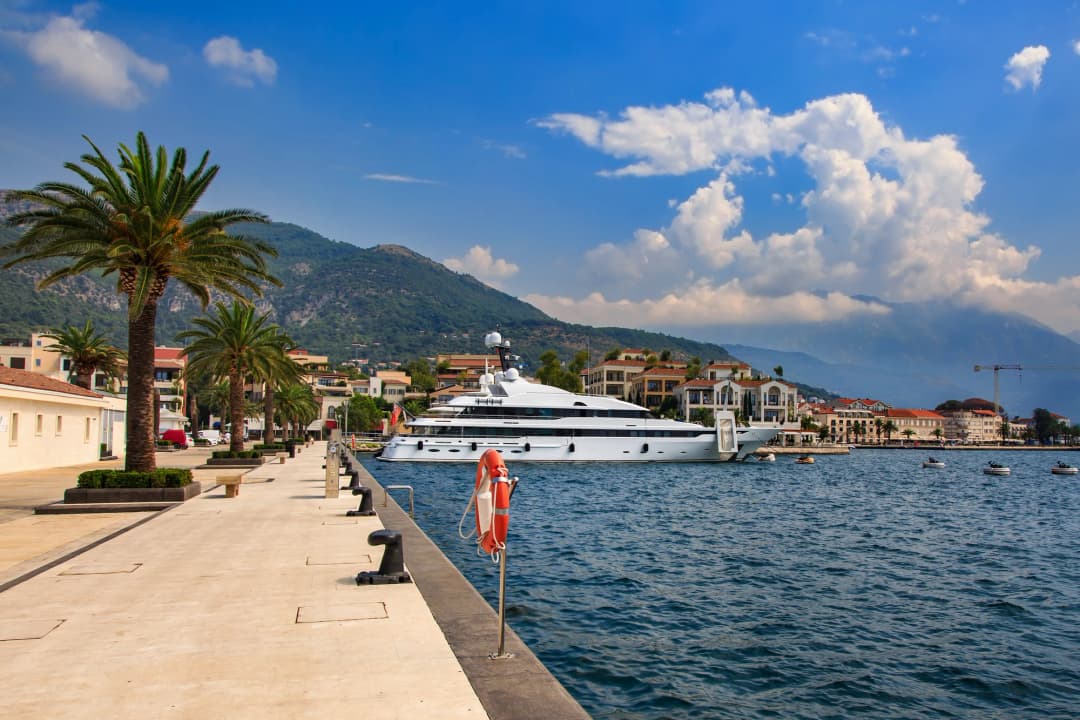
Tivat provides a modern contrast to the historic inner bay. Walk the public waterfront and decide from posted menus rather than assuming every venue shares a luxury price point. The Tivat and Porto Montenegro guide separates the town, marina and practical arrival choices.
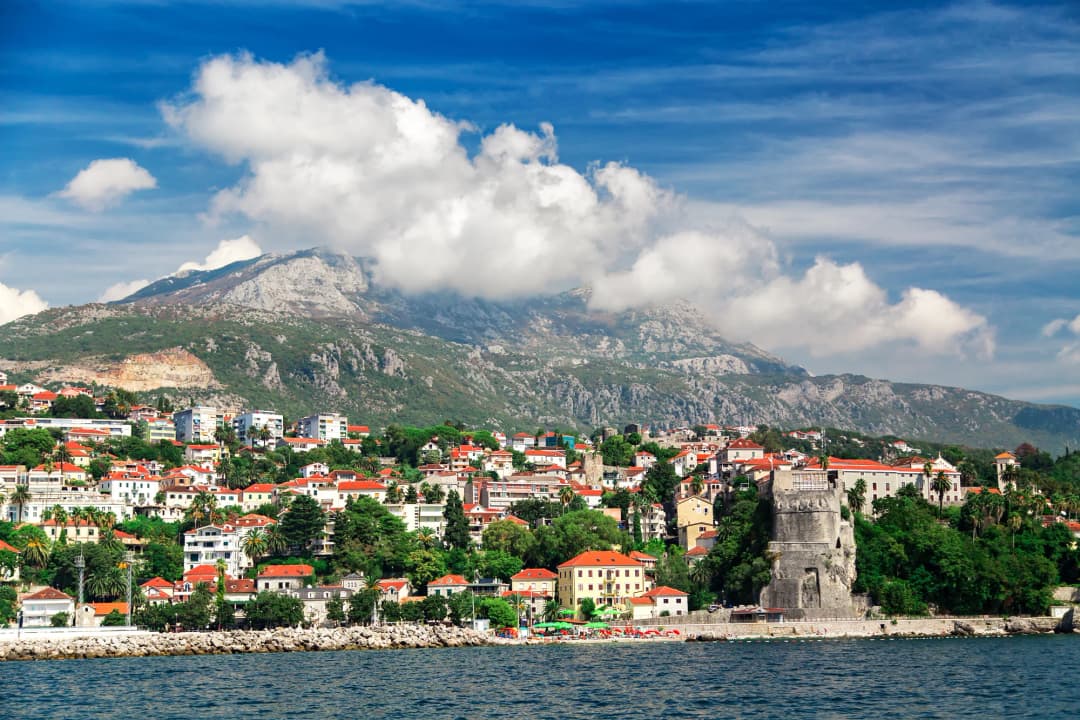
4. Herceg Novi: make the route accessible to your group
Herceg Novi rewards shorter linked stops rather than a heroic climb through every level. Pick a café close to the promenade or the specific fortification you want to visit, then verify steps and entrances on the day. If a quieter bay base matters more than ticking off the centre, compare nearby options in our Kumbor and Herceg Novi Riviera guide.
5. Cetinje: connect diplomacy with the old royal capital
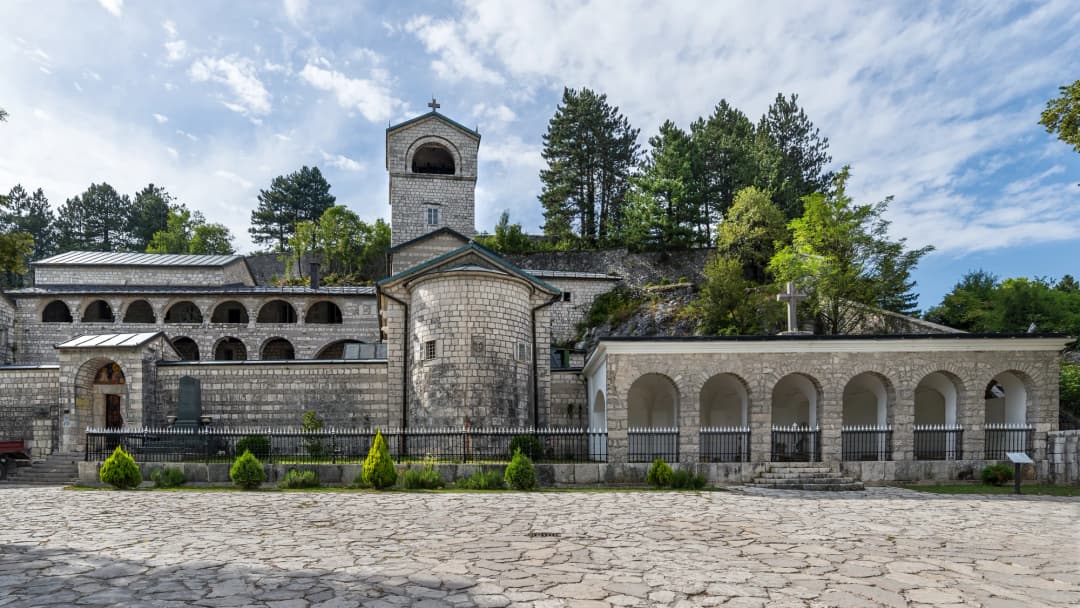
Cetinje gives the political theme historical depth without pretending that nineteenth-century diplomacy predicts EU accession. The National Tourism Organisation describes it as the old royal capital, at 672 metres, with former royal residences and museums. Confirm the exact museum’s hours and ticket before travel; use a café pause between two nearby institutions rather than trying to cover every collection.
6. Žabljak and Black Lake: put conditions before the cup
UNESCO describes Durmitor as a glacier-shaped landscape crossed by rivers and underground streams, with clear lakes and the Tara canyon. That is landscape evidence, not an operating notice. Check the national park, local forecast, road and trail before leaving Žabljak. The Durmitor and Black Lake guide explains route choices and safety without calling the lake circuit universally easy.
Here the coffee belongs after a suitable walk or as the fallback when conditions fail. Do not build the day around a claim that a café sits at a particular elevation or that rafting runs in every month.

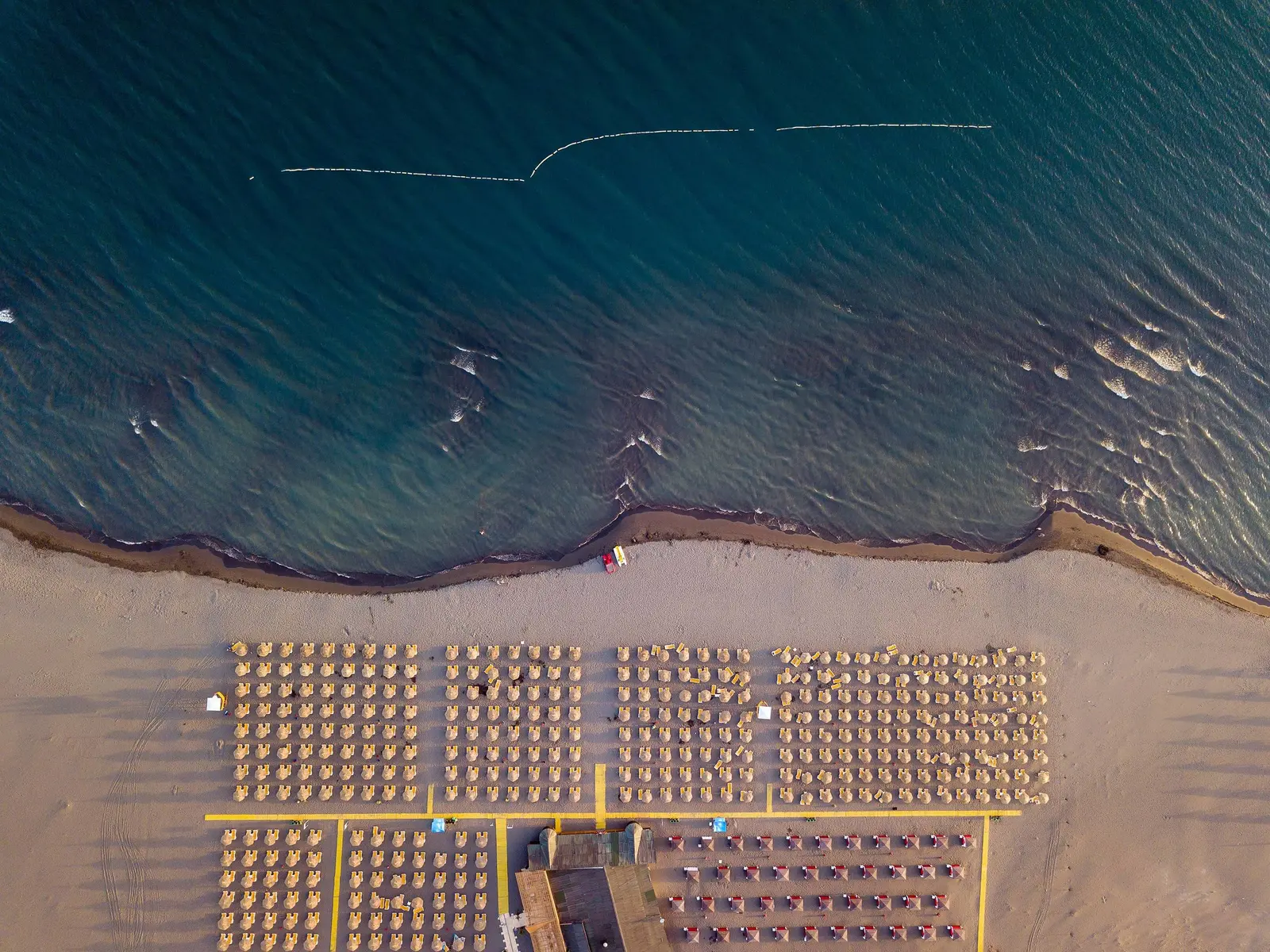
7. Ulcinj and Velika Plaža: choose the exact beach sector
The southern coast is not one continuous service zone. Velika Plaža contains separately managed sectors, and wind, flags, sanitary results, equipment and access can differ. Use the Velika Plaža guide to select a sector, then check the newest result and on-site flag. Coffee nearby is optional; safe water and a workable return matter more.
8. Sveti Stefan: use a public viewpoint, not an access assumption
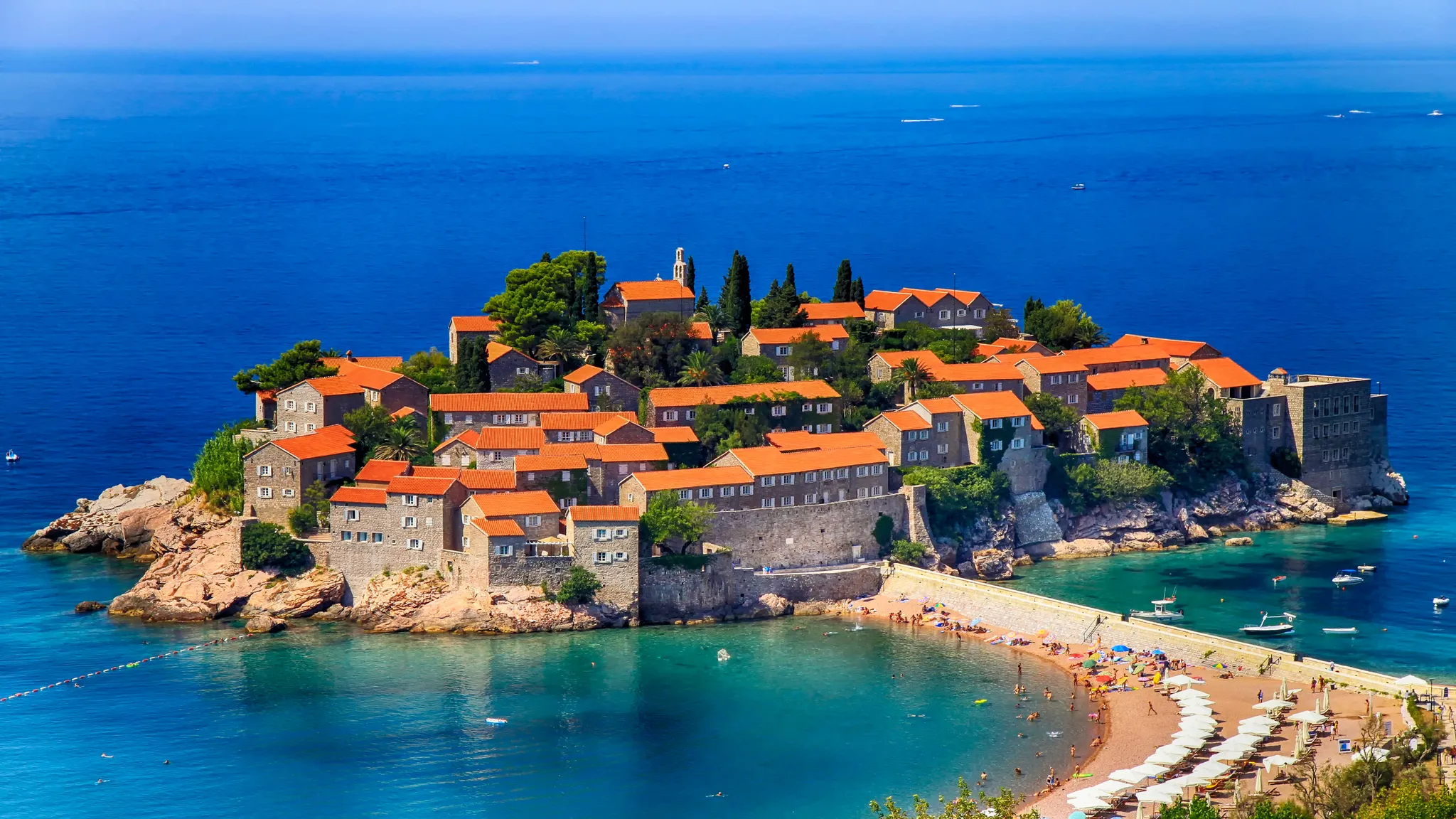
Sveti Stefan is a powerful final image, but the islet’s interior and adjoining managed areas can have changing access. Plan a lawful public viewpoint and a separate café stop; never buy a drink on the assumption that it includes islet entry. Our Sveti Stefan area guide helps distinguish villages, beaches and viewpoints.
Practical ways to turn eight ideas into one trip
Do not attempt all eight stops in sequence. Choose one route according to arrival point and interests, then verify transport and operations. The long view of international Montenegro coverage is useful context, but no headline should determine your daily plan.
| Route | Stops | Best length | Check |
|---|---|---|---|
| Bay route | Kotor • Perast • Tivat • Herceg Novi | 2–3 days | Weather and hours |
| Culture route | Cetinje • Kotor | 2 days | Confirmed museums • weather fallback |
| Contrast route | Durmitor • Ulcinj • Sveti Stefan | 4+ days | Long transfer check |
Montenegro.com editorial framework
- Bay route: base in one town and connect Kotor, Perast, Tivat and Herceg Novi over two or three days. Ferry, boat, parking and bus information must be confirmed.
- Culture route: pair Cetinje with Kotor and one confirmed museum day. This works well when beach weather is weak.
- Contrast route: combine Durmitor with the southern coast only if you have at least four days and a safe, daylight transfer. It is not a same-day coffee crawl.
- One fallback: give every weather-sensitive or access-sensitive stop a nearby substitute whose hours you have checked.
Frequently asked questions
Has Montenegro joined the EU?
No. At the 31 August 2026 cutoff, Montenegro is a candidate country in accession negotiations. All 33 chapters are open and 18 are provisionally closed. Membership requires an overall agreement and a fully ratified accession treaty.
Will Montenegro definitely join in 2028?
No date is guaranteed. 2028 is a political target and a scenario accommodated by the proposed EU budget package. The Commission explicitly says the package does not mean accession will occur in January 2028.
Does accession really cost each EU citizen one euro?
A media report attributed a roughly one-euro-per-citizen-per-year comparison to an anonymous senior Commission official. The public legal documents establish the €3.2 billion conditional package, but they do not publish the complete coffee calculation. Treat it as a scale metaphor.
Are 18 chapters fully and permanently closed?
No. They are provisionally closed. The Council states that chapter agreements are not final until an overall agreement is reached, and the EU can revisit chapters if necessary.
Does candidate status change entry rules for tourists?
Not by itself. Use Montenegro’s current government visa guidance for your nationality and date. A July 2026 decision also changes visa requirements for several nationalities from 1 November 2026, demonstrating why old travel summaries can be wrong.
Can I buy coffee for one euro in all eight places?
No such promise is made. The phrase concerns a political budget comparison, not menu prices. Read the current menu, check service charges and card-currency choices, and decide before ordering.
Is the route an endorsement of specific cafés?
No. It recommends flexible town and landscape stops, not venues. Accessibility, hours, smoking policy, payment methods and prices can change, so inspect the exact business yourself.