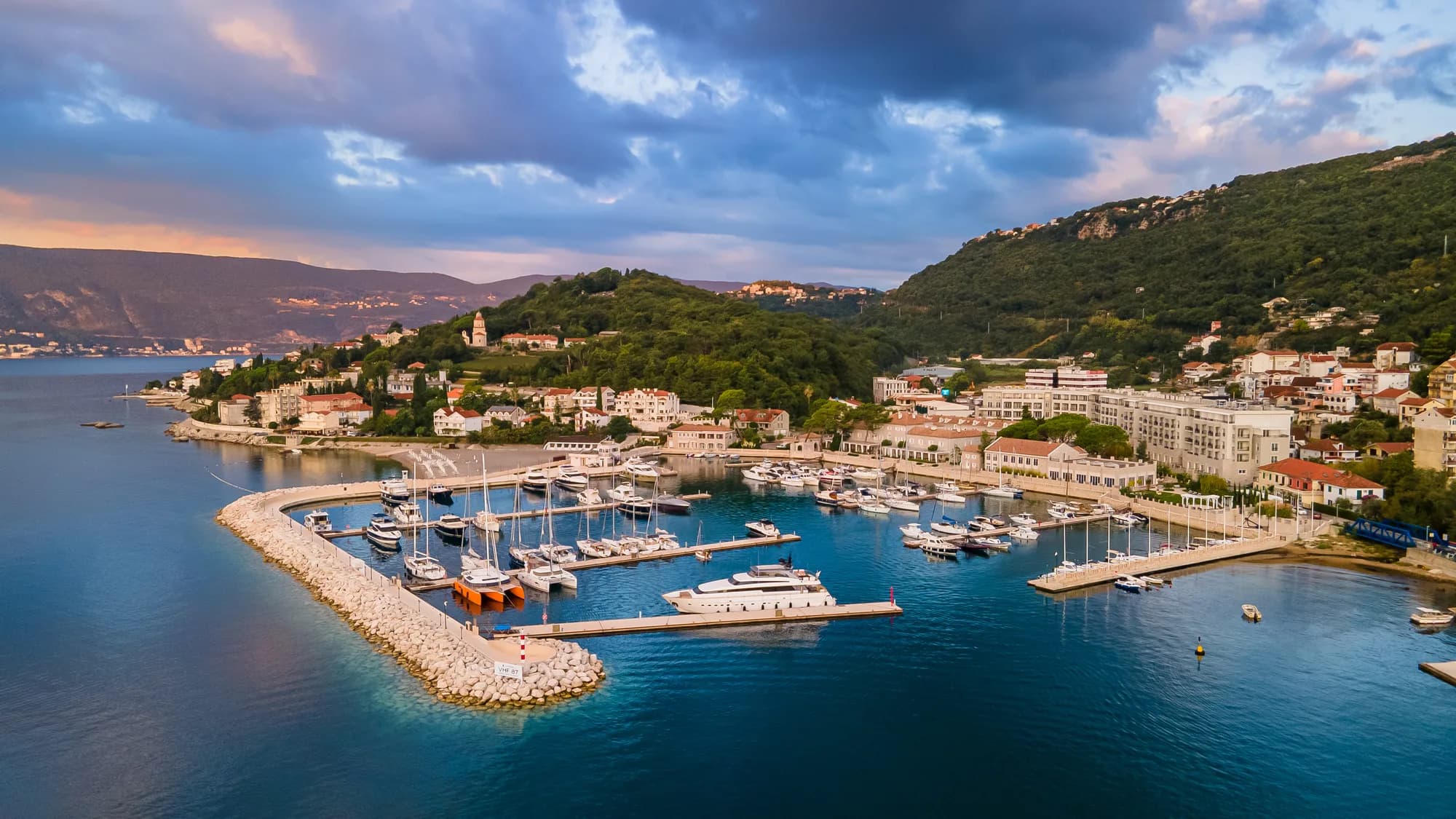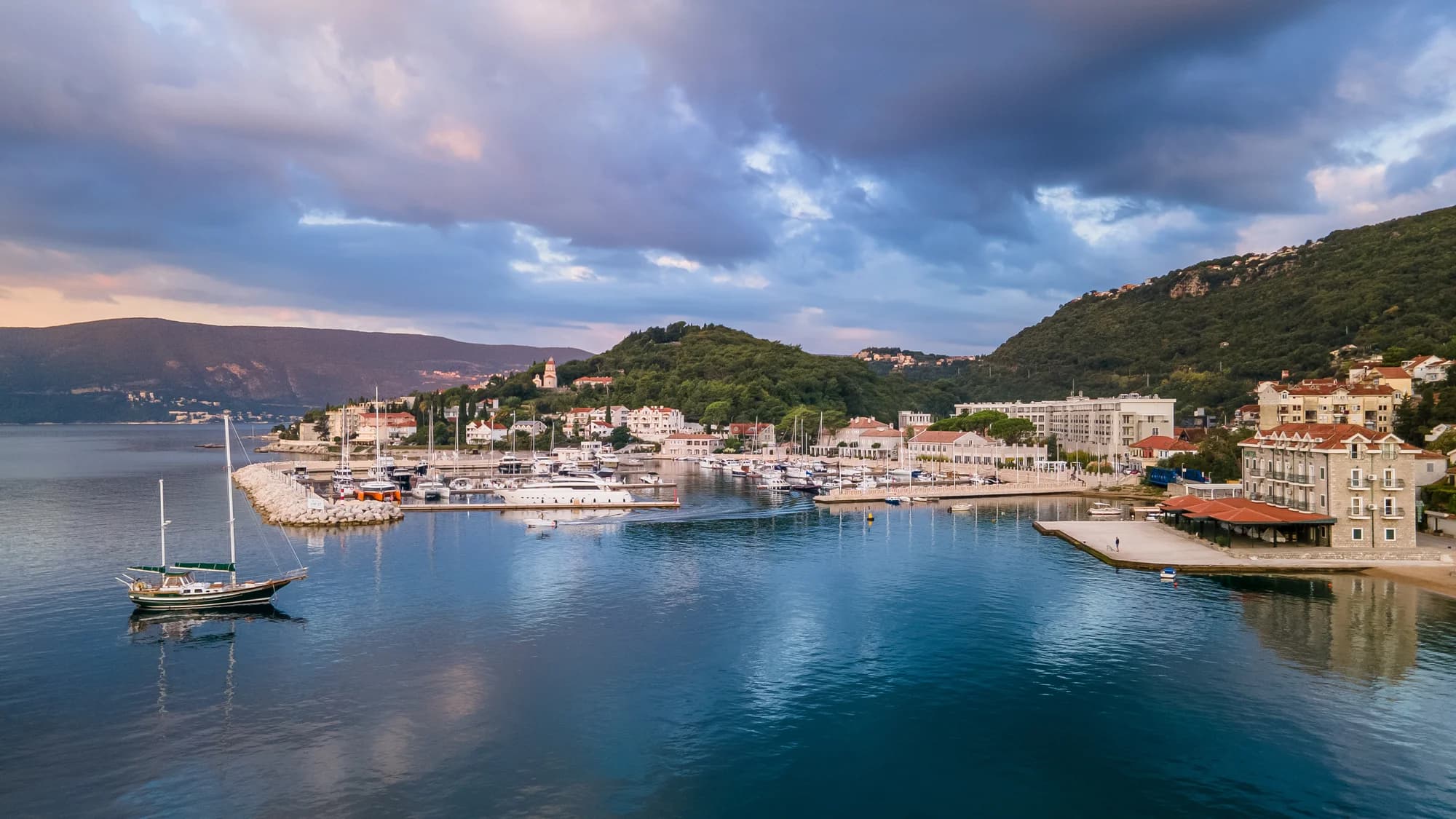
Meljine works best when you choose an address by access route, not by the label “near Herceg Novi.” A waterfront room may sit beside the newly controlled Pet Danica promenade. An upper address may be closer to the M1 road and its traffic noise. A beach photo says nothing about the latest water sample, and a historic Lazaret does not automatically mean a public museum.
This 2026 article is deliberately different from our general Meljine destination guide. It audits the settlement’s practical fault lines: vehicle access at the promenade’s eastern end, seasonal one-way streets, provisional bus data, current bathing-water results, visitor registration, and what official records actually establish about the Lazaret.
| Question | Verified evidence | Confirm before payment |
|---|---|---|
| Waterfront vehicle access | Promenade bollards operate year-round; ordinary access is restricted | Legal drop-off point and luggage route to the exact door |
| Summer driving | Part of Braće Pedišića is one-way 1 July–1 September | Approach direction, parking and departure route |
| Bus use | A current route service lists hospital and roundabout stops | Stop side, timetable, fare and last service with the carrier |
| Swimming | Meljine 01 had seven 2026 samples through 19 August | Latest dashboard result, flag and exact shore entry |
| Lazaret visit | Protected complex now used as a hotel and marina | Public access, event, tour and photography rules |
| Visitor registration | Tourist office is listed at the Meljine roundabout | Who registers you and proof of completion |
Start with the real scale of Meljine
MONSTAT’s final 2023 settlement workbook records 1,283 residents in Meljine: 616 male and 667 female. A separate workbook records 516 households. Those counts use the census reference moment; they are not summer occupancy, tourist beds, dwellings, parking spaces or the number of businesses open tonight.
The population is large enough that Meljine is not merely a resort compound, but small enough that “Meljine” remains an imprecise booking location. The practical split is between the coast/promenade level, the roads rising above it, and addresses influenced by the M1 corridor. Ask for a map pin and an entrance video.
Road noise is not a speculative concern. In August 2026, Montenegro’s Ministry of Ecology opened a public consultation on a noise action plan specifically for the M1 Meljine–Kamenari section. That process does not establish the sound level inside a particular apartment. It does justify asking which side the bedroom faces, whether windows can remain closed, and whether cooling works with them shut.
Practical promenade access changed in 2025–2026
In June 2025, Herceg Novi municipality opened the reconstructed section from Hotel Plaža to Meljine. It gives that section’s length as 1.7 kilometres and says the full Titova vila–Meljine route was then paved and lit. That is strong evidence for the eastern section; it does not make every building entrance level, step-free or reachable by car.
A total-length claim is intentionally omitted. Official publications use different scopes: Morsko Dobro described a three-kilometre reconstruction project, while the tourist organization’s panorama map describes a six-kilometre Igalo–Zelenika promenade. The inherited article said five kilometres. These can refer to different endpoints or project packages, so presenting one number as the uncontested length would mislead.
The name’s history belongs in our focused Five Danicas promenade article. For a Meljine stay, the current operating rule matters more: in June 2026 the municipality activated retractable bollards along the full Igalo–Meljine walking route. The municipality says ordinary vehicle access is restricted year-round. Authorized residents and deliveries use cards; bollards are lowered from 05:00 to 09:00 for delivery vehicles and people with property along the promenade.
A booking host cannot convert that controlled public system into guaranteed guest access by saying “you can drive to the door.” Ask for the legal drop-off pin, whether the driver must reverse or detour, the walking surface, step count and who carries luggage outside the access window. If the answer depends on a resident card, ask whether that arrangement lawfully covers your stay.
Summer traffic adds another layer
The municipality’s 2026 summer regime makes part of Braće Pedišića one-way from 1 July to 1 September. The affected section runs from the bridge to the junction at the western entrance to Lalovina Street, by the old railway tunnel, in the direction of the tunnel. A route that works on a winter map may therefore fail as a summer approach.
Micromobility also changes by date and hour. On Obala Nikole Kovačevića and Pet Danica to its Braće Pedišića junction, electric scooters are prohibited from 1 June through 30 September. Bicycles and motorized bicycles are prohibited on the same stretch from 19:00 to 01:00 during that period. Do not sell a bicycle-based evening commute without checking the signed limits.
For drivers using the northern Meljine–Petijevići road toward the hinterland or Bosnia and Herzegovina, the municipality reported a temporary June 2026 repair near the quarry after landslide damage. It explicitly described the work as temporary pending a full reconstruction. Check road conditions rather than treating the repair notice as a permanent all-clear.
Getting there without inventing a timetable
A current InfoGrad route page, explicitly described as based on carrier data, lists an Igalo–Meljine–Igalo circuit with two Meljine stops: Meljine – kod Bolnice and Meljine – Kružni Tok. It displays a €1.50 fare and a provisional schedule, but also warns that the carrier may change routes, times and conditions without notice.
Blue Line’s official contact page gives its Herceg Novi traffic office as +382 31 336 002 / 335 100 and mobile +382 68 898 010, with published hours 07:00–21:00. Use the route page to learn the stop names, then use the carrier to confirm your travel date, stop side, operating day, fare, luggage and accessible boarding. The Tourist Organization gives the main bus-station number as +382 31 321 225.
A host saying “the bus stops nearby” must identify which stop. The roundabout and hospital stops serve different access contexts, and the final walk may cross a busy road or climb. Ask for an uncut video from the chosen stop to the entrance. Our Herceg Novi area guide helps compare Meljine with flatter or more central alternatives.
Read Meljine 01 water results by date
The official Morsko Dobro dashboard identifies the local monitored bathing water as Meljine 01. Through the sample taken at 05:30 on 19 August 2026, it showed seven regular rounds: four excellent, one good, two sufficient and none bad. The English interface labels the sufficient category “Okay” in its returned data.
| Sample date | Dashboard classification | Sea temperature at sampling |
|---|---|---|
| 25 May | Excellent | 19.8°C |
| 8 June | Excellent | 22.5°C |
| 22 June | Excellent | 24.3°C |
| 6 July | Sufficient (“Okay”) | 21.2°C |
| 20 July | Excellent | 25.5°C |
| 7 August | Good | 24.0°C |
| 19 August | Sufficient (“Okay”) | 25.9°C |
This series directly refutes the inherited article’s timeless promise of a uniquely clean, inviting shore. It also does not justify the opposite conclusion: no 2026 sample in the checked sequence was classified bad. The correct practice is to read the latest local result and the flag at the bathing place.
Morsko Dobro’s national update for the 17–21 August round adds context, not a substitute. Across 22 Herceg Novi locations it reported 15 excellent, three good, three sufficient and one bad result. That poor result was at Baošići 01, not Meljine; a repeat sample on 26 August was sufficient. Never transfer either finding along the coast.
Water quality and shore access are separate checks
The dashboard evaluates microbiological quality for a defined bathing water. It does not evaluate steps, surface, lifeguards, ladder condition, depth, currents, commercial access or the right to cross private property. Inspect the exact entry you plan to use.
Lalovina lies toward the boundary with Zelenika, but the old article’s description of a secluded, uniquely clean beach is subjective and unverified. Morsko Dobro recorded an unauthorized organized bathing operation at Lalovina in July 2021. That enforcement note is too old to describe the 2026 operator or condition; it is evidence that an attractive shore should not be assumed compliant from appearance alone.
Ask who manages the precise bathing area today, whether a free strip remains, what the current price board says, and where the safety information and water-quality link are displayed. For a child, weak swimmer or traveler with reduced mobility, ask for a dated, continuous video from the public route into and back out of the water.
The Lazaret is protected heritage and an operating resort
Herceg Novi’s 2018 official cultural-heritage study says the Lazaret received protected immovable-cultural-property status by decision in February 2015. It records that construction began in 1729, that the principal entrance originally faced the sea, and that the side entrance was opened during a 1767 reconstruction.
The municipality’s current riviera page likewise uses 1729 and says water was brought from Savina in 1741. The operator’s own history describes a construction span of 1729–1732. These are compatible if 1729 is the start and 1732 the completion, but the inherited article’s single “built in 1732” date erased that distinction.
The complex is now Lazure Hotel & Marina. Heritage status does not establish free public access to courtyards, the chapel, hotel rooms, marina pontoons or a museum exhibition. Use the operator’s official history page for background, then ask whether a public tour or event exists on your date. Do not enter private hotel or marina areas merely because the site is culturally important.
Savina Monastery is a separate religious complex uphill. The 1741 water connection is a historical link, not a modern public footpath or a promise of step-free access between the two sites.
Even the “first mention” is disputed by official pages
The municipality’s current riviera page says Meljine appeared as the port of Dračevica in a Dubrovnik document from 1371. Its official “89 churches” page says the first mention was in 1326. Without seeing and dating the underlying archival documents, this article will not declare either one the uncontested first record.
The safe conclusion is that municipal sources place Meljine in medieval Dubrovnik records before Herceg Novi’s traditional 1382 founding date. Readers interested in a wider regional chronology can continue to our Topla cultural-history guide. Precision should come from the document, not from repeating whichever tourism page appears first.
Do not treat the hospital as a landmark only
The old article described a “Military Hospital complex” as scenery along the walk. Current government records establish an active public-health role. Since March 2023, Meljine Hospital has operated as an organizational unit of Kotor’s public hospital structure. In May 2026, Herceg Novi municipality donated an ambulance, incubator, anaesthesia equipment and an ophthalmology device to the Meljine unit.
That status does not tell a traveler which department is open now or whether a condition should be taken there. Use Montenegro’s emergency number 124 for medical emergencies and follow the dispatcher’s direction. Do not enter the grounds as a tourist shortcut, and do not assume the label “hospital nearby” guarantees every specialty or travel-insurance arrangement.
Register the stay and get evidence
The Tourist Organization’s current useful-information page lists TIB Meljine at Put žrtava fašizma bb by the roundabout, telephone +382 31 348 331, Monday–Saturday 08:00–21:00. It currently publishes the residence tax as €1 per adult per night, €0.50 for ages 12–18 and an exemption under 12, alongside other exemptions.
The same page is internally inconsistent about timing. One section says a registered accommodation provider must register a guest within 12 hours of arrival; a later obligations section says within 24 hours. The visitor obligation is described as within 24 hours of entering Montenegro. Do not solve this conflict by choosing the slower deadline. Ask the host to register immediately and send the digital or stamped confirmation.
The local office is useful, but its published hours do not prove holiday opening or explain what happens after a late Saturday arrival. Confirm before depending on it. Our tourist-tax and registration guide explains the national framework; the local office confirms the current Herceg Novi execution.
An evidence-based accommodation checklist
- Pin the entrance. Distinguish promenade, Braće Pedišića, roundabout, hospital and M1-side addresses.
- Test arrival legality. Obtain the permitted drop-off point and the luggage route after bollards rise.
- Check the summer direction. Ask whether the 1 July–1 September one-way segment changes your approach.
- Screen noise. Request a bedroom-window video with windows open and closed at the hour you expect to sleep.
- Name the bus stop. Confirm hospital versus roundabout, the correct side and service on your date.
- Inspect the shore. Ask for the exact entry, surface, ladder, depth, shade, management and latest flag.
- Verify registration. Keep the host’s promise and the completed confirmation in the booking platform.
- Keep a fallback. Save the carrier, tourist office, accommodation and emergency contacts offline.
For a car-free day beyond the coast, do not improvise an Orjen trip from the Meljine–Petijevići road. Use the Orjen guide, current mountain conditions and a confirmed operator. A temporarily repaired road is not a marked walking route.
Frequently asked questions
Can a taxi drive along Pet Danica to my apartment?
Do not assume so. The municipality describes year-round controlled vehicle access with authorized cards and a 05:00–09:00 window for deliveries and property access. Ask the host for a legal drop-off pin and walking distance that apply to an ordinary guest.
Is the promenade five or six kilometres long?
Official publications use different endpoints and project scopes. The municipality verifies the reconstructed Hotel Plaža–Meljine section at 1.7 km; Morsko Dobro described a three-kilometre reconstruction, while the tourist map describes a six-kilometre Igalo–Zelenika promenade. Use named endpoints rather than one unsupported total.
Was Meljine 01 water clean throughout 2026?
The seven samples through 19 August included four excellent, one good and two sufficient results, with none bad. The latest checked result was sufficient. That is a dated monitoring series, not a permanent safety guarantee.
Can I tour the Lazaret?
The complex is protected heritage now used as a hotel and marina. Protection does not create general access to private areas. Ask Lazure whether a public tour, exhibition or event operates on your date.
Is Meljine Hospital open?
Official 2026 records show an active organizational unit within the Kotor public hospital structure. They do not establish every department’s current hours. For an emergency call 124 and follow dispatch instructions; for planned care confirm the service directly.
Where is the Meljine tourist office?
The Tourist Organization lists it at Put žrtava fašizma bb by the roundabout, with +382 31 348 331 and Monday–Saturday 08:00–21:00. Recheck holiday and seasonal operation before relying on those hours.
Methodology and update boundary
This article prioritizes final MONSTAT workbooks, municipality and ministry notices, the public bathing-water system, the Tourist Organization, the carrier’s contact page and the official cultural-heritage study. The bus route aggregator is identified as secondary and is used only to name provisional stops; the carrier remains the confirmation source.
Research was checked on 30 August 2026. Traffic restrictions, water samples, office hours, fares, exhibitions and medical services can change. Where official sources conflict—promenade length, Meljine’s first documentary mention and registration timing—the disagreement remains visible rather than being silently harmonized.