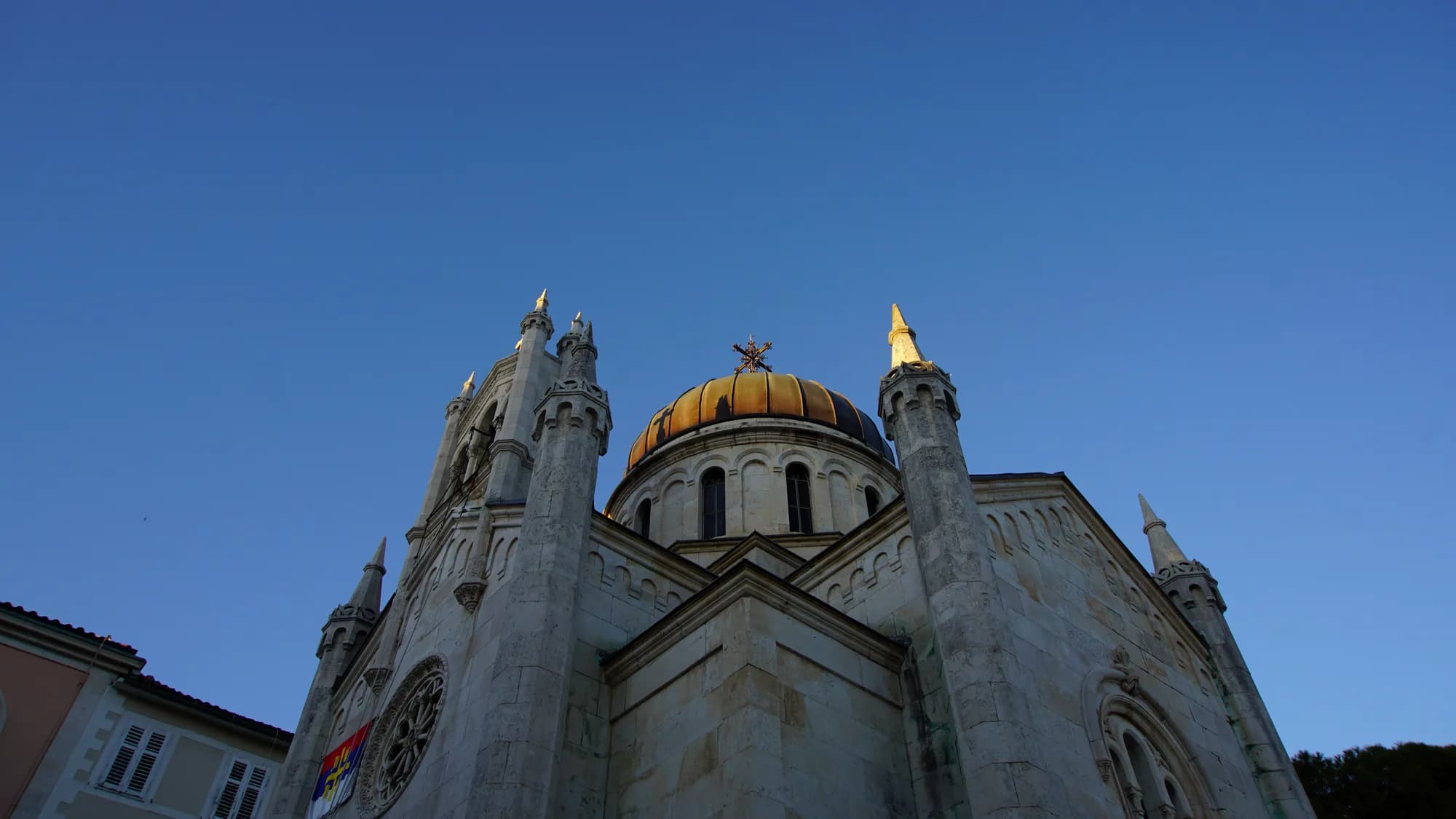
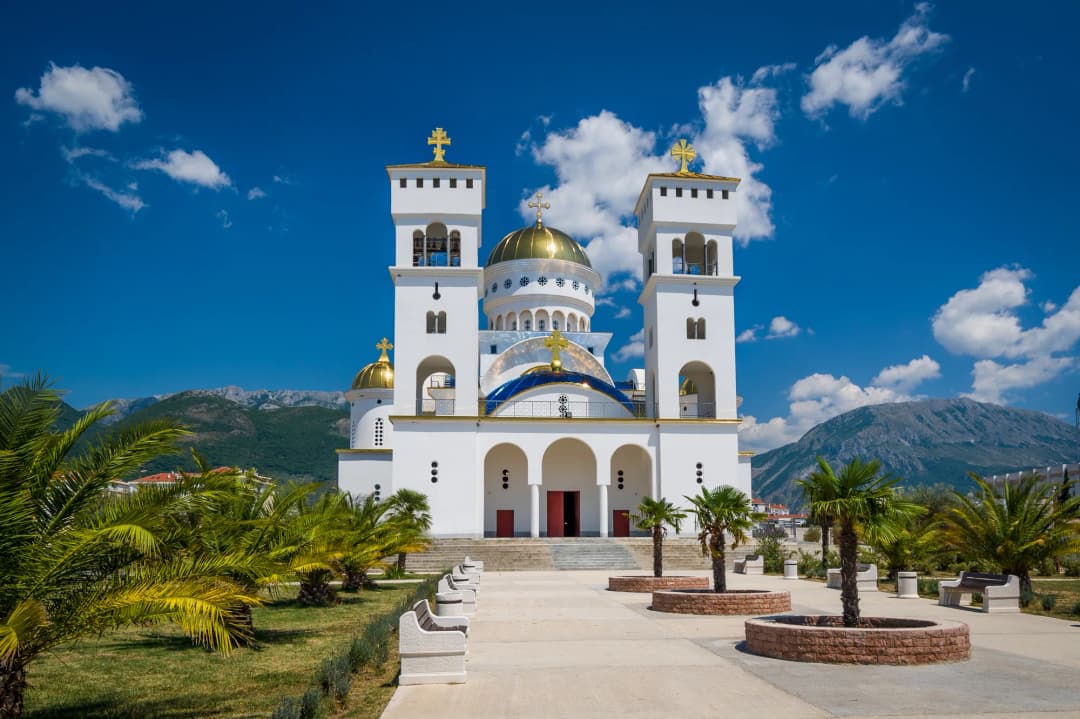
You see the gold before you see the church. Approaching Bar from almost any direction, the gilded domes of the Cathedral of Saint Jovan Vladimir catch the sun above the rooftops of a town otherwise built in the practical concrete of the post-earthquake decades. It is a deliberately arresting sight — a brand-new cathedral in the ancient Serbo-Byzantine manner, and the largest Orthodox church in Montenegro.
A thousand-year-old story
The man it honours died a millennium before it was built. Jovan Vladimir ruled Duklja — the early medieval principality on whose territory today's Montenegro largely sits — from around the year 1000. His short reign fell in the middle of the great war between Byzantium and the Bulgarian Empire of Tsar Samuel, and Duklja was caught between the two. Captured by Samuel, Vladimir won an unlikely reprieve: the tsar's daughter Kosara fell in love with the imprisoned prince, and their marriage — one of the Balkans' oldest recorded love stories — restored him to his throne as the tsar's vassal and son-in-law.
The peace did not survive Samuel's death. In 1016, the usurper Ivan Vladislav lured Vladimir to the imperial capital at Prespa with a sworn guarantee of safety. According to the medieval chronicle tradition, Vladislav sent a golden cross as his pledge; Vladimir replied that Christ had died not on gold but on wood, and came only when churchmen brought him a wooden cross to swear on. He was beheaded in front of a church at Prespa on 22 May 1016, holding the cross he had been given.
Venerated as a martyr almost immediately, Jovan Vladimir is counted among the very first South Slavic saints and is the patron saint of Bar. The legend lives on in a startlingly physical way: a cross associated with the saint, kept for generations by the Andrović family of Velji Mikulići near Bar, is carried each Pentecost in a procession to the summit of Mount Rumija — the mountain that rises directly behind the town. Faith, landscape and memory bound together in a single annual walk.
Building a cathedral in the twenty-first century
The cathedral was built between 2006 and 2016 and solemnly consecrated on 25 September 2016, with Patriarch Theophilos III of Jerusalem taking part in a ceremony that drew thousands of faithful. The timing was pointed: the millennium of the saint's martyrdom.
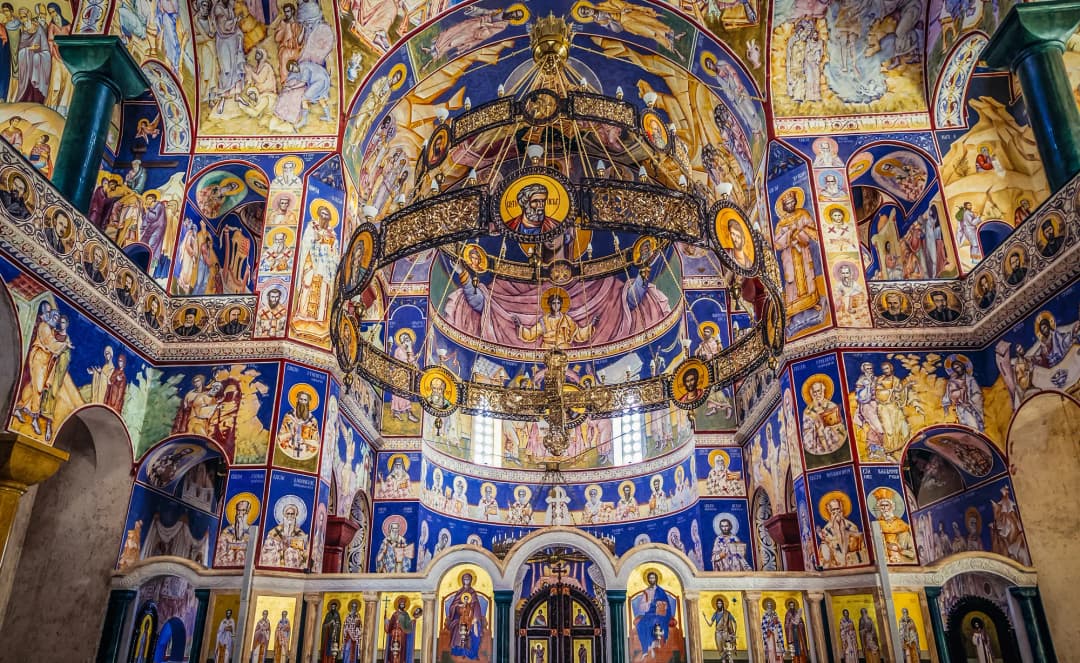
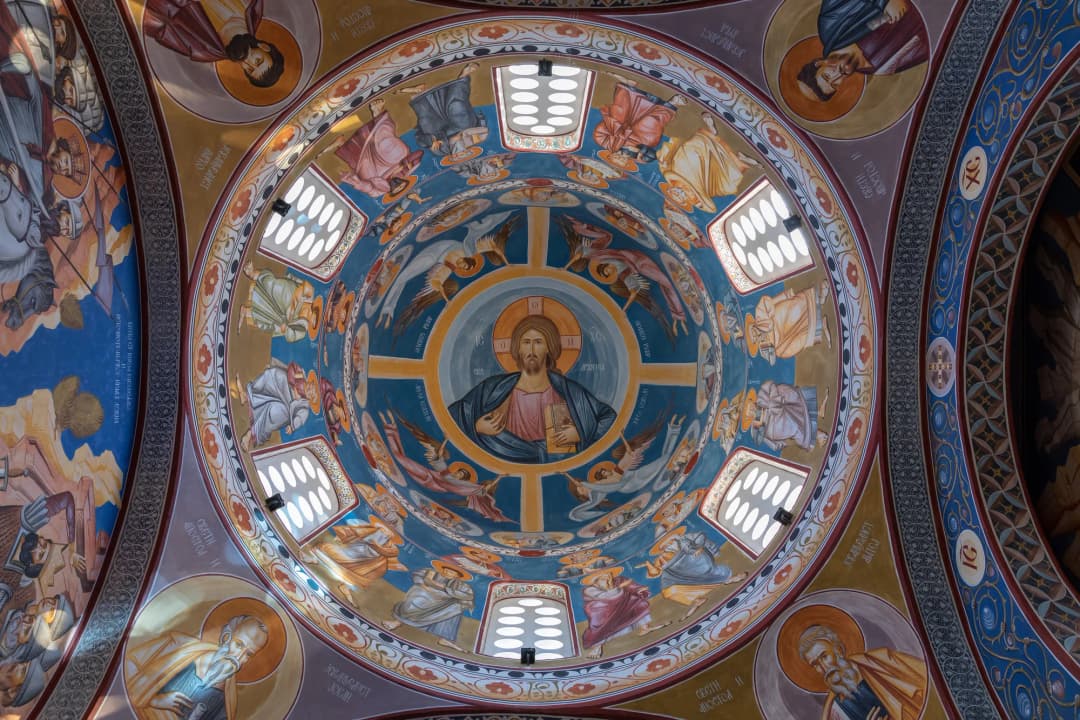
The architecture speaks the Serbo-Byzantine language of the great medieval churches — a cross-in-square plan crowned with domes — but at a scale those builders never attempted here. The church covers some 1,350 square metres, its central dome rises around forty metres and carries a golden cross weighing close to 400 kilograms, and the gilded cupolas make it visible from far out on the water. Inside, the walls carry a programme of vivid contemporary frescoes and mosaics: traditional iconography executed by living hands, still bright in a way that centuries-old churches can only hint at. The interior can hold over a thousand worshippers, and on major feast days it does.
Old saint, new town
There is a quiet symmetry in the cathedral's location. Medieval Bar — Stari Bar, up in the karst below Rumija — was abandoned after war and earthquake, and the modern town by the port is barely a century and a half old, rebuilt again after the devastating earthquake of 1979. A town that young has few monuments. The cathedral gives it one: a place where Bar's oldest story, the martyred prince of Duklja, stands at the centre of its newest neighbourhood. Whatever your beliefs, stepping from the bright Mediterranean glare into the cool, fresco-lined half-light is one of the most striking transitions the town offers.
Visiting
The cathedral stands in the modern centre of Bar, a short walk inland from the marina and an easy stop along the town-centre stage of the King's Promenade walk. It is an active place of worship: entry is free, modest dress is expected (shoulders and knees covered), and quiet is appreciated during services — liturgy on Sunday mornings is also when the church is at its most atmospheric. Photography of the interior is generally tolerated outside services, but ask if in doubt. Come in the morning for the best light on the mosaics, or at dusk, when the floodlit golden domes glow above the town and Rumija darkens behind them.