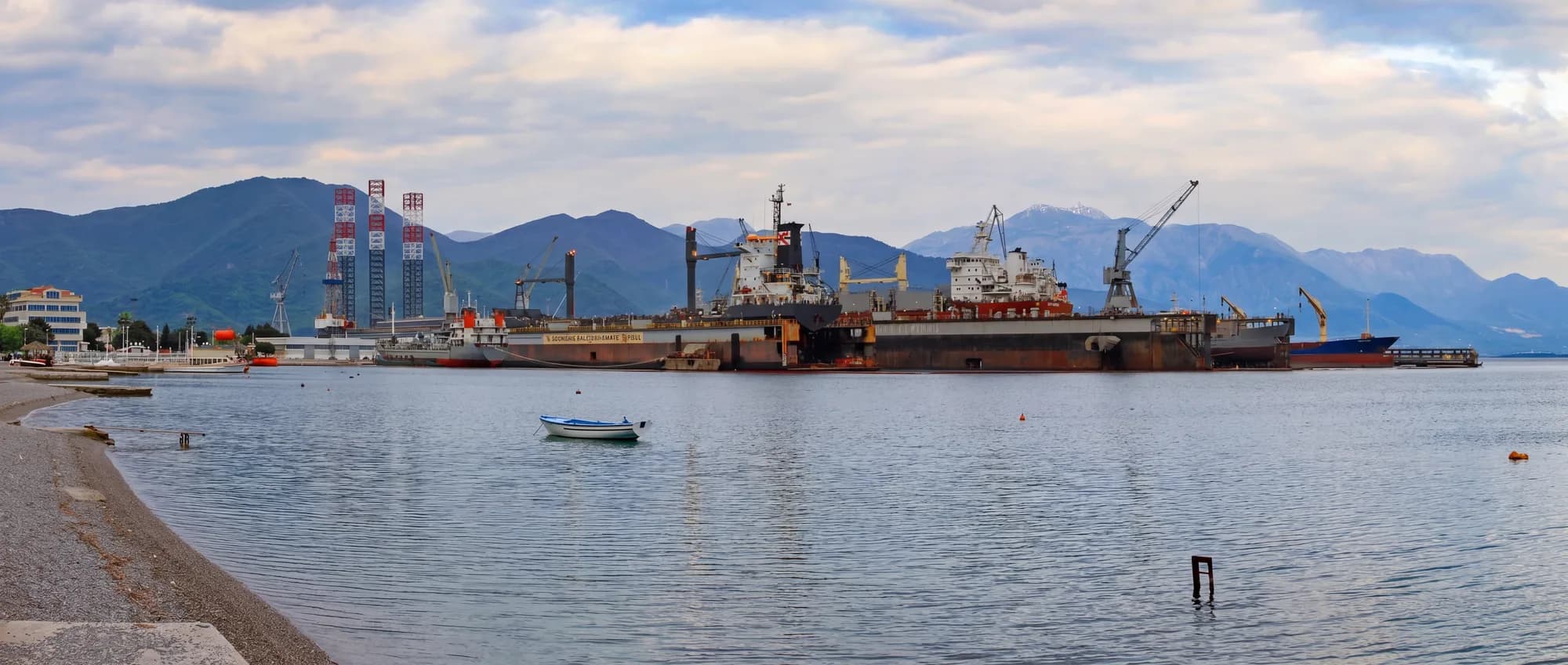
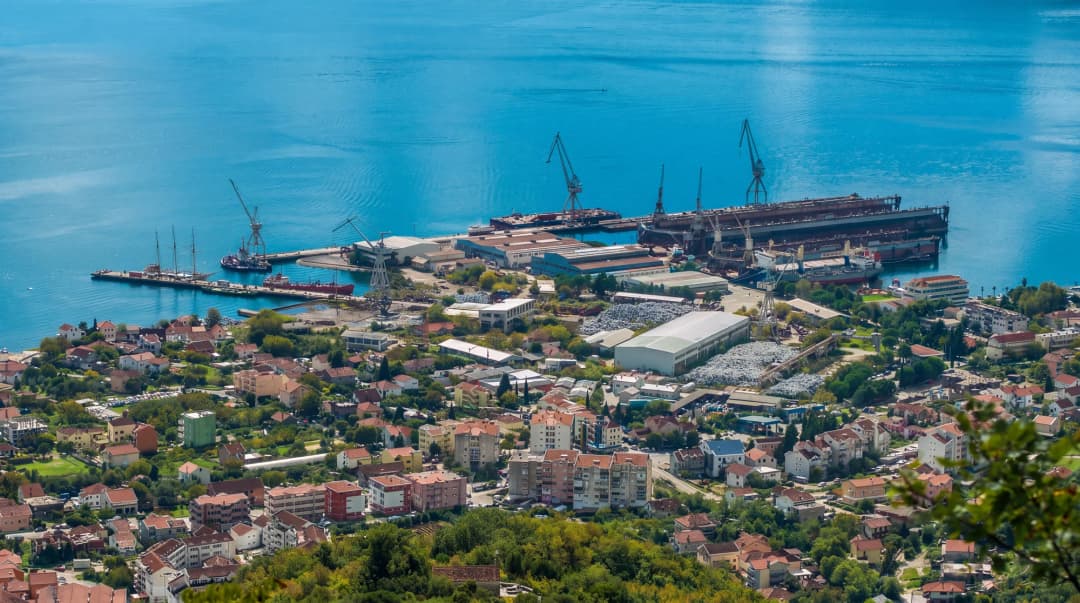
Halfway along the northern shore of the outer bay, between beaches and holiday apartments, the skyline abruptly turns industrial: cranes, sheds and a vast floating dock rise over the village of Bijela. Visitors are often startled to find heavy industry inside a bay this beautiful, but the shipyard is no intruder — it has been here for a century, it was once the largest ship-repair yard of the southern Adriatic, and it is now living one of the more remarkable second acts on the coast, reborn as a refit centre for some of the largest yachts on earth.
A yard since 1927
The Boka has built and repaired ships for as long as it has had sailors, and Bijela itself was long a village of seafarers. The modern yard was founded in 1927, and over the decades of the twentieth century it grew into the biggest conventional ship-repair and maintenance centre in the southern Adriatic. Its golden age came under Yugoslavia: by the mid-1970s Bijela operated the largest floating dock in the region, with a lifting capacity of 33,000 tonnes, and employed more than nine hundred workers. Freighters, tankers and bulk carriers from across the world's merchant fleets steamed through the Verige strait to be docked, scraped, welded and repainted beneath the Orjen mountains — an incongruous but proud sight, and for generations of local families the yard was simply where one worked.
Decline and a poisoned inheritance
The collapse of Yugoslavia in the 1990s hit the yard as hard as any industry on the coast. Orders thinned, the fleet of customers scattered, and the yard limped through the post-war decades well below its old capacity. It also left a darker legacy: decades of sandblasting hulls had buried the site in enormous quantities of contaminated blasting grit, laced with heavy metals and old anti-fouling paint — an environmental burden entirely at odds with a bay that was, by then, selling itself to the world as an unspoiled natural harbour. Any future for Bijela had to begin with a cleanup, and the removal of the accumulated grit from the site, backed by international financing, became the precondition for everything that followed.

Enter Damen — and exit Damen
The turning point came on 30 November 2018, when Montenegro's government signed a thirty-year concession for the roughly 198,000-square-metre site with a consortium of the Dutch shipbuilding group Damen and Adriatic Marinas, the company behind the Porto Montenegro marina in Tivat. The plan was to convert the old yard from merchant-ship repair to superyacht refit — a logical marriage, since Porto Montenegro had already filled the bay with exactly the vessels such a yard would serve. The partnership, however, did not last: in November 2020 Damen and Adriatic Marinas agreed to part ways, and the Dutch group's place in the concession was taken by Drydocks World — Dubai, the shipyard giant that, like Porto Montenegro's owner, belongs to the Investment Corporation of Dubai. The reshuffled consortium pressed on.
Adriatic 42
The reborn yard took the name Adriatic 42 — for the 42nd parallel north, on which it sits. Its centrepiece arrived by sea in June 2022: a new floating dock measuring 180 by 37 metres with a lifting capacity of 10,000 tonnes and twin cranes, by a wide margin the most capable dock for large yachts in this part of the Adriatic. Operations began that October, and the yard announced itself to the industry in style when the Black Pearl — at 106 metres the largest sailing yacht in the world — came in for refit as one of its first flagship clients. Around a hundred people already work at the yard, many of them heirs to Bijela's long shipfitting tradition, and the ambition is explicit: to make the bay a place where the world's superyachts are not only berthed and admired, as at Porto Montenegro, but lifted, rebuilt and re-engineered — the full industrial ecosystem of yachting, anchored in a village of nine hundred former shipyard workers' descendants.
Why it matters
It is easy to read Bijela as a parable of the coast itself: heavy industry giving way to high-end tourism. But the truer reading is continuity — the same deep water, the same sheltered anchorage and the same skilled hands that served freighters for ninety years now serve yachts. Unlike a hotel, a refit yard exports skilled labour at world prices all year round, and the sight of a dock at Bijela cradling a hull the length of a football pitch is the bay doing what the bay has always done: working on ships.
Visiting
Adriatic 42 is a working industrial site and is not open to the public, but its scale is best appreciated exactly as locals see it — from the waterfront. The shoreline path that continues east from the Pet Danica promenade through Zelenika, Kumbor and Đenovići reaches Bijela's seafront, where the floating dock and cranes loom photogenically over the village beaches; the walk from Meljine takes a little over an hour, or minutes by the coastal bus. There is nothing to pay and nothing to book — come towards evening, when the yard's silhouette darkens against Orjen and, with luck, a superyacht sits high and dry in the dock across the water.