Hotel Plaža matters, but not quite for the slogan usually attached to it. The building in Zelenika is not the first hotel ever built within today’s Montenegro—Cetinje’s Lokanda predates it. Its defensible milestone is narrower and historically more revealing: a hospitality licence issued on 24 November 1902 marks what the Montenegrin Academy describes as the beginning of hotel tourism on the coast of present-day Montenegro.
There is another essential caveat. In 1902, Zelenika belonged to Austria-Hungary, not the then Principality of Montenegro. Hotel Plaža’s story therefore crosses changing borders as well as changing forms: 1899 villa, coastal pension, interwar hotel, wartime requisition, postwar nationalisation, children’s resort, military use, contested property and damaged ruin. The latest located evidence includes a non-final court judgment reported in May 2024 and a serious fire in March 2025. No reviewed official source announced public interior access or completed restoration by 30 August 2026.
| Date | Documented milestone | Qualification |
|---|---|---|
| 1899 | Mađar family villa in Zelenika was habitable | CANA says later personal design authorship is oral tradition |
| 16 Jul 1901 | First ceremonial train reached Zelenika | Railway monograph; regional connections required junctions |
| 24 Nov 1902 | Kotor district issued hospitality licence | Precise coastal-hotel milestone |
| 1909 | Antal died; Adorjan continued the enterprise | Scholarly biography using family manuscript material |
| 1948 | Property nationalised | Consistent across reviewed property reports |
| Mar 1960 | Agreement transferred use to Sarajevo municipality | Detailed RTCG and RTHN reporting |
| 30 Jun 1968 | Last passenger train left Zelenika | Freight had ended earlier |
| May 2024 | Judgment reported as non-final | Appeal announced; do not infer final title |
| Mar 2025 | Fire damaged lower rooms | Officials discussed securing a potentially ruinous structure |
First hotel: define the claim before repeating it
The Montenegrin Academy’s art lexicon gives the most precise starting point. Antal Mađar’s family villa was usable in 1899 and enlarged over the following years for hotel purposes. The Kotor district issued its hospitality permit on 24 November 1902. The lexicon treats that date as the beginning of hotel tourism on the Montenegrin coast while explicitly noting that Zelenika was then Austro-Hungarian territory.
That wording avoids two common mistakes. Hotel Plaža was not created from empty ground in a single year; an earlier villa evolved into the pension. And “Montenegro’s first hotel” collapses coast, state and modern borders. A stronger formulation is: the 1902 Zelenika licence is the conventional starting point for modern hotel tourism on the coast of present-day Montenegro.
| Framing | Scope | Why |
|---|---|---|
| TOO BROAD | "first hotel in Montenegro" | Cetinje's Lokanda came earlier |
| SUPPORTED | 1902 coastal hotel milestone | present-day Montenegro; then Austria-Hungary |
| Anchor | 24 November 1902 hospitality licence | The defensible anchor |
Source: leks.canu.ac.me
Who was Antal Mađar?
The Academy entry identifies Antal Mađar (Magyar) as born in Buda in 1857. He began architectural studies, completed law, served in the military sphere and eventually settled in Zelenika after seeking a milder climate. That documented biography is more nuanced than the inherited image of a lone hotel architect arriving from Budapest in 1895.
The building is described as castle-like, with three towers and a red-brick façade influenced by Austro-Hungarian military architecture. The lexicon says oral tradition credits Mađar with planning houses in Zelenika, but it also mentions collaboration with authorized builders. “Self-designed” is therefore a tradition, not a signed architectural attribution.
After Antal’s death in Dubrovnik in 1909, his son Adorjan continued the enterprise. A scholarly biography in Herceg Novi’s Boka journal describes the pension’s interwar operation and draws partly on Adorjan’s manuscript autobiography. That source relationship matters: family testimony is valuable evidence, but anecdotes about celebrity guests, room counts and service details should not be presented as independently audited facts.
| Source type | Claim |
|---|---|
| DOCUMENTED DESCRIPTION | 1899 villa enlarged for hotel use |
| DOCUMENTED DESCRIPTION | Castle-like form with three towers |
| DOCUMENTED DESCRIPTION | Red brick; military influence |
| ORAL TRADITION | Mađar personally planned buildings |
| ORAL TRADITION | CANA also notes collaboration with authorized builders |
| Bottom line | No single signed architect can be confirmed |
Source: leks.canu.ac.me
| Evidence | What it carries |
|---|---|
| ACADEMY | Biography + form |
| LICENCE | 24 Nov 1902 |
| AUTOBIOGRAPHY | Adorjan manuscript |
| STUDY | Context + critique |
| Handling | Use family evidence with attribution |
| Caution | Do not convert every remembered guest or amenity into verified fact |
Source: bibhn.mycpanel.rs
The railway came first
Zelenika’s rail date is unusually well documented. The Railway Infrastructure of Montenegro monograph records the first ceremonial train on 16 July 1901 and the last passenger departure on 30 June 1968. The line linked Zelenika through the regional narrow-gauge network toward Herzegovina and Sarajevo. It made the shore accessible to a broader travelling public, but the inherited promise that someone simply boarded in Vienna and stepped off at the beach obscures required connections.
The relationship is chronological: rail service arrived in 1901; the hospitality licence followed in 1902. Transport did not single-handedly invent tourism, but it changed who could reach the outer bay and on what timetable. Zelenika’s port also mattered, while the pension turned connectivity into a commercial stay.
In 2021, the Municipality of Herceg Novi marked 120 years since the train’s arrival and opened a rehabilitated memorial carriage near the former route. The municipality described it as a protected example of technical culture. That statement applies to the carriage—not automatically to every surviving bridge or the hotel building.
| Year | Event | Date |
|---|---|---|
| 1901 | First train | 16 July |
| 1902 | Hotel licence | 24 November |
| 1968 | Last passenger train | 30 June |
| 2021 | Memorial carriage | Rehabilitated |
| Note | Regional network connections—not a direct no-change Vienna service |
Source: zicg.me
Nationalisation, transfer and a dispute that should not be simplified
After wartime interruption, postwar authorities nationalised the property in 1948. The complex later served as a children’s holiday facility connected to Sarajevo. Detailed RTCG and RTHN accounts date the agreement transferring its use to Sarajevo’s Municipality Centar to March 1960. A shorter 2025 fire recap says 1961; this guide uses the more specific contract reporting. Later military use and Yugoslavia’s dissolution added further layers.
The ownership story remains legally sensitive. RTCG reported a continuing contest involving Mađar heirs, Montenegrin institutions and Sarajevo’s Municipality Centar. In May 2024, Radio Television Herceg Novi described a judgment as non-final and reported that an appeal would be filed. A travel article cannot turn that procedural snapshot into a final title declaration.
Nor should general national restitution news be used to declare this particular case resolved. The latest reviewed, property-specific court reporting controls the wording here. Anyone considering research, filming, entry or commercial activity needs current permission from the legally competent party and should obtain independent legal confirmation.
| Stage | What the record shows |
|---|---|
| 1948 | Nationalisation |
| MAR 1960 | Reported agreement |
| LITIGATION | Multiple claims |
| MAY 2024 | Non-final ruling |
| CURRENT AUTHORITATIVE TITLE CHECK | Required before entry, works, filming or commercial use |
Source: rthn.me
The March 2025 fire changed the visitor advice
A contemporaneous March 2025 report says fire damaged basement or ground-floor rooms of the abandoned hotel. Seven firefighters and two vehicles responded; no injuries were reported. The quoted municipal official said the structure might be ruinous and described starting a procedure to contact the owner and require the location to be secured.
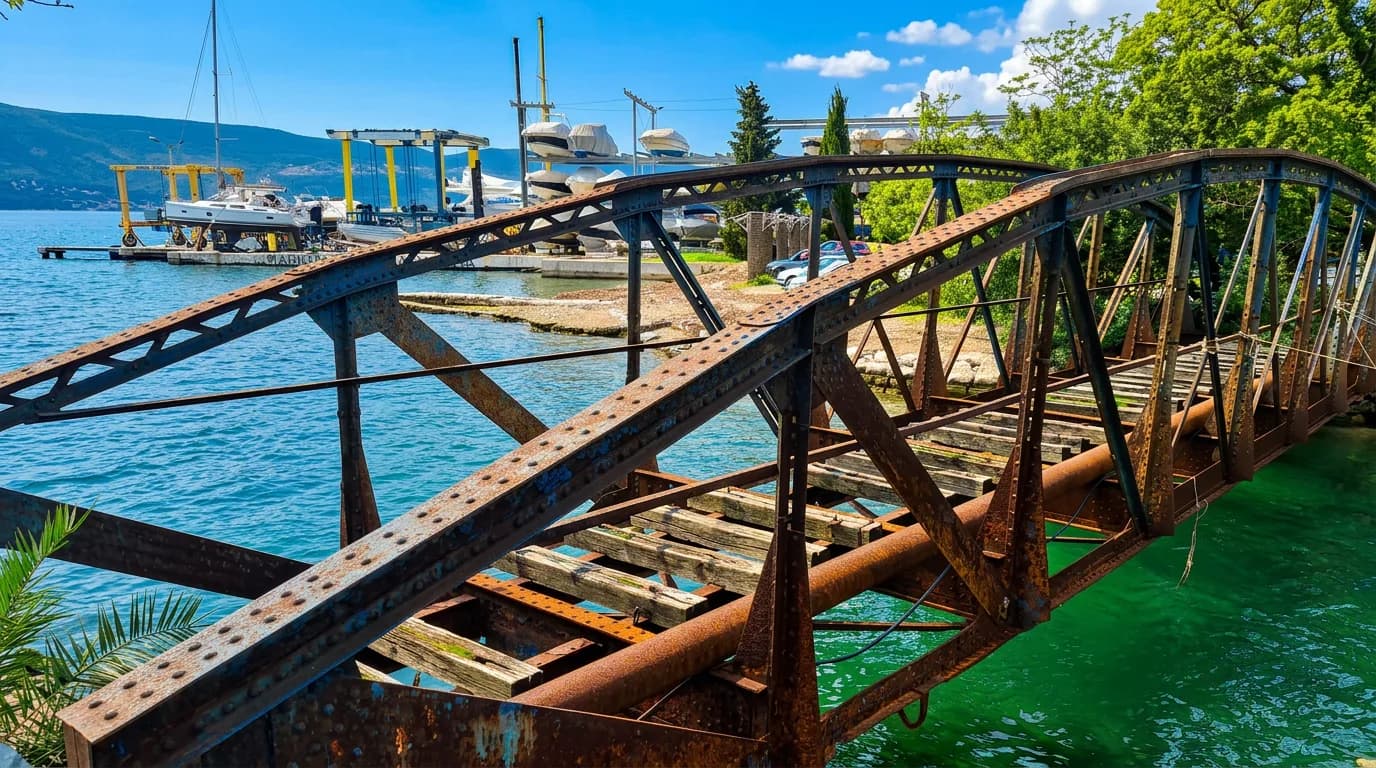
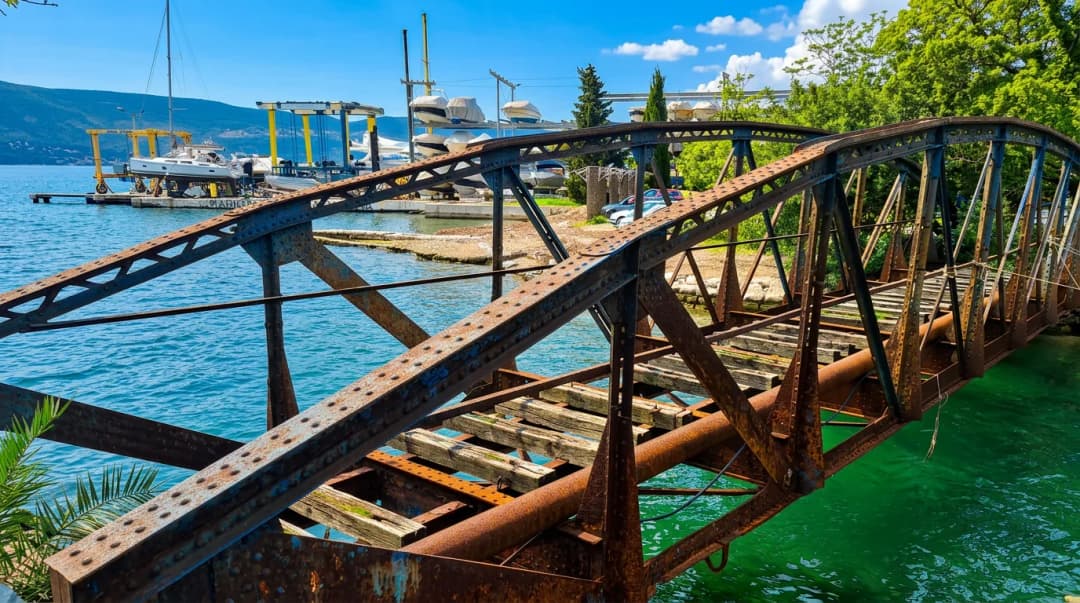
That report is not a structural survey, and it does not prove what barriers exist today. It does establish enough risk to reject the inherited invitation to approach the façade casually. Do not enter the hotel, pass through openings, climb walls or cross the damaged rail bridge. Observe from a lawful public route and obey current fencing and official notices. If conditions make even exterior viewing unsafe, leave.
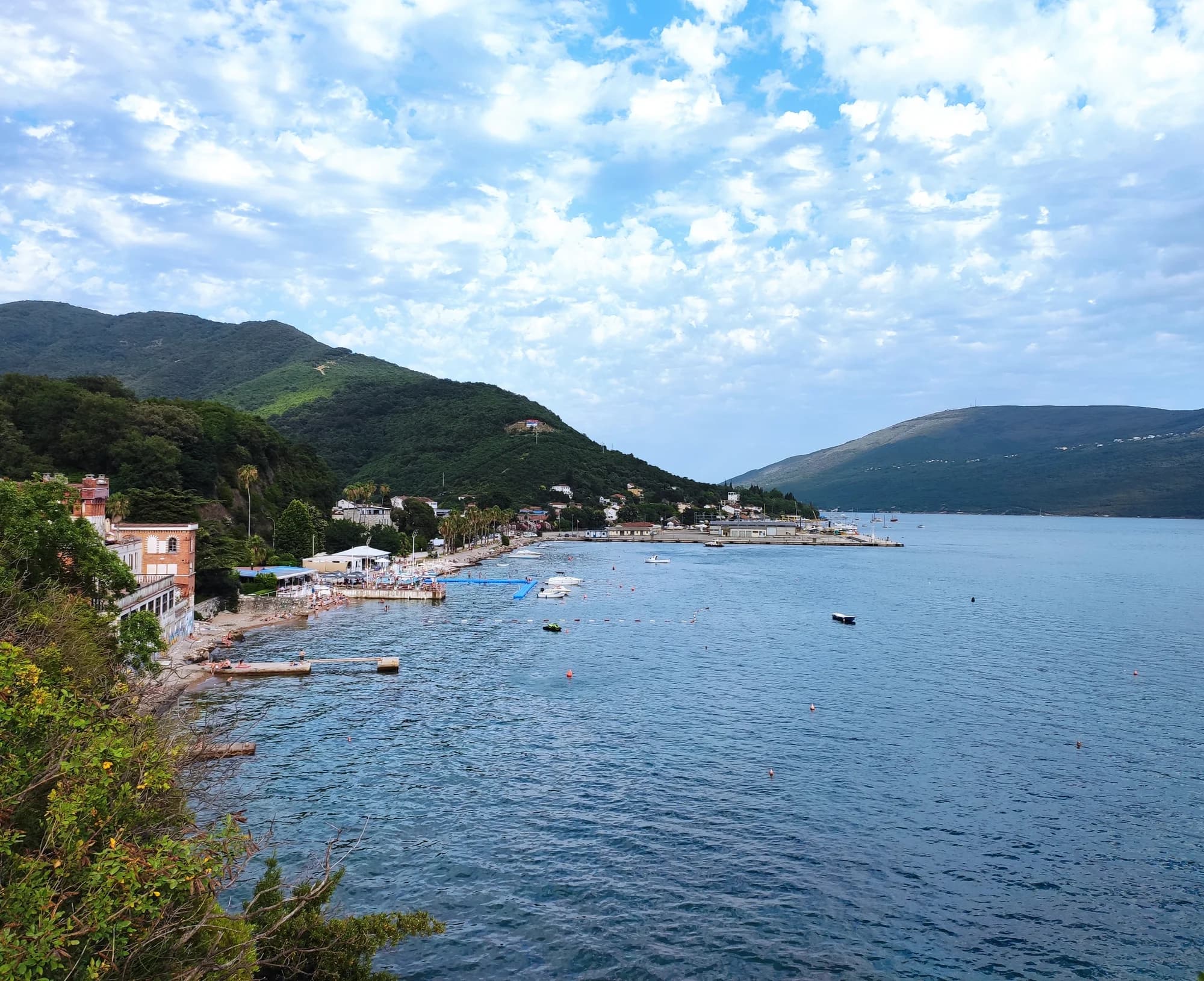
The broader location is still worth understanding through the Zelenika guide. It connects west toward Meljine and the history of the Pet Danica promenade; eastward context continues toward Kumbor. Those public-place guides are not authorisation to enter private or unsafe structures.
| Zone | Rule |
|---|---|
| STOP | × Enter hotel rooms |
| STOP | × Pass fences or openings |
| STOP | × Climb masonry |
| STOP | × Cross corroded rail bridge |
| ONLY IF LAWFUL | ✓ Stay on public route |
| ONLY IF LAWFUL | ✓ Obey barriers and notices |
| ONLY IF LAWFUL | ✓ Keep clear of falling material |
| ONLY IF LAWFUL | ✓ Leave if conditions are unclear |
| Emergency 112 | Identify Zelenika and precise access point |
Source: novosti.rs
Practical guide: how to read the site without trespassing
Begin with context, not entry. Read the Academy chronology and railway dates before arriving. Use a current map to orient toward the Zelenika waterfront, then remain on clearly public, unobstructed routes. Do not rely on an old article’s “nothing to pay” wording: absence of a ticket does not create access rights.
The municipal-supported memorial carriage is a separate railway-history feature near the former route. The 2021 announcement described its opening, but hours and present access were not verified for this article; inspect current signage rather than assuming it is staffed. Likewise, the current Morsko Dobro register shows separately coded Zelenika bathing areas, so the shore cannot be treated as one automatically public hotel beach.
For landscape context, the Orjen guide explains the mountain behind the riviera. For a different view of how Montenegro’s tourism image was constructed and repeated, the world-press history helps place Hotel Plaža’s early marketing role in a longer continuum.
What survives as history even without restoration
Hotel Plaža’s value is not dependent on a romantic ruin narrative. It documents a system: railway access, imperial geography, private hospitality, multilingual promotion, war, socialist property transformation, Yugoslav municipal networks and post-socialist restitution. Each layer changes what “Montenegrin tourism began here” means.
The building also teaches source discipline. Its exact licence date is stronger than a vague opening legend. Its red-brick form is stronger than an unsupported claim of sole authorship. The rail monograph is stronger than nostalgia about a direct train from every European capital. A non-final judgment is not ownership. A planning aspiration is not restoration. And a heritage story is never permission to enter a fire-damaged structure.
| Status | Items |
|---|---|
| VERIFIED | 1902 licence; rail chronology |
| REPORTED | March 2025 fire; safety concern |
| UNRESOLVED | Final ownership; restoration future |
| NOT VERIFIED | Interior access; completed works |
| Override | Current barriers and authoritative records override this article |
Source: novosti.rs
FAQ
Was Hotel Plaža the first hotel in Montenegro?
Not without qualification. Cetinje’s Lokanda was earlier. Hotel Plaža’s 24 November 1902 licence is conventionally treated as the beginning of modern hotel tourism on the coast of present-day Montenegro.
Was Zelenika in Montenegro in 1902?
No. Zelenika was part of Austria-Hungary. The modern national framing refers to the coast’s present-day geography.
Was the hotel built entirely in 1902?
The Academy says the family villa was habitable in 1899 and expanded for hotel use. The precise 1902 milestone is the hospitality licence.
Did Antal Mađar design it himself?
CANA records that as oral tradition and also notes collaboration with licensed builders. Sole authorship should not be stated as settled documentary fact.
When did the railway operate?
The first ceremonial train arrived on 16 July 1901. The last passenger train left on 30 June 1968; freight traffic had ended earlier.
Who owns Hotel Plaža now?
This article does not declare final ownership. The latest property-specific court report reviewed here, from May 2024, described a non-final judgment and an intended appeal. Obtain a current authoritative title check for any legal purpose.
Can visitors enter the hotel?
No public interior access was verified. After a March 2025 fire and reported concern about possible ruinous condition, do not enter or cross barriers.
Can I walk across the old railway bridge?
No. Photographs of the bridge show missing sleepers and heavy corrosion. View it from a safe lawful position; it is not a pedestrian route.