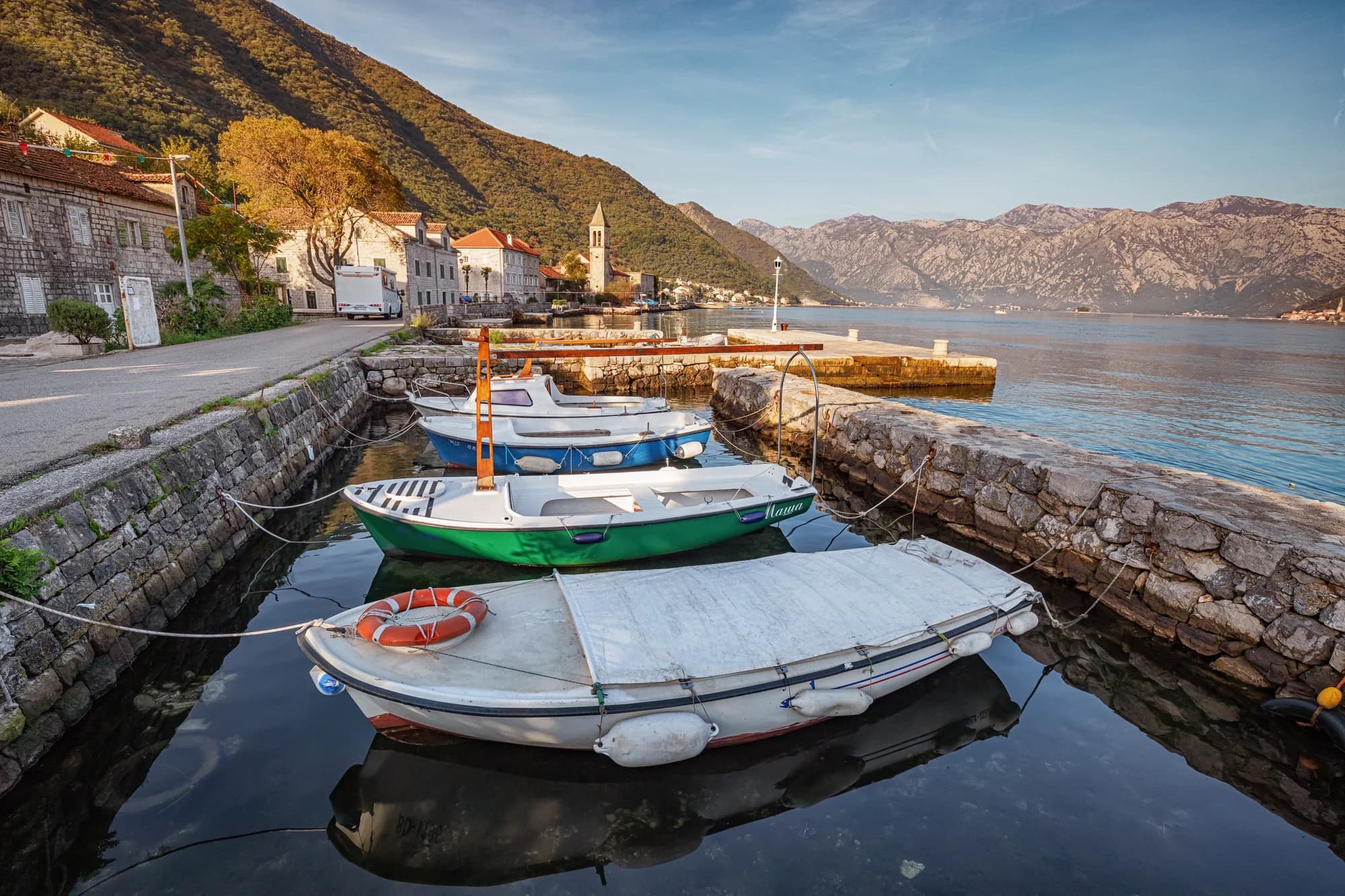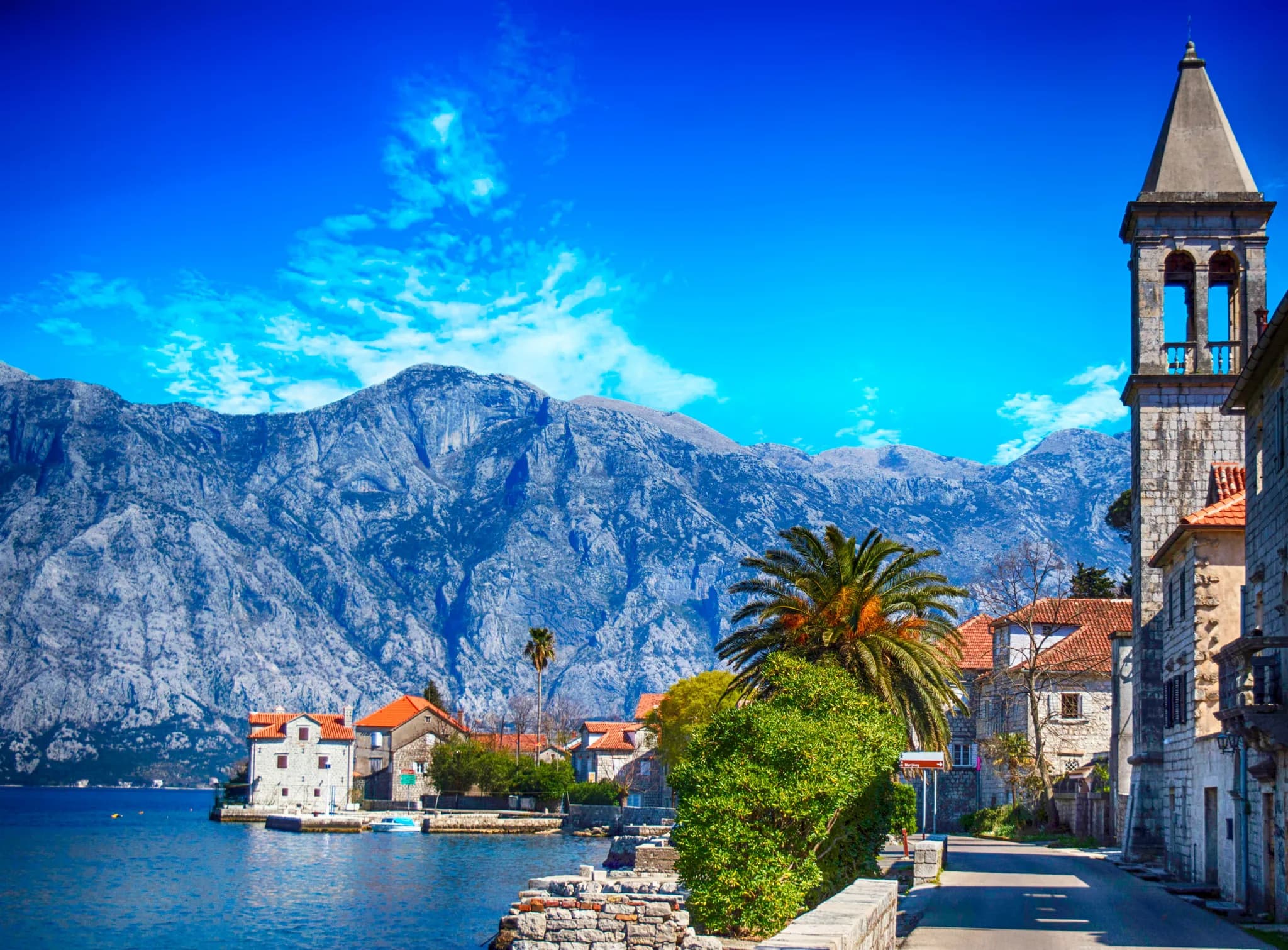
Every settlement on the Boka shore once had a twin higher up the mountain. Before the sea was safe — before piracy died out and the shore road existed — people lived defensively, above the water, and came down only to fish and trade. Almost everywhere, the upper villages have dissolved back into the maquis. Above Stoliv, on the flank of Vrmac, one of them is still standing: Gornji Stoliv, a hamlet of stone houses around a church tower, roughly 240 metres above the bay, reached only on foot and inhabited today by barely a soul.
The climb through the chestnuts
The path starts behind the waterfront houses of Donji (lower) Stoliv and climbs in broad, old switchbacks — a proper mule track, cobbled in places, built for daily use by people who thought nothing of the ascent. After the first terraced gardens and olive plots you enter the feature that makes this walk unlike any other in the bay: a dense sweet-chestnut forest, rare on this limestone coast, that closes over the path in a green vault. In autumn the ground is littered with chestnuts; in summer the shade is the point. Allow forty-five minutes to an hour of steady climbing.
Stoliv is old — it appears in the Kotor notarial books in 1326 — and for most of its history the upper village was the village. The pattern reversed as seafaring made the shore prosperous and safe: families moved down to the water, built captains’ houses, and the mountain hamlet emptied by degrees. What is left above is an architectural time capsule — thick-walled stone houses, vaulted konobas, threshing floors — of a Boka that predates the maritime golden age below.
The church of Sveti Ilija
At the heart of the hamlet stands the church of Sv. Ilija (St Elijah), the village patron. Its origins are older than any record: an inscription over the entrance documents its renovation and enlargement in 1556, and the bell tower was added in 1833 — a late flourish from the era when the lower village’s sailors were doing well and still remembered the mountain. The tower is what you see from the water: a small pale exclamation mark against the grey-green of Vrmac, visible from Perast across the bay.
The view — and the one day a year the village fills
Walk past the church to the edge of the hamlet and the Boka opens up in the single best framing of its most photographed scene: Perast and the two islets, Our Lady of the Rocks and Sveti Đorđe, sit directly across the water below you, with the Verige strait to the right and the inner bay stretching toward Risan. From shore level the islets read as scenery; from Gornji Stoliv they read as a map — you understand at a glance why this narrow water was worth fortifying, blessing and fighting over.
And once a year, the ghost village wakes. On 20 July, the feast of St Elijah (Ilindan), families from Stoliv and the whole surrounding shore climb the old path — as they have for centuries — for mass at the church, followed by food, music and dancing that lasts from morning into the night. The event now runs under the name “Night in the chestnut forest of Gornji Stoliv,” with Boka home cooking served among the old houses and the lights of Perast glittering below. Locals describe the hot climb itself as a small sacrifice offered to the saint. If your visit falls in late July, reorganize it around this day; there is no better way to see what these abandoned places meant, and still mean, to the people whose surnames are carved in their lintels.
Camellias below: the other Stoliv season
Lower Stoliv has its own botanical claim to fame: Japanese camellias, brought home generations ago by local sailors from distant ports, now grow in nearly every garden along this stretch of shore and have become the village emblem. They flower in late winter — February into March is peak bloom — and since 1995 the village has celebrated them with the Fešta kamelija (Camellia Festival), whose central events fall in late March or early April: flower and art exhibitions, a camellia ball, wooden-boat rowing races, a mussel feast, and guided walks up Vrmac and to Gornji Stoliv itself. Visit in that window and you get the strange, lovely double image of subtropical blossom on the shore and a bare-branched chestnut forest on the mountain above.
Visiting
Gornji Stoliv is reached only on foot. The marked path leaves the shore road in Donji Stoliv, which is a stage on the Boka shore road walk — you can fold the climb into the walk as a there-and-back detour of about two hours including time in the hamlet. There is no entry fee and no infrastructure: carry water, wear proper shoes on the worn cobbles, and treat the houses with respect — a few are still seasonally occupied and the church is a living sanctuary. Go early in the morning in summer for shade and clear light on Perast, or in October for chestnuts underfoot; and if you can be here on 20 July, climb with the pilgrims.