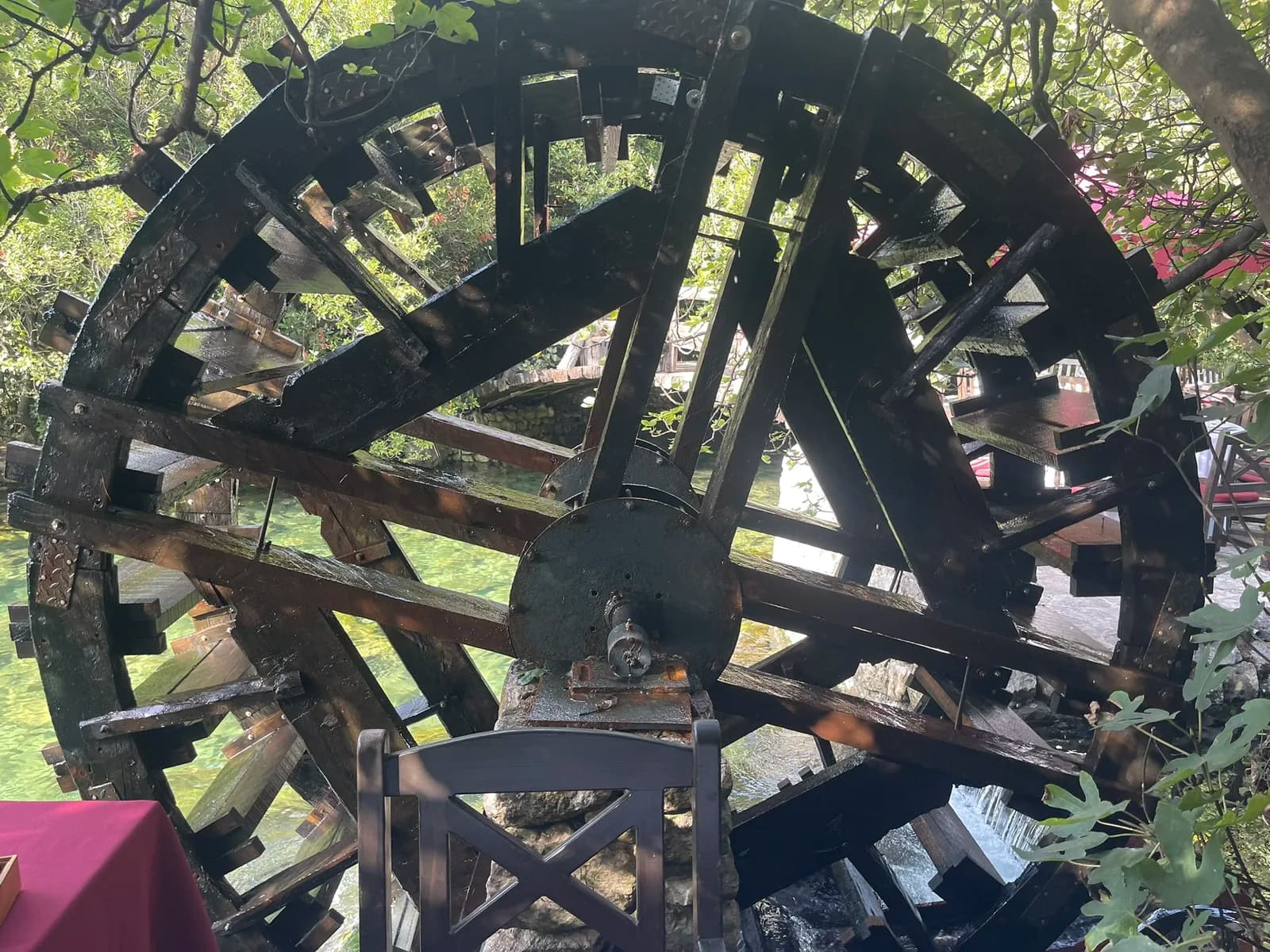
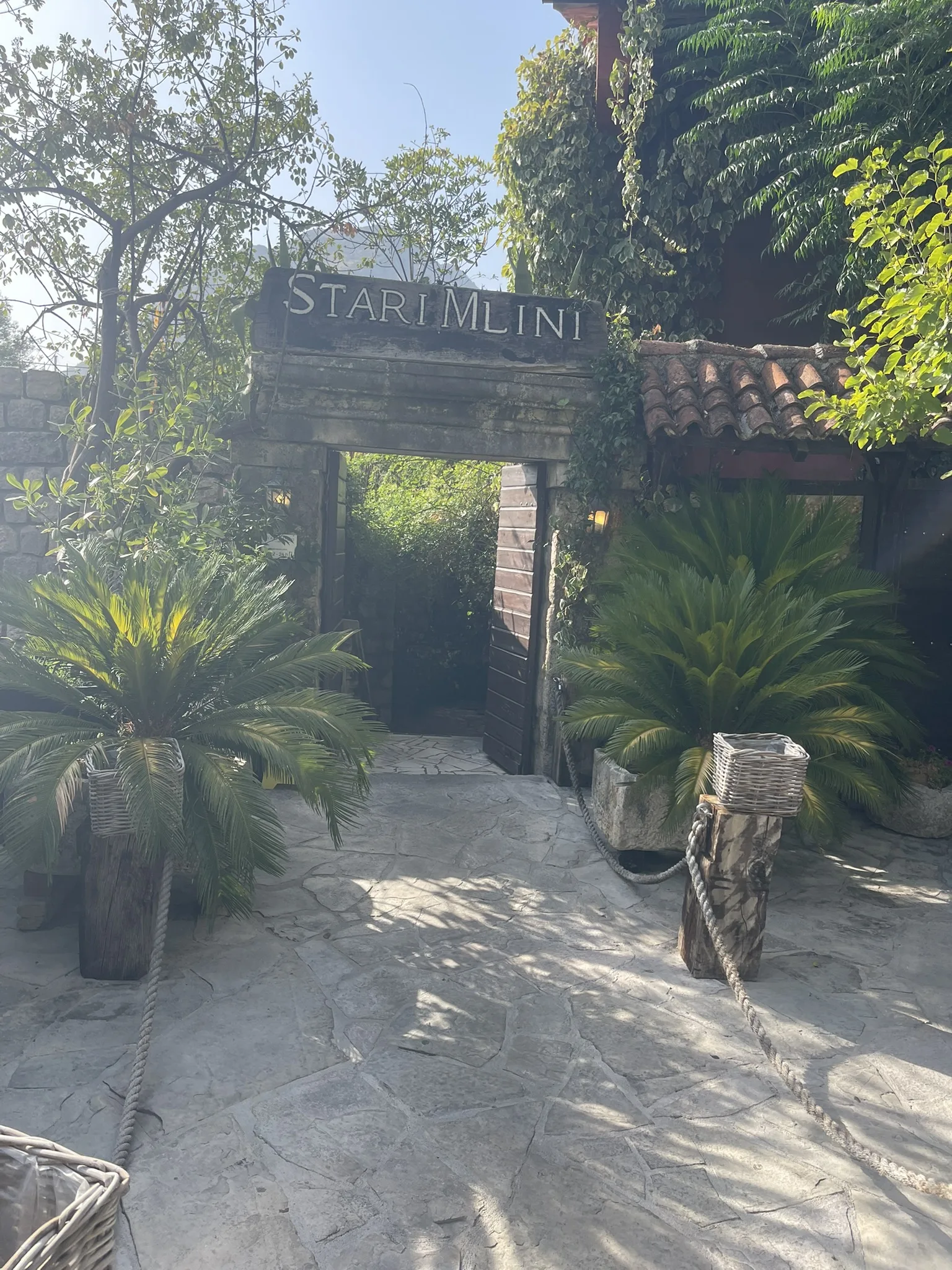
Stari Mlini is a restaurant built into a watermill complex at the mouth of the Ljuta, on the coast road between Dobrota and Orahovac. The food is what people travel for, but the site reads more clearly the other way round: a karst spring surfaces at the foot of the mountain, runs a few hundred metres to the sea, and was harnessed to grind grain long before anyone thought of putting tables beside it. The wheels, the races and the millponds are the reason a restaurant could be placed here without inventing a setting.
That distinction matters, because the dates attached to this place vary a great deal depending on who is telling it. Published accounts put the mill in the sixteenth century, in 1670, and in the 1700s, and the phrase “300 years” appears in the operator’s own material as a description of method rather than a construction date. This guide separates what the operator states from what independent sources support, then turns the current contact and access information into a plan you can act on.
Verified snapshot
- What it is: a restaurant occupying a former watermill complex on the Ljuta river at Ljuta, Kotor municipality.
- Where exactly: Dobrota – Ljuta bb, 85330 — on the Kotor–Perast coast road, roughly 7 km north of Kotor. Not in Dobrota village itself, despite the postal address.
- Age of the mill: unsettled. Sources give the sixteenth century, 1670 and the 1700s; no primary record is cited by any of them.
- As a restaurant: the operator states family ownership for “over 40 years”.
- Hours: the official site publishes none. Third-party listings give daily 12:00–24:00. Reconfirm for your date.
- Booking: [email protected] or +382 32 333 555.
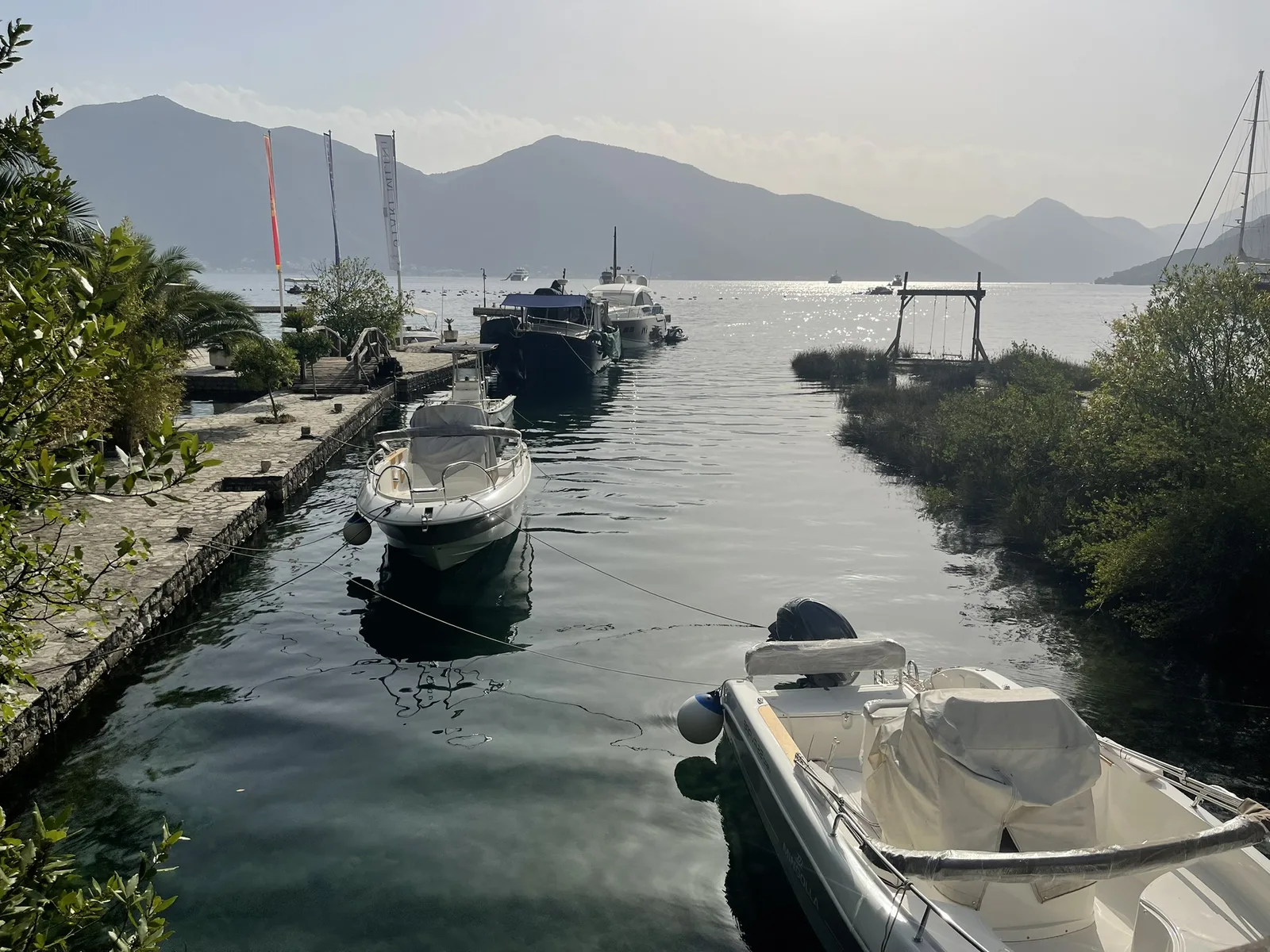
- Arrival: by road with private parking, or by boat — the restaurant has its own jetty on the bay.
- Checked: 3 September 2026.
The river came first
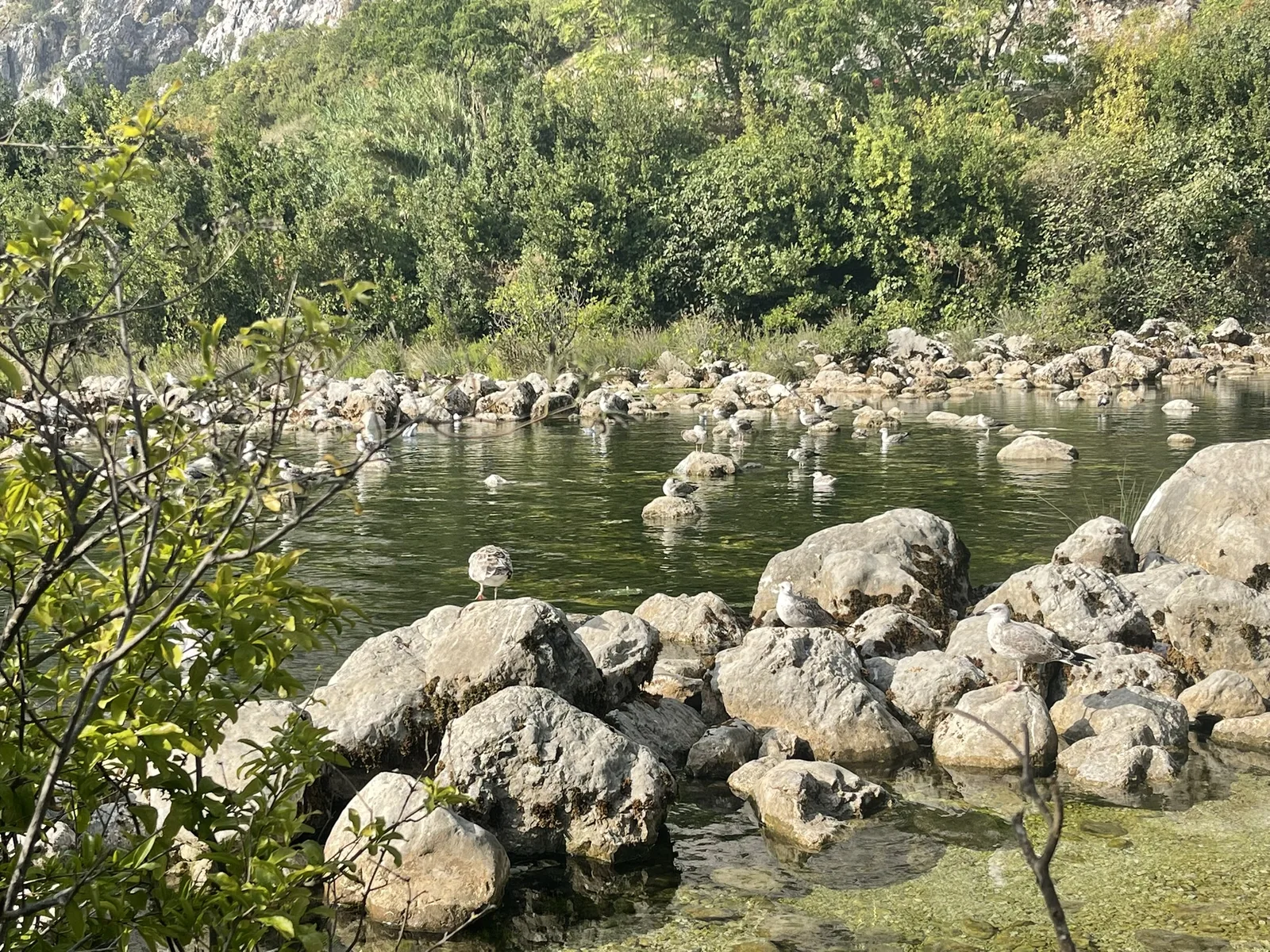
The Ljuta is a karst spring river. Rain falling on the limestone above the bay disappears underground, travels through the rock, and resurfaces at the base of the slope in a single strong outflow that reaches the sea within a few hundred metres. Published lengths differ — one venue profile gives 180 metres, other accounts say simply a few hundred — and you will also see it described as the shortest river in Europe, which is a marketing claim rather than a measured one; several rivers in the region compete for that title on different definitions.
What is not in dispute is the behaviour. The same profile records the water arriving at about 7 °C. It runs low and glass-clear in summer and turns into a genuine torrent after heavy autumn rain, and the volume of cold fresh water is enough to lower the salinity and keep this end of the bay noticeably cleaner than the water further south. That is the resource the mills were built on: not a river with a useful flow, but a spring with a reliable one.
The mill before the restaurant
Watermills clustered at karst springs all around the inner Bay of Kotor, for the same reason they clustered at Morinj a bay further out: constant flow, no dry season, and a short drop to the shore where grain could arrive and flour could leave by boat. The Ljuta site is one of the larger surviving groups.
Beyond that, the record thins. The accounts in circulation are not consistent with one another — sixteenth century in some, 1670 in others, the 1700s in the venue’s own press material — and none of them cites a cadastral entry, a charter or an inventory. The honest position is that the buildings are old, that milling here is documented by the structures themselves, and that a specific founding year should not be quoted as fact. Where a comparable claim can be pinned down it usually rests on the 1838 Austrian cadastre, which sets a “no later than” threshold rather than a start date.
What is original, and what is not
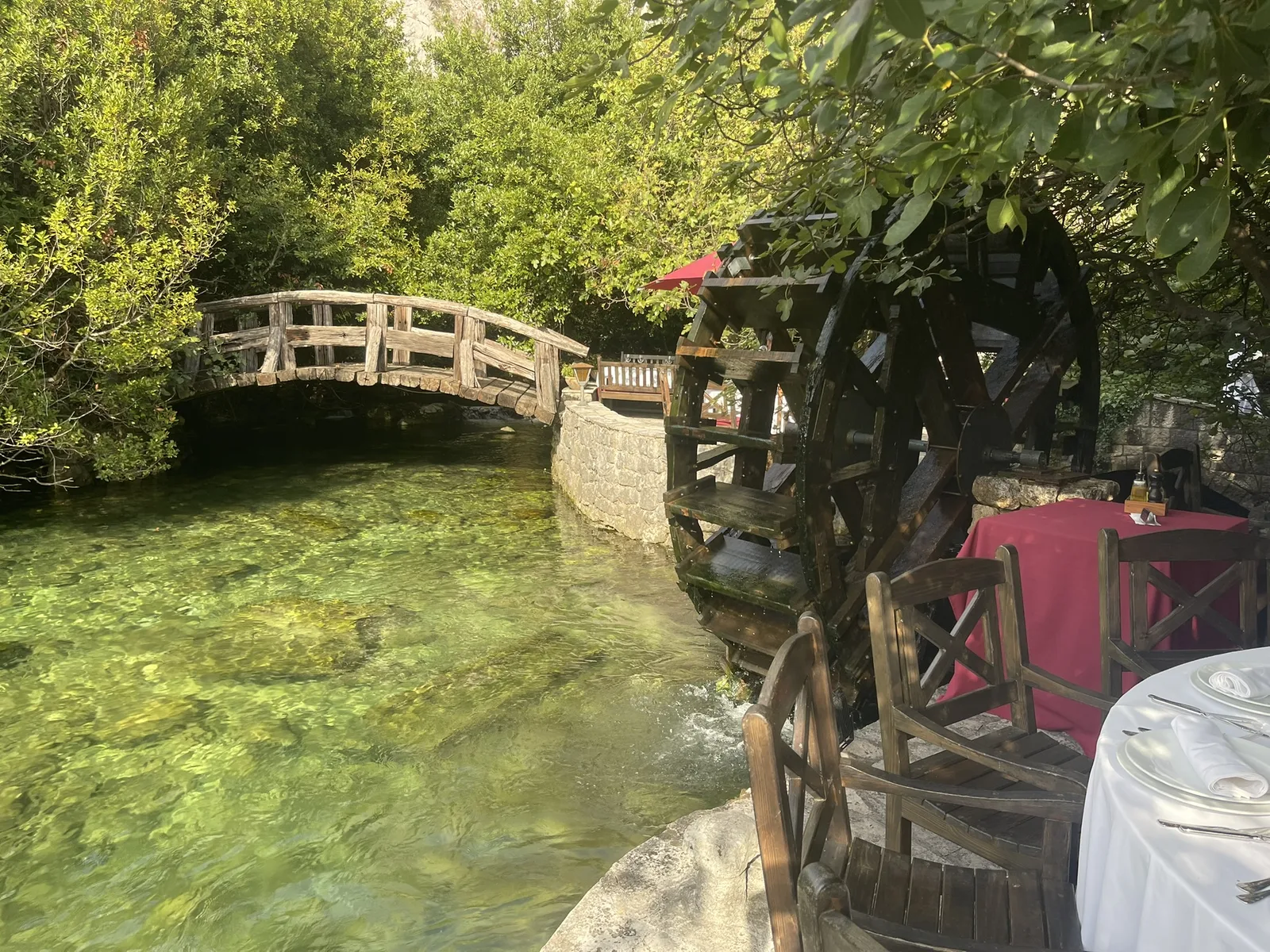
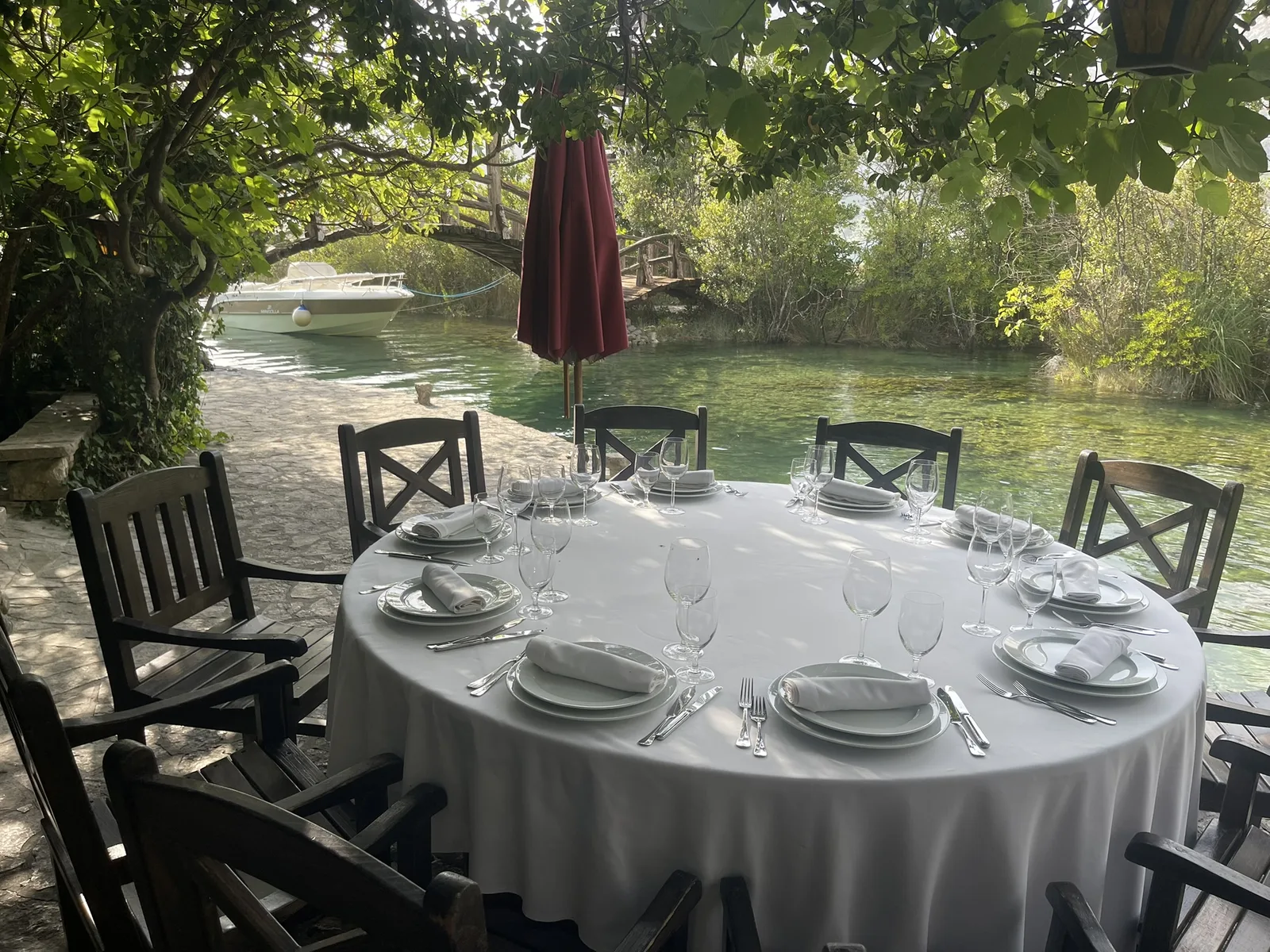
The operator states that much of the original machinery and architecture has been kept, and the site bears that out in part: stone buildings, channels and millponds are structural rather than decorative, and the wheels sit in real races fed by the real river. It is worth being clear about what that does and does not mean. The wheels turn for guests, not for millers. The dining terraces, the bridges, the planting and the trout ponds are restaurant work. A visitor arriving expecting a preserved industrial monument will find a restaurant in a mill; a visitor arriving expecting a themed interior will find considerably more genuine fabric than that.
The setting is also protected in a broader sense, not a specific one. Ljuta sits inside the Bay of Kotor, whose natural and cultural region is inscribed on the UNESCO World Heritage list. That inscription covers the landscape and settlement pattern; it is not an endorsement of any business inside it, and no source we found records a separate heritage designation for these particular buildings.
What the operator states
The restaurant’s own account is short and worth reading as its own claim rather than as background. It says the business has been family-owned and run for over forty years; that vegetables are grown on site and everything else — fish, meat, the rest of the produce — is bought daily from neighbours and local families; and that the kitchen works to methods it describes as three centuries old. Cooking here leans on the Adriatic: fish, shellfish and whatever the day’s catch supports.
The site does not publish a menu with prices, opening hours, or a seating plan, and it does not name the family members who run it. If any of those matter to your booking — a dietary requirement, a table by the water, a large group, a specific dish — ask when you reserve rather than assuming.
Planning the visit
By road, by boat, or on foot?
By road it is a straightforward drive north from Kotor on the coast road, about 7 km, with private parking at the restaurant. That road is narrow, busy in July and August, and unlit in stretches; if you intend to drink, plan the return before you go, because taxis back from Ljuta at midnight are not a given.
By boat is the other option, and the reason the restaurant keeps a jetty. Arriving from Kotor or Perast by water removes the parking problem entirely and is the more pleasant approach in summer. Confirm mooring when you reserve rather than turning up.
On foot is realistic only if you are already staying in Ljuta, Orahovac or upper Dobrota. There is no continuous pavement along the coast road, and walking it after dark is not advisable.
Around the water
Two things are worth knowing before you arrive with a family. The mill races and ponds are open water with stone edges and no railings in places, and the current where the spring surfaces is stronger than it looks. Second, the water is genuinely cold — single figures at the source — so the pools are not for swimming, whatever the August air temperature suggests.
The site is largely flat but surfaced in stone, gravel and timber, with bridges and steps between areas. Anyone with limited mobility should ask about the route to a specific table when booking.
FAQ
How old is the mill at Stari Mlini?
Unsettled. Published accounts give the sixteenth century, 1670 and the 1700s, and none cites a primary record. It is old; the specific year is not established.
Is it in Dobrota?
The postal address says Dobrota – Ljuta, but the restaurant is at Ljuta, on the coast road between Dobrota and Orahovac, about 7 km north of Kotor. Navigation apps that aim at Dobrota village will send you several kilometres short.
Do the waterwheels actually work?
They turn on the river’s flow, but nothing is being milled. Treat them as preserved machinery on display rather than a working mill.
What is on the menu?
Adriatic fish and seafood, with vegetables grown on site and other produce bought locally. The restaurant does not publish a menu with prices online, so ask when you book.
Can I arrive by boat?
Yes — the restaurant has its own jetty. Confirm mooring at the time of reservation.
What are the opening hours?
The official site publishes none. Third-party listings give daily 12:00–24:00, which should be reconfirmed by phone or email for your date.
Is it suitable for young children?
With supervision. There is open, fast, cold water with unrailed stone edges throughout the site.
Methodology and sources
Location, address and contact details are taken from the restaurant’s own site, starimlini.com, read on 3 September 2026, which is also the source for the operator’s statements about ownership length, on-site growing and daily local sourcing. The river’s temperature and the 180-metre length figure come from a 2021 venue profile in Kongres magazine. The conflicting mill dates are drawn from that profile, from restaurant directories and from regional travel coverage; we quote the disagreement rather than picking one. Opening hours are third-party and unconfirmed by the operator. The World Heritage context refers to the inscribed Natural and Culturo-Historical Region of Kotor, which covers the bay; it is not a designation of the restaurant. Photographs are our own, taken on site on 30 August 2026.
Where this guide says something is unsettled, that is the finding, not a gap we intend to fill with the most confident-sounding version.