Short answer: most visitors should either buy a local Montenegrin tourist eSIM before arrival or register a local tourist SIM after arrival. Official plans from Montenegro’s three mobile operators start at €15 for 500 GB lasting 15 days, while longer and “unlimited” options have explicit validity and fair-use rules. Keep your home line available for banking texts, but disable its data roaming unless your carrier explicitly names Montenegro in your allowance.
This guide was checked on 31 August 2026. Mobile offers change quickly, so use the comparison as a decision aid and confirm the final price, included regional data, renewal rule and identity requirement on the operator’s checkout page.
| Situation | Action | Notes |
|---|---|---|
| Does your home plan explicitly include Montenegro? | YES → Use home roaming | Save the tariff proof. Set a data warning. |
| Does your home plan explicitly include Montenegro? | NO / UNCLEAR → Need a local number? | Yes: local SIM/eSIM · No: data-only can work |
| One-country trip | Local tourist SIM or eSIM | Data-only can work if no local number needed |
| WB6 road trip | Compare regional quota | Regional data eSIM option |
Montenegro.com editorial framework
Official tourist SIM and eSIM prices
All three network operators sell high-data tourist packages. The table below uses their own current pages, not reseller rankings. A large domestic quota does not automatically travel with you: the much smaller Western Balkans allowance is the relevant number on a cross-border trip.
| Operator / package | Price | Montenegro data | Validity | Regional data stated |
|---|---|---|---|---|
| Telekom Tourist 15 | €15 | 500 GB | 15 days | 9 GB WB6 + Croatia |
| Telekom Tourist 20 | €20 | 1 TB | 30 days | 11 GB WB6 + Croatia |
| Telekom Tourist 25 | €25 | Unlimited label; 1.5 TB fair use | 30 days | 15 GB WB6 + Croatia |
| One Tourist 15 | €15 | 500 GB | 15 days | 8.5 GB WB6 |
| One Tourist 20 | €20 | 1 TB | 30 days | 11 GB WB6 |
| One Tourist 25 | €25 | Unlimited label; 1 TB then 1 Kb/s | 30 days | 13.5 GB WB6 |
| m:tel Tourist 15 | €15 | 500 GB | 15 days | 9.92 GB WB6 |
| m:tel Tourist 20 | €20 | 1 TB | 30 days | 13.23 GB WB6 |
| m:tel Super Tourist | €30 | Unlimited label; 3 TB fair use | 45 days | 20 GB WB6 |
Sources: Crnogorski Telekom, One Montenegro and m:tel. “Unlimited” is not a synonym for infinite full-speed transfer: Telekom states 1.5 TB fair use, One states a 1 TB threshold before a severe speed reduction, and m:tel states 3 TB fair use. Those thresholds are ample for ordinary travel, but material for remote workers moving large backups or video.
Local eSIM, physical SIM or data-only eSIM?
Local tourist eSIM
This is the strongest default for an unlocked compatible phone: online registration, a Montenegrin number and the same generous domestic data concept as a local physical card. Telekom says its eSIM can be installed before travel and activates with first traffic in Montenegro. One and m:tel also sell tourist eSIMs. The QR code is not a decorative receipt: save it securely, but do not assume it can be scanned repeatedly or moved freely between phones.
Physical tourist SIM
Choose physical SIM when the phone lacks eSIM support, you want staff help, or you will put the card in a MiFi router. Check that the device is carrier-unlocked before paying. Keep the original home SIM safe, note the new number, and ask the seller to show that mobile data works before leaving. Telekom explicitly publishes router APN details; other operators should be checked directly rather than copying settings from an old blog.
Regional data-only eSIM
A regional product is useful when Montenegro is one stop on a Western Balkans itinerary and you do not need a local voice number. Telekom’s official regional eSIM currently lists 5 GB/7 days for €6.90, 10 GB/15 days for €11.90 and 15 GB/30 days for €16.90. It covers the six Western Balkans economies but is data-only. Compare that usable regional quota—not the local plan’s 500 GB headline—if you are extending the trip from Montenegro into Albania.
Home-plan roaming
Home roaming wins only when the carrier confirms Montenegro by name and the included allowance meets your needs. Save a screenshot of the tariff and any fair-use limit before departure. If the plan is vague, turn roaming off on the home line and select the local or travel line for mobile data. Apple’s current guidance likewise recommends checking the carrier first and disabling data roaming where it is not included; Google describes prepaid eSIM as an international-travel option.
Registration and activation: a low-risk sequence
- Before purchase: confirm the phone is unlocked and supports the intended eSIM or physical SIM. Record the IMEI/eSIM identifier only where the operator’s official flow asks for it.
- Use accepted identification: Telekom states that Balkan and EU nationals can register with an identity card or passport, while other nationals need a passport. Carry the original document and follow your chosen operator’s current process.
- Install on Wi-Fi: download the eSIM while you still have a dependable connection, but follow the operator’s activation timing so validity does not start prematurely.
- Name the lines: label them “Home” and “Montenegro.” Choose Montenegro for cellular data. Keep data switching off until you understand whether the phone can fall back to the home line.
- Protect the home line: leave it enabled for incoming bank or account messages only if needed, with mobile data roaming disabled. Calls and texts may still cost money; check the home carrier.
- Test before moving: open a web page, send a message, run navigation and place any required call. Save the operator app, support number, APN instructions and balance code offline.
| Step | Action |
|---|---|
| 1 | Unlocked + compatible |
| 2 | Register identity |
| 3 | Install on Wi-Fi |
| 4 | Select data line |
| 5 | Test maps + messages |
| 6 | Save help offline |
| Warning | Do not delete an eSIM profile while troubleshooting unless support instructs you. |
Montenegro.com editorial framework
The EU roaming position in 2026
Montenegro is not yet inside the EU/EEA Roam Like at Home area. On 4 June 2026, the Council authorised negotiations with all six Western Balkans partners. Its decision says each partner must align with and implement the EU roaming acquis, receive a positive Commission assessment, and then obtain a decision through the relevant joint body before reciprocal market opening. That is progress, not a start date.
A separate voluntary agreement reduced data-roaming prices between participating EU and Western Balkans operators. The European Commission published maximum retail levels of €18/GB from October 2023, €14/GB from 2026 and €9/GB from 2028. These are caps in a voluntary operator arrangement—not a promise that every EU subscriber gets €14/GB, and certainly not free roaming. Your own carrier’s country list and tariff control the bill.
Within the Western Balkans, the regional arrangement removed roaming surcharges from 1 July 2021 for regulated calls, messages and data. Domestic-plan limits and fair-use rules remain. Croatia is an EU member, not part of WB6; it appears in some Telekom tourist allowances only because that operator includes it commercially.
| Regime | Status | Detail | Limit |
|---|---|---|---|
| WB6 regional roaming | Active since July 2021 | No surcharge under the regional arrangement | Fair use still applies |
| EU–WB price pledge | Voluntary participants | 2026 cap: €14/GB for covered offers | Not universal or free |
| EU Roam Like at Home | Talks authorised June 2026 | Alignment + assessment + joint decision required | Not active yet |
| Bottom line | — | For today's bill, only your operator's named-country tariff is decisive. | — |
Source: consilium.europa.eu, enlargement.ec.europa.eu, rcc.int
Coverage: check the address, not a winner label
Montenegro has three substantial networks. EKIP counted 1,490,773 mobile connections in June 2026—239.05% of the resident-population measure used in the report—with m:tel at 41.71%, Telekom at 36.08% and One at 22.21%. That high penetration reflects multiple and visitor connections; it is not evidence that every resident owns two phones. Market share also does not identify the best signal for your room, trailhead or road.
Use EKIP’s official predicted-coverage portal to compare operator, technology, speed and period. Then ask the host which network works inside the accommodation. The map is a model, and stone walls, terrain, congestion and weather can change the experience. EKIP’s published 2025 quality parameters are operator-reported service measurements, not a nationwide traveler speed test, so this guide does not turn them into a league table.
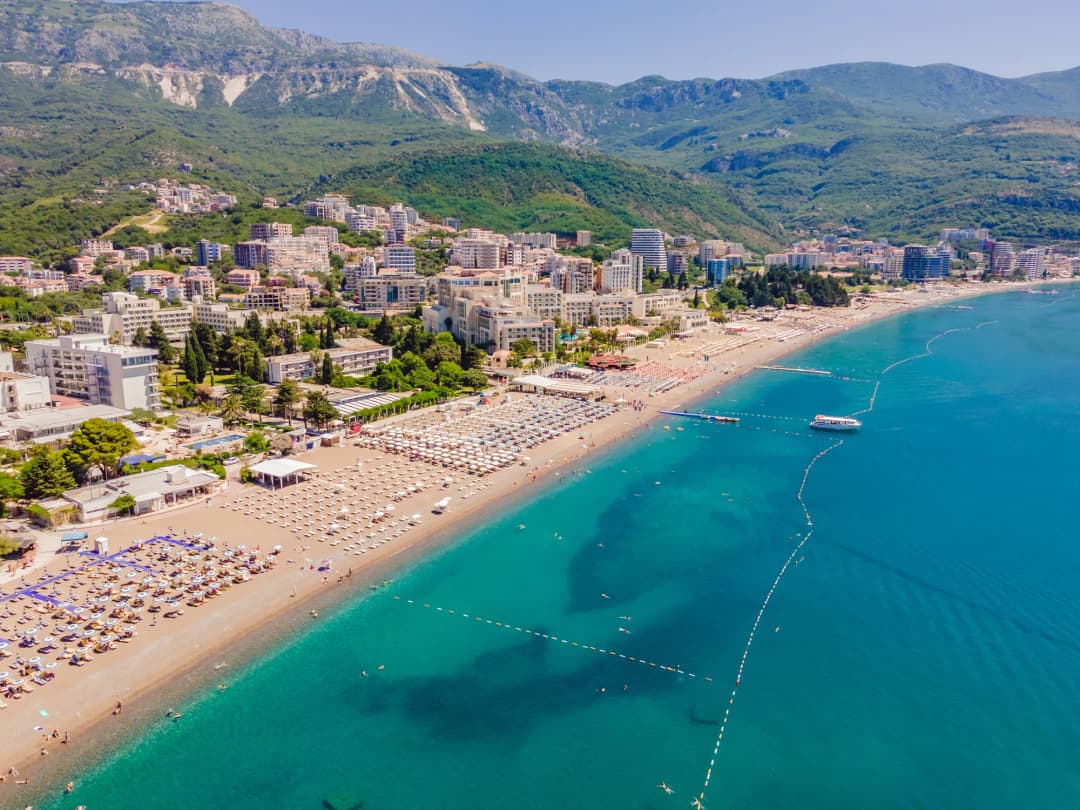
For a coast-based holiday, choose by package and the exact addresses where you sleep; the accommodation questions in the Budva area guide are a useful model. If your trip moves north, download maps and reservations before the drive and do not rely on a live signal for every turn. Ask a host before booking a work stay in Žabljak or Kolašin. A second operator can be a rational backup for critical remote work, but only after checking local evidence.
Practical choices by trip type
- Weekend with an eSIM phone: a local or regional eSIM avoids a shop stop. Pick regional only if another WB6 country is actually on the itinerary.
- One to two weeks in Montenegro: the €15 local tier is usually enough by both duration and data. Do not pay more because 500 GB sounds smaller than “unlimited.”
- Three to four weeks: compare the €20 and €25 tiers. Choose on calls, regional quota and fair-use terms rather than the largest headline.
- Remote work: ask the accommodation for a recent wired or Wi-Fi test, keep a local mobile backup and test video calling before an important meeting. The wider digital nomad permit guide covers residence rather than promising connectivity.
- Budget planning: put the package, a possible second line and any home-line voice charges into the trip budget. A tourist SIM does not replace mandatory visitor formalities; check the separate tourist tax and registration guide.
Wi-Fi, tethering and secure backup
Accommodation and café Wi-Fi can reduce mobile use, but a network name is not proof of security or speed. Confirm the correct SSID with staff, keep the device updated, prefer encrypted sites, and avoid sensitive work on an unknown hotspot. CISA’s public Wi-Fi guidance recommends verifying the network and using protective measures rather than treating public access as trusted.
For work, test the upload path as well as download speed, because calls and cloud backups depend on it. Ask whether router access is shared, whether the host can restart it, and whether tethering is allowed by your chosen tariff. Telekom expressly says its tourist SIM can be used in a phone or router and publishes the APN. Do not assume the same settings or tethering policy for every provider.
If mobile data does not work
- Confirm the correct SIM is enabled and selected for cellular data.
- For a regional travel eSIM, follow its instruction on data roaming; for the home line, keep roaming disabled unless covered.
- Toggle airplane mode for about 30 seconds, then let the phone re-register. This matches Apple’s current first-line roaming troubleshooting.
- Restart the phone and recheck remaining quota and validity in the operator app or menu.
- Check the operator’s current APN instructions. Do not paste credentials from an unrelated network.
- Move outdoors or to a different side of the building to distinguish configuration from indoor signal loss.
- Contact the operator with the number, plan, location, device model and error. Do not delete the eSIM unless support confirms how replacement works.
| Rung | Step |
|---|---|
| 1 | Select the intended data line and check quota |
| 2 | Airplane mode, restart, automatic network |
| 3 | Verify official APN and test outdoors |
| 4 | Contact operator; keep QR and receipt |
| Warning | Deleting the profile can turn a configuration problem into a replacement problem. |
Montenegro.com editorial framework
Frequently asked questions
Does EU free roaming cover Montenegro in 2026?
No—not automatically. Negotiations were authorised in June 2026, but Montenegro had not yet joined the EU Roam Like at Home area at the research cutoff. Some carriers voluntarily include it; verify the country list for your exact plan.
Can I buy a Montenegrin eSIM before arrival?
Yes. Official local operators offer online tourist eSIM purchase and identity checks. Installation and activation timing vary, so follow the selected operator’s current instructions and keep the QR code and receipt.
Do I need a passport?
Registration is required. Telekom currently says Balkan and EU nationals may use an identity card or passport; other nationals need a passport. Requirements can differ by onboarding route, so carry the original passport if uncertain.
Which operator has the best coverage?
There is no evidence-based national winner for every traveler. Use EKIP’s predicted maps for your addresses, ask the host about indoor reception, and treat market share or one speed result as something other than a coverage guarantee.
Will 500 GB work in Albania, Serbia or Bosnia and Herzegovina?
Not in full. Tourist packages list a smaller WB6 allowance, often around 8.5–20 GB in the plans compared here. Check that line in the tariff. For a multi-country trip, a dedicated regional eSIM may be simpler.
Can I keep WhatsApp on my home number?
Usually yes: changing the data SIM does not by itself change the number registered with a messaging app. Do not accept an in-app number-change prompt unless you actually want to migrate the account, and keep access to the home number for security codes.