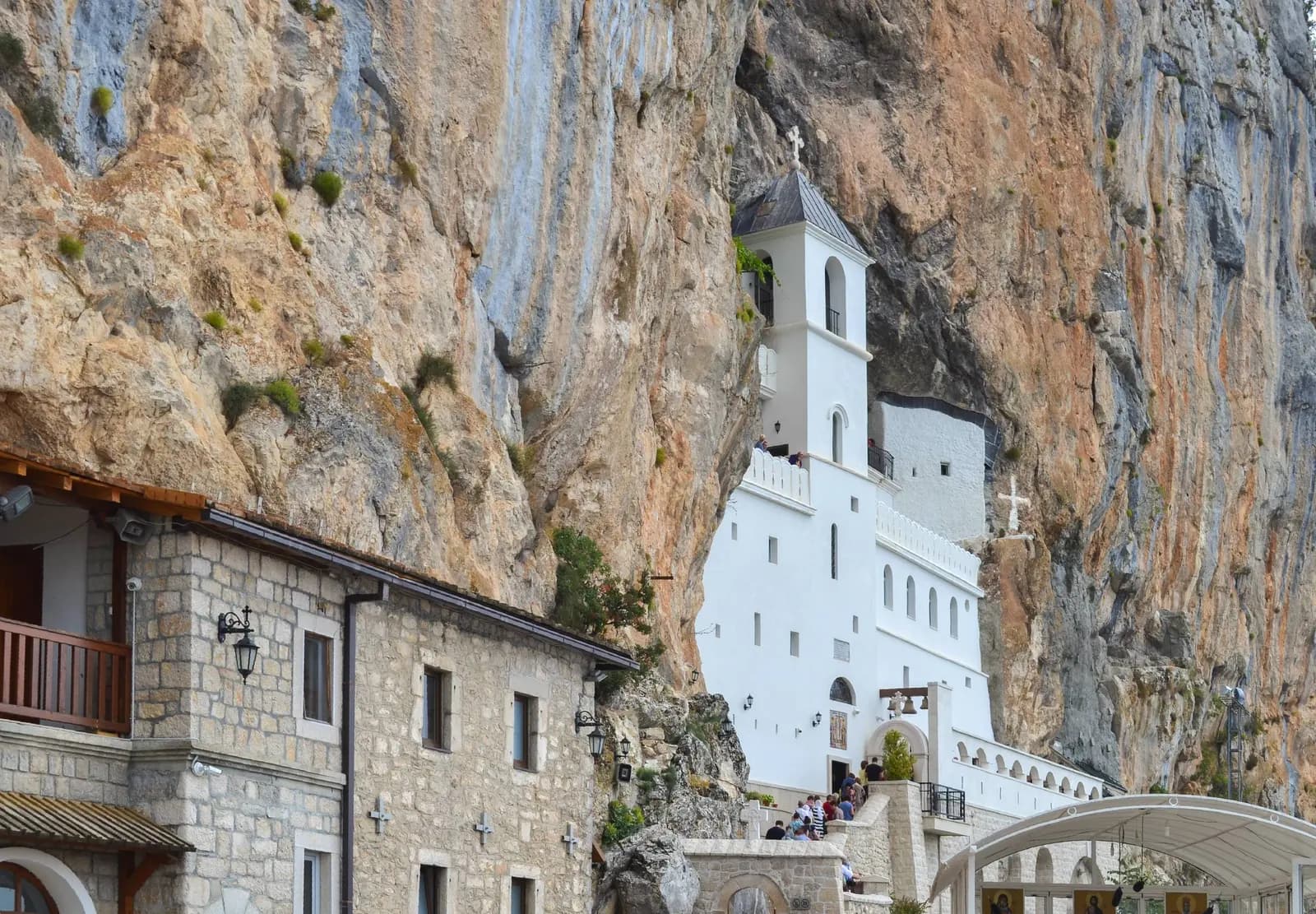
Ostrog is a living Orthodox monastery, not a cliffside attraction with a fixed tourist script. Pilgrims come to venerate Saint Basil of Ostrog, attend worship and seek prayer; other visitors come for history, architecture or the extraordinary meeting of white walls and vertical rock. A good visit makes room for all of them without turning belief into spectacle.

Before leaving, decide what “Ostrog” includes for your visit, whether road or rail suits the approach, how you will cover the final climb, and whether the 12 May feast crowds fit your purpose. Worship times, transport and access can change, so check them again on the day.
Ostrog at a glance
| Question | Official baseline | What still needs checking |
|---|---|---|
| What is the destination? | A working monastery complex with Lower and Upper sections; the famous cliff structure is Upper Ostrog | Which sections and services are available on your date |
| How do I approach? | Road access reaches the complex; Montenegro's rail operator also lists Ostrog station | Road controls, parking, train times and the entire last-mile plan |
| How long is the climb? | Official descriptions range from about 30 minutes to 2.5 km/about 40 minutes between the levels | Fitness, weather, chosen path, crowds and actual starting point |
| When is the major feast? | Saint Basil's feast is celebrated on 12 May; thousands attended in 2026 | That year's worship schedule, traffic regime and crowd controls |
| Can I stay overnight? | The monastery publishes a separate guest-house telephone number | Advance permission, availability, price, bedding, facilities and rules |
| Is access step-free? | Upper Ostrog has slopes, stone steps, narrow circulation and a small church doorway | Assistance and access to each desired space; contact the monastery before travel |
| Is there admission? | The monastery does not publish a current visitor ticket price | Never infer parking, transport or accommodation costs from absence of an entry price |
What the monastery complex actually contains
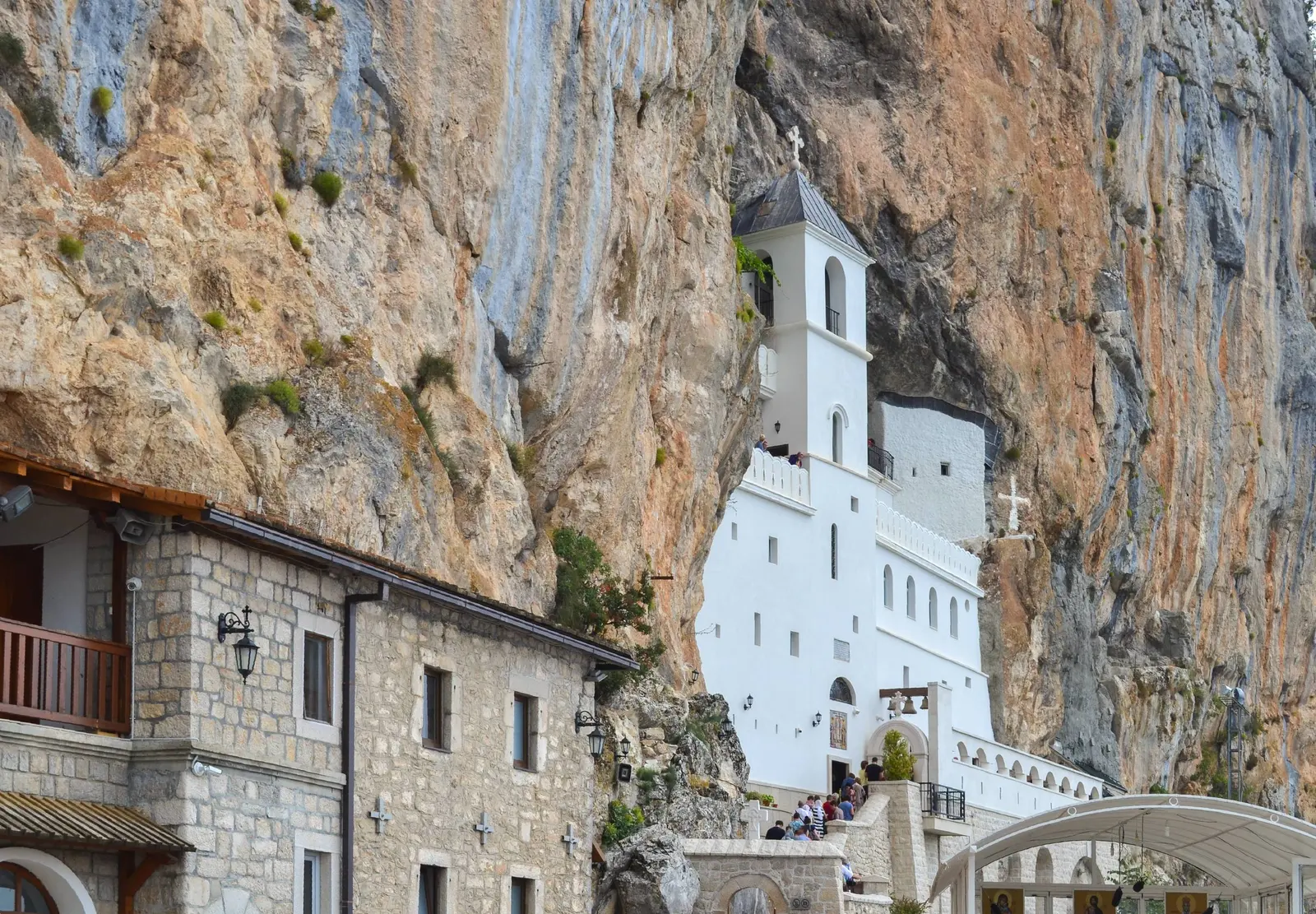
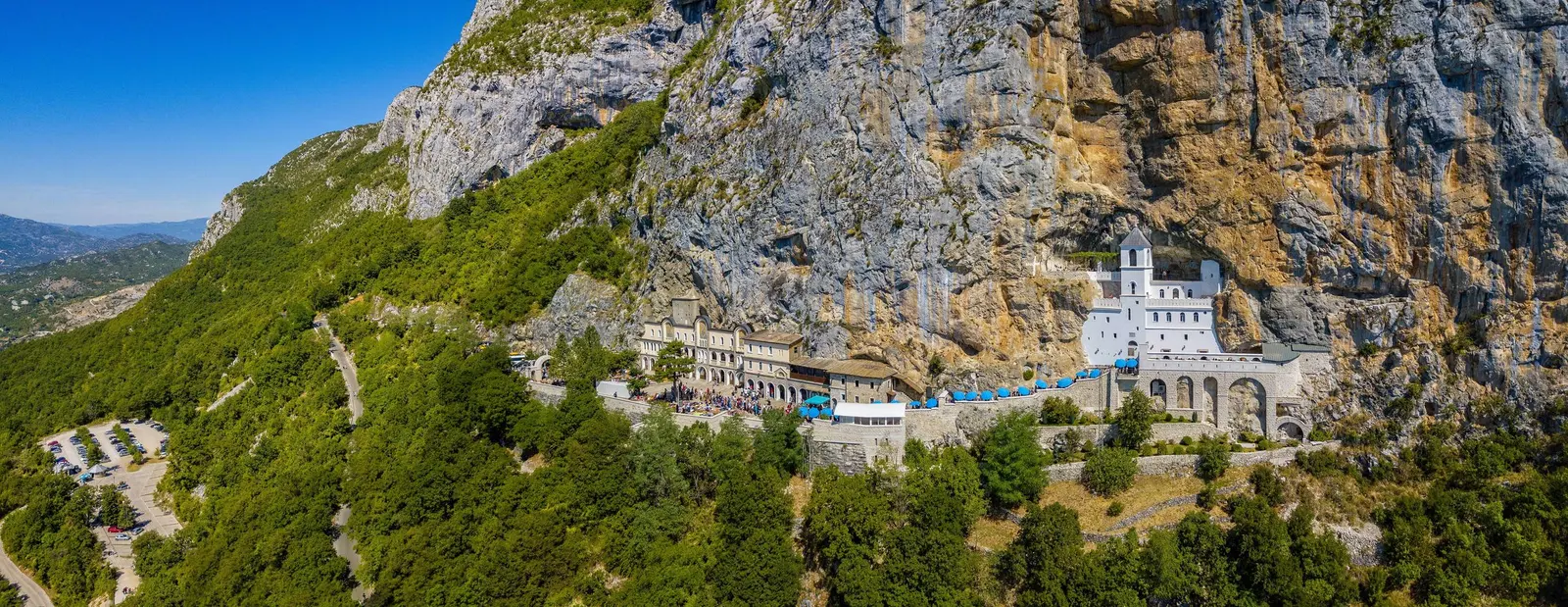
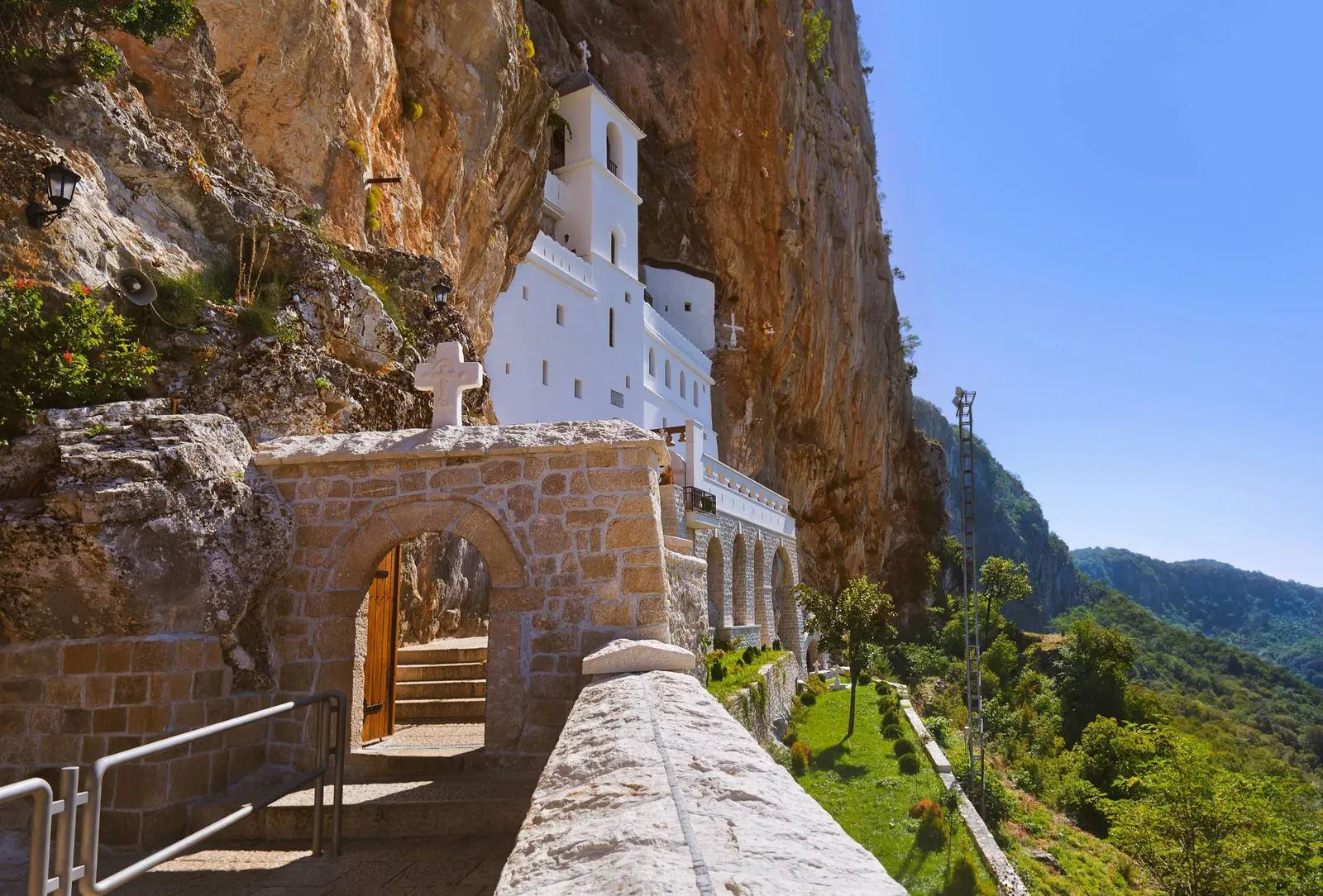
Upper Ostrog is the white cliff monastery most people recognise. The monastery's own history page describes a tiny cave church of the Presentation of the Mother of God, the shrine containing the relics venerated by the Church as those of Saint Basil, internal rock-cut stairs and terraces leading higher to the Church of the Holy Cross. The approach narrows as it reaches the sacred core. That spatial compression is part of both the architecture and the visitor challenge.
The official monastery account dates the Holy Cross church to 1665 and its fresco painting by master Radul to 1667; those dates refer to specific work, not the entire complex visible today. A fire struck Upper Ostrog in 1923; a Metropolitanate archive lecture records a reconstruction designed by Russian architect Vladimir Sukurenko and consecrated on 2 November 1924. The familiar exterior therefore carries seventeenth-century sacred spaces within a site substantially rebuilt in the twentieth century.
Lower Ostrog centres on the Church of the Holy Trinity and serves the wider complex. Even official church pages disagree on its exact construction date. The Metropolitanate's monastery directory says it was raised in 1820, while a 2024 anniversary announcement described 200 years since construction in 1824. “Early 1820s” is the honest summary unless a stronger building record resolves that four-year difference.
For a fuller historical and devotional account, use the companion respectful Ostrog pilgrimage guide. The wider Ostrog destination guide helps place the monastery within the landscape rather than treating the cliff façade as the entire region.
| Stage | What to check |
|---|---|
| Same-day check | weather · worship · traffic · rail |
| Road | driver · parking · police controls |
| Rail | live train + last-mile plan |
| Lower Ostrog | regroup · assess heat and mobility |
| Upper Ostrog: walk about 30–40 min or use permitted road transfer | steps · narrow passages · queues · worship takes priority |
Source: manastirostrog.com, montenegro.travel, zpcg.me, gov.me
Getting there by road
The National Tourism Organisation gives a broad Podgorica-to-Ostrog drive of about 42.5 km and roughly one hour. That is orientation, not a promise. The final mountain approach is winding, visibility changes with weather, and traffic may slow sharply near worship or feast times. Navigation estimates do not know whether police have imposed a temporary direction or closed a segment.
Choose a rested driver comfortable with narrow mountain roads. Set the destination to the intended monastery level, then follow road signs and police or steward instructions over the app. Do not stop on bends for photographs, reverse into a stream of pilgrims or assume an apparent verge is safe parking. If the vehicle cannot continue, accept the controlled stopping point and reassess the walk.
On 11–12 May 2026, the Police Administration changed the Ostrog-to-Ždrebaonik road to one-way operation because it expected increased attendance for Saint Basil's feast. The order ran from 09:00 on 11 May to 19:00 on 12 May. That exact pattern has expired, but it proves that feast traffic can materially change the route. Check current police notices rather than copying last year's times.
If building a longer central-Montenegro day, the Nikšić city guide provides a sensible second base. Do not squeeze Ostrog between distant attractions with rigid reservations: worship, queues, heat and mountain traffic make the duration unusually elastic.
Getting there by train
Railway Transport of Montenegro includes Ostrog in its live journey search on the Podgorica–Nikšić line. Train can remove the mountain-road driving decision, but it creates a different one: how to complete the climb from the station. Do not confuse a station name with arrival at Lower or Upper Ostrog, and do not assume a scheduled shuttle or waiting taxi.
Use the official railway search for the exact date in both directions. Record train numbers, stations and the last return you could realistically make after a delayed monastery visit. Recheck on the morning of travel. A timetable captured in an old guide cannot account for engineering work, disruption or seasonal revision.
Before boarding, arrange the complete onward and return route. That may be a pre-booked licensed transfer or a walking plan based on a current local assessment. Confirm pickup identity, location and price directly; keep the return contact offline. If no safe last-mile arrangement exists, rail is not a complete itinerary.
Walking from Lower to Upper Ostrog
The tourism organisation describes the Lower-to-Upper route as about 2.5 km and 40 minutes. The monastery's history page says the journey from below takes no more than half an hour on foot or about ten minutes by car. Different starting points and assumptions can explain some of that gap. Use 30–40 minutes as an optimistic planning range, not a deadline.
Add time for heat, rest, route finding, crowds and anyone who needs a slower pace. Wear secure shoes. Carry water, sun protection and essential medication, but keep the load small enough for steps and narrow passages. Avoid beginning the ascent if thunder, ice, darkness, smoke, illness or police instructions make it unsafe.
Walking is a devotional act for many pilgrims. Do not obstruct them for photographs or pressure a companion to imitate barefoot practice. The earlier Ostrog pilgrimage-route archive explains the meaning of the approach; it should inspire respect, not turn voluntary hardship into a requirement for spiritual or tourist authenticity.
Etiquette inside a living monastery
Arrive in clean, modest clothing that covers shoulders and knees, and carry a light layer rather than debating standards at the doorway. Follow current posted instructions and staff or monastic guidance. Silence the phone. Speak quietly in courtyards, and stop conversation when entering a church or when worship is underway.
Queues are not ordinary ticket lines. Some people are approaching the shrine in prayer or distress. Keep the group compact, let worshippers move at their own pace and do not film faces, prayer, relics, clergy or intimate moments without explicit permission. Ask before photographing inside any church; a lack of a prohibition sign is not consent.
Non-Orthodox visitors are welcome to observe respectfully, but should not imitate a rite they do not understand or enter spaces marked private. If unsure about lighting a candle, receiving a blessing or approaching the shrine, watch calmly and ask a steward at an appropriate moment. Communion is governed by Church rules, not general visitor admission.
Children need close supervision around steps, parapets, crowds and candle stands. Food, loud calls and staged portraits belong outside worship spaces. The broader Montenegro monastery guide gives context for behaviour at other active religious communities.
Saint Basil, relics and claims of healing
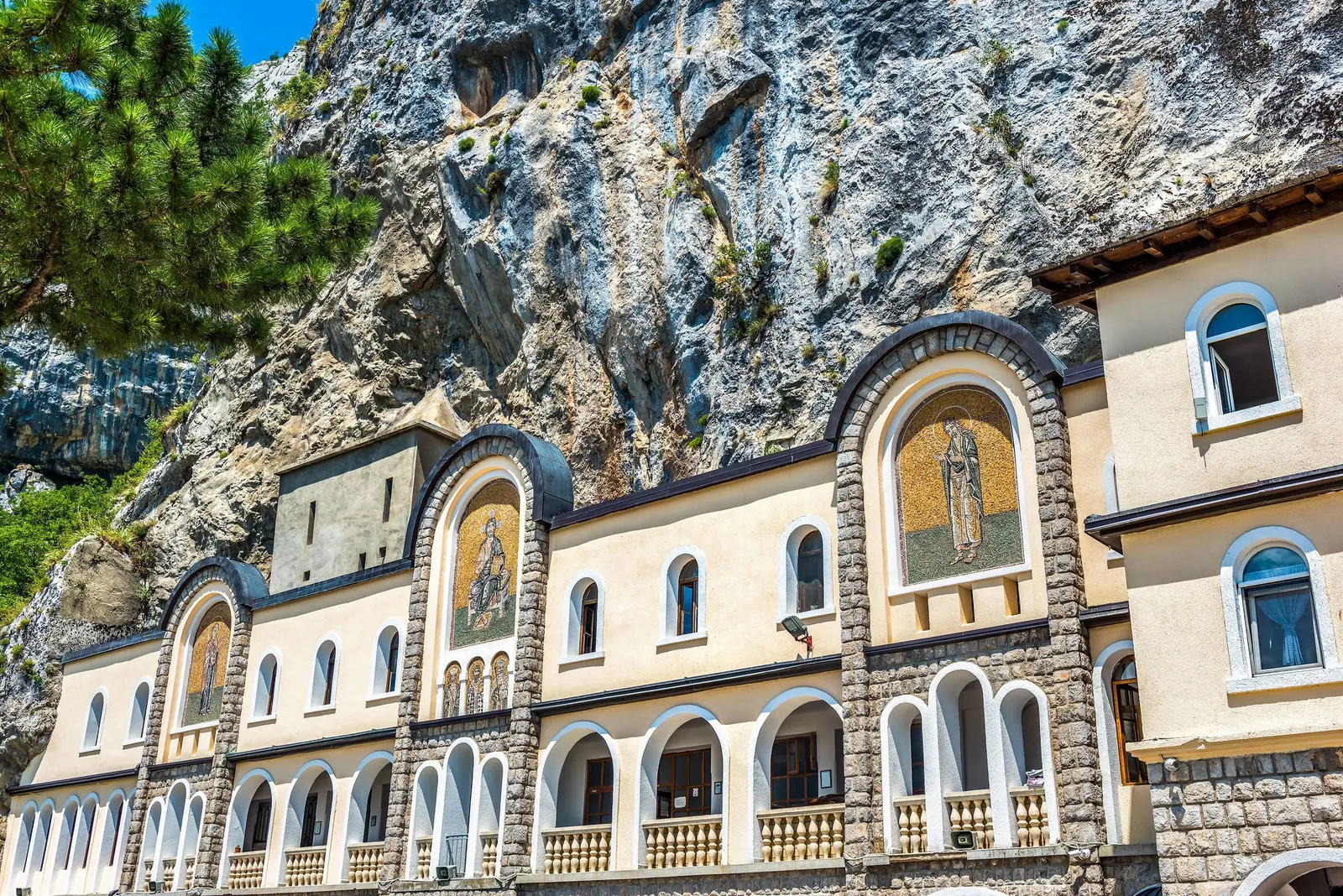
Saint Basil of Ostrog—born Stojan Jovanović and remembered as a seventeenth-century bishop—is the centre of the monastery's devotional life. The Church venerates the relics kept in the cave shrine and calls him the Wonderworker. Pilgrims' accounts of consolation and healing belong to the monastery's faith tradition.
Religious testimony and clinical evidence answer different questions. Books of testimony may describe blindness, deafness, infertility, immobility and other conditions, but they do not establish diagnosis, treatment, causation or general likelihood. A visitor may understand an account as miracle, personal witness or devotional literature without presenting it as a reproducible health claim.
Do not stop medication, delay emergency care, abandon fertility treatment or tell another person that fasting or belief is a precondition for recovery. Prayer may accompany care for someone who wants it; it does not replace qualified assessment. Respect also means avoiding intrusive questions about why another pilgrim is present.
The monastery does not publish a current visitor rule stating that the saint's body is fully exposed only once each year. Access at the shrine follows its present liturgical and pastoral practice, not a fixed tourism promise.
The 12 May feast and high-crowd days
Saint Basil's feast is celebrated on 12 May. The monastery's 2026 report describes thousands of faithful and notes that many arrived on foot, including young people. The preceding day also drew thousands and a continuous column of visitors. If quiet architectural observation is your priority, this is the least predictable time to choose.
If the feast is the purpose of the journey, plan it as a major religious gathering. Expect altered roads, distant parking, long standing, compressed queues and changing access. Carry water and weather protection without burdening the route. Establish a meeting point because phone contact can fail in crowds. Children, older people and anyone vulnerable to heat or prolonged standing need a conservative exit plan.
Do not reproduce the 2026 service or traffic schedule for another year. The monastery publishes dated worship announcements and the authorities publish dated controls. Check both close to departure, then obey the on-site arrangement even if it differs from the notice.
Accessibility and health planning
Upper Ostrog's visible route includes slopes, uneven stone, stairs and narrow circulation. The monastery history describes a small doorway requiring most adults to bow deeply. Those features may exclude or strain visitors with reduced mobility, limited balance, cardiopulmonary illness, pain, sensory overload or claustrophobia.
Contact the monastery before travel with a precise question: which level you need to reach, whether step-free access exists to the desired place, where a vehicle may stop, and whether a companion can assist. Do not accept “the road goes up” as proof that the shrine itself is accessible. Bring prescribed medication and choose the Lower Monastery only if the upper approach is unsuitable.
Summer rock and stone can intensify heat; winter brings cold, wet surfaces and possible ice. Start early enough to retain daylight, but do not assume an opening hour. Check weather and monastery activity first. Anyone feeling chest pain, severe breathlessness, faintness or neurological symptoms should stop and seek help rather than treating the climb as a test of devotion.
Overnight stays and monastery contact
The monastery's official portal currently publishes a general number, +382 68 800 899, and a separate guest-house number, +382 68 080 133. It also publishes [email protected]. Those details establish a contact channel—not a confirmed room, reservation system, free bed or right to sleep outdoors.
Ask in advance about availability, who may stay, arrival deadline, identification, donation or price, bedding, meals, bathrooms, accessibility and worship expectations. Repeat the date and party size in writing if possible. Do not arrive late expecting monastics to solve a missing hotel booking.
For wider trip preparation, consult the tourist tax and registration guide, while the first-time visitor guide covers driving, connectivity and general trip preparation.
A realistic half-day plan
- The day before: check the monastery portal, weather, road notices and—if relevant—both directions in the live rail timetable.
- Before departure: confirm the final segment, return transport, meeting point and mobility plan. Carry water, a modest layer and essential medication.
- At Lower Ostrog: pause, observe worship activity and reassess heat, weather and the climb. Do not force the upper visit if conditions have changed.
- At Upper Ostrog: follow the queue, keep photography restrained and allow worship to set the pace. See fewer spaces well rather than pushing through every doorway.
- Return: leave enough daylight and schedule margin for the descent or controlled road transfer. Rail users should work backward from a realistic train, not the last theoretical one.
Allow at least half a day from a nearby base. Add more around weekends, feast periods or a worship service. If traffic or weather defeats the plan, return another day rather than improvising an unsafe road or footpath.
Emergency planning
Montenegro's general emergency coordination number is 112. Save it, but do not rely on continuous signal. Keep the monastery name, current level, nearest landmark and your transport details available offline.
When calling, state what happened, exact location, number of people and immediate hazards such as traffic, fall exposure, heat or ice. Follow the 112 dispatcher's instructions and on-site responders rather than improvising treatment or movement.
Frequently asked questions
Is Ostrog open all day?
As of 29 August 2026, the official monastery portal did not publish a permanent daily opening schedule. Worship, maintenance, crowds and feast arrangements can affect access. Check dated announcements or contact the monastery before a journey that depends on a particular time or space.
How long is the walk from Lower to Upper Ostrog?
Official descriptions vary: the monastery says no more than about 30 minutes, while the National Tourism Organisation gives 2.5 km and around 40 minutes. Add margin for heat, fitness, rest, crowds and your actual starting point.
Can I take the train from Podgorica?
Ostrog appears in the official rail journey search, but the station is not the monastery entrance and it has no guaranteed monastery shuttle. Search the exact date in both directions and arrange the whole station-to-monastery and return segment before departure.
Is there an entrance fee?
As of 29 August 2026, the official monastery portal did not publish a visitor admission price. That does not mean parking, transfers, accommodation or other services are free. Confirm each paid element with its actual provider and avoid unofficial “entry” sellers.
What should I wear?
Choose modest clothing covering shoulders and knees, bring a light layer and follow current signs or monastic guidance. Secure shoes matter on the approach. Clothing should help you enter quietly and safely, not become a performance or judgement of other visitors.
Can non-Orthodox visitors enter?
The monastery receives people from beyond the Orthodox community, but it remains a sacred working place. Visitors of any background should respect worship, private areas, photography restrictions and Church rules around sacraments.
Do I need to visit on 12 May?
No. The feast of Saint Basil is spiritually important and very crowded. Choose it only if participation in the religious gathering is your aim. For a calmer architectural visit, select another date and still check the current worship programme.