0 accommodations available
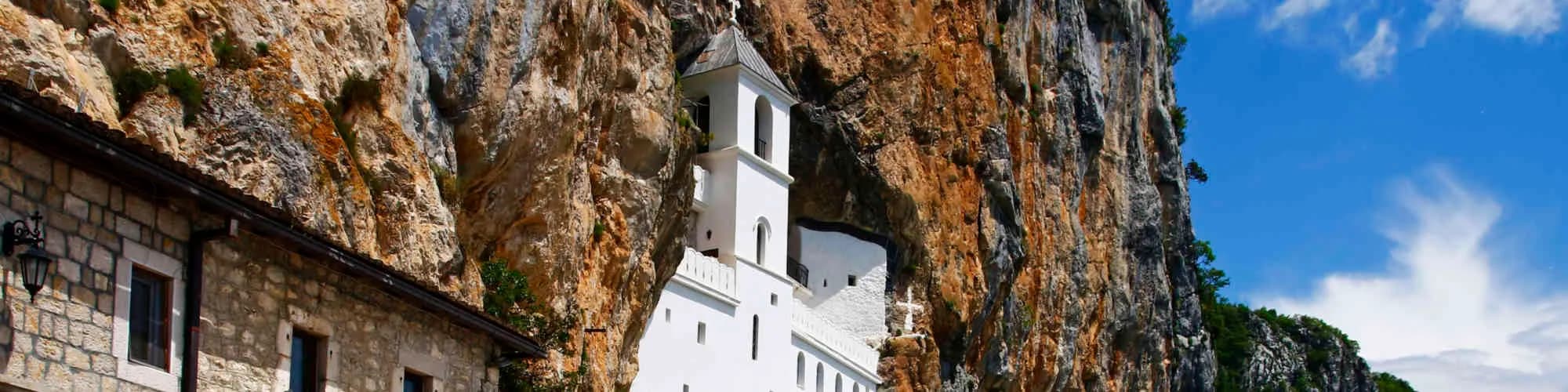
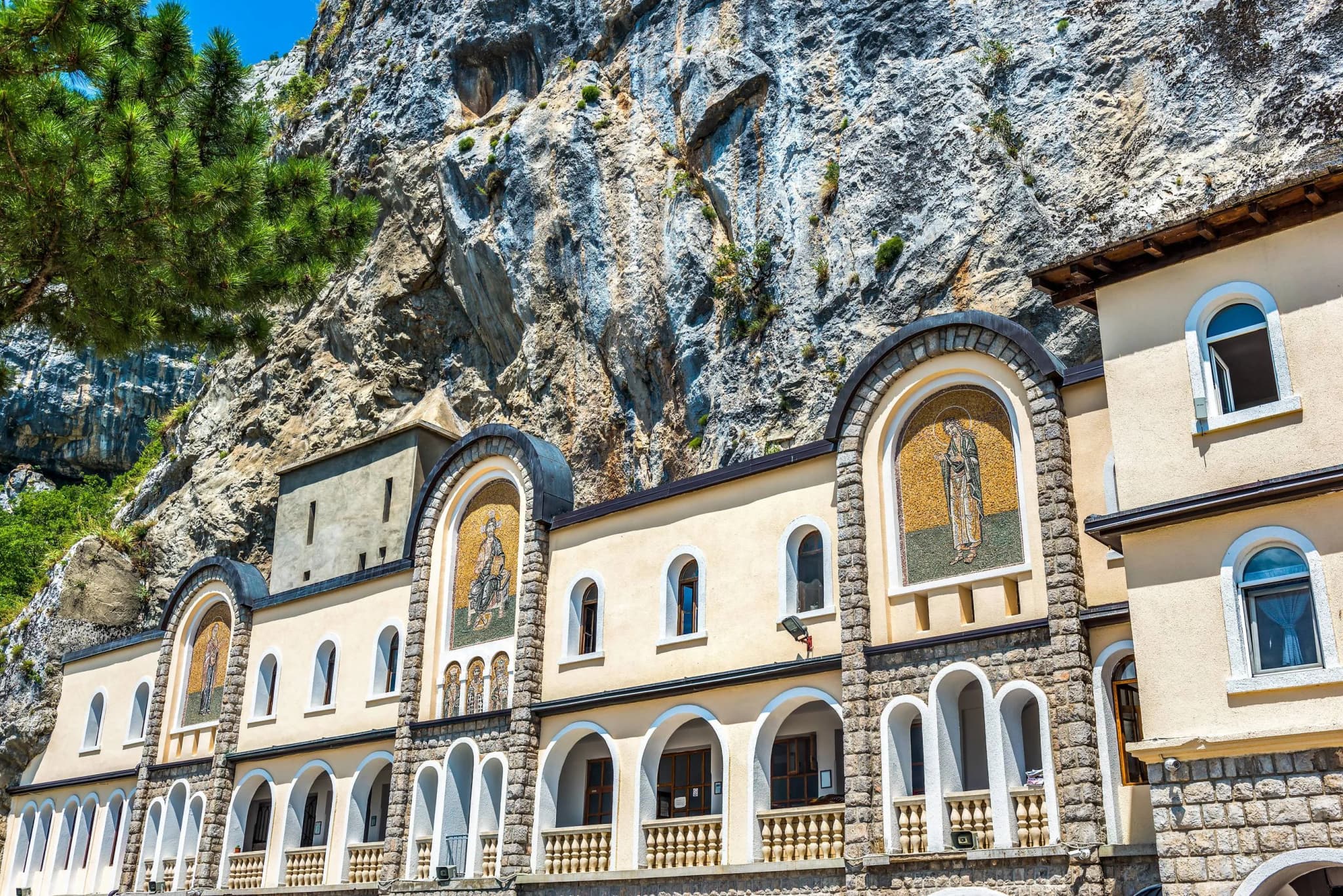
Ostrog Monastery stands in a white cliff above the Bjelopavlići plain in central Montenegro, roughly 900 metres up, its two small churches set into caves in the rock so that the whitewashed façade looks pressed flat against the mountain. It is the most visited pilgrimage site in Montenegro, with around a million people a year making the journey, and it draws Orthodox, Catholic and Muslim visitors alike — unusual in this part of Europe, and something local people mention with pride. The monastery was founded in the seventeenth century by Vasilije Jovanović, later Saint Vasilije of Ostrog, who withdrew here with a small community and died in 1671; his relics lie in the Upper Monastery and are the reason most pilgrims come. Two rock-cut churches sit at that level, the Church of the Presentation and the Church of the Holy Cross, both painted directly onto the cave walls in frescoes that follow the curve of the stone. The Lower Monastery, built in the nineteenth century about three kilometres below, holds the church of the Holy Trinity and the guest quarters, and is where the walking path up begins — some pilgrims climb it barefoot. Visitors find a working monastery rather than a museum. Monks live and serve here, queues form quietly at the reliquary, candles burn on an outside wall, and the terrace outside the upper church looks straight down the Zeta valley towards Podgorica. Modest dress is expected, covered shoulders and knees for everyone. Entry is free, and the narrow road up from Danilovgrad is steep and busy with buses. Ostrog suits anyone interested in faith, history, or simply an extraordinary piece of building, and it makes an easy detour from Podgorica or Nikšić. Early morning is far calmer than the middle of the day, and the feast of Saint Vasilije on 12 May brings crowds on an entirely different scale.
Search thousands of hotels and apartments with live prices.
We may earn a commission from partner links. This helps us keep Montenegro.com free for travelers.
Search hotels, apartments and guest houses with live availability.
We may earn a commission from partner links. This helps us keep Montenegro.com free for travelers.
Ostrog is an Orthodox monastery built into a vertical cliff face above the Zeta valley, founded in the 17th century around the cave cells of Vasilije, bishop of Herzegovina. His relics rest here, and it is by a wide margin the most visited religious site in Montenegro.
On the flank of Ostroska Greda, above the Bjelopavlici plain in central Montenegro. It is about 50 minutes by car from Podgorica, half an hour from Niksic and roughly two hours from Budva, on a narrow road that climbs in tight switchbacks.
The Lower monastery, from the 19th century, sits in woodland and holds the church of the Holy Trinity and the guest quarters. The Upper monastery, the white facade set in the rock, is 2 km further up and holds the two cave chapels and the relics.
Yes, and many pilgrims do — a shaded footpath of about 3 km climbs from the Lower monastery, taking 40 minutes to an hour. The road also goes all the way up, but parking at the top is limited and often full in high summer.
Yes. Shoulders and knees must be covered for both men and women, and swimwear or beachwear will not be admitted. Wraps are usually available at the entrance. Entry is free, photography is restricted inside the chapels, and the site is busiest around midday.
Early morning, before the coach tours arrive from the coast. The monastery is open year-round and receives visitors of all faiths. The feast of St Vasilije on 12 May draws very large crowds, as do the days around Orthodox Easter.
95.8 km by road, about 2 h 9 min by car.
The UK Foreign, Commonwealth & Development Office (FCDO) has no advisory against travel to Montenegro; it last reviewed its guidance on 13 August 2026. That is their assessment of the country as a whole, not ours and not a judgement about Ostrog, so read it yourself before you travel. The emergency number in Montenegro is 112.
The nearest places to Ostrog, at their true positions — Šavnik is about 32 km away in a straight line.
Schematic. Positions and straight-line distances from the coordinates we hold for each place; mountain roads make the drive longer. Coastline and Lake Skadar © OpenStreetMap contributors.
Best time: June · July · September
| Place | By road | Driving |
|---|---|---|
| Bogetići | 10.2 km | about 17 min |
| Nikšić | 19.8 km | about 32 min |
| Danilovgrad | 21.1 km | about 33 min |
| Podgorica | 42.9 km | about 1 h 2 min |
| Žabljak | 94.7 km | about 2 h 7 min |
| Budva | 95.8 km | about 2 h 9 min |
| Kotor | 97.3 km | about 2 h 6 min |
Road distances routed over OpenStreetMap data, © OpenStreetMap contributors. Driving times are free-flow and take no account of summer traffic or a queue at the ferry ramp.