Gusinje: Montenegro's Remote Mountain Village and the Ali Pasha Springs
Gusinje is a remote mountain village at the foot of Montenegro's Prokletije peaks, home to the magical Ali Pasha Springs and the famous cross-border trail to Albania's Valbona Valley.
Updated Originally published 23 min readby Pavle Obradović
Gusinje: Where Montenegro's Wildest Mountains Begin
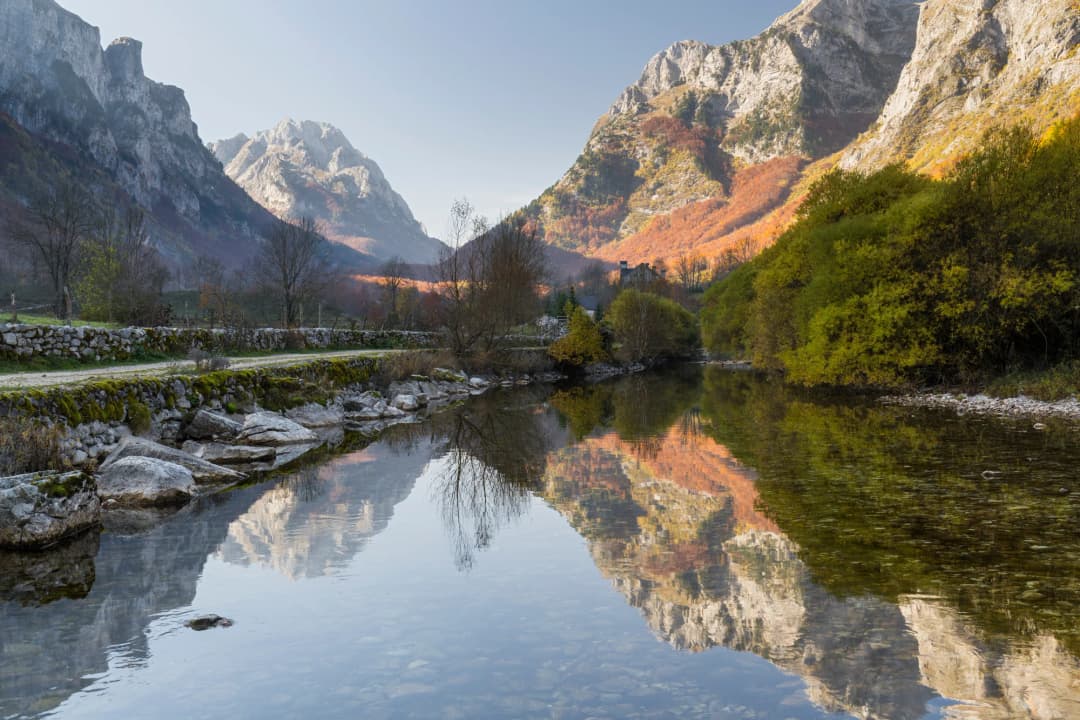
Gusinje is a small, beautifully situated mountain village in Montenegro's far northeast, tucked into a valley at the foot of the Prokletije Mountains just 10 km south of Plav. With a population of barely 1,500, Gusinje feels like the edge of the world — and in many ways, it is. The Albanian border lies just a few kilometres to the south, and the dramatic Valbona Pass connects this Montenegrin village to Albania's equally stunning Valbona Valley in one of the Balkans' most celebrated cross-border treks.
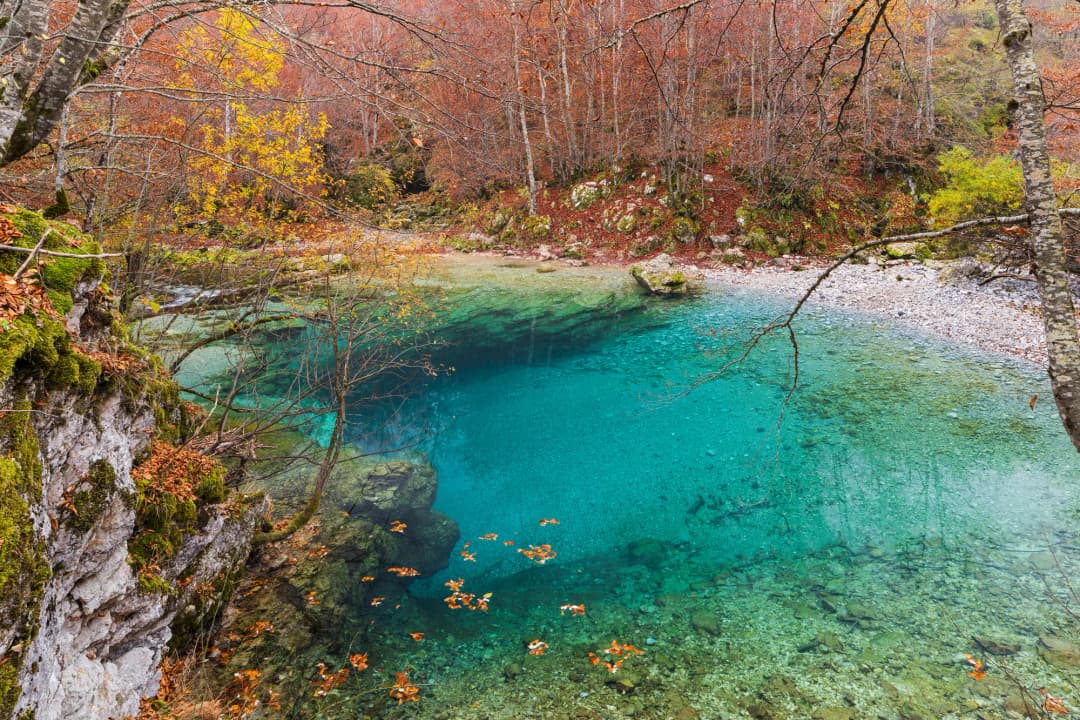
What draws visitors to this remote corner of Montenegro is the extraordinary natural beauty that surrounds it on all sides. The Ali Pasha Springs (Ali-Pašini Izvori), a magical karst spring where icy turquoise water erupts from beneath a sheer cliff face, is one of Montenegro's most extraordinary natural wonders. The towering limestone peaks of the Prokletije rise over 2,000 metres directly above the village, and the Grbaja Valley extends south into some of the wildest mountain terrain in all of Europe. For travellers seeking genuine wilderness, unspoiled mountain scenery, and the authentic atmosphere of a traditional Balkan mountain community, Gusinje delivers in abundance.
How to Get There
Gusinje is reached via a two-lane road from Plav (10 km, 15 minutes), which in turn is accessed from Podgorica (180 km, approximately 3.5 hours) via Kolašin, Andrijevica, and Plav. The road from Plav to Gusinje follows the Lim River valley through increasingly dramatic scenery, with the Prokletije peaks growing larger with every kilometre.
Bus services from Podgorica and Berane typically terminate in Plav, from where you'll need a taxi (approximately 5-7 euros) or local minibus to reach Gusinje. In summer, occasional minibus services run between Plav and Gusinje, but don't rely on them. Having your own vehicle is strongly recommended for exploring the area — the Ali Pasha Springs, Grbaja Valley, and mountain trailheads are all outside the village and not served by any public transport.
The road from Gusinje continues south to the Albanian border crossing at the Valbona Pass (Qafa e Pejes), which has been open seasonally from approximately May to October since its official opening in 2014. In recent years, the road has been improved and the crossing is open to both hikers and vehicles, though the final section from the Montenegrin side remains unpaved. Check the current status before planning a border crossing — conditions can change from year to year.
Best Time to Visit
June through September is the prime visiting season for Gusinje. The Ali Pasha Springs are accessible year-round (the road may be muddy in winter but is usually passable), but the Grbaja Valley and higher mountain trails are best from late June (after the spring snowmelt) through early October. July and August are the warmest months, with daytime temperatures of 22-30°C in the valley, though afternoon thunderstorms are common at altitude and can develop with startling speed.
Climate at a glance
Best time: April · May · October
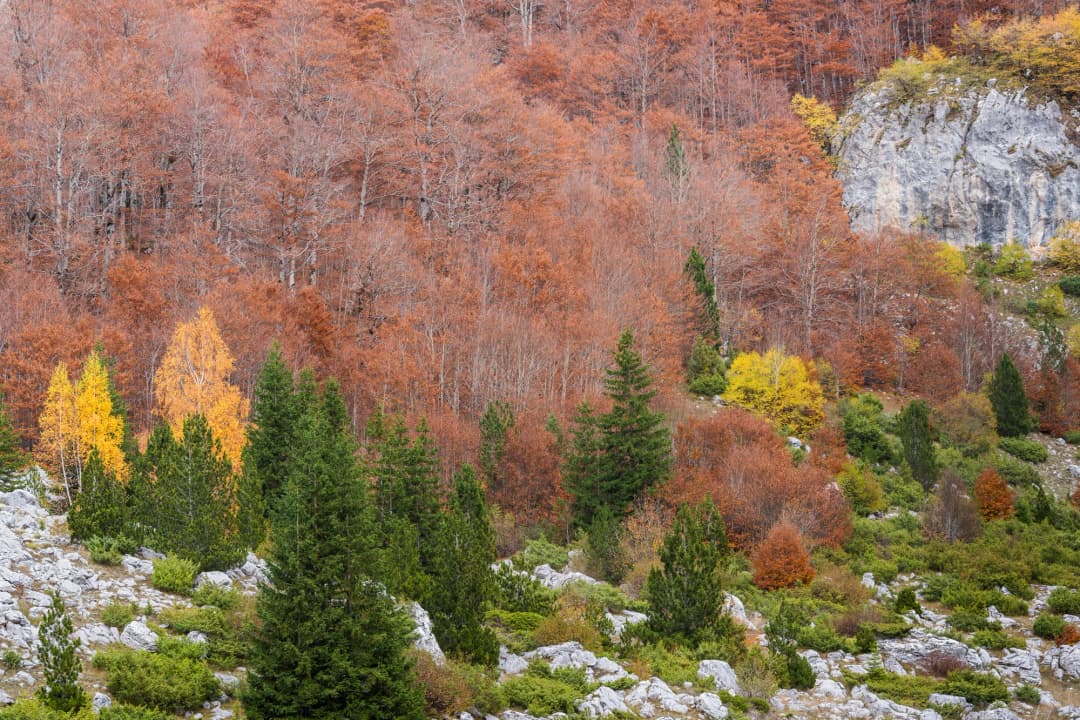
Early June offers the most dramatic waterfalls and the highest water flow at the Ali Pasha Springs, as snowmelt from the Prokletije fills the underground karst system to capacity. The springs are impressive at any time of year, but the volume of water in early summer is spectacular. Late September and early October bring cooler, often clearer weather with excellent visibility and the first hints of autumn colour in the beech forests.
The Valbona border crossing is typically open May to October, weather permitting — confirm the exact dates locally before planning a cross-border hike. Winter brings heavy snow and a very quiet, isolated atmosphere. The village essentially hibernates from November to April, with most guesthouses closed, though a few remain open for adventurous winter visitors seeking cross-country skiing and snowshoeing in pristine mountain landscapes.
Top Things to See and Do
Ali Pasha Springs (Ali-Pašini Izvori / Oko Skakavice)
The Ali Pasha Springs are Gusinje's crown jewel and one of the most extraordinary natural sights in all of Montenegro. Located in the Grbaja Valley about 5 km from the village, the springs emerge from the base of a towering vertical cliff in a series of vivid turquoise pools and cascades. The water, filtered through kilometres of limestone karst, maintains a constant temperature of about 5°C year-round and is so pure that every pebble on the streambed is visible even at depth.
The name Oko Skakavice ("Eye of the Waterfall") refers to the main spring, where water surges from a cave at the cliff base with tremendous force, particularly in late spring and early summer when snowmelt fills the underground system. The turquoise colour — caused by dissolved limestone minerals and the extraordinary clarity of the water — photographs beautifully but is even more stunning in person. The setting is magical: towering cliffs on three sides, ancient beech forest, and the sound of rushing water filling the valley.
A small seasonal restaurant operates near the springs from approximately June to September, serving fresh grilled trout (often caught that morning from the river), kajmak, and bread baked under hot embers. Eating fresh trout beside the turquoise springs, surrounded by 2,000-metre peaks, is one of Montenegro's most memorable dining experiences.
Grbaja Valley Hiking
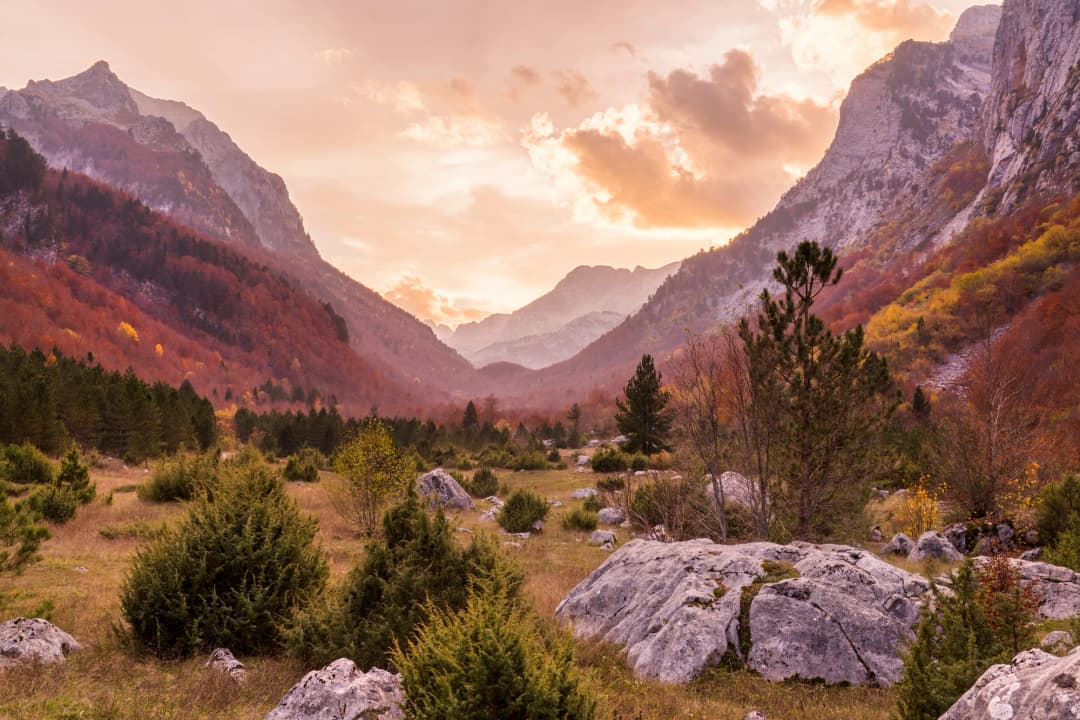
The Grbaja Valley extends south from Gusinje into the heart of the Prokletije, flanked by enormous limestone walls that rise vertically for hundreds of metres on both sides. The valley is the starting point for several outstanding hikes ranging from easy valley walks to serious mountain ascents.
The trail up the Grbaja Valley toward the Valbona Pass (1,759 m) follows the river through increasingly dramatic scenery, passing alpine meadows, shepherd huts (katuni), and finally climbing through a rocky landscape to the pass on the Albanian border. The full round trip to the pass and back is a demanding full-day excursion of approximately 7-8 hours, with significant elevation gain. For a shorter walk, follow the valley trail for an hour or two past the Ali Pasha Springs and return — even a brief excursion into the valley reveals spectacular scenery.
Other hiking routes from the Grbaja Valley lead to high mountain lakes, ridges with panoramic views, and connection points with the Peaks of the Balkans trail. A local guide is strongly recommended for any hike beyond the main valley floor, as trails can be faint, weather unpredictable, and the terrain remote.
The Valbona Cross-Border Trek
Since the border crossing between Gusinje and Albania's Valbona Valley opened, the Gusinje-to-Valbona route has become one of the Balkans' most celebrated treks and a highlight of the Peaks of the Balkans trail. The walk takes 6-7 hours one way, climbing from the Gusinje side through the Grbaja Valley to the Valbona Pass (1,759 m) and descending through Albanian territory to the village of Valbona.
The trek is challenging but achievable for fit hikers with good equipment. The views from the pass — looking back over the Montenegrin peaks and forward into the Albanian alps — are extraordinary. It is possible to hike to Valbona, spend the night in one of the village's growing number of guesthouses, and return the next day via the same route. Alternatively, continue through Albania to Theth and onward, completing a multi-day circuit through some of the most spectacular mountain terrain in Europe. Carry your passport and check visa requirements for all three countries if planning the full Peaks of the Balkans route.
Village Heritage and Local Culture
Gusinje's village centre retains a distinctly Ottoman character, with stone tower houses, a historic mosque, and a small bazaar area. Several of the tower houses (kule) have been preserved and can be viewed from the outside — their thick stone walls, narrow defensive windows, and fortified upper floors tell the story of life in a contested border region. The town mosque, with its modest minaret and shaded courtyard, is a peaceful focal point.
The village has a rich pastoral tradition that continues today. In summer, shepherds drive their flocks to high mountain pastures following routes used for centuries, and the sound of cowbells drifting down from the heights is part of the daily soundtrack. Local families produce outstanding cheese, kajmak, and other dairy products from their herds — buying some directly from a farmer is a highlight.
Photography and Nature
Gusinje is one of Montenegro's finest destinations for nature and landscape photography. The Ali Pasha Springs, with their turquoise water against grey rock, are photogenic at any time but especially striking in early morning or late afternoon light. The Grbaja Valley offers classic mountain valley compositions with converging walls and distant peaks. The village itself, with its Ottoman architecture against a backdrop of soaring mountains, provides atmospheric cultural photography opportunities. Bring a polarising filter for the spring waters and a wide-angle lens for the valley panoramas.
Day Trip Suggestions
Plav and Plav Lake: The neighbouring town of Plav, just 10 km north, offers lake walks, the atmospheric old town, traditional Bosnian coffee culture, and additional dining options. Easily combined with a Gusinje visit for a full-day exploration of the region.
Valbona (Albania): If the border crossing is open and you have the fitness and equipment, the day hike over the Valbona Pass into Albania is an extraordinary adventure. Allow 6-7 hours one way, and arrange accommodation in Valbona in advance.
Hridsko Jezero: This spectacular glacial lake at 1,970 metres can be reached from the Plav/Gusinje area in a long day hike. The turquoise water surrounded by barren peaks makes it one of the most beautiful mountain lakes in the Balkans.
Where to Eat and Drink
Restaurant at Ali Pasha Springs — Open seasonally (approximately June to September), this rustic eatery beside the springs serves the freshest possible grilled trout (often caught from the river that morning), kajmak (clotted cream), and bread baked under hot embers. The cooking is simple but perfectly suited to the setting, and the combination of extraordinary natural beauty and honest mountain food is unforgettable.
Local guesthouses: Several families in Gusinje offer home-cooked meals as part of their accommodation packages. Expect abundant portions of pita (filled pastry), grilled lamb, stuffed peppers, fresh salads from kitchen gardens, homemade bread, and generous pourings of homemade rakija (plum or grape brandy). These family dinners, often eaten around a communal table with your hosts, are among the most authentic culinary experiences in Montenegro.
Cafés in the village: A couple of small cafés in Gusinje's centre serve coffee, cold drinks, and basic snacks. The pace is unhurried and the conversation — if you can find someone who shares a language — is invariably interesting. These are places to sit, observe, and absorb the rhythm of mountain village life.
Where to Stay
Gusinje has a handful of guesthouses and small family-run pensions. The experience is authentic, personal, and far removed from the polished hospitality of the coast. Hosts often prepare home-cooked dinners, share local knowledge, and can arrange guides for hiking — the relationship between guest and host in Gusinje retains a warmth and generosity that is increasingly rare in more touristed areas.
Accommodation is basic but clean, typically with private rooms, shared bathrooms, and home-cooked meals. Expect to pay 20-40 euros per person including breakfast and sometimes dinner. In peak summer (July-August), booking in advance is advisable as options are limited. Check montenegro.com for listings in the Gusinje and Plav area to find the right fit for your adventure.
Practical Tips
Bring sufficient cash — there are no ATMs in Gusinje, and the nearest reliable one is in Plav (10 km). Most guesthouses and the seasonal restaurant at the springs deal in cash only.
The road to Ali Pasha Springs is unpaved for the last 2 km. A standard car can manage in dry conditions, but a higher-clearance vehicle is more comfortable and essential after rain.
If hiking to the Valbona Pass, carry your passport, sufficient water (at least 2 litres), food, warm clothing, and rain gear. Conditions at the pass can be challenging even in summer — fog, wind, and lingering snow patches are common.
Stock up on water, snacks, and any supplies before heading out on hikes — there are no shops once you leave the village, and options even in the village are limited.
Photography here is extraordinary — bring a polarising filter for the turquoise spring waters and a wide-angle lens for the valley and mountain panoramas.
Mobile phone coverage is unreliable to nonexistent once you leave the village. Download offline maps before arriving and tell someone your hiking plans.
The Gusinje diaspora community in New York has its own restaurants and cultural organisations — if you're visiting from the US, mentioning this connection will likely earn you extra warmth from locals.
Respect the multi-ethnic and multi-religious character of the village. Both the mosque and any churches should be treated with equal respect.
If visiting in early summer (June), prepare for mosquitoes near the river and springs. Insect repellent is essential.
Consider hiring a local guide for any serious mountain hiking. They know the terrain intimately, can read the weather, and their fees (typically 30-50 euros per day) directly support the local economy.
Practical Gusinje base plan
Choose the outing before arranging transport
Plan
Best purpose
Control before leaving
Do not assume
Gusinje + Ali Pasha Springs
Low-commitment cultural and waterscape day
Footpath, event crowd, weather, return route
Step-free access or drinkable spring water
Grebaje valley floor
Mountain scenery and short walking
Road, park ticket, parking, snow and last light
That a valley visit equals a summit hike
Volušnica
First proper ascent for prepared hikers
Guide advice, current route, weather, equipment
“Not too demanding” means easy for everyone
Vusanje + Ropojana
Glacial-valley walking and Peaks context
Transfer, route extent, water levels, border line
Permission to cross into Albania
Grlja / Oko Skakavice
View a powerful water landscape
Safe viewpoint, wet rock, barriers, flow
Permission or competence to enter the canyon
Cross-border trek
Multi-day Peaks of the Balkans itinerary
Written permits, exact crossing, documents, guide
A park ticket is a border permit
National Parks describes Grebaje as suitable for short walks and Volušnica as a first ascent, with Talijanka and Popadija for more experienced hikers. That is useful triage, not a difficulty grade. Snow, thunder, cloud, wind, damaged markings and fitness can turn a familiar route into a different undertaking. Start at the lowest level that still satisfies the day.
Climb the commitment ladder one decision at a time
Level
Where
What it requires
1. Near town
Gusinje + Ali Pasha Springs
—
2. Valley floor
Grebaje or a defined Ropojana section
—
3. Mountain route
—
current track + weather + equipment + turnaround
4. Border crossing
—
written approval for exact place and date
If a check fails
step down a level—not up a ridge
—
Source: nparkovi.me
2026 park fees and what they buy
The current official Prokletije price list charges €3 per person per day. It describes admission as including the visitor centre and educational paths. The National Parks ticket page says children under 15 enter without charge; the annual-pass checkout asks visitors to carry proof of a child’s age.
The live day-ticket checkout also charges €3 and says the ticket can be used within 30 days after purchase. That window does not reserve a guide, guarantee the visitor centre is open, hold parking or certify a route as safe. The same price list separates parking, camping, equipment and guiding from entry. Published guide-service tariffs are €40 for four hours and €80 for eight hours, but confirm route, language, group size, transport, technical competence and cancellation terms.
A 2026 all-parks pass costs €13.50. It becomes cheaper than €3 daily entry on the fifth paid park-day. However, the live annual-pass checkout says online annual-pass sales are currently suspended, despite the December 2025 launch announcement saying sales were online and at physical points. Treat the live suspension as controlling and call the published number before relying on a sales point.
Start with the visitor centre and tourism office
National Parks places its Prokletije visitor centre in Gusinje. The published description includes an exhibition gallery, ethnographic room, education space and multimedia room. It lists [email protected] for organised educational visits; the 2025 guided-tour announcement uses [email protected] for route enquiries.
No dependable daily public opening hours were established on those pages. Email before an essential visit and ask for the exact entrance, hours, ticket collection, current trail bulletin, guide availability and equipment rental. The municipal Tourism Organisation publishes Čaršijska 62, +382 68 565 657 and [email protected]. Confirm that office is staffed before building a morning around it.
No authoritative date-specific bus or trailhead-transfer timetable was found. Do not interpret “ten minutes from Plav” in the old page as a service promise. Ask accommodation, tourism office or guide for a written pickup point, price, luggage rule and return time. Save a map pin offline. The Plav guide is useful for a second base; the Plav-to-Murino route guide covers the wider valley without pretending it is trailhead transport.
Ali Pasha Springs: nearby does not mean frictionless
What the sources say
The National Tourism Organisation places Ali Pasha Springs about 1.5 kilometres from Gusinje. That makes the springs a sensible low-commitment outing, especially after uncertain weather or a late arrival. They are a field of upwellings and channels, not one fountain. The dedicated Lake Plav and Ali Pasha Springs guide explains the water landscape and conflicting event dates in depth.
Distance is not an accessibility specification. No current official source reviewed here establishes continuous pavement, step-free banks, accessible toilets or a safe wheelchair viewing position. Water level, saturated ground and gathering crowds can change the experience. Keep children away from unprotected channels, stay off soft vegetated patches and do not describe the water as drinkable without current local testing or an official notice.
Grebaje: separate the valley from the ridges
Grebaje is the easiest place to make a serious-looking mountain day modest. National Parks recommends the valley for short walks, rest and photography. That does not require climbing Volušnica, Talijanka, Popadija or the Karanfili. Confirm the access road, parking tariff, ticket point, surface and final safe turnaround before leaving town.
Volušnica is still a mountain ascent. The park calls it a good first climb and says more experienced hikers can continue toward Talijanka and Popadija. Read that as a sequence of increasing commitment, not permission to continue because the weather looked clear at breakfast. Ask whether snow remains, whether markings are continuous, whether exposed or steep ground is involved, and when a guide would turn around.
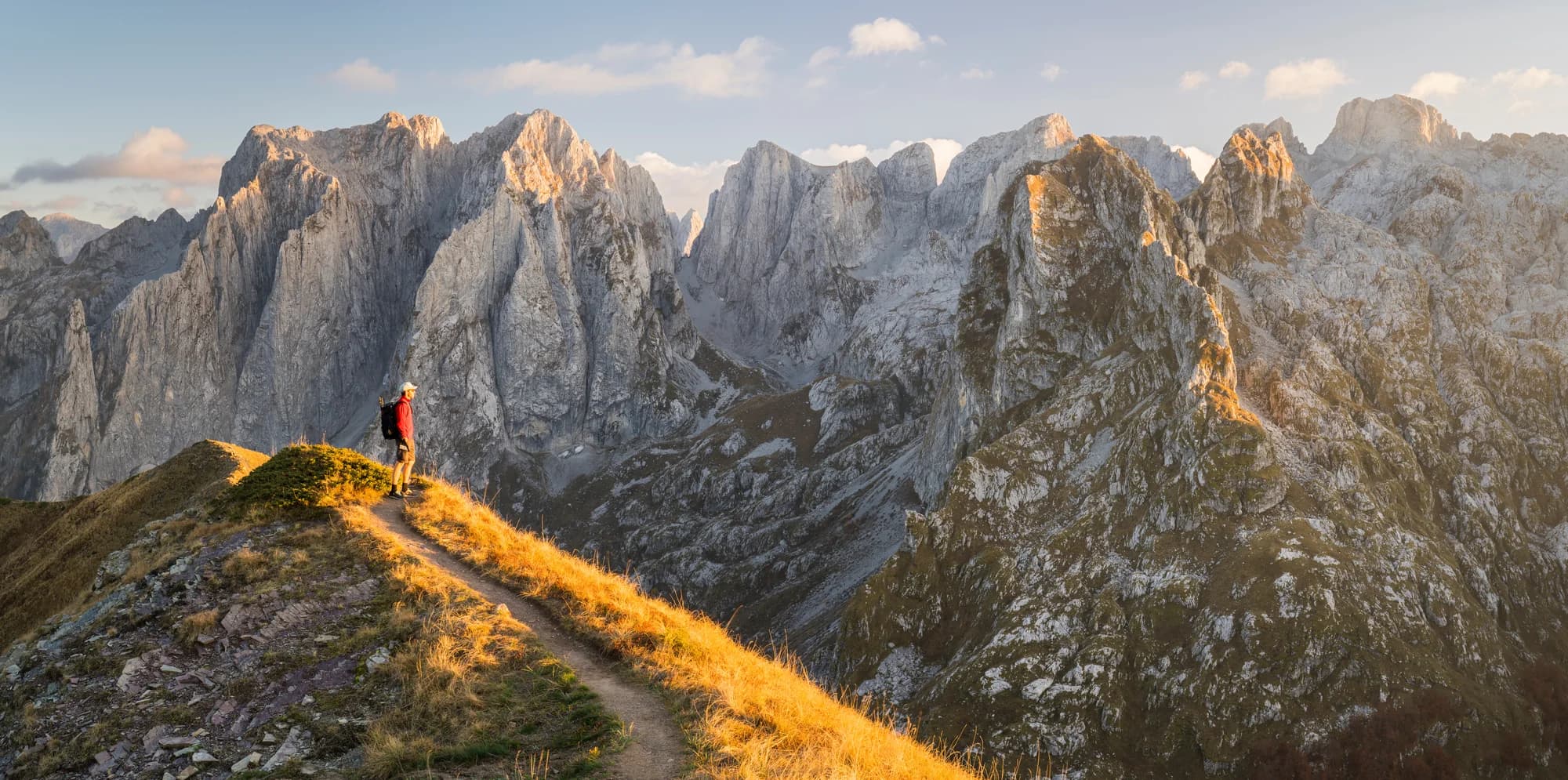
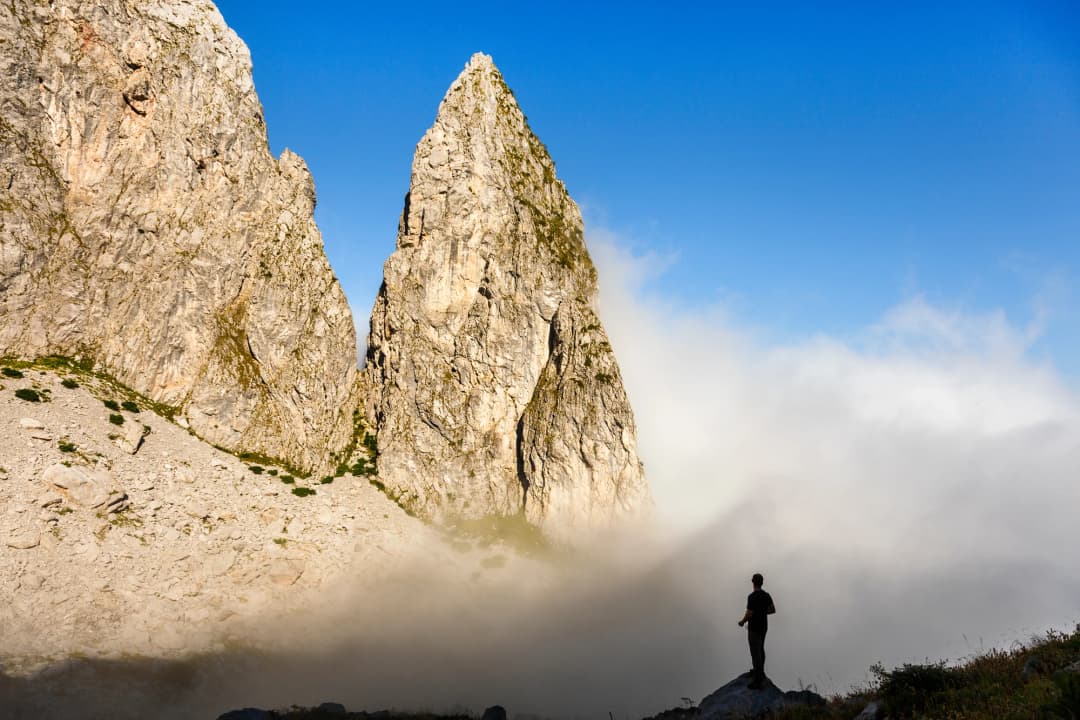
High, exposed terrain in the Prokletije range. The licensed photograph was visually checked; it does not identify a precise summit, prove current trail conditions or make this terrain suitable for an ordinary valley visitor.
National Parks advertised licensed guided routes in 2025 across Grebaje, Ropojana, Ali Pasha Springs and Hrid Lake. Availability in 2026 is not automatic. The official list repeats one Grebaje itinerary while calling the set eight routes, so use it as a menu of route families and ask for a current written itinerary.
Vusanje, Ropojana and Grlja
Ropojana is a glacial valley reached through the Vusanje side of the municipality. National Parks identifies Vusanje–Ropojana–Ropojansko Lake among its guide itineraries and describes the valley as part of the international Peaks of the Balkans route. Decide in advance where your domestic day walk ends. A line on a hiking map can become an international border.
Oko Skakavice and the Grlja canyon belong to the same water-rich landscape, but a viewpoint visit is not canyoning. Wet rock, changing flow, vertical drops and cold water make independent canyon entry an entirely different activity. Use barriers and signed viewpoints where present. Technical canyoning requires a properly licensed specialist operator, suitable equipment and a same-day water assessment; a general mountain guide or park ticket is not enough.
Weather, equipment and the turnaround rule
Gusinje sits around 920 metres, but high routes rise far above the town. Check a current official forecast, then ask the park or guide what it means for the exact ridge. The National Tourism Organisation's mountain guidance also calls for marked routes, layered clothing, non-slip footwear, water, charged phones and lights. Town sunshine does not exclude cloud, thunder, wind, cold or remaining snow above.
Carry offline route data, a charged phone plus power reserve, insulation, rain shell, sun protection, enough food and water, first-aid essentials and a light source. Tell a responsible person the exact route, party, vehicle, turnaround and overdue time. The Ministry of Interior says calls and SMS to 112 are free and its 112 MNE app can send GPS coordinates by SMS without internet. That is emergency support, not a coverage guarantee or substitute for conservative planning.
Turn around for deteriorating weather, lost markings, unexpected snow, fatigue, a delayed start or a border doubt. The summit is optional; the return is part of the route.
No departure until all four boxes have an answer
Box
Answer needed
Also confirm
Route
track · border line · turnaround
current park or guide confirmation
Weather
town forecast + high-route meaning
snow · thunder · cloud · wind
Party + equipment
layers · light · water · offline map
pace set by the least-ready person
Overdue plan
route and return time shared
112 saved; location available offline
A missing answer
is a reason to choose the valley
—
Source: montenegro.travel, gov.me, nparkovi.me
Albania border rules: road crossing versus mountain crossing
The Police archive lists Grnčar–Baškim as a passenger road crossing between Montenegro and Albania. The same page is explicitly archived, and a December 2025 government document concerns technical planning for a new Grnčar facility. Those sources establish a recognized crossing and ongoing infrastructure work, not current hours, queues, vehicle eligibility or document rules. Confirm all four before driving there.
A remote Peaks of the Balkans crossing is different. The regional trail project says hikers should apply to the relevant police authority at least 15 days in advance. Obtain written approval naming each traveller, exact date and crossing point. Verify passports or identity documents, visa status, fee and collection method with the competent authority. Do not cross a “green border” because a GPS track continues or another hiker says checks are rare.
Two routes across one border require different proof
Crossing
Where / what
Proof required
Watch out
Regular road checkpoint
Grnčar ↔ Baškim; confirm opening + vehicle
carry required travel documents
Archived list ≠ today's hours; allow queue and works margin
Remote mountain crossing
Peaks of the Balkans; exact date + crossing point
written police approval; apply at least 15 days ahead
GPS track ≠ border permission
If authorization is unclear
remain in Montenegro
—
—
Source: gov.me, peaksofthebalkans.com
Town culture belongs in the plan
Gusinje is not only a gear depot. National tourism material places the Vizier's Mosque, Orthodox Church of St George and Catholic Church of St Anthony along the same street. Opening, worship, photography and step-free access were not established for each building, so visit quietly, dress conservatively and ask before entering or photographing interiors and people.
The inherited exact 1743 mosque date conflicts with current tourism wording that calls the Vizier's Mosque 17th-century. This logistics guide does not choose between them. Use the visitor centre or a specialist heritage source for a researched architectural history. When passing homes, farms and villages, keep gates as found, do not block lanes and ask before photographing residents; the responsible-visit principles in the Žlijebi village guide transfer better than treating any community as an open-air museum.
Families and accessibility
A nearby attraction is not automatically accessible. Ask separately about the Gusinje visitor-centre entrance, toilet, seating and exhibits; the path and banks at Ali Pasha Springs; vehicle drop-off in Grebaje; and the walking surface you intend to use. No reviewed official source supports a universal step-free claim.
For families, keep the day reversible: town plus springs, or a valley-floor visit with a fixed turnaround. Do not add Grlja edges, a summit or an international crossing because children still have energy at lunch. Weather layers, supervision near water and a return vehicle matter more than collecting locations.
Season and responsible use
National Parks promotes spring, summer and autumn walking, but a season label is not a trail report. Shoulder-season snow can remain high while town roads are clear; summer brings heat and afternoon instability. The Montenegro off-season guide explains the national pattern, while the first-time visitor guide covers country-level transport and emergency basics.
The park asks visitors to move in groups on marked paths and not leave food or waste, especially when spring wildlife activity increases. Do not seek or feed wildlife. Carry waste back, keep food secured, avoid loud playback and leave flowers, fossils, rocks and archaeological traces in place. “Untouched” is not a useful description of a lived, visited and managed landscape.
A Brief History of Gusinje
Gusinje's history mirrors that of its neighbour Plav, shaped by its position at the convergence of Montenegrin, Albanian, and Ottoman cultures. The name Gusinje may derive from the Albanian word "gusht" (August), referring to the month when highland shepherds traditionally descended to the valley, or from an old Slavic root relating to the geese that once populated the wetlands around the Grnčar River.
Under Ottoman rule, which lasted until 1913 in this region, Gusinje was part of the Gusinje nahiyah (administrative district) and had a predominantly Muslim population. The Ottomans built mosques, a bazaar, and the distinctive stone tower houses (kule) that several prominent families erected as both residences and defensive structures. The most notable of these tower houses survive today, their thick stone walls and narrow windows testifying to the turbulent history of this border region.
The period between 1878 and 1913 was particularly dramatic. The Congress of Berlin in 1878 awarded Plav and Gusinje to Montenegro, but the local population resisted incorporation, leading to armed conflict. The area was not actually integrated into Montenegro until after the Balkan Wars, and even then it retained a fiercely independent character. This history of resistance and autonomy remains part of local identity today.
Many Gusinje families emigrated to the United States and Western Europe in the 20th century, particularly to New York City, where a substantial Gusinje diaspora community maintains strong ties to the homeland. This emigrant connection means that Gusinje, despite its remoteness, has an unexpectedly cosmopolitan streak — you may meet returning diaspora members who speak perfect American English in the most unlikely mountain setting.
Quick answers
When is the best time to visit Gusinje?+
June through September is the prime visiting season for Gusinje. The Ali Pasha Springs are accessible year-round (the road may be muddy in winter but is usually passable), but the Grbaja Valley and higher mountain trails are best from late June (after the spring snowmelt) through early October.
The Grbaja Valley extends south from Gusinje into the heart of the Prokletije, flanked by enormous limestone walls that rise vertically for hundreds of metres on both sides. The valley is the starting point for several outstanding hikes ranging from easy valley walks to serious mountain ascents.
Restaurant at Ali Pasha Springs — Open seasonally (approximately June to September), this rustic eatery beside the springs serves the freshest possible grilled trout (often caught from the river that morning), kajmak (clotted cream), and bread baked under hot embers.
Gusinje has a handful of guesthouses and small family-run pensions. The experience is authentic, personal, and far removed from the polished hospitality of the coast. Hosts often prepare home-cooked dinners, share local knowledge, and can arrange guides for hiking — the relationship between guest and host in Gusinje retains a warmth and generosity that is increasingly rare in more touristed areas.
Pavle Obradović is from Herceg Novi. He was Manager of Montenegro.com, then Director of the Herceg Novi Tourism Organization, and is now Coordinator for Investment and Development Projects at the Municipality of Herceg Novi. He holds a BSc in International Hospitality and Service Management from the Rochester Institute of Technology (RIT).
···
Updated · Originally published
Montenegro Travel Newsletter
Get weekly stories, guides, and insider tips about Montenegro delivered to your inbox.