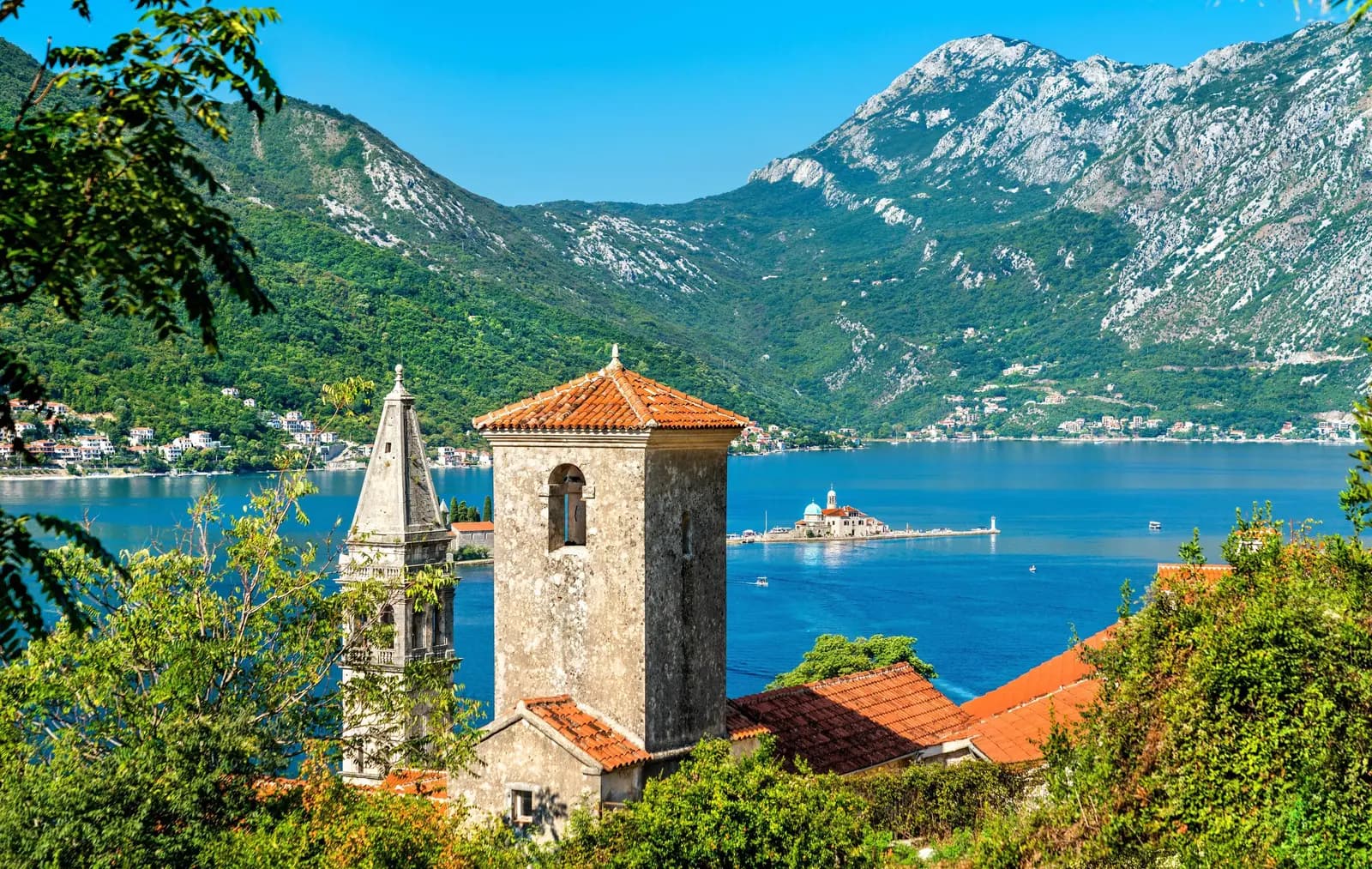
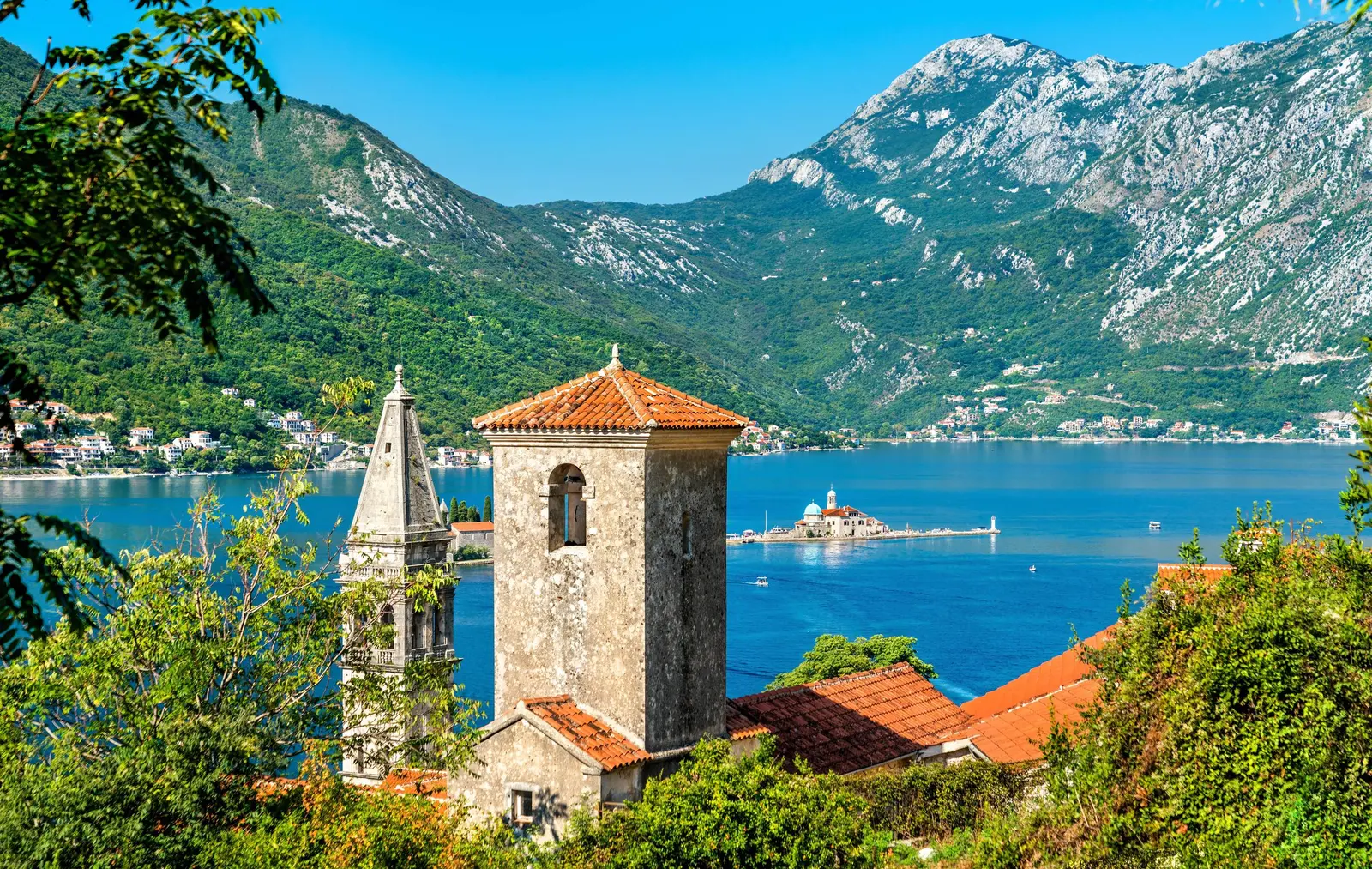
Perast is usually introduced as a beautiful Baroque town. That is true but incomplete. Its most revealing feature is the way a small settlement turns geography into civic structure: a narrow waterfront serves as street, landing place and public room; palaces face the shipping lane; defensive positions look across the water; and two islands extend the town's religious memory into the bay. This is a walking essay for reading that system, not another checklist of attractions.
The argument of the street
Begin with a correction. Perast is not separately “a UNESCO site.” It is one of the historic settlements within the Natural and Culturo-Historical Region of Kotor, a 14,600-hectare World Heritage property inscribed in 1979. UNESCO describes the region's value as the relationship among fortified and open cities, palaces, monastic ensembles, cultivated slopes and the water. It also names paths, coastal roads, pontas and mandrachi—stone piers and small sheltered basins—as evidence of the sea's organizing role. For accommodation, transport and a broad attractions overview, use the comprehensive Perast travel guide; this article instead reads the town's surviving fabric at walking pace.
That wording supplies a useful method. Do not treat each façade as an isolated photo opportunity. Ask what it faces, who could approach it, how goods moved from boat to room, where a family displayed status and how a town without continuous walls watched the passage toward the inner bay. Our Bay of Kotor guide explains the larger geography; here the scale contracts to one street and the water immediately beside it.
Perast's long coastal axis is easy to walk quickly and hard to understand quickly. The buildings do not announce a neat chronology. Medieval religious sites, seventeenth- and eighteenth-century prosperity, nineteenth-century decline, earthquake reconstruction and present-day hospitality uses sit beside one another. A productive walk therefore moves in two directions at once: east to west through space, and back and forth through time.
Start at Bujović Palace: when wealth became an archive
At the waterfront, Bujović Palace makes an effective first stop because the building and its present function explain each other. Government and museum sources date the palace to 1694. Its arcaded ground level, terraces, balconies and stone ornament project the standing of its original owner, Captain Vicko Bujović. Today it houses Perast Museum, so the visitor moves from an exterior statement of maritime wealth into the records, portraits, weapons, ship models, charts and domestic objects through which that society is studied.
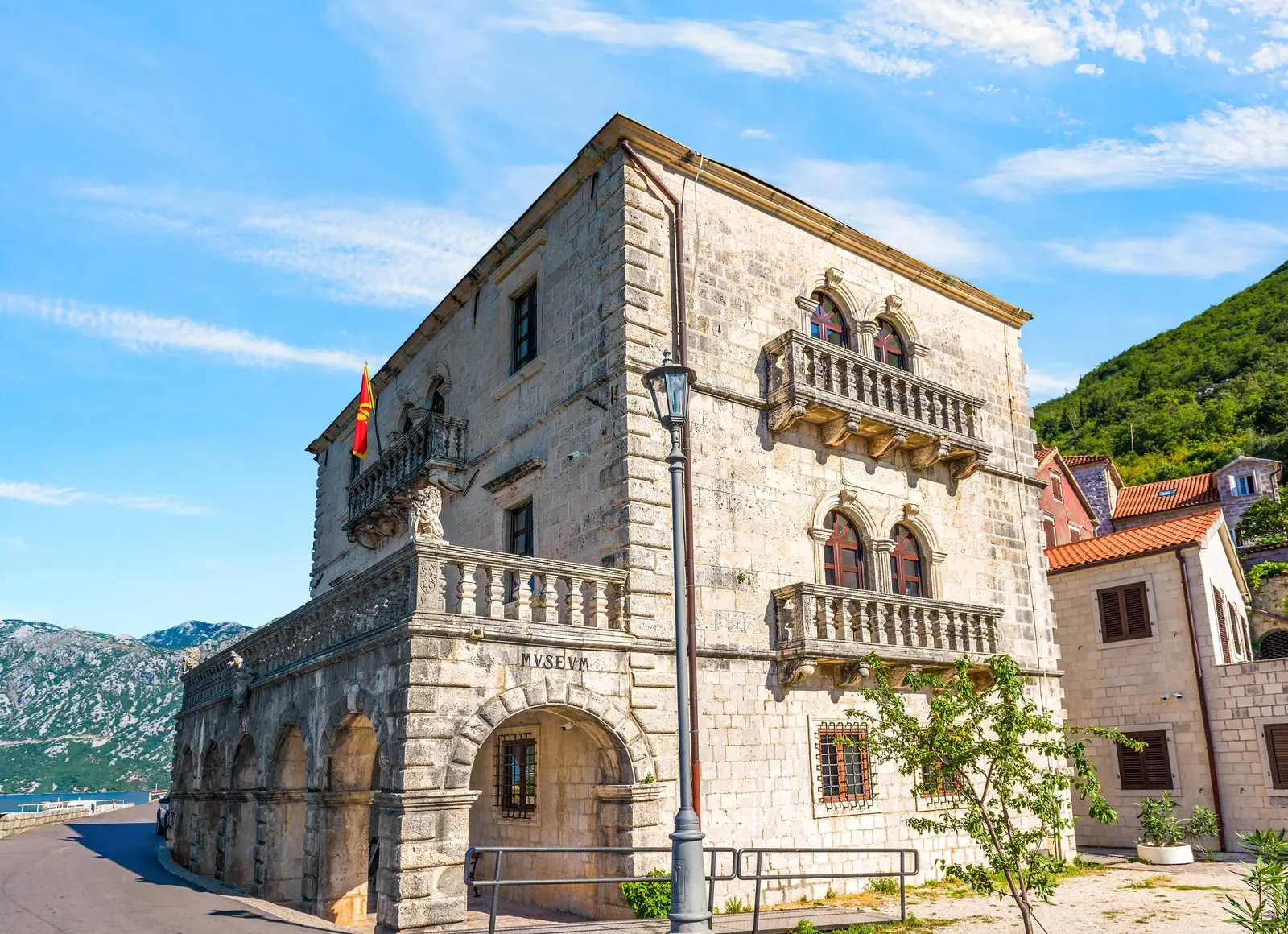
The museum itself is not an untouched seventeenth-century interior. The town museum was founded in 1937 and first operated elsewhere. Bujović Palace was reconstructed for museum use in 1957; the institution closed after the 1979 earthquake, and later remediation continued until its reopening in 1998. That sequence matters. What visitors see is both historical fabric and a twentieth-century conservation history.
Collection totals also require care. A 2017 government account refers to 16 movable cultural properties comprising roughly 450 museum objects, while the museum's current English page says the holdings contain about 2,000 objects. Those figures may use different definitions or dates, but the pages do not reconcile them. The defensible point is qualitative: the museum preserves maritime, ethnographic, historical-art and family-archive collections spanning life in the town from the fifteenth century onward.
If the museum is open, begin on the ground floor with navigation and ship material before looking at portraits upstairs. The objects help turn painted uniforms and family crests back into evidence of labor, command, trade, violence and aspiration. For another way a coastal palace connects private status to public history, compare the Buća Palace and Great Park in Tivat.
Read the waterfront as working infrastructure
Outside the museum, keep the water on one side and building fronts on the other. The space between them may now feel like a promenade, but its historic logic was more demanding. Boats needed places to approach; people, cargo and information crossed the landing edge; houses and palaces needed direct visual command of that movement. Even a short projection of stone into the bay could connect a household to a regional network.
UNESCO's emphasis on the coast and its small harbor structures helps resist a common error: calling the sea a “view.” For Perast it was also a route. The settlement stands by the approach through the Verige strait toward the inner bay. The official museum account says it held a strategic checkpoint role in defence and goods traffic. Unlike a walled city, Perast relied on Holy Cross Fort above the settlement, built in 1570, and on defensive towers and loopholes associated with many noble houses.
Look up as well as across. A palace balcony is a performance of rank, but its elevation also opens a sightline. A loophole may be decorated with a carved face, yet it remains part of defence. A landing is civic space and a functional threshold. Perast's architecture repeatedly refuses a clean separation between beauty and use.
| Date | Documented event or structure | What it changes on the walk | Primary institutional source |
|---|---|---|---|
| 1420–1797 | Period of Venetian rule and the town's principal maritime prosperity | Explains the concentration of captains' palaces, civic symbols and Adriatic connections | Perast Museum |
| 1570 | Holy Cross Fort built above the town | Reveals a distributed defence system rather than continuous walls | Perast Museum |
| 1694 | Bujović Palace built | Connects a captain's status to today's museum and waterfront | Government of Montenegro |
| 1698 | Marko Martinović organized navigation training for Russian nobles | Turns the town from a collection of houses into a site of transmitted maritime expertise | Perast Museum |
| 1937 | Town museum founded | Marks the organized conversion of family inheritance into public memory | Government of Montenegro |
| 1979 | World Heritage inscription and a destructive regional earthquake | Explains why authenticity here includes documented reconstruction and conservation | UNESCO; Perast Museum |
| 2025 | World Heritage Committee requested stronger management and Perast-specific restoration guidance | Shows that preservation remains an active policy question | UNESCO Decision 47 COM 7B.115 |
Saint Nicholas and the town's unfinished ambition
The central square and Saint Nicholas bell tower interrupt the linear walk. The National Tourism Organisation describes the tower as 55 metres high. Its scale makes it a useful orientation point from the street and water, but the more interesting lesson is how religious, civic and maritime identities overlap around it. Saint Nicholas is associated with seafarers; the square gathered public life; nearby museum history began in the former town hall.
Do not assume that every church door or bell-tower stair is open. Religious buildings remain places of worship, and access can change with services, conservation work and staffing. If a climb is offered, judge the narrow stair against mobility, heat and crowding rather than treating it as mandatory. From street level, the relationship among tower, square, rooflines and water is already legible.
The town's deeper past does not begin with its Baroque image. For archaeological and ancient context around the bay, use the separate guide to the prehistoric and ancient Boka region. This walk concentrates on the later maritime town because that is what its most prominent surviving fabric explains best.
The two islands: one view, different rules
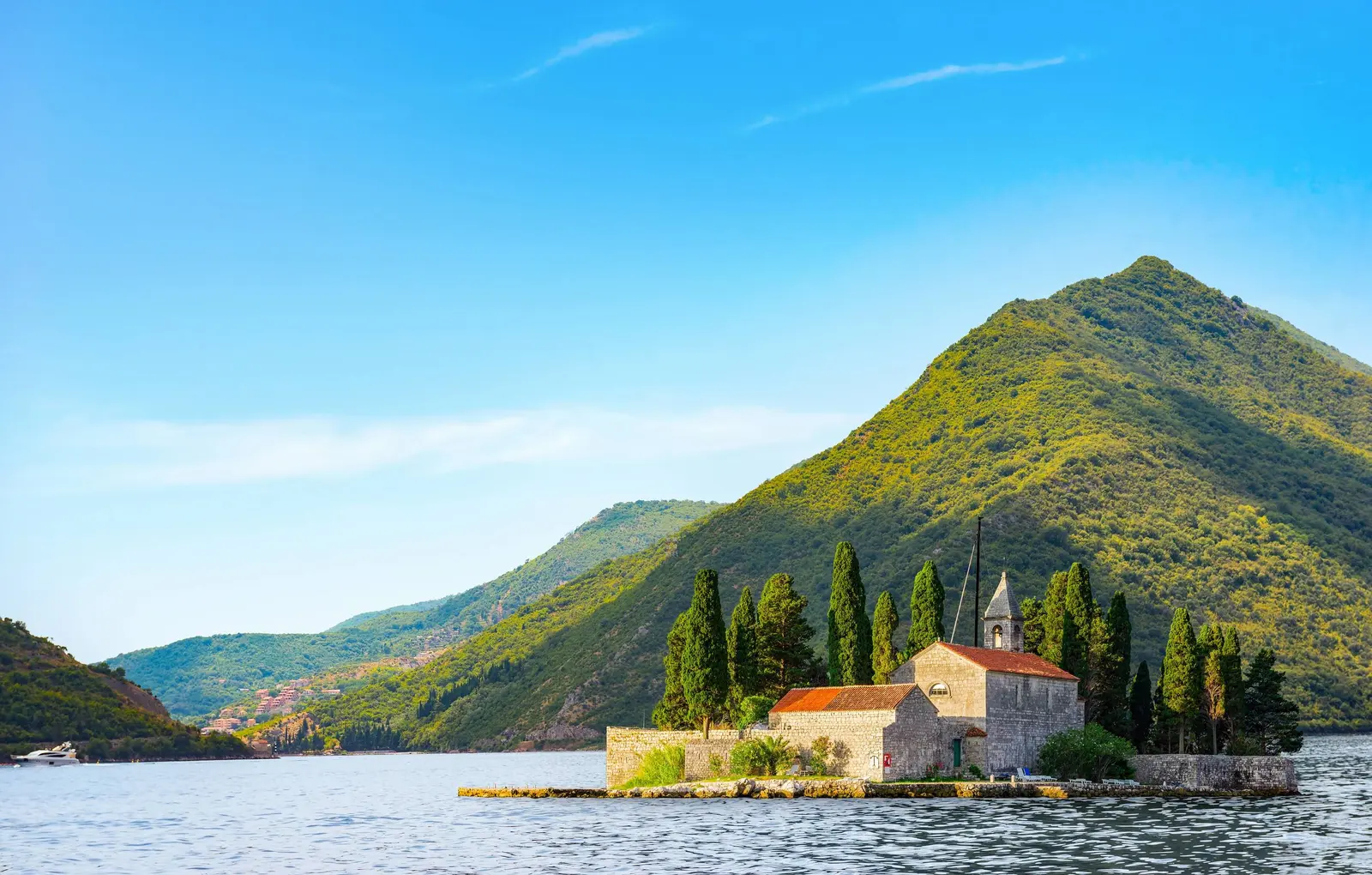
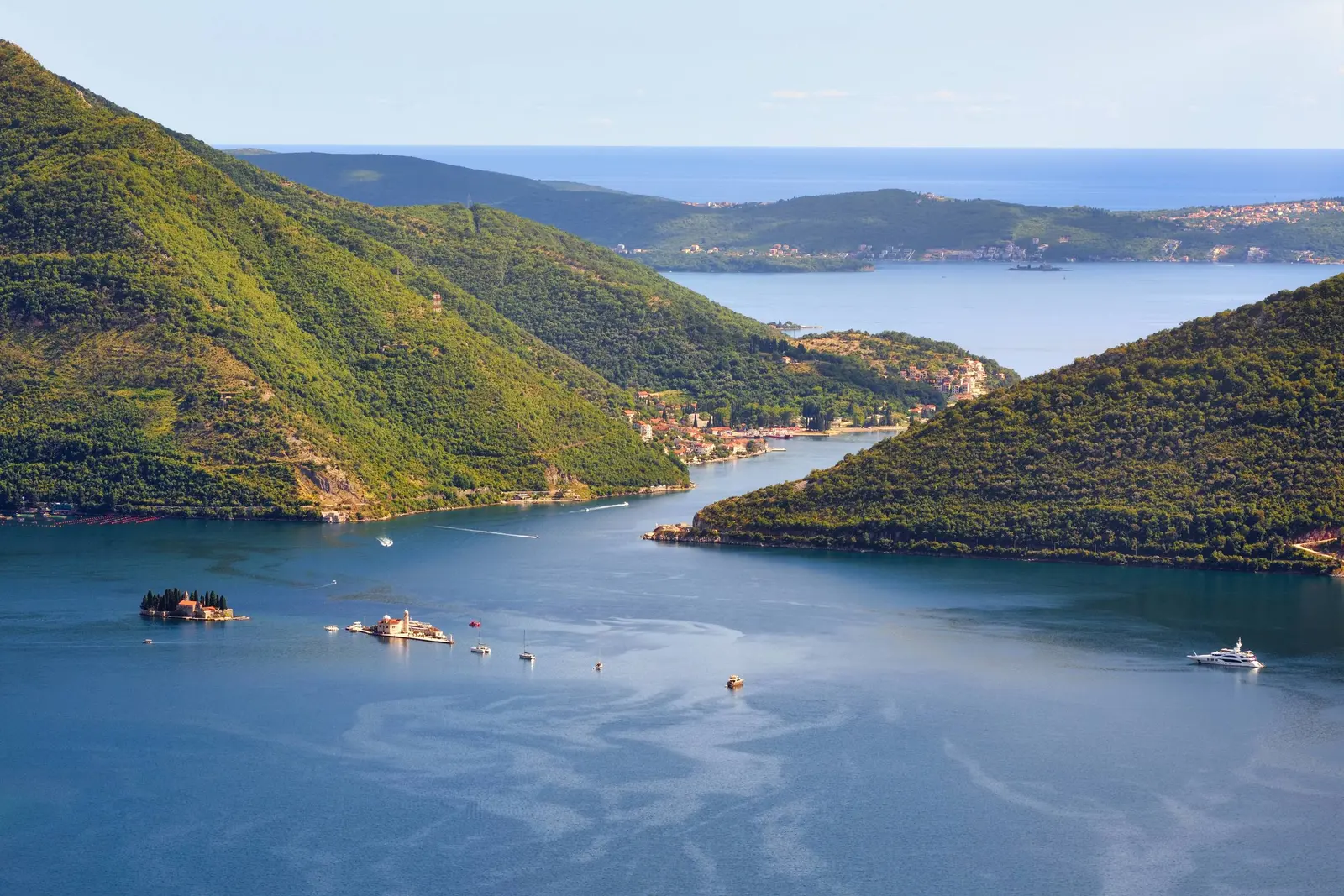
From almost anywhere on the waterfront, Our Lady of the Rocks and Saint George island appear as a pair. They should not be treated as interchangeable attractions. Our Lady of the Rocks is the constructed island associated with a Catholic sanctuary, votive culture and the continuing Fašinada tradition. Saint George is the darker, cypress-ringed island with a monastic complex and cemetery. A public view does not imply public access.
Municipality records describe Fašinada as an annual 22 July procession in which decorated boats circle Our Lady of the Rocks and stones are placed around the island, recalling the tradition of its creation. The event is not proof that visitors may improvise the ritual on another day. Do not throw stones, land independently or pressure boat operators to approach restricted edges.
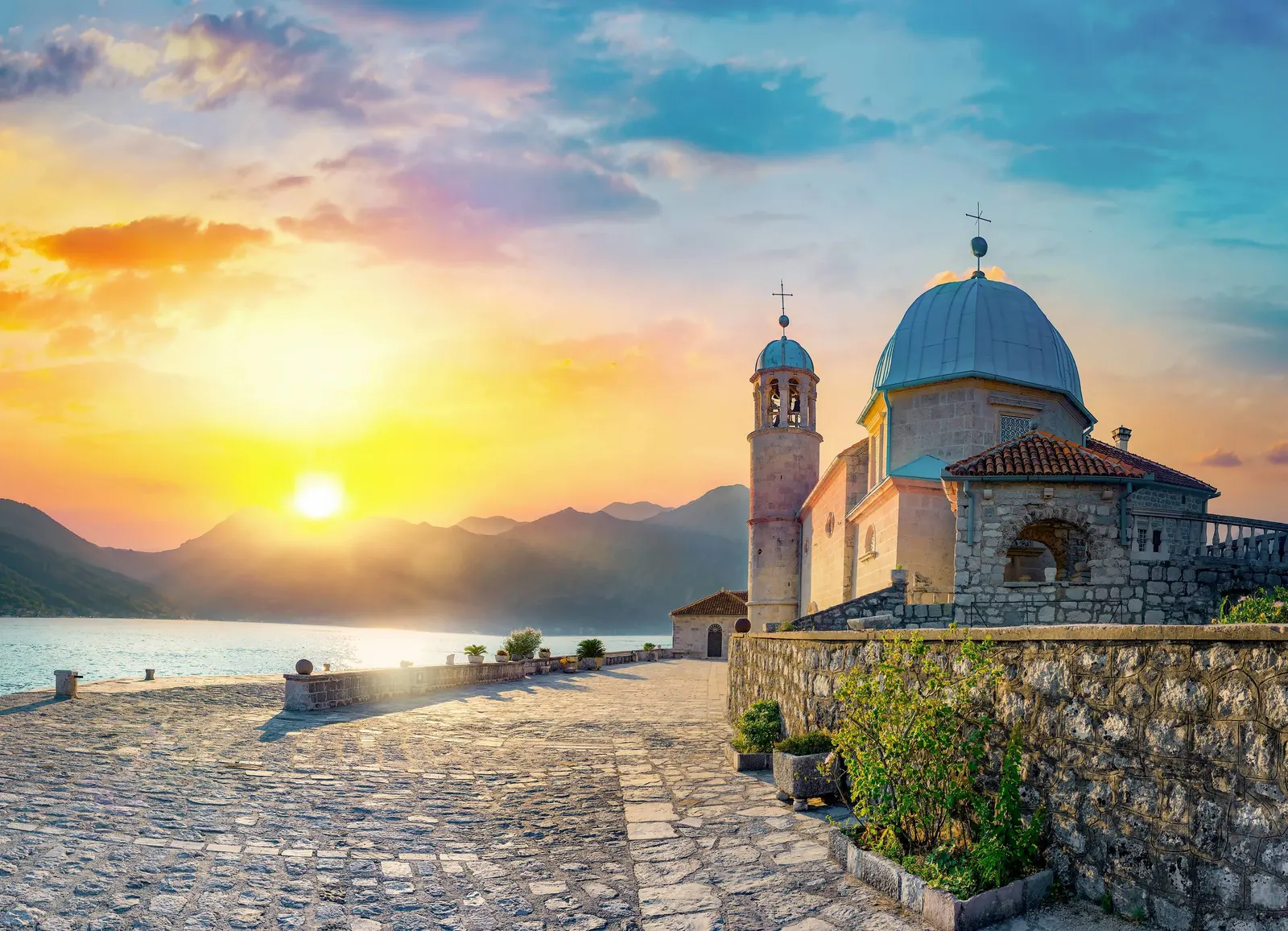
Inside the church, if access is available, the major art-historical reference is Tripo Kokolja. The official museum catalogue describes a cycle of 68 canvases created over about ten years. Read it as an integrated commission rather than a gallery of unrelated pictures: architecture, painting, patronage and maritime devotion reinforce one another. Our regional essay on art through the ages in coastal Montenegro provides a wider comparison.
People behind the stone: teach, sail, collect
Perast's historical reputation can become a roll call of captains. Three figures are more useful when tied to institutions and surviving evidence.
Marko Martinović organized navigation training for Russian nobles in 1698. The museum calls this the first maritime school in the Balkans. The inherited article inflated it into the first private and recognized maritime school in the world, a superlative the located evidence does not support. The narrower fact is significant enough: a small Adriatic town exported formalized maritime knowledge into the networks of Peter the Great's Russia.
Matija Zmajević worked in Russian service as a shipbuilding expert and rose to admiral. Official museum language pages disagree on the year of that promotion, so this account does not choose one. His career still demonstrates that Perast's maritime competence moved with individuals far beyond the bay.
Tripo Kokolja made the town's religious and civic culture visible. The museum's Captain's Salon preserves his portraiture and self-portrait as well as documentation of his church work. This matters because the palaces were not only containers for imported taste; a painter from the town participated in the Baroque visual culture that patrons wanted to project.
The museum changes how those biographies should be told. Portraits, charts, ship models, privileges, weapons and chests are not decorative proof that the past was glamorous. They reveal a society structured by family fraternities, civic offices, trade, armed conflict, education and movement. A careful visit allows material evidence to complicate the heroic summary.
Preserved does not mean frozen
Perast's visual coherence tempts the word “timeless.” UNESCO's record says the opposite. The region was seriously damaged by the 1979 earthquake, after which monuments and historic urban areas were restored and reconstructed. Authenticity here is not the absence of intervention; it depends on the quality, documentation and compatibility of intervention.
The pressure is current. In 2025 the World Heritage Committee requested stronger legal and planning coordination, cumulative impact assessment, sustainable tourism management and context-specific conservation and restoration guidelines for historic buildings in Perast and other settlements. It also warned that urgent conservation needs could lead to consideration of the property for the List of World Heritage in Danger.
Visitors participate in that pressure in small ways. Blocking a doorway, leaning on stonework, flying an intrusive drone, entering a private terrace or crowding a boat landing converts a living town into scenery. Spend longer and move slower. Buy from operating local businesses, but do not mistake adaptive reuse for permission to treat every palace as public. Smekja Palace, for example, is documented by the National Tourism Organisation as a historic palace adapted to hotel use; its exterior can be read from public space while interior access follows the rules of the business.
Perast also helps explain a later turn in coastal history. The age of sail declined, museum-making organized the memory of the maritime town, and modern tourism created new uses for inherited buildings. For that transition elsewhere on the bay, the story of Hotel Plaža in Zelenika follows the emergence of a different coastal economy.
Practical information: walking plan
Allow at least two unhurried hours for the street and museum, more if you take an authorized boat to Our Lady of the Rocks. For a broader same-day sequence, the Risan–Perast–Kotor day guide handles transport logic; do not duplicate that itinerary by trying to turn this close-reading walk into three towns at once.
- Arrive at the edge, not through the center. In June 2025, a municipal notice reported digital barriers and permit-only entry on the coastal road. Park only in a signed area outside the controlled section and check current rules before relying on that arrangement.
- Begin at Bujović Palace. Read the façade from public space, then enter the museum if open. The official page currently lists seasonal hours, Monday and January closures, and a photography restriction, but labels its prices as effective from 2024. Verify the day before.
- Walk the waterfront once without boarding a boat. Identify landing edges, palace fronts, tower sightlines and the central square. This establishes the land-water system.
- Take one upper lane if mobility allows. The slope and steps reveal how little buildable land separates shore from mountain. Wear grippy shoes; polished stone can be slick.
- Choose the island visit deliberately. Use an authorized operator for Our Lady of the Rocks, confirm return arrangements and follow church rules. Treat Saint George as non-public unless a legitimate authority says otherwise.
- Finish by retracing the waterfront. The second pass should look different: the view has become infrastructure, and the palaces have become evidence rather than background.
Summer traffic, heat and group arrivals can overwhelm the narrow public realm. Early morning or later afternoon generally gives more room, but access hours still control museum and church visits. There are steps, uneven stone and narrow passages; a waterfront-only version is possible, while upper lanes and bell-tower stairs are not reliably step-free. Ask individual venues about current accessibility rather than assuming a historic threshold has an alternative entrance.
Frequently asked questions
Is Perast itself a UNESCO World Heritage Site?
Perast is a historic settlement within the Natural and Culturo-Historical Region of Kotor, inscribed in 1979. The distinction matters because UNESCO protects a connected cultural landscape, not only the town's best-known buildings.
Can I visit both islands?
Our Lady of the Rocks is served by authorized visitor boats when conditions and operations permit. Saint George island should not be assumed open to casual landing. Confirm locally and respect religious, cemetery and property restrictions.
How long does this walk take?
The main waterfront can be crossed quickly, but this evidence-led walk needs about two hours with the museum and pauses. Add separate time for a permitted island visit. Crowding, heat, mobility and opening hours change the total.
Is the Perast Museum open every day?
No. The official page currently lists Monday closures, a January closure and different seasonal hours. It also says photography requires special approval. Because the price note still references 2024, verify hours, admission and photography policy directly before travel.
Why not call Perast “timeless”?
Because the town has changed through economic decline, adaptation, the 1979 earthquake, reconstruction and continuing conservation. Its value lies in a legible historical relationship among buildings, water and landscape—not in pretending that time stopped.
Methodology and references
This article was rebuilt from institutional evidence rather than from the inherited promotional copy. UNESCO documentation establishes the regional property, its attributes, earthquake history and current management pressure. Perast Museum and Government of Montenegro pages support the palace, collections and biographies. Municipality and national-tourism pages support Fašinada, visitor orientation and adaptive reuse. Where official pages conflict, the disagreement is disclosed or the disputed detail is omitted.
- UNESCO World Heritage Centre: Natural and Culturo-Historical Region of Kotor
- World Heritage Committee: 2025 conservation decision
- Museums of Kotor: Perast Museum history and collections
- Museums of Kotor: Captain's Salon catalogue
- Museums of Kotor: hours, admission and photography policy
- Government of Montenegro: Perast Museum anniversary history
- Municipality of Kotor: Fašinada
- National Tourism Organisation: Perast visitor overview
- National Tourism Organisation: Smekja Palace
- Radio Kotor: municipality traffic notice
- Radoslav Tomić, Hrvatska revija: Our Lady of the Rocks and the reconciliation table