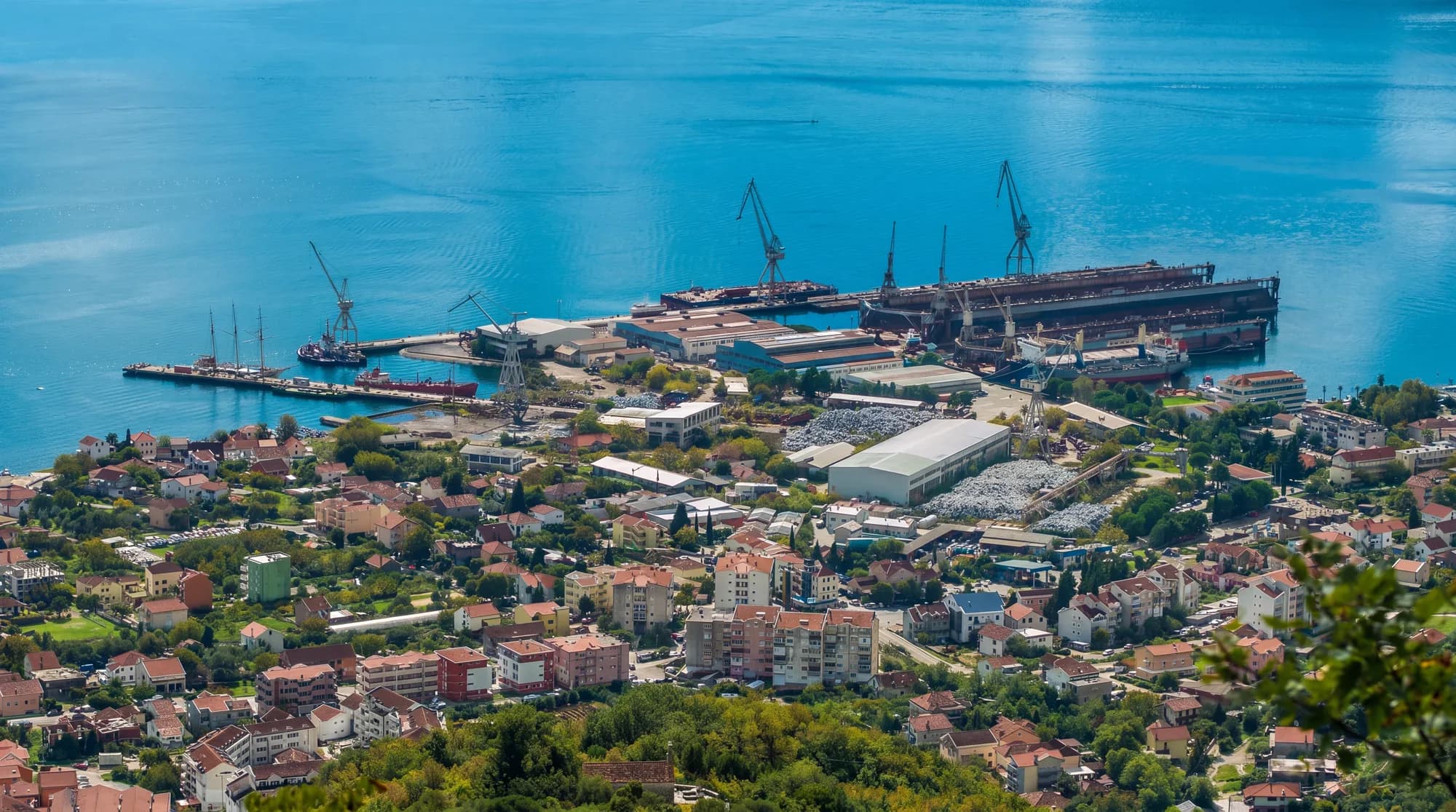
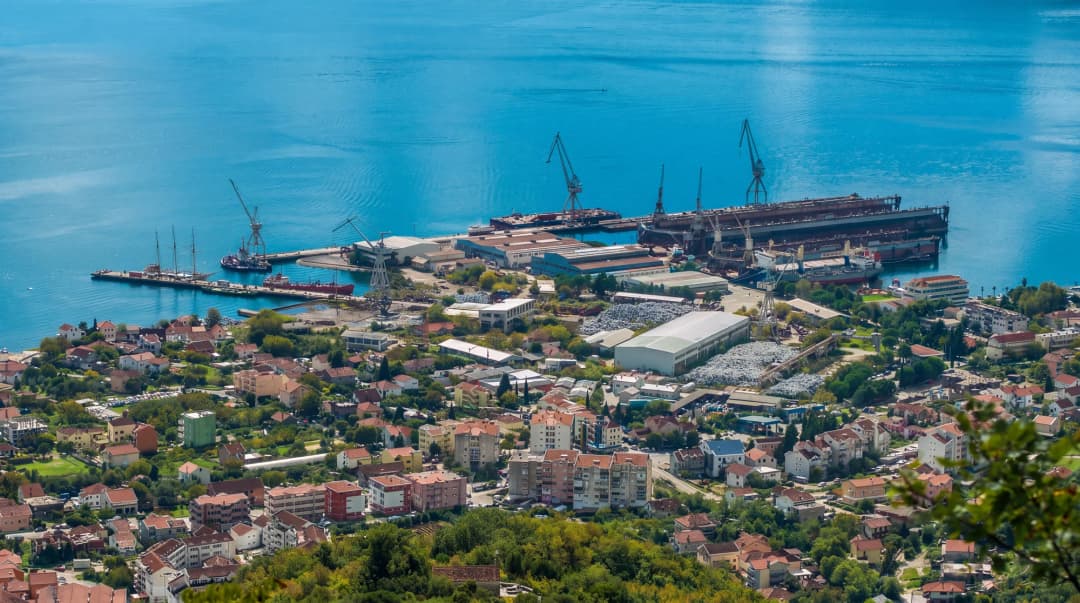
Bijela’s shipyard story is not a clean swap from rusting freighters to glamorous superyachts. It is three overlapping stories: a merchant-repair yard that stopped operating in 2015, a state concession that changed partners before the new yard opened, and a major remediation project that reduced pollution while leaving a documented quantity of contaminated soil in temporary, secure storage. Adriatic 42 is real and working; so is the need to describe the transition without turning corporate claims into audited facts.
This is the industrial dossier. For beaches, buses, heritage and everyday planning, use our Bijela guide. The questions here are narrower: Who holds the concession? What can the yard handle? What work has been independently confirmed? What exactly did the cleanup complete—and what did its last authoritative report leave unresolved?
The verified record in one table
| Question | Best located evidence | Editorial status |
|---|---|---|
| Old yard | World Bank: formerly southern Adriatic’s largest repair yard; stopped in 2015 | Historical baseline, not proof of every inherited statistic |
| Concession | Government: signed 30 Nov 2018 for 30 years | Original partners later changed |
| Current venture | Government transfer record; operator and Porto Montenegro pages | Adriatic Marinas/Porto Montenegro and Drydocks World relationship |
| Operating record | Operator: 108 projects, 54 in 2025, vessels 20–105 m | Self-reported, not presented as audited |
| Independent work example | Defence Ministry: two naval refits completed Mar 2025 | Confirms broader repair capability, not annual totals |
| Cleanup | World Bank itemized table: 98,783 t exported; 33,045 t securely stored | Another annex gives a conflicting 129,409 t total |
What survived the old yard
The World Bank’s project brief describes the former Bijela operation as once the largest ship-repair yard in the southern Adriatic. It entered bankruptcy and ceased operating in 2015. That supports the broad historical arc, but it does not validate every number repeated in local memory. This edition therefore does not freeze an exact founding year, peak payroll or former dock capacity without a primary archive in the source set.
What clearly survived was the location’s industrial logic: protected water, a large waterfront footprint and a community shaped by marine trades. The new operation did not turn the site into a resort. It retained ship repair as the central activity, now connected to the yachting ecosystem around Tivat and Porto Montenegro.
| Year | Milestone |
|---|---|
| 2015 | old yard stops |
| 2018 | 30-year concession |
| 2020 | partner transfer |
| 2022 | operations begin |
| 2025 | naval refits confirmed |
Source: thedocs.worldbank.org, gov.me, wapi.gov.me, adriatic42.com
From Damen consortium to Adriatic 42
Montenegro’s government says the 30-year concession was signed on 30 November 2018 with Adriatic Marinas and Damen. Later official documentation records a transfer on 4 November 2020 to a consortium of Adriatic Marinas and Dry Docks World–Dubai, followed on 25 November by a transfer of concession rights and obligations to Montenegro Yacht Services. The company name was subsequently registered as Adriatic 42.
That sequence matters. “Damen built the current yard” collapses the original bid and the later partnership into one claim. “Drydocks World bought the shipyard” also obscures the concession and company structure. The defensible description is that Adriatic 42 operates the concession-backed refit facility, with current Porto Montenegro material identifying it as a joint venture involving Porto Montenegro and Drydocks World.
What the facility claims in 2026
The live Adriatic 42 website lists a 150,000-square-metre operational area, 8,000 square metres of workshops and warehouses, a 720-tonne travel lift and a floating dock measuring 180 by 34 metres. It describes work across refit, maintenance, engineering, systems, exterior finishing and interiors. Porto Montenegro repeats the 180-by-34-metre dock, 720-tonne lift and workshop figure.
There is a source conflict worth keeping visible. When the floating dock arrived in June 2022, Adriatic 42’s announcement described it as 180 by 37 metres with a 10,000-tonne lifting capacity. The current website narrows the width to 34 metres and does not repeat the 10,000-tonne number. Dimensions can reflect different measurement conventions, but no source located explains the difference. This edition uses the current 180-by-34 figure for planning and preserves the older specification only as a dated announcement.
| Item | Current claim | Note |
|---|---|---|
| floating dock | 180 × 34 m | 2022 announcement: 180 × 37 m • 10,000 t |
| travel lift | 720 t | Historical specification; current page does not reconcile it |
| operating area | 150,000 m² | |
| workshops + stores | 8,000 m² | |
| Caveat | Facility marketing is evidence of what the operator states—not an independent survey |
Source: adriatic42.com, portomontenegro.com
From superyacht promise to documented work
Adriatic 42 says it has completed 108 projects since beginning operations in 2022, including 54 during 2025, and reports full occupancy. It says vessels actually serviced ranged from 20 to 105 metres. Those are useful signs of commercial scale, but they are operator-published metrics. The visible page also uses animated counters that appear as zeros in extracted markup; the figures are stated in its surrounding narrative, not derived from those counters.
A government record supplies a different kind of confirmation. On 21 March 2025, Montenegro’s Defence Ministry reported that Adriatic 42 completed work on patrol vessel P-105 Durmitor and offshore tug PR-41 Orada, followed by sea trials and return to Bar. This proves that the yard’s active workload extends beyond luxury yachts. It does not verify the operator’s total project count.
The result is a more varied industrial base than “superyachts only.” For the wider cruising context, see our Montenegro sailing and yachting guide. For the investment narrative that often surrounds such projects, our coastal investment audit distinguishes committed capital from marketing totals.
The cleanup: major progress, unfinished disposal record
Ship repair left contaminated blasting grit, oily soil and other hazardous material. Montenegro financed remediation through a World Bank-backed industrial-waste project. Paragraph 36 and itemized Table A7.8 of the completion report say the work dealt with 131,828 tonnes of contaminated materials: 68,463 tonnes of blasting grit, 62,573 tonnes of soil above national clean-soil thresholds and smaller waste categories in the final accounting.
Of the total, 98,783 tonnes were exported to European treatment or disposal destinations. The remaining 33,045 tonnes of contaminated soil were encapsulated and temporarily stored on-site. The report says pollutant concentrations had fallen below the export limit, but it also says the material should eventually be removed and treated under Montenegro’s regulations. Its final environmental assessment used October 2023 evidence and found major reductions in soil and groundwater contamination.
The report is internally inconsistent: Annex 4 uses 129,409 tonnes as a total, 2,419 tonnes below the itemized 131,828-tonne figure. It does not explain the difference. The diagram below therefore visualises the itemized table because 98,783 plus 33,045 equals 131,828 exactly; it is not presented as a reconciliation of the conflicting annex.
Both halves must stay together. “Nothing was cleaned” ignores a large excavation, export and measurable reduction. “The site was fully cleared” erases the documented temporary store. No later authoritative disposal record was located by 31 August 2026, so this article does not claim the 33,045 tonnes were still present—or that they had gone.
What the transition means for Bijela
The yard remains an industrial neighbour, not scenery added for visitors. Its scale sits beside homes, roads and small waterfront uses. The economic case is year-round specialist work and a service chain that can keep vessels in Montenegro beyond the summer marina season. The public-interest questions are equally concrete: compliance with concession obligations, safe management of residual materials, environmental monitoring and whether skills and contracts create durable local value.
Those outcomes cannot be inferred from one yacht in dock. They require dated employment, procurement, environmental and concession reporting. Nearby transitions offer useful comparison: the former hotel story in Zelenika shows why a prominent waterfront asset’s identity and current legal or operating state should be separated.
Practical viewing without entering the yard
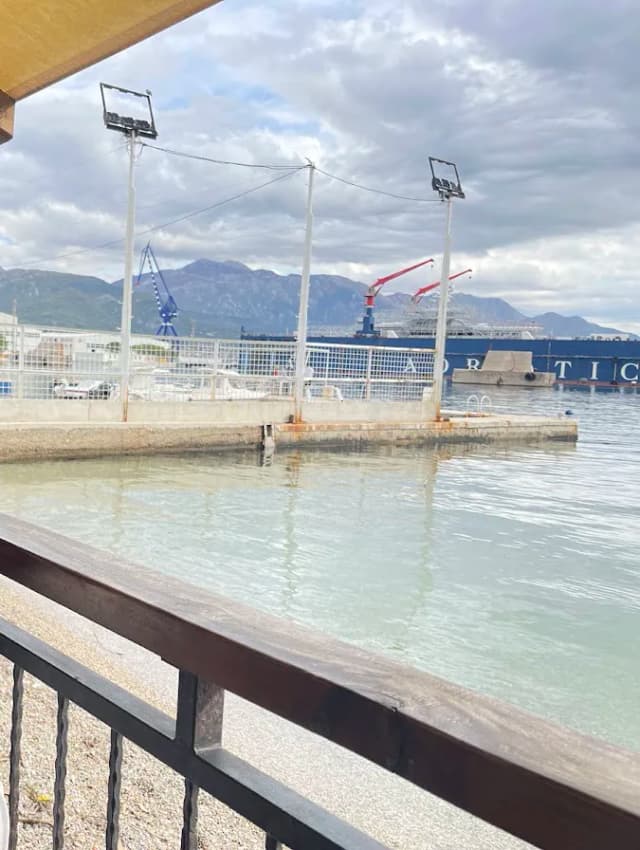
Adriatic 42 is a working industrial facility, and its public website advertises services and business contact details rather than a visitor-tour programme. Do not treat gates, quays or operational land as a sightseeing route. Use only clearly public waterfront space, keep road and emergency access open, respect signs and security direction, and never cross a barrier to improve a photograph.
A vessel visible today may depart before arrival, and a quiet dock does not mean the yard has closed. Weather, work screens, cranes and security needs change the view. Check the Herceg Novi east-shore practical guide for current traffic and promenade caveats, then verify local transport on the day. The safest plan is a normal Bijela waterfront stop where the industrial skyline is incidental, not a promised shipyard experience.
| Zone | Marker | Rule |
|---|---|---|
| PUBLIC WATERFRONT | ✓ | stay on lawful access |
| SIGNS + SECURITY | → | follow direction |
| WORKING YARD | ✕ | no sightseeing entry |
Montenegro.com editorial framework
Frequently asked questions
Is the old Bijela shipyard closed?
The former company ceased operating in 2015. Adriatic 42 now runs an active refit, repair and maintenance facility at the site under the concession structure described above.
Is Damen still the current partner?
No. Damen was in the original 2018 consortium. Government records document the 2020 transfer to a consortium involving Adriatic Marinas and Dry Docks World.
How large is the floating dock?
The current operator and Porto Montenegro pages say 180 by 34 metres. A June 2022 announcement said 180 by 37 metres and 10,000 tonnes. No located source reconciles that difference.
Does Adriatic 42 work only on superyachts?
No. Montenegro’s Defence Ministry confirmed completion of refits on a patrol vessel and offshore tug in March 2025.
Was all contaminated material removed?
No, not according to the World Bank completion record. It says 98,783 tonnes were exported and 33,045 tonnes of contaminated soil were temporarily encapsulated on-site for eventual treatment.
Can visitors tour the yard?
No public tour programme was found on the operator’s site. Treat it as a controlled workplace and view only from lawful public space.

.jpg&w=2048&q=75)